



A simple chair cover sofa slipcover is so much more than just a piece of fabric; it's one of the smartest, most budget-friendly ways to completely redefine your living space. These modern covers offer stylish, practical solutions for everything from updating your decor on a whim to defending against spills or just trying out a new colour palette without the commitment.
Why Sofa Covers Are a Smart Home Update
Tired of looking at that faded armchair or the sofa that's seen better days? Before you start thinking about the massive expense and hassle of buying new furniture, consider a simpler, more affordable route. A well-chosen chair cover or sofa slipcover can instantly revitalise your room, giving it a fresh new look in a matter of minutes. This isn't about hiding your furniture; it's about reinventing it.
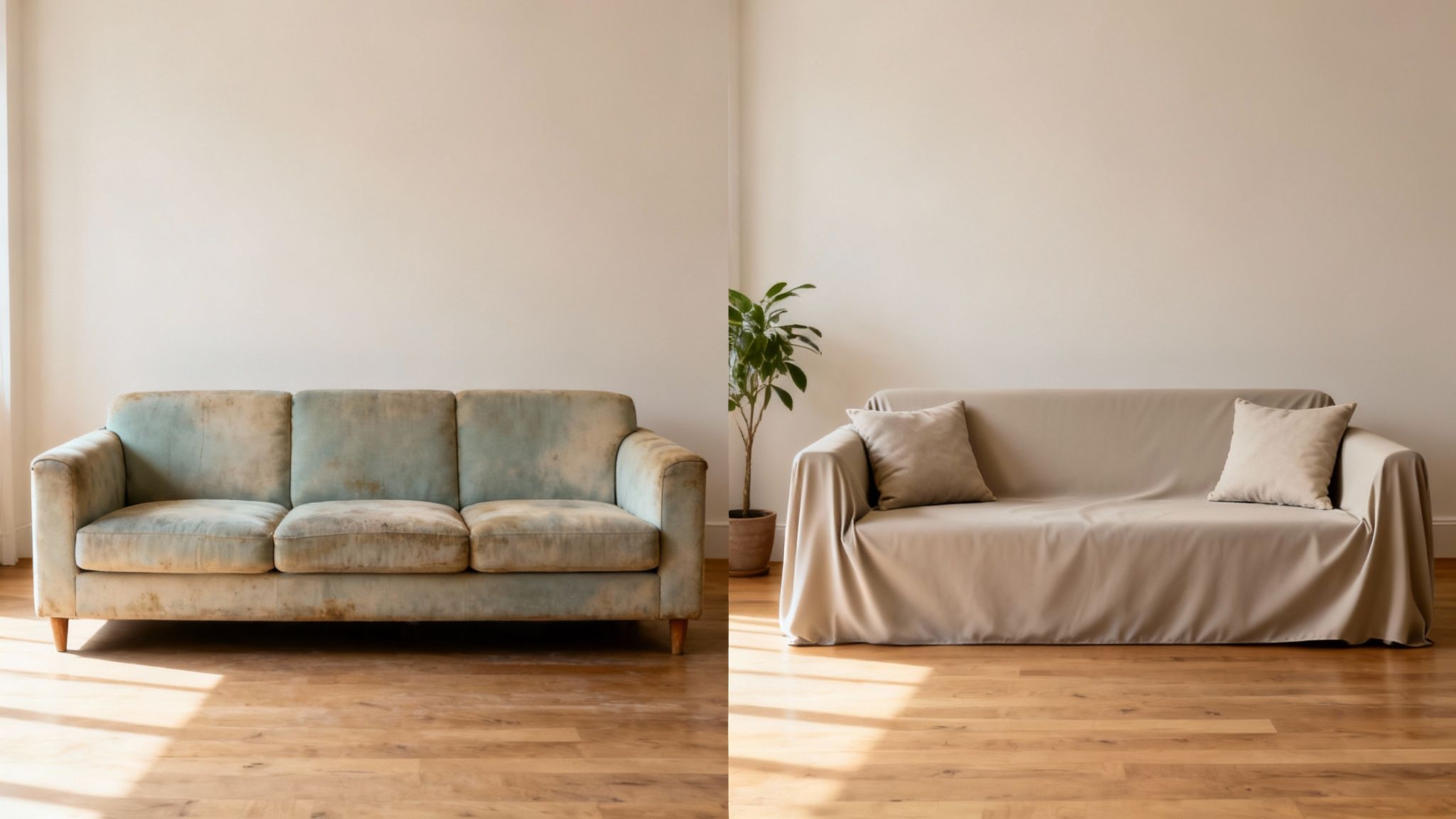
The real magic of a chair cover sofa solution lies in its versatility. It’s an incredibly accessible way to experiment with interior design trends. You could introduce a bold new colour for a season, switch to a lighter fabric for summer, or add a luxurious texture like velvet for a cosy winter feel, all without the long-term investment.
More Than Just a Pretty Face
Beyond the aesthetic benefits, slipcovers serve a hugely practical purpose, especially in a busy home. They act as a crucial barrier against all the little mishaps of everyday life.
- Protection from Spills and Stains: Life happens. A quality cover means a coffee spill or a child’s sticky fingers won’t spell disaster for your upholstery.
- A Pet Owner’s Best Friend: For homes with pets, covers are an absolute essential. They protect against fur, scratches, and muddy paws, and most are machine washable for a super easy clean-up.
- Extending Furniture Lifespan: By shielding your original fabric from daily wear and tear, a good cover can add years to the life of your beloved sofa or chair.
This growing interest in home furnishings hasn't gone unnoticed. In fact, the UK sofa and chair retail industry saw its online visibility surge by a remarkable 25% as brands adapted their strategies to meet consumer demand. You can explore more insights on sofa retailer market performance. This trend highlights a broader movement towards enhancing and preserving our home spaces, making accessories like sofa covers more popular than ever.
A slipcover offers that rare combination of immediate gratification and long-term value. It’s a single purchase that can transform your decor, protect your investment, and adapt to your changing style over time.
Finding the Perfect Fabric and Fit for Your Lifestyle
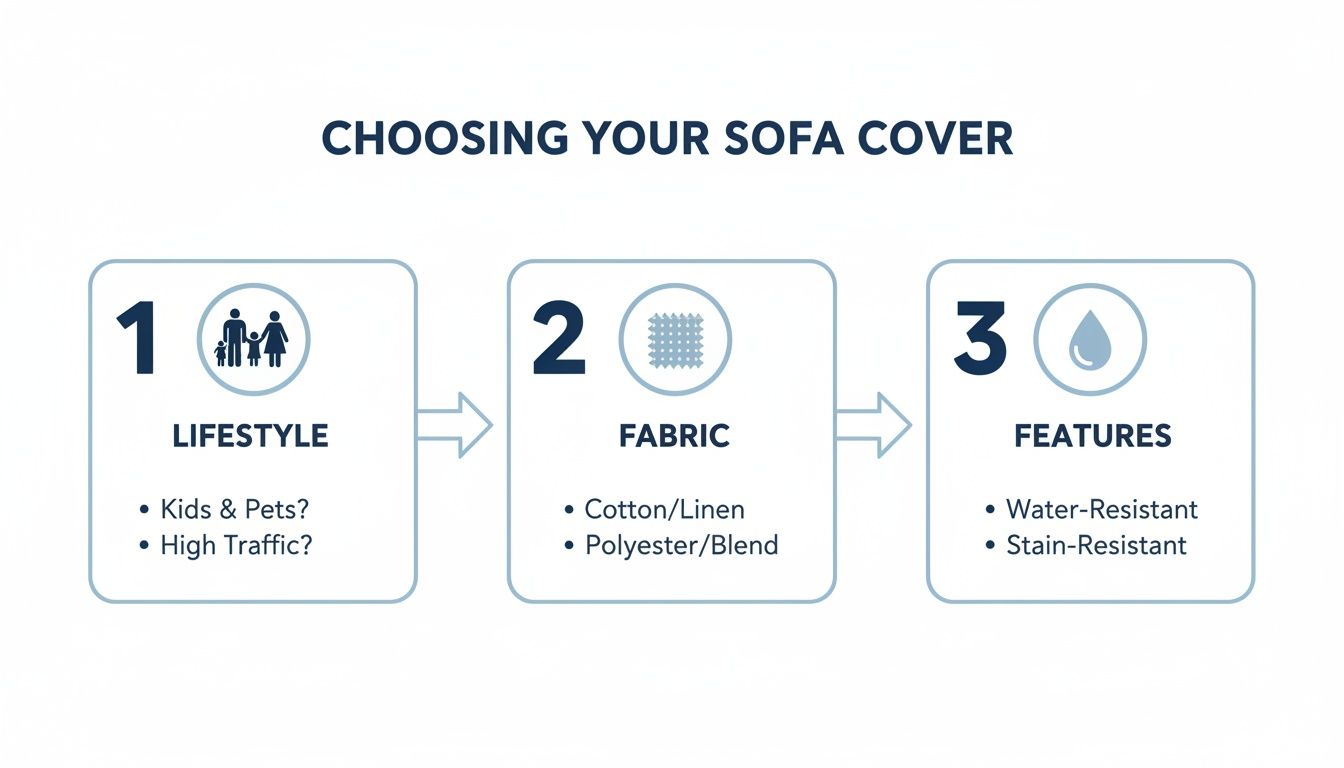
Choosing the right chair cover sofa slipcover is about so much more than just picking a favourite colour. What really transforms a piece of furniture is the material under your fingertips and the precision of the fit. Your lifestyle should be your number one guide here, because a cover for a formal, quiet sitting room has completely different demands than one in the chaotic heart of a family home.
Think about your daily life. A household with young children or pets needs durability and practicality above all else. In that scenario, robust materials like tough polyester blends, microfibre, or a tightly woven cotton canvas are your best friends. They're built to withstand serious wear and tear, and many modern options even come with special coatings for water resistance—an absolute lifesaver against those inevitable spills.
Material Matters Most
The fabric you choose sets the entire tone for the room. Velvet, for instance, adds an immediate sense of luxury and warmth, making it perfect for creating a cosy, inviting atmosphere in winter. On the flip side, a lightweight cotton or linen blend feels airy and relaxed, ideal for a brighter, more casual space.
Consider these popular options:
- Polyester/Spandex Blends: These are the real workhorses of the cover world. Their incredible stretch means you get a snug, almost custom-like fit on all sorts of furniture shapes, while the polyester provides resilience and is nearly always machine-washable.
- Cotton Duck or Canvas: Known for its sturdy, slightly textured feel, this fabric is incredibly durable and holds its shape brilliantly, offering a more structured, traditionally upholstered look.
- Velvet or Microfibre: Both offer a soft, plush feel. Microfibre is particularly good at resisting stains and is a breeze to clean, making it a surprisingly practical choice for busy homes.
For a deeper dive into materials, check out our guide on choosing the best fabric for a sofa to find the perfect match for your needs.
To make things a bit clearer, I've put together a quick comparison of the most common options.
Comparing Fabrics For Your Sofa and Chair Covers
This table breaks down how different fabrics stack up, helping you weigh up what matters most to you—be it opulent texture, practical resilience, or casual comfort.
| Fabric Type | Best For | Feel and Appearance | Durability | Care Instructions |
|---|---|---|---|---|
| Polyester/Spandex | Busy families, modern looks, oddly-shaped sofas. | Smooth and stretchy, often with a slight sheen. | High | Typically machine washable and quick-drying. |
| Cotton Duck/Canvas | A structured, tailored look in high-traffic areas. | Sturdy, matte, and slightly textured. | Very High | Machine washable, though may require ironing. |
| Velvet | Creating a luxurious, warm, and inviting atmosphere. | Soft, plush, with a rich, elegant sheen. | Moderate to High | Often requires dry cleaning or spot cleaning. |
| Microfibre | Homes with pets and young children. | Very soft and suede-like. | High | Excellent stain resistance; usually machine washable. |
| Linen Blend | A relaxed, airy, and casual 'coastal' aesthetic. | Light, breathable, with a natural texture. | Moderate | Can be machine washed, but prone to wrinkling. |
Looking at the options side-by-side really highlights why a polyester blend is a go-to for a busy home, while velvet is perfect for that touch of luxury.
Ready-Made vs Custom Fit
The next big decision is the type of fit. Ready-made, universal covers are by far the most common and affordable option. Thanks to high-stretch fabrics and elasticated edges, they can adapt to a huge range of standard sofa and chair sizes, offering a quick and effective refresh without breaking the bank.
A custom-fit cover, while more of an investment, is tailored specifically to your furniture’s exact dimensions. This gives you a flawless, professional finish that’s virtually indistinguishable from the original upholstery. This is often the best route for unusually shaped furniture—like a wingback chair with intricate curves or a chaise with unique dimensions—where a universal cover might bunch or stretch awkwardly.
Key Takeaway: Prioritise features that solve your specific problems. If your leather sofa causes covers to slide, look for options with anti-slip backing. If easy cleaning is your top priority, make sure the material is 100% machine-washable.
This focus on practicality is being seen right across the UK furniture market. Manufacturers are increasingly adopting materials like bamboo and recycled plastics for home goods. In fact, while wood still dominates, the use of recycled plastics is growing at a 5.9% compound annual growth rate, creating durable and eco-conscious options for items just like chair and sofa covers. You can learn more about these trends in the UK home furniture market.
How to Measure Your Furniture for a Flawless Fit
Let’s be honest, getting the measurements right is the single most important thing you’ll do when choosing a chair cover sofa slipcover. A cover that’s too saggy or stretched too tight is the number one reason for returns, but a few minutes with a tape measure will give you the confidence to order the perfect size.
Think of it like buying a perfectly fitted jacket; you need to know more than just a general "large" or "small". The right measurements are what guarantee your new cover will hug every curve of your furniture for that clean, tailored look. You’ll want a flexible, soft tape measure for this – a rigid one just can’t follow the contours of a sofa properly.
Core Measurements for Any Sofa or Chair
No matter what kind of furniture you’re covering, from a classic wingback to a modern three-seater, there are three essential dimensions you need to get. Always measure each one at its widest or tallest point to make sure you have enough fabric to play with.
- Width: This is the big one. Measure from the outer edge of one armrest, straight across the front, to the outer edge of the other. For most ready-made covers, this single number is the most critical for choosing the right size.
- Height: Run your tape measure from the floor at the very back of the sofa, up over the highest point of the backrest, and all the way down to the floor at the front.
- Depth: Measure from the very front edge of the seat cushion straight back to where the backrest begins.
Tackling Unique Furniture Shapes
Of course, not all furniture is a simple rectangle. Pieces like L-shaped sectionals or chairs with distinctive T-cushions just need a little extra attention to detail.
For L-shaped or corner sofas, the trick is to measure each section as if it were a separate piece of furniture. Measure the length and width of the main sofa part first, and then do the same for the chaise or corner piece. Most sectional covers are sold in two or more pieces to handle this exact setup.
Don't forget the little details that can make a huge difference, either. If your sofa has particularly thick or high cushions, it’s a good idea to add a few extra centimetres to your depth and height measurements just to be safe.
For a more detailed walkthrough, our complete guide on how to measure a sofa is packed with extra tips for those trickier pieces. Taking those few extra moments to be precise is the best insurance you have for a flawless, custom-like fit.
Installing Your Cover for a Professional Finish
You’ve done the hard part of measuring up and picking the perfect fabric. Now for the really satisfying bit: the transformation. A great installation is what separates a saggy, loose-fitting sheet from a sharp, tailored look that could almost pass for expensive custom upholstery. With just a few simple techniques, you can get a professional finish that actually stays put.
Before you even think about draping the cover, give your sofa or chair a quick once-over with the vacuum. Getting any crumbs or pet hair out of the crevices will help the cover sit much more smoothly. This is also the perfect time to give your cushions a good plump to get them back into a full, even shape.
Finding Your Starting Point
The first step can often feel like the most confusing: figuring out which way is up. Most covers have a tag sewn into an inside seam, usually labelled "BACK" or "CENTRE BACK". This is your anchor point. Go ahead and drape the cover over your furniture, lining this tag up with the middle of your sofa’s backrest.
From there, gently pull the fabric down over the armrests, and then forward over the front. Don't worry about getting it perfect just yet; the goal right now is simply to get the cover roughly in position. You should start to see the seams of the cover begin to align with the natural contours and edges of your furniture.
Getting this initial alignment right is crucial. It ensures the stretchy fabric is distributed evenly across the whole piece, which is the key to avoiding any awkward pulling or bunching in one area. If you need a bit more visual guidance, our detailed installation guide has some great video tutorials for different furniture types.
The Secret to a Wrinkle-Free Finish
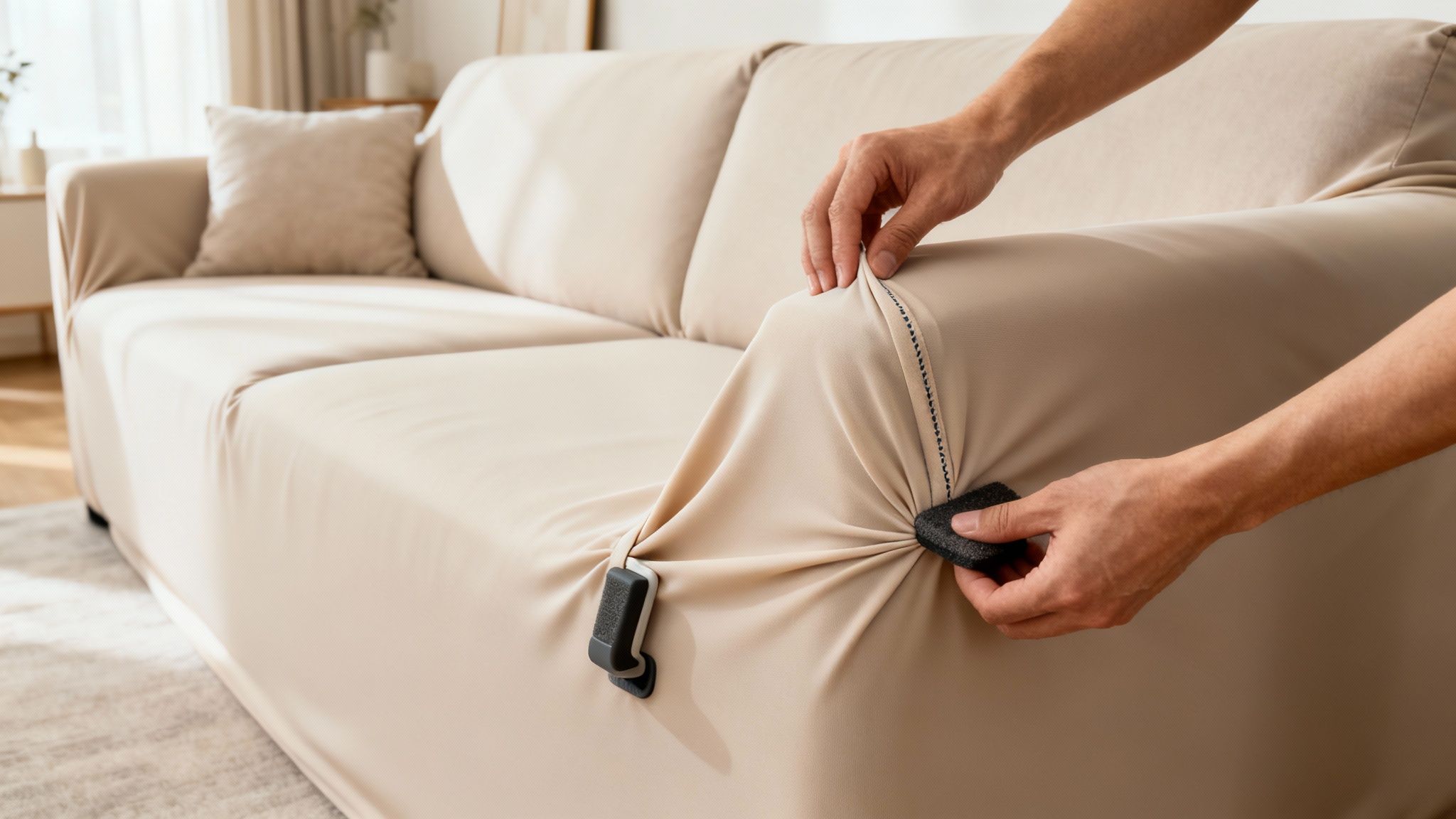
Now for the magic trick that ensures your chair cover sofa slipcover looks incredibly sharp: the tuck. With the cover draped evenly, start pushing any excess fabric deep into the gaps between the armrests, backrest, and seat cushions. A wooden spoon or even a flat ruler works wonders for pushing it in firmly.
This is where the included foam inserts or tuck-in grips become absolutely essential. Once you’ve tucked the fabric, push these foam rolls into the same crevices, right on top of the fabric.
- They create friction, gripping the material tightly.
- This anchors the cover and stops it from pulling out when someone sits down.
- They provide a clean, crisp line that helps to define the shape of the sofa.
For leather sofas, which are notoriously slippery, these foam inserts are non-negotiable. They are the single best tool for stopping a cover from shifting and riding up during daily use.
Finally, secure any elasticated loops or clips underneath the sofa to pull everything taut. This last step pulls the entire cover downwards, smoothing out any final wrinkles on the surface for that flawless, almost painted-on look. The emphasis on durable and well-designed accessories like these mirrors a broader trend within the UK furniture market, which was valued at USD 28.23 billion. As manufacturers innovate with advanced materials, so too do the covers designed to protect these investments. You can find more on this in the United Kingdom furniture market report.
Styling and Maintaining Your New Furniture Look
With your new chair cover sofa slipcover installed, the real fun begins. You’ve basically created a fresh canvas, and now it’s time to style it into a true centrepiece that pulls the whole room together. This is your chance to play with textures, colours, and layers to get that cohesive, professionally designed feel.
The easiest place to start is with cushions and throws. I always think of these as the jewellery for your furniture. If you’ve gone for a neutral-coloured cover, like a soft grey or beige, you can introduce pops of colour with some bold cushions. A splash of mustard yellow or a deep emerald green, for instance, can add a vibrant, contemporary touch.
On the flip side, if your sofa cover is the statement piece, use your accessories to balance the look. A richly coloured velvet cover looks absolutely beautiful paired with simple, cream-coloured bouclé or linen cushions. The key is to create contrast not just in colour, but in texture as well.
Creating a Cohesive Room Design
Of course, your newly covered sofa doesn't exist in a vacuum; it needs to harmonise with the rest of your decor. Take a moment to look around at your curtains, rug, and wall art. Your new cover should complement these existing elements to create a unified look.
- Colour Coordination: A simple trick is to pull a secondary colour from your rug or a piece of art and find cushions that feature that same shade. It’s a small detail that instantly makes the room feel more intentional and put-together.
- Balancing Patterns: If your cover is a solid colour, you can be more adventurous with patterned throws or cushions. But if your cover already has a pattern, it's best to stick to solid-coloured accessories to avoid a visually cluttered look.
Your goal is to make the sofa feel like it truly belongs in the space, not like an afterthought. It's about creating a conversation between the different elements in your room, making sure they all work together seamlessly.
Long-Term Care for Lasting Freshness
To keep your investment looking fantastic for years to come, a little maintenance goes a long way. The biggest advantage of a slipcover is its washability, but you’ve got to do it correctly to avoid any shrinkage or damage. First things first: always check the care label.
Most polyester and spandex blends can be machine washed on a gentle, cool cycle. Try to avoid using high heat in the dryer; either tumble dry on the lowest setting or, even better, let the cover air dry. For those nightmare stains like coffee or wine, tackle them immediately. Blot the spill—never, ever rub—and treat it with a suitable spot cleaner before you wash the entire cover.
A few simple habits can also prolong its life. Regularly vacuum the surface to get rid of dust and pet hair, and remember to rotate the seat cushions every few months to ensure the wear is distributed evenly. With just a little care, your revived furniture will continue to be a source of pride and comfort.
Your Chair Cover & Sofa Questions Answered
Even after you've picked the perfect fabric and triple-checked your measurements, a few questions might still be nagging at you. That's completely normal. Getting into the world of furniture covers brings up some practical bits and bobs, so let’s tackle the most common queries I hear. This should give you that final boost of confidence to make the right choice.
Will a Universal Cover Fit My Uniquely Shaped Furniture?
This is a brilliant question, and one that comes up all the time, especially if you have a piece with really distinct curves or quirky dimensions. Universal covers are actually quite clever bits of modern fabric tech, usually made from high-stretch stuff like spandex blends. This means they can hug a surprisingly wide range of standard sofa and armchair shapes for a really snug, clean fit.
For most common furniture styles, you’ll probably be pleasantly surprised at how well they work. But if you have a highly stylised piece—think an armchair with massive rounded arms, a chaise with a dramatic swooping curve, or a wingback chair with very prominent wings—a universal chair cover sofa slipcover might bunch up or stretch in awkward ways.
For these specific cases, it's worth tracking down a cover designed for that particular furniture type. And if a completely flawless, bespoke look is your absolute top priority, then a custom-made slipcover is the ultimate, albeit more expensive, solution.
How Can I Stop My Sofa Cover From Slipping?
There’s nothing more frustrating than a cover that needs constant re-tucking. It's a particularly common headache on smooth surfaces like leather or faux leather sofas, which just don't have much natural grip to hold fabric in place. Thankfully, there are a few excellent, easy fixes.
The most effective tools I've found are slipcover grips or foam tuckers. These are just simple foam rolls or cardboard strips that you push deep into the crevices between the cushions and the sofa frame.
- They create that crucial bit of friction needed to lock the tucked fabric securely in place.
- They stop the cover from pulling out every time you sit down or get up.
- Many good quality covers come with them in the box, but you can also buy them separately.
Here's another pro tip, especially for leather sofas: pop a thin, non-slip rug pad on the seat area before you put the cover on. This adds a huge amount of extra grip and dramatically cuts down on any of that annoying shifting or sliding.
Are Chair and Sofa Covers a Good Option for Pets?
Absolutely—in fact, they are one of the best investments any pet owner can make for their home. A good cover is essentially a durable, washable shield between your beloved pets and your valuable upholstery. It'll save you from endless worry about muddy paws, shedding fur, and accidental scratches.
When you're choosing a cover for a home with pets, the fabric is your number one priority. Look for options made from tough, tightly woven materials like microfibre, canvas, or a robust polyester blend. These are far more resistant to claws and snagging than looser weaves.
Many modern covers also have a water-resistant or even fully waterproof layer. This is a genuine lifesaver for protecting your sofa from spills or little accidents, giving you complete peace of mind. And honestly, the sheer convenience of being able to whip off the entire cover and chuck it in the wash makes cleaning up pet hair, dirt, and odours incredibly simple—much more effective than trying to spot-clean the furniture itself. Choosing a darker colour or a subtle pattern can also work wonders to camouflage stray pet hair between washes.
Ready to give your furniture a stylish and protective upgrade? Explore the beautiful and practical collection at The Sofa Cover Crafter and find the perfect fit for your home today at https://thesofacovercrafter.co.uk.