



Before you even think about fabrics or colours, getting the dimensions for a couch right is the most important step you'll take. A few centimetres can be the difference between a sleek, custom-fit cover and a baggy, frustrating mess. This guide will make sure you get it right the first time.
Table of Contents
- Why Accurate Couch Dimensions Are Your First Step to a Perfect Fit
- The Foundation of a Flawless Fit
- Measuring Your Standard Sofa, Loveseat, or Armchair
- The Three Essential Measurements
- Don't Forget the Secondary Details
- Tackling Measurements for Corner and Sectional Sofas
- How to Nail the A-A and B-B Measurements
- Common Corner Sofa Setups
- Fitting and Tucking Your New Cover
- Troubleshooting Common Corner Issues
- How to Handle Sofa Beds and Recliners
- Measuring Your Versatile Sofa Bed
- Getting Recliner Dimensions Right
- Common Measuring Mistakes and How to Avoid Them
- The Puffy Arm Problem
- Forgetting the Full Frame Width
- Ignoring the Overall Back Height
- From Measurements to a Fresh New Look
- Your Final Pre-Purchase Checklist
- Still Have Questions About Measuring?
- What If My Sofa Is Between Sizes?
- How Do I Measure Sofas with Thick or Padded Arms?
- Do Your Covers Fit Sofas with Non-Removable Cushions?
Why Accurate Couch Dimensions Are Your First Step to a Perfect Fit
We've all been there: you find the perfect sofa cover online, order it with excitement, and then spend an hour wrestling with it, only to find it sags in some places and pulls too tightly in others. It's a common headache for homeowners, landlords, and anyone trying to refresh a living space on a budget. The culprit is almost always inaccurate measurements.
Getting the correct dimensions for a couch isn't just about making a cover fit; it’s about achieving that professional, reupholstered look without the sky-high cost. A well-measured sofa ensures your new cover hugs every curve, tucks neatly into the crevices, and stays put, even in a busy family home.
The Foundation of a Flawless Fit
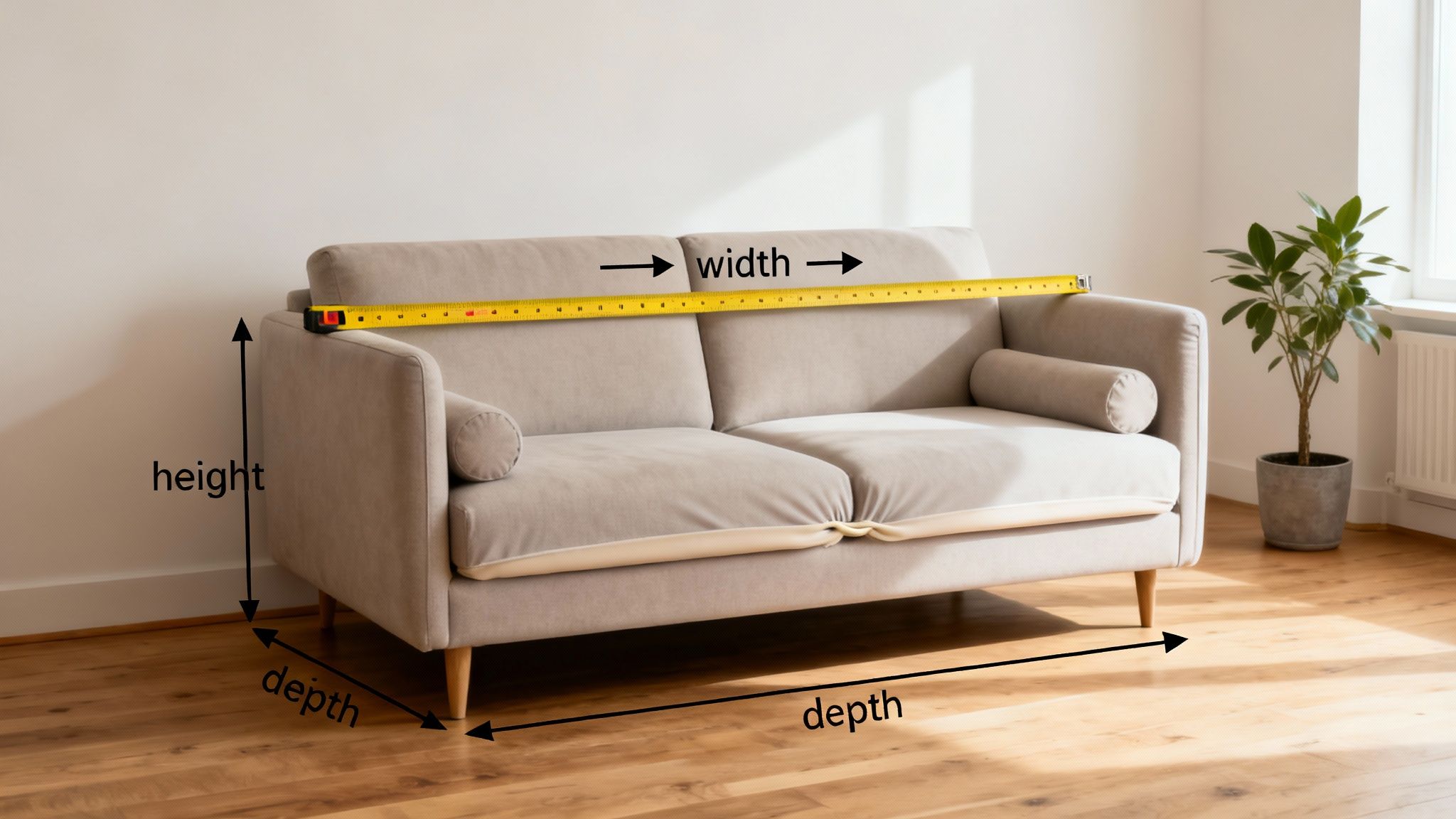
The three core measurements you'll need are width, depth, and height. These numbers form the foundation for choosing a cover that looks like it was made just for your sofa.
- Width: Measure from the outer edge of one armrest clear across to the outer edge of the other. This is the single most important dimension.
- Depth: This tells you how far the sofa will stick out from the wall. You'll measure from the very front of the frame to the very back.
- Height: Run your tape measure from the floor right up to the highest point of the sofa's backrest.
In the UK, the average two-seater sofa measures roughly 130-150 cm in width, 85-90 cm in depth, and 80-90 cm in height. These dimensions have stayed pretty consistent for decades, designed to fit comfortably in the average UK living room.
A cover that fits properly not only looks better but also lasts longer. When a cover is stretched beyond its limits or is too loose, the fabric is more prone to wear and tear, especially at the seams.
To avoid the classic mistake of buying a sofa that completely overwhelms your space, understanding how to design a room layout is a huge help. It helps you visualise how your furniture will work with the room's natural flow.
Our high-quality stretch covers are specifically designed to fit these standard UK sofa sizes, and we even include complimentary foam tucks to secure the fabric for a flawless, non-slip finish. To see which cover size matches your furniture, you can check out our detailed size guide at https://thesofacovercrafter.co.uk/pages/size-guide.
Measuring Your Standard Sofa, Loveseat, or Armchair
Let's start with the basics: the standard sofas, loveseats, and armchairs that you’ll find in most UK living rooms. While they might seem straightforward, a few little details can easily trip you up. Getting the right dimensions for a couch, whether it’s a classic two-seater or a cosy armchair, really comes down to the same core principles.
The main goal here is to capture the furniture's complete footprint. Think of it as measuring the total space your sofa takes up in the room, not just the bit you sit on. This is what ensures your new cover will stretch over every single part of the frame, from the very top of the backrest down to the floor and across from one outer arm to the other.
The Three Essential Measurements
Before you even grab your tape measure, here’s a crucial tip: measure the furniture itself, never the old cover. Fabric can stretch or shrink over time, which will throw your numbers off completely. Always work with the solid frame of the sofa.
You’re going to focus on three main dimensions to get started.
- Length (or Width): This is the big one. Start at the outermost point of one armrest and stretch your tape measure straight across to the outermost point of the opposite armrest. This single number is usually what determines whether you need a 1-seater, 2-seater, or 3-seater cover.
- Height: Place the end of your tape measure flat on the floor and extend it vertically up to the highest point of the sofa's back frame. A common mistake is stopping at the top of the cushions, but they compress, so always measure to the solid frame.
- Depth: Measure from the very front edge of the sofa's frame straight through to the very back. This helps you understand the overall profile of your couch.
Imagine you have a modern Scandinavian-style armchair with slim, straight arms. The length is easy—just outside of the left arm to the outside of the right. But for something like a classic Chesterfield with massive, rolled arms, you absolutely must measure over the curve of the arms to capture their fullest extent. Ignoring this is one of the most common mistakes I see, and it always leads to a cover that's frustratingly tight.
For a more detailed look at this, our guide on how to measure your sofa offers extra visuals that can really help clarify these first few steps.
Don't Forget the Secondary Details
While those first three dimensions get you most of the way there, a few secondary measurements are what ensure a truly snug, custom-like fit. These are the little details that separate a good fit from a great one.
- Armrest Length: Measure along the top of one armrest, from its front edge to where it meets the back of the sofa.
- Armrest Width: Measure across the top of the armrest at its widest point. This is absolutely critical for sofas with puffy or pillow-top arms.
- Seat Cushion Depth: Just measure a single seat cushion from its front edge to the back where it meets the sofa frame.
- Back Height from Seat: Place your tape measure on top of the seat cushion and measure straight up to the top of the sofa’s back. This confirms the cover has enough fabric to tuck in properly without popping out.
Remember, high-quality stretch covers are designed to be forgiving. Our spandex-blend fabrics can accommodate slight variations, but starting with accurate numbers gives you the best possible foundation for that wrinkle-free, seamless finish you're after.
Let's take a real-world example. Say you have a two-seater loveseat that measures 145 cm in length. According to most standard sizing charts, this puts it perfectly within the 2-seater cover range (which is often 145-185 cm). But what if it has exceptionally thick, padded arms, each adding 5 cm more than a standard model? That extra bulk has to be accounted for, and this is exactly where knowing the armrest width becomes invaluable.
By taking a few extra moments to capture these secondary dimensions, you can choose a cover with complete confidence. You'll avoid all the guesswork and the potential hassle of a return, letting you get straight to the fun part: transforming your living space with a fantastic new look.
Tackling Measurements for Corner and Sectional Sofas
Getting the measurements right for a corner or sectional sofa is where most people trip up. Let’s be honest, it’s a bit more involved than a standard two-seater, but a few minutes of careful measuring is the difference between a sleek, custom-like fit and a cover that looks baggy and wrinkled.
The secret is to stop thinking of it as one giant piece of furniture. Instead, treat each section as its own mini-sofa. We use what's called the A-A and B-B system, which just means you’re measuring from the outermost arm of one section right into the corner where it meets the next. You'll do this for each part of your sofa.
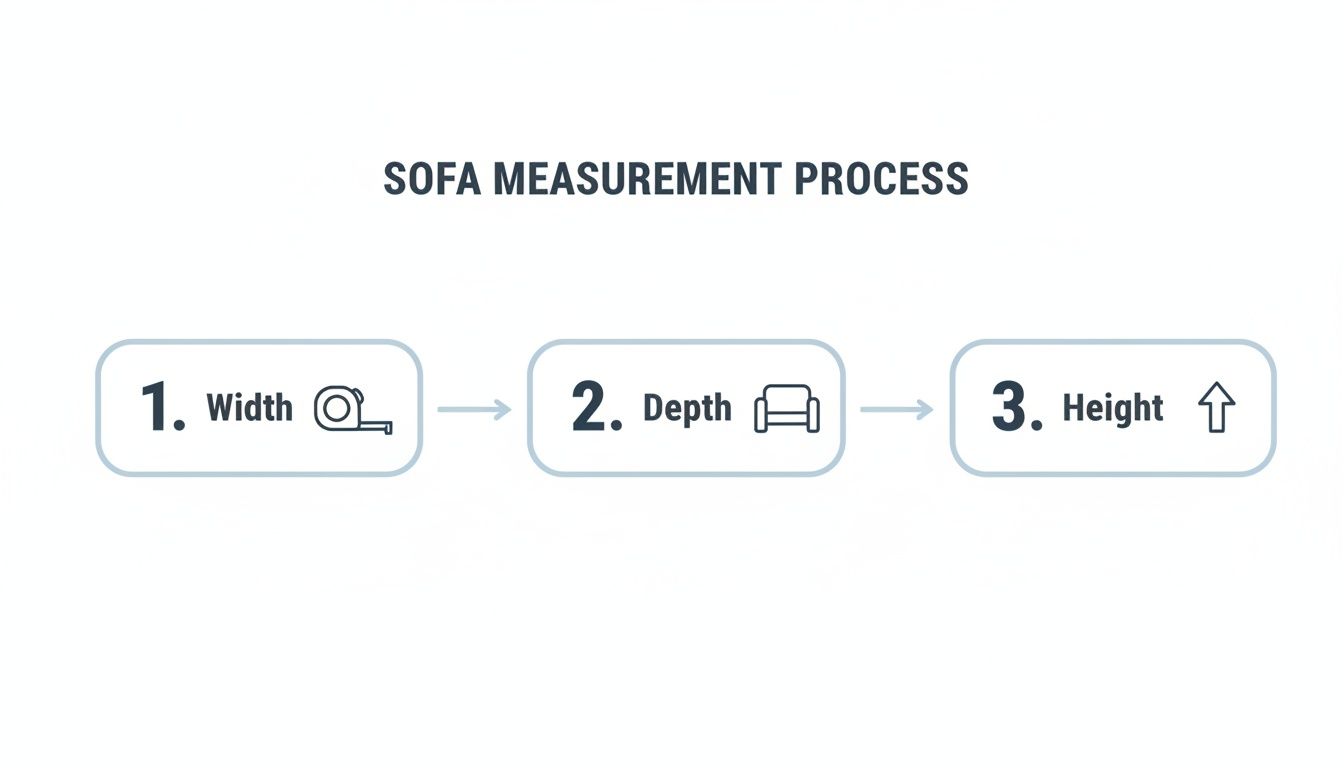
This diagram shows you exactly where your tape measure needs to go for each key dimension—width, depth, and height. Getting these three core numbers right for each section is the foundation for a flawless fit.
How to Nail the A-A and B-B Measurements
It's a straightforward process, but you need to be methodical. Here’s how I recommend doing it to avoid any confusion:
- Identify your sections. Your L-shaped sofa has two main parts that meet at a corner. A U-shaped sofa has three.
- Start with the first section (A-A). Place your tape measure on the outer edge of the armrest.
- Measure to the corner. Stretch the tape in a straight line along the back of the sofa until you hit the very corner where the two sections join.
- Write it down. Don't try to remember it! Note down the A-A measurement in centimetres.
- Repeat for the other section (B-B). Do the exact same thing for the second arm section, measuring from its outer armrest into that same corner point.
Recording these numbers separately is crucial. It ensures the cover panels you receive will line up perfectly where they meet, giving you that smooth, seamless look.
Common Corner Sofa Setups
Most sectional sofas fall into one of three common layouts. While they look different, the measuring principle remains the same—you're just adding a third section for U-shaped models.
| Configuration | Sections to Measure | Typical Width Range (per section) |
|---|---|---|
| Left-Hand Facing | 2 (A-A, B-B) | 70–80 cm each |
| Right-Hand Facing | 2 (A-A, B-B) | 70–80 cm each |
| U-Shaped Sectional | 3 (A-A, B-B, C-C) | 70–80 cm each |
Corner sofas have become incredibly popular in the UK, making up around 25% of the market in 2024. They typically span 250–300 cm in total width, with each arm section being about 70–80 cm deep and seats sitting 45–50 cm high. These are the exact dimensions our modular covers are designed for. You can see more details in Statista’s seats & sofas forecast.
Fitting and Tucking Your New Cover
Once your cover arrives, lay out the separate pieces on the floor. You’ll find they are labelled to match the A-A and B-B sections you measured.
Start by sliding one panel over its matching sofa section. Don't worry about getting it perfect just yet; focus on getting the general alignment right. Once both pieces are on, it’s time for the most important step: tucking.
This is where our free foam inserts really prove their worth. Push them deep into the gaps between the cushions, arms, and back of the sofa. This simple action is what anchors the fabric, creating tension and smoothing out any potential sags or wrinkles. For extra security, attach the under-sofa clips to lock the cover in place and stop it from shifting.
A little pro tip from my own experience: I’ve found that starting with the main back panel and then fitting one arm section at a time cuts down on re-tucking by at least 50%.
Troubleshooting Common Corner Issues
What if one section still looks a bit loose? Nine times out of ten, the solution is to simply push the foam insert deeper into the crevice. This creates more tension and pulls the fabric taut. If it still needs a little help, re-fastening the under-sofa clips a bit tighter should do the trick.
Master these simple steps, and you’ll get a flawless, professional-looking finish every time.
How to Handle Sofa Beds and Recliners
Sofa beds and recliners are brilliant, multi-functional pieces, but their moving parts add an extra layer of complexity when you’re measuring for a new cover. It’s not quite as straightforward as a static sofa. You need a slightly different approach to make sure your cover fits perfectly without getting snagged in the mechanisms. It's all about accommodating that movement.
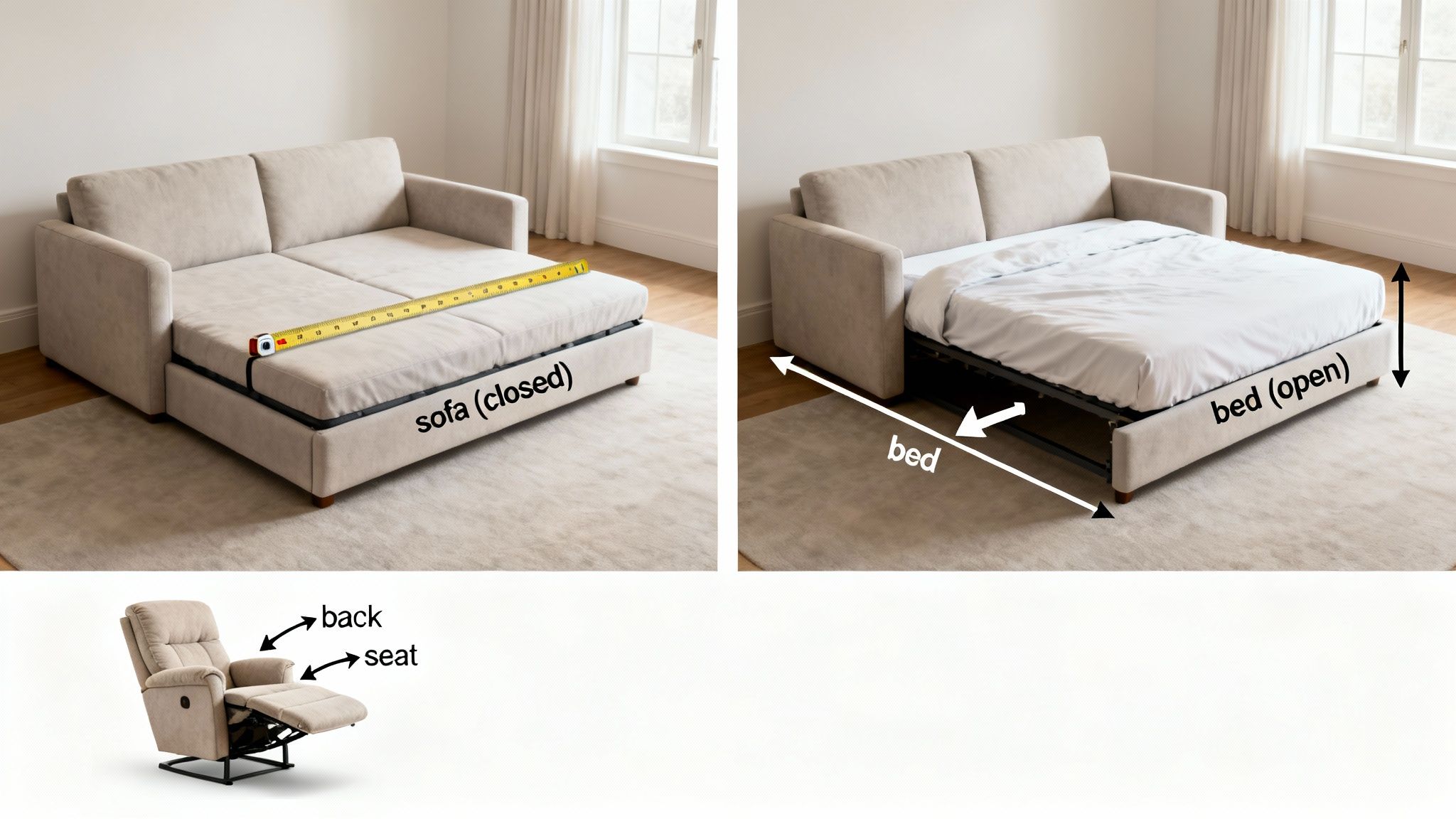
When you're dealing with furniture that transforms, a single set of measurements just won't cut it. The trick is to think about the furniture in all its possible states—both when it's still and when it's in motion.
Measuring Your Versatile Sofa Bed
A sofa bed is a true space-saver, but its dual-function design means you absolutely have to measure it twice. This is non-negotiable if you want a cover that works seamlessly, whether you're sitting on it or pulling out the bed for guests.
You'll need to capture its dimensions in two distinct configurations:
- Closed (Sofa Position): First, measure it exactly like you would a standard sofa. Take the total width from outer arm to outer arm, the height from the floor to the top of the backrest, and the depth from front to back. These are your baseline numbers.
- Open (Bed Position): Next, fully extend the bed mechanism. Now, measure the total length it takes up, from the back of the sofa frame right to the very end of the extended mattress. Don't forget to also measure the width of the mattress itself.
This second set of measurements ensures the cover has enough give to accommodate the frame when it's unfolded. It stops the fabric from pulling tight or, worse, getting caught and obstructing the mechanism when you convert it.
Capturing both sets of dimensions is the only way to guarantee a functional fit. A cover that's too restrictive can strain the seams and even damage the sofa bed's folding mechanism over time.
Sofa beds are essential for the 35% of UK households living in smaller spaces or rental properties. Standard models are typically 120-140 cm wide as a sofa, unfolding to a length of 180-200 cm as a bed. Our stretchy, durable zip-on covers are specifically designed to handle this transformation with ease. You can discover more insights in the latest FIRA statistics digest.
For a few extra styling tips, you might like our guide on decorating with covers for sofa beds and chaise longues.
Getting Recliner Dimensions Right
Recliners present a unique challenge because nearly every part moves on its own. A standard, one-piece cover simply won't work; it would either tear or bunch up the moment you lean back. The solution is to measure each section as a separate component to fit a specialised, multi-piece recliner cover.
Think of your recliner as a collection of individual parts rather than a single chair. You'll need to measure each one separately:
- Backrest: Measure the width across the widest point and the height from the seat cushion to the very top.
- Seat: Get the width and depth of the seat cushion itself.
- Footrest: Extend the footrest fully and then measure its width and length.
- Armrests: Measure the length from front to back and the width across the top.
Our multi-piece recliner covers are designed with exactly this in mind. Each piece is crafted to fit a specific part of the chair, with generous elasticated edges that stay put as the chair moves. This approach ensures complete coverage and a snug fit, no matter how far back you recline. It’s the best way to get that custom-like appearance while protecting your favourite chair from daily wear and tear.
Common Measuring Mistakes and How to Avoid Them
Getting the dimensions for a sofa cover can feel straightforward, but a few common slip-ups are the difference between a perfect fit and a frustrating mess. We’ve seen it all over the years, and trust me, even the most careful person can overlook one or two small details that throw everything off.
Think of this as your preventative checklist. By knowing where people usually go wrong, you can measure with confidence and nail that smooth, tailored fit on your very first try. Let’s walk through the most frequent mishaps and how to get them right.
The Puffy Arm Problem
One of the biggest culprits we see is with sofas that have large, rounded, or heavily padded arms, like a classic Chesterfield. The mistake is simple: measuring the sofa’s width in a straight line from the outside of one arm to the other, completely ignoring the curve or bulk of the armrests themselves.
This straight-line measurement cheats you out of several crucial centimetres. When the cover arrives, it’ll be incredibly tight across the front, putting a real strain on the seams and making it impossible to tuck in properly.
The Fix: You have to measure up and over the curve of the armrest. Start your tape measure at the outermost point of one arm, follow its contour all the way across the seating area, and then trace the contour up and over the other arm. This is the only way to capture the true surface area the fabric needs to cover.
Forgetting the Full Frame Width
It’s so easy to just focus on the seating area—the cushions where you actually sit—and use that as your main width measurement. This is a critical error because a sofa cover is designed to encase the entire piece of furniture, frame and all.
If you only measure the seat cushions, you’ll end up with a number that’s massively smaller than the sofa’s total width. The result? A cover that’s far too small to even pull over the armrests.
Our stretch fabrics are designed with a generous amount of give, but they can't overcome a measurement that is 20-30 cm too short. Capturing the full outer width from armrest to armrest is non-negotiable for a successful fit.
Ignoring the Overall Back Height
Another frequent oversight is measuring the height from the top of the seat cushions to the top of the backrest. While that number is useful for knowing proportions, it isn’t the main height dimension you need for a cover. The cover has to be tall enough to go from the floor all the way over the top of the sofa’s solid back frame.
If you only measure from the cushion upwards, you’ll end up with a cover that’s too short, leaving the bottom of your sofa exposed or creating a constant battle with it riding up.
Here’s how to get it right every time:
- Place your tape measure on the floor, right behind the sofa.
- Extend it straight up to the highest point of the sofa's solid back frame.
- Don't stop at the top of the back cushions, as they can squish down and give you a false reading.
This single measurement ensures you have enough fabric for complete, floor-to-top coverage. By sidestepping these common pitfalls, you’re not just taking numbers; you're guaranteeing a stress-free installation and a beautiful, refreshed look for your living space.
From Measurements to a Fresh New Look
With your measurements written down, you’re ready for the exciting bit—choosing the cover that’s going to completely transform your sofa. This is where your careful work pays off, making it simple to pick the right size from our product pages and get that perfect, reupholstered look you’re after.
The most important number you have is the total width, measured from the outer edge of one armrest clear across to the other. This is what you’ll use to find your size. For example, if your sofa measures 155 cm wide, you’ll be looking at our 2-Seater covers. A snug little armchair will fall into the 1-Seater category. If you have a corner sofa, you'll simply match your two A-A and B-B measurements to the corresponding L-Shape Right or Left cover set. It’s that straightforward.
Your Final Pre-Purchase Checklist
Before you head to the checkout, just run through this quick mental check. It’s the final step to guarantee a flawless fit and complete peace of mind.
- Total Width Confirmed: Did you measure from the absolute outermost point of each arm?
- Back Height Included: Was your measurement from the floor all the way to the top of the sofa's solid frame?
- Unique Features Noted: Have you accounted for any particularly puffy arms or extra-deep cushions?
Once you’ve ticked these boxes, you can buy with total confidence. We've designed the process to take all the guesswork out of the equation.
Your careful measuring now pays off with a simple, satisfying installation. It’s the final step in turning a tired piece of furniture into something fresh and new, and it takes just minutes to achieve.
When your new cover arrives, you’ll find the installation is a breeze. Our high-stretch fabric glides right over your sofa, and the foam inserts we include are your secret weapon. You just push them deep into the gaps between the cushions and the frame to get a sharp, defined finish. Then, just secure the clips under the sofa for a smooth, non-slip fit that really stays put.
By the way, if you're renovating or just need to clear some space, having precise couch dimensions is also essential when looking into flexible furniture storage solutions.
You've done the hard work. Now, it's time to bring your vision to life. Browse our collections with your measurements ready and find the perfect style to refresh your home today.
Still Have Questions About Measuring?
Even with the best instructions in hand, sometimes a particularly unique sofa can leave you scratching your head. Let's run through some of the most common questions we get from customers, so you can feel totally confident you’ve got the right numbers.
What If My Sofa Is Between Sizes?
This happens all the time. Say your two-seater sofa measures 188 cm across, putting it just over the limit for a 2-seater cover (which goes up to 185 cm) but not quite hitting the start of a 3-seater cover (which begins at 190 cm).
When in doubt, always size up. It’s far better to have a little extra fabric to work with. You can easily tuck any slack deep into the crevices using the free foam inserts we provide, which gives you that snug, seamless finish. A cover that’s too small will just strain at the seams and will never, ever look right.
How Do I Measure Sofas with Thick or Padded Arms?
If your sofa has really substantial, puffy, or rounded arms—think of a classic Chesterfield—just measuring in a straight line across the front won't cut it. You have to account for all that extra surface area the fabric needs to stretch over.
The best way to tackle this is to measure over the curve. Start your tape measure on the floor at the outer edge of one arm, then run it up and over the armrest, across the whole seating area, over the opposite arm, and right down to the floor on the other side. This captures the true dimension the cover needs to hug.
Do Your Covers Fit Sofas with Non-Removable Cushions?
Yes, they absolutely do. Our stretch covers are cleverly designed to fit snugly over sofas with both removable and fixed cushions.
The secret is to use the foam tucks that come with your cover. You just push the fabric deep into the creases where the cushions meet the frame. This simple trick creates the sharp, defined look of separate cushions while locking the cover securely in place so it doesn't shift around.
This same logic applies if you have a unique shape like a chaise lounge. Just measure each section as if it were a separate piece of furniture and pick the right cover sizes for each part. You’ll get a perfect modular fit that looks like it was made to measure.
At The Sofa Cover Crafter, we make it simple to find a beautiful, durable cover that fits like a glove. Protect your furniture and give your living space a fresh new look by browsing our full collection of stylish sofa covers today.