



You'll rarely find universal, legally-mandated dimensions for a sofa, but the good news is that most UK sofas stick to fairly predictable size ranges. A typical three-seater usually lands somewhere between 190-220 cm wide, a two-seater is often around 130-150 cm wide, and a sprawling corner sofa can span 250-300 cm. Getting your head around these common measurements is the perfect first step in planning your living space.
Table of Contents
- Your Quick Guide to Standard Couch Dimensions
- Understanding the Averages
- Average UK Sofa Dimensions at a Glance
- The Essential Terms for Sofa Measurements
- Decoding the Core Dimensions
- Getting into the Finer Details
- Measuring Two and Three-Seater Sofas
- The Classic Two-Seater Sofa
- The Three-Seater Sofa The Family Favourite
- How Covers Are Designed for These Dimensions
- How to Measure L-Shaped and Chaise Sofas
- Tackling the L-Shaped Corner Sofa
- Measuring a Sofa with a Chaise Longue
- Measurement Guide for Complex Sofa Shapes
- Finding Dimensions for Armchairs and Loveseats
- Mastering Armchair Measurements
- Decoding Loveseat and Snuggler Dimensions
- The Cushion vs The Frame Mistake
- Forgetting the Details
- Finding the Right Sofa Cover Size
- Mapping Your Measurements to Our Cover Sizes
- Avoiding Common Measurement Mistakes
- Overlooking Obstacles and Access Routes
- Installation Tips for a Flawless Finish
- Smoothing and Shaping the Fabric
- The Secret Weapon: Foam Inserts
- Securing for a Taut Finish
- How to Handle Sofa Beds and Recliners
- Measuring Your Versatile Sofa Bed
- Getting Recliner Dimensions Right
- Common Measuring Mistakes and How to Avoid Them
- The Puffy Arm Problem
- Forgetting the Full Frame Width
- Ignoring the Overall Back Height
- Couch Dimensions: Your Questions Answered
- How Do I Know if a Sofa Will Fit Through My Door?
- What Is the Difference Between Seat Depth and Overall Depth?
- Are Sofa Bed Dimensions Different from Standard Sofas?
Your Quick Guide to Standard Couch Dimensions
Shopping for a new sofa or trying to find a cover that fits like a glove can feel a bit daunting without a decent starting point. Will that dream sofa even make it through the front door? Will it look lost in your living room, or completely overwhelm it? Thankfully, furniture makers tend to play by a set of unwritten rules, creating standard sizes that work for the average British home.
Think of these standard dimensions as helpful guidelines rather than rigid laws. Just like clothes sizes vary a little from brand to brand, sofa dimensions can shift based on the style, how chunky the arms are, or how plump the cushions are. But knowing the typical measurements gives you a powerful advantage, whether you're mapping out a room layout or choosing one of our stylish, snug-fitting covers.
Understanding the Averages
To make your search a bit simpler, we’ve broken down the most common sofa types you'll find in UK homes. These figures give you a solid idea of the ranges you're likely to come across, making it much easier to picture what will work for your own space.
- Two-Seater Sofa: Often called a loveseat, this is the go-to for smaller living rooms and flats, or as a cosy partner in a larger furniture suite. Its compact size makes it wonderfully versatile.
- Three-Seater Sofa: The absolute workhorse of the British living room. This size is perfect for families and guests, often acting as the main centrepiece of the room.
- Corner or L-Shaped Sofa: An ideal choice for larger, open-plan spaces. These sofas provide loads of seating and are brilliant for defining a specific zone for lounging and socialising.
For a quick visual reference, you can always consult comprehensive sizing charts that lay out dimensions for all sorts of furniture types. They can be a real help when you're trying to compare different styles at a glance.
Remember, the most important dimensions of a couch aren't just the ones you see online, but the ones that work for your unique home and lifestyle. A sofa should ground a seating area, not overwhelm it.
To help you get started, we've put together a table summarising these average measurements. Use this as your initial guide before you pull out the tape measure for the precise figures, which we'll dive into in the next section.
Average UK Sofa Dimensions at a Glance
Here’s a quick look at the typical dimensions for the most common sofa types found across the UK. Think of this as your cheat sheet before you start measuring up your own space.
| Sofa Type | Average Width (cm) | Average Depth (cm) | Average Height (cm) |
|---|---|---|---|
| Two-Seater Sofa | 130–150 cm | 85–90 cm | 80–90 cm |
| Three-Seater Sofa | 190–220 cm | 85–100 cm | 80–95 cm |
| Corner Sofa (Total Span) | 250–300 cm | 90–100 cm | 80–95 cm |
Having these ballpark figures in mind makes it much easier to narrow down your options and spot a sofa that’s likely to be a great fit, both for your room and for one of our covers.
The Essential Terms for Sofa Measurements
Before you even think about grabbing a tape measure, it’s vital to know exactly what you’re measuring. Getting a sofa’s dimensions right is less about the numbers themselves and more about speaking the right language. It’s like learning a few key phrases before travelling; it makes the whole journey smoother and ensures you end up with exactly what you need.
Think of it this way: ordering a “large” coffee can mean something completely different from one café to the next. In the same way, a sofa’s “depth” can refer to a couple of different things. By getting these essential terms straight first, you’ll be able to measure with confidence and avoid the common pitfalls that lead to a baggy cover or a sofa that gets stuck in the hallway.
This simple visual breaks down the three core measurements every sofa has, giving you a clear starting point.
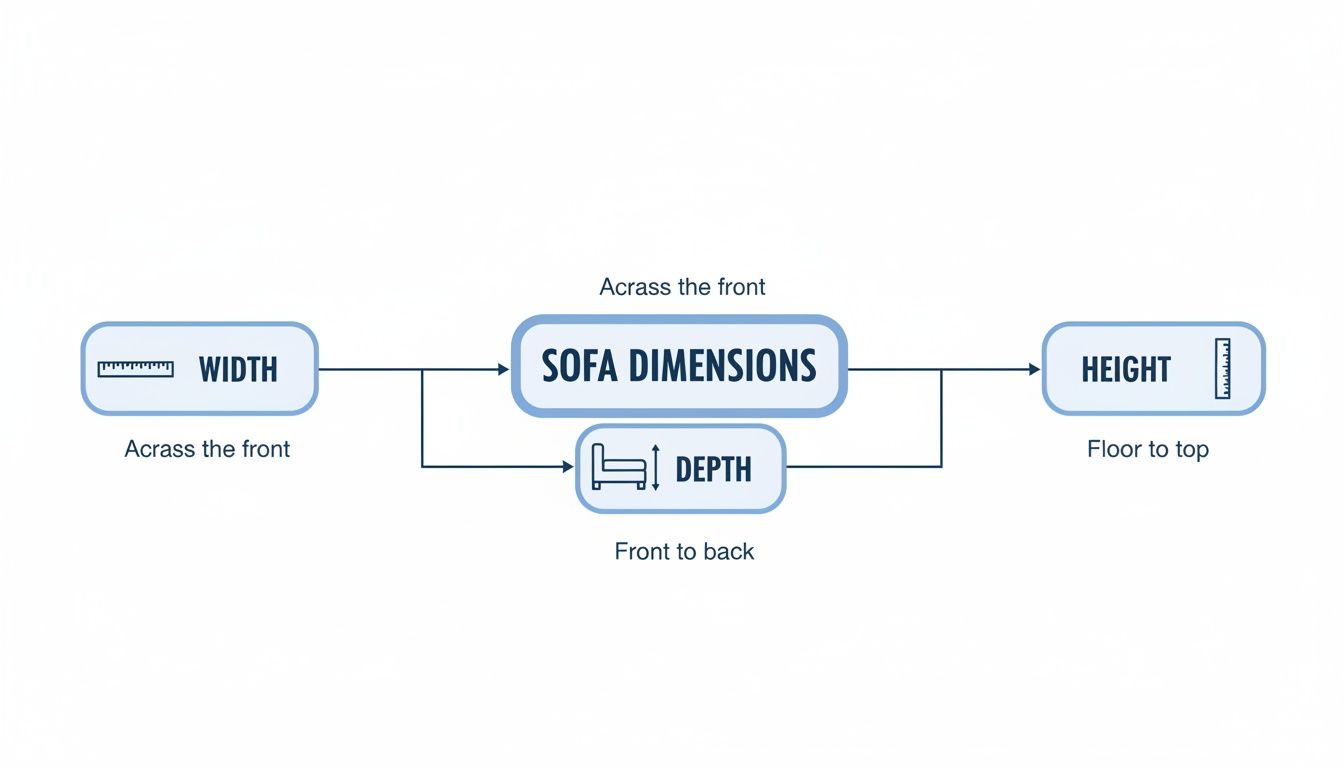
As you can see, each one captures a different part of the sofa's overall size, from how much floor space it takes up to how tall it stands in a room.
Decoding the Core Dimensions
Let's break down the most important measurements you'll need. Getting these right won't just help you find the perfect cover; it’ll also make planning your room layout a breeze. For a more general overview of the process, you can learn how to measure furniture accurately.
-
Overall Width: This is the big one. It’s the measurement from the outermost point of one arm clear across to the outermost point of the other. Imagine you're parking a car in a tight spot; you need to know its absolute widest point. This is the most crucial measurement for getting the right size sofa cover.
-
Overall Depth: This is the distance from the very front of the sofa to the very back of its frame. We’re not talking about just the seating area, but the sofa’s entire footprint from front to back. This dimension is key for making sure you have enough space to walk around it comfortably.
-
Overall Height: This is measured from the floor right up to the highest point of the sofa’s back frame. A quick tip: don't measure to the top of the cushions, as they squash down. This number is essential for making sure the sofa will fit under window sills and, most importantly, through your doorways. A sofa that’s just 2 cm too tall can be impossible to get inside.
These three—width, depth, and height—are the foundational language for understanding any sofa’s size.
A common mistake is measuring only the seating cushions. Always measure the full frame from the absolute edge to edge to get the true dimensions. This ensures your cover won’t be too small or look hopelessly baggy.
Getting into the Finer Details
Once you've nailed the main measurements, a few other dimensions can help you get an even more tailored fit, especially with our versatile covers.
-
Seat Height: The distance from the floor to the very top of the seat cushion. This tells you how high up you'll be sitting, which is a big factor for comfort, especially if you're tall or have mobility concerns.
-
Seat Depth: This measures from the front edge of the seat cushion to the front of the back cushion. Deeper seats are brilliant for lounging and curling up, while shallower seats offer more upright support.
-
Arm Width: The measurement across the top of one of the sofa's arms. The width of the arms can really change the overall style and how bulky a sofa feels in a room.
Taking a moment to get familiar with these terms turns measuring from a chore into a simple, straightforward task. It empowers you to choose a cover from The Sofa Cover Crafter with the certainty that it will hug every curve perfectly, giving your furniture a fresh, custom-fitted new look.
Measuring Two and Three-Seater Sofas
When you're trying to furnish a home here in the UK, the two and three-seater sofas are the undisputed kings of the living room. From a cosy terraced house in Manchester to a modern London flat, these are the pieces that form the backbone of British homes. Their popularity isn't some happy accident; it’s because their dimensions have been perfected over decades to fit our spaces.
Manufacturers have spent years honing these sizes to work with the typical UK home. This means that whether you have a two or a three-seater, its measurements probably fall within a fairly predictable range. That's great news, because it makes finding things like a perfectly fitting sofa cover a whole lot easier. Understanding these standard dimensions is your first step to getting everything just right.
The Classic Two-Seater Sofa
Often called a "loveseat," a two-seater is the go-to solution for smaller living areas or as a neat little addition to a larger suite. Its compact size offers plenty of comfort without completely taking over the room, which is why it's such a favourite for first-time buyers and anyone living in an apartment.
The dimensions of a two-seater are all about efficiency and comfort in these tighter spaces. In the UK, you'll find the average two-seater sofa measures around 130-150 cm in width, 85-90 cm in depth, and 80-90 cm in height. This general profile has stayed pretty consistent since the post-war housing boom of the 1950s, when the size of the average British living room more or less settled. These dimensions are perfect for stretchy spandex covers, which hug the contours without sagging—a fact you can see reflected in the living room setups of over 70% of British households. For more on UK furniture trends, Grandview Research has some fascinating insights.
The Three-Seater Sofa The Family Favourite
The three-seater is the quintessential family sofa. It’s the heart of so many living rooms, with enough space for everyone to pile on for a film night or a good chat. Its generous size really anchors a room and gives you a clear focal point for your entire seating arrangement.
Typically, a three-seater sofa will have dimensions that look something like this:
- Width: Usually between 190 cm and 220 cm. This gives three adults enough room to sit comfortably.
- Depth: Often ranges from 85 cm to 100 cm. Deeper models are brilliant for properly lounging and curling up.
- Height: Just like the two-seater, expect a height of around 80 cm to 95 cm from the floor to the top of the frame.
A key takeaway here is that while these ranges are standard, individual styles can throw a spanner in the works. A sofa with big, chunky rolled arms will have a much greater overall width than a sleek, minimalist one, even if their actual seating space is identical. Always measure your own specific sofa.
How Covers Are Designed for These Dimensions
Knowing these common sizes is one thing, but how does that actually help you pick the right cover? Well, at The Sofa Cover Crafter, our products are engineered with these exact dimensions in mind. The high-quality, stretchy fabric blends we use are designed to accommodate all the little variations you find within these standard two and three-seater sizes.
This built-in flexibility is what gives our covers that snug, almost custom-made fit. The elasticity allows the cover to stretch over the widest parts of your sofa while pulling in neatly around the narrower sections, getting rid of any ugly sagging or bunching.
On top of that, we add a few clever design features to really nail the fit. The free foam inserts we provide are perfect for tucking down into the gaps between the frame and cushions of these standard sofas. This secures the fabric deep into the sofa's creases, creating a smooth, wrinkle-free finish that stays put, no matter how much you use it. It's this combination of adaptable fabric and thoughtful little extras that ensures a perfect, non-slip fit for the kind of sofa you most likely have. For a detailed walkthrough, check out our guide on how to measure your sofa for a perfect cover fit.
How to Measure L-Shaped and Chaise Sofas
Measuring a straightforward rectangular sofa is one thing, but what about the more complex shapes that have become the heart of modern living rooms? Don't be put off by the angles and extended seats of L-shaped and chaise sofas. The process is surprisingly simple once you know the trick: just break it down into smaller, manageable sections.
These larger sofas are no longer just for grand sitting rooms. Corner sofas, in particular, have exploded in popularity across the UK, becoming a real centrepiece in family homes. Their rise is tied to the boom in open-plan living, a design choice found in a staggering 83% of new English homes. These layouts cry out for furniture that can anchor a space, making an L-shaped sofa the perfect way to create a cosy, defined lounge area. You can find out more in these UK furniture statistics.
This guide will walk you through measuring these specific sofa types, making sure you get the right dimensions for a cover that looks and feels custom-made.
Tackling the L-Shaped Corner Sofa
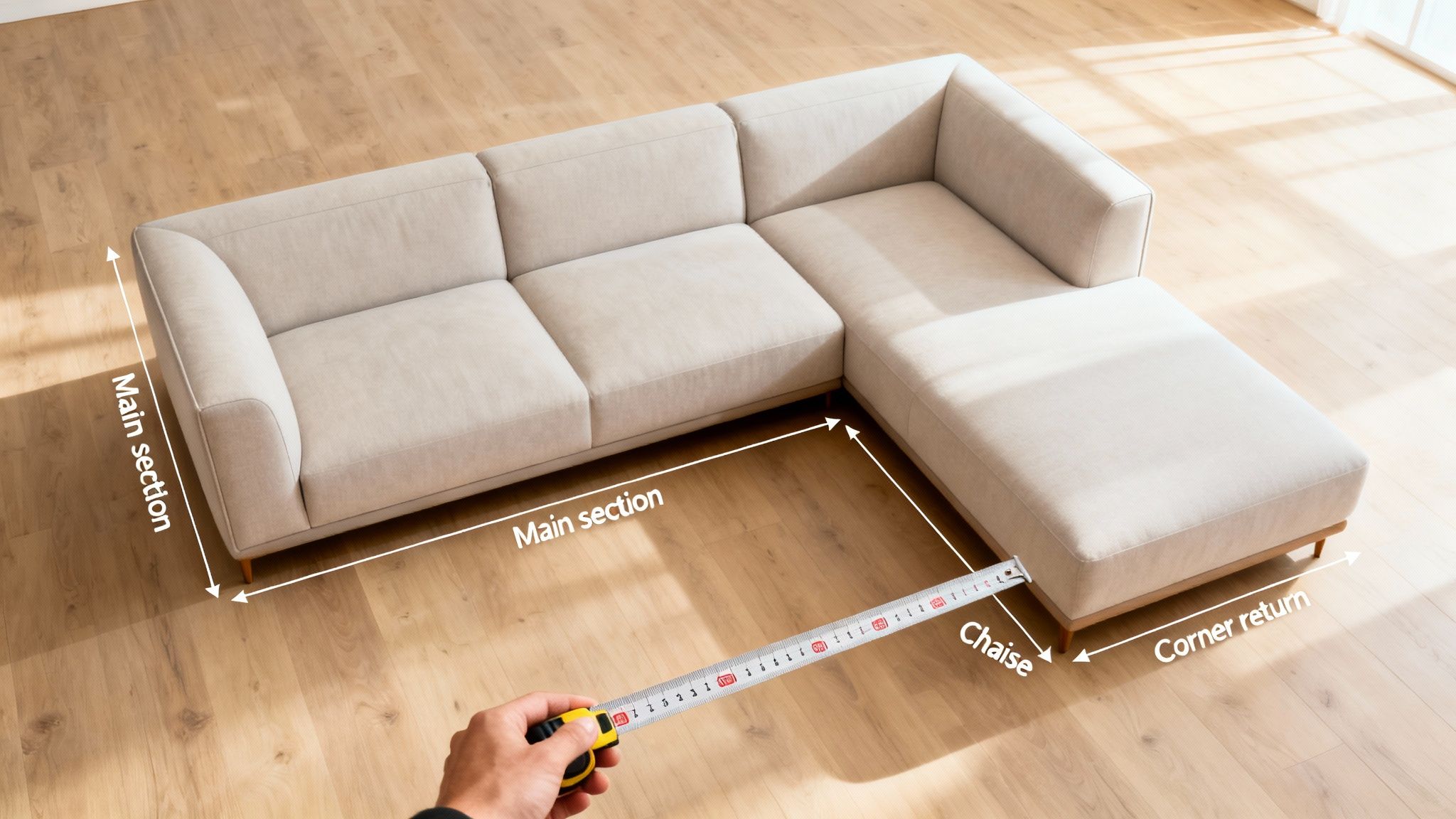
The secret to measuring an L-shaped sofa is to stop seeing it as one giant piece of furniture. Instead, think of it as two separate sofas that just happen to meet in the corner. Your goal is to measure the length of each section individually, from its outer arm right into that central corner where they join.
Imagine drawing a line on the floor where the two sections meet. You'll measure one 'sofa' from its arm to that imaginary line, then do the exact same for the other section. This simple trick stops you from double-counting the corner seat and gives you the two main lengths you need.
Here’s a quick breakdown:
- Measure Section One: Start at the outer arm of the longer part of your sofa. Run your tape measure right along the back of the frame until you hit the corner. That’s your first key number.
- Measure Section Two: Now, repeat the process for the shorter part (often called the 'return'). Measure from its outer arm along the back until you get to that same corner point. This is your second number.
- Measure the Depth and Height: Finally, measure the overall depth (from the back of the sofa to the front edge) and the height (from the floor to the highest point of the frame). These will probably be the same for both sections, but it never hurts to check.
Don’t forget the corner itself. While you measure the two lengths into the corner, the depth of the corner cushion itself is also a useful dimension to have, especially for multi-piece cover sets.
Measuring a Sofa with a Chaise Longue
A chaise sofa is really just a standard sofa with a built-in footstool on one end—perfect for putting your feet up. Measuring this style is very much like tackling a corner sofa; you just treat the main sofa and the chaise section as two distinct parts.
The most important measurement here is the depth of the chaise. This is the distance from the back of the sofa frame to the very front edge of the chaise cushion. This, along with the sofa's total width, gives you the main dimensions you’ll need.
Here’s how to get it right:
- Measure the Total Width: Run your tape measure from the outermost edge of one arm to the outermost edge of the other, just as you would with a standard sofa.
- Measure the Chaise Depth: Start at the back of the sofa frame and measure in a straight line out to the very front tip of the chaise section.
- Note the Chaise Side: This is crucial! Make a note of whether the chaise is on the left or the right side as you face the sofa. This ensures you order the correct cover configuration.
We've created this simple table to break down the process even further, guiding you through each specific measurement for these more complex sofa shapes.
Measurement Guide for Complex Sofa Shapes
| Sofa Section | Measurement Point | How-To Tip |
|---|---|---|
| Corner Sofa: Main Section | Length | Measure from the outer arm, along the back, right into the corner point. |
| Corner Sofa: Return Section | Length | Measure from the outer arm of the shorter side into that same corner point. |
| Chaise Sofa: Main Body | Total Width | Measure from the outside of one armrest clear across to the other. |
| Chaise Sofa: Chaise Part | Chaise Depth | Measure from the back frame straight out to the very front of the chaise cushion. |
| Both Types | Overall Height & Depth | Measure floor-to-top for height, and back-to-front for depth. Check both sections. |
Taking a few moments to get these key numbers right is the secret to a perfect fit.
Understanding the unique shape of your sofa is key. For more inspiration on styling these versatile pieces, explore our guide to sofa beds and chaise longue ideas. By taking these careful measurements, you’ll have all the information needed to pick a cover from The Sofa Cover Crafter that will fit like it was made for it, hugging every corner and contour perfectly.
Finding Dimensions for Armchairs and Loveseats
While big, sprawling sofas often get all the attention, it’s the smaller pieces like armchairs and loveseats that really make a living space feel balanced and complete. They’re perfect for tucking into a cosy corner, adding extra seating without overwhelming a small room, or creating a stylish accent next to your main sofa. From a classic wingback to a modern tub chair, each style brings its own personality—and its own unique measurements.
Getting to grips with these smaller dimensions is crucial for a flawless slipcover fit. The gentle curve of a rolled arm or the height of a wingback needs a cover that can stretch and conform without bunching up or slipping out of place. And with more of us working from home, the humble armchair is having a real moment in home offices and reading nooks, making it more important than ever to know its size to keep it protected and looking sharp.
Mastering Armchair Measurements
Don’t let their size fool you; armchairs can have surprisingly tricky shapes. A traditional wingback, for instance, has those signature protrusions at the top you need to account for, while a tub chair has a single continuous curve from the armrest all the way around the back. When you’re measuring, always focus on the widest, deepest, and tallest points of the frame itself, not just the cushions.
The average armchair here in the UK typically has a width of 70-90 cm, a depth of 90-100 cm, and a height of 80-95 cm. These sizes have become pretty standard, especially since armchairs are a key feature in 23% of British living rooms. With the recent rise of hybrid working, living room furniture sales have surged, making protective covers for these hardworking pieces absolutely essential. You can see more on these market trends and their impact on UK furniture sales at Statista.com.
For a truly tailored look, especially with uniquely shaped chairs, you’ll want to grab these specific measurements:
- Total Width: Measure from the outer edge of one armrest clear across to the outer edge of the other.
- Back Height: Run your tape measure from the floor right to the very highest point of the chair’s back.
- Seat Depth: Measure from the front edge of the seat cushion to where it meets the backrest.
- Arm Height: Find the distance from the floor to the top of the armrest.
A common mistake is forgetting to measure the circumference of the chair's back. For rounded or barrel-shaped chairs, this can be a vital measurement to ensure a cover has enough fabric to wrap around smoothly without being stretched too tight.
Decoding Loveseat and Snuggler Dimensions
A loveseat, often called a ‘snuggler’ in the UK, sits perfectly between an armchair and a two-seater sofa. It’s designed for cosiness, giving you more room to curl up than a single chair but with a smaller footprint than a standard sofa. This makes it a fantastic choice for flats, bedrooms, or larger living rooms that need a secondary seating spot.
Loveseats usually measure somewhere between 110 cm and 140 cm in width, making them noticeably wider than an armchair but more compact than a full two-seater. Their depth and height tend to follow standard sofa dimensions, often falling between 85-100 cm for depth and 80-95 cm for height.
When you’re measuring a loveseat, the process is exactly the same as for a regular sofa—just focus on those three key dimensions of overall width, depth, and height. Because of their ‘in-between’ size, a high-quality stretch cover is your best friend here. The spandex blends used in our products are specifically designed to accommodate this size range, giving you a snug, seamless fit that looks intentional, not forced. Getting these measurements right is the first step to a successful refresh, and our guide on choosing the perfect covers for armchairs and sofas has plenty more tips.
Even with the best intentions, a small slip of the tape measure can lead to a big headache. Suddenly, you’re left with a sofa cover that’s baggy, overstretched, or just plain won’t go on. Getting the right dimensions the first time is all about knowing the common pitfalls. Luckily, they’re easy to dodge once you know what to look for.
Think of it like baking a cake; if you misread the flour measurement, the end result is going to be a bit of a disaster, no matter how good the other ingredients are. The same idea applies here. A few simple checks now will save you the frustration of a cover that doesn't fit, and make sure your sofa gets the fresh new look it deserves.
The Cushion vs The Frame Mistake
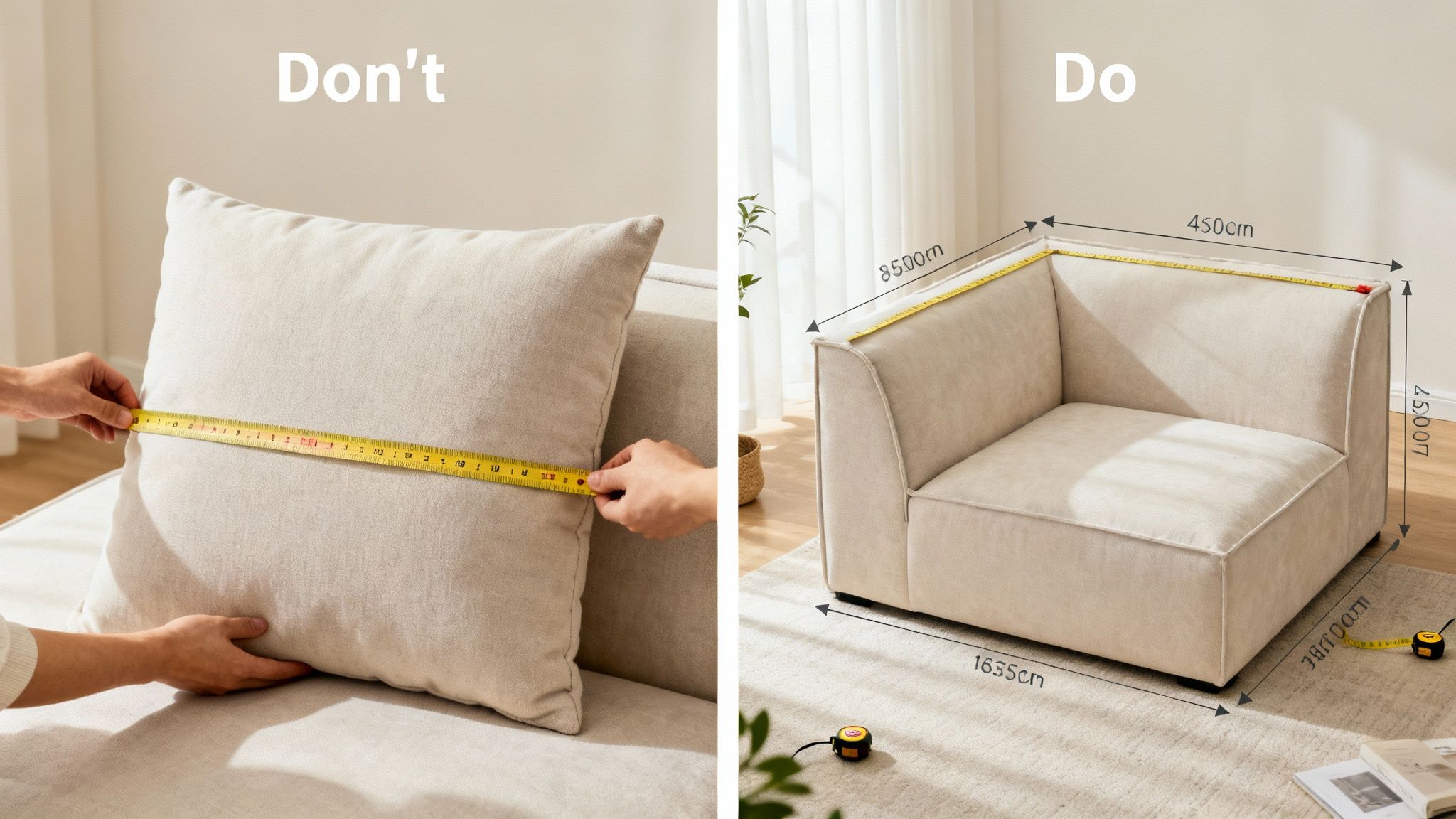
One of the most frequent slip-ups is measuring the soft, squishy cushions instead of the solid frame beneath them. Cushions give a false reading of your sofa's true size because they compress and shift around. For a cover to fit properly, it needs to hug the permanent structure of the sofa, not the temporary shape of its padding.
To get it right, you have to measure from the absolute widest, highest, and deepest points of the sofa’s frame. That means stretching your tape measure from the outer edge of one armrest clear across to the outer edge of the other for the width. For height, measure from the floor to the very top of the back frame, not the top of the cushions.
Forgetting the Details
Little things like bulky arms or a curved back can make a huge difference to how a cover fits, yet they often get overlooked. A sleek, modern sofa and a classic Chesterfield might have the same seating width, but the Chesterfield's puffy, rolled arms add a considerable amount of bulk.
- Bulky Arms: Don't just measure the width from arm to arm. If your sofa has thick, padded arms, measure their individual width and height, too. This helps ensure the cover has enough fabric to go over them without pulling or looking stretched.
- Curved Backs: For sofas with a curved or camelback design, measure the length along the curve itself, as well as the straight-line width. This gives a much more accurate picture of the surface area the cover needs to stretch over.
The Golden Rule of Measuring: Always measure twice, and write your numbers down straight away. It’s a simple habit that catches tiny mistakes before they become big problems. Trusting your memory after a few different measurements is just asking for trouble.
By sidestepping these common pitfalls, you’ll have a set of accurate, reliable measurements. This precision is the key to choosing a cover from The Sofa Cover Crafter that delivers that sought-after tailored look, transforming your sofa with a snug, professional-quality fit. You're not just measuring; you're laying the groundwork for a successful and stylish room refresh.
Finding the Right Sofa Cover Size
Giving your sofa a new lease of life with a stretch cover is a brilliant and affordable update, but all that good work hinges on getting the measurements right. A cover that fits perfectly looks seamless and stays put, while one that’s just a little too small or large will constantly shift, bunch up, and look untidy. Measuring for a stretch cover is a bit different than just jotting down the basic dimensions of a new sofa.
You need to think beyond the overall length, depth, and height. The real key is to measure the parts of the sofa the cover will actually hug. This means getting the tape measure out for the width of each armrest, the total length of the seating cushions from one end to the other, and the height of the backrest from where the cushions end to the very top. For a complete walkthrough, our detailed guide on how to measure your sofa for a cover breaks down the entire process step-by-step.
Mapping Your Measurements to Our Cover Sizes
Once you've got your numbers, you can easily match them to the correct size. While stretch fabrics are quite forgiving, starting with the right size is essential if you want that polished, almost-reupholstered finish. Sofas with unusual shapes, like those with deep T-cushions or an attached chaise, need a bit of extra attention to make sure every contour is accounted for.
Top Tip: Always, always measure the longest possible seating length. For an L-shaped sectional, this means measuring the total length of both seating sections as if they were one continuous line. This single number is the most important one for choosing the right size.
To make things simple, we’ve put together a quick reference table to help you map your sofa’s total seating length to our standard cover sizes here at The Sofa Cover Crafter.
Here’s a straightforward guide to help you match your sofa's dimensions with the corresponding cover size you'll need from our collection. Just find your total seating length in the first column to see which size to choose.
| Measurement (cm) | Cover Size to Choose (e.g., S, M, L, XL) | Compatible Sofa Types |
|---|---|---|
| 90 - 140 cm | Small (S) | Armchair, Cuddler Chair |
| 145 - 185 cm | Medium (M) | 2-Seater, Loveseat |
| 190 - 230 cm | Large (L) | 3-Seater Sofa |
| 235 - 300 cm | Extra Large (XL) | 4-Seater, L-Shaped Sectionals |
As you can see, a little bit of measuring goes a long way. Taking a few moments to get an accurate number ensures you order a cover that will fit like a glove and give your furniture the fresh, new look it deserves.
Avoiding Common Measurement Mistakes
Even with the best of intentions, it’s surprisingly easy to make a tiny error with a tape measure that leads to a huge headache on delivery day. Getting wise to the most frequent pitfalls is the key to a smooth, stress-free process when you’re bringing new furniture home.
One of the most common oversights is completely forgetting about the permanent fixtures in your room. Things like skirting boards, window sills, and radiators all stick out from the walls, eating into your usable floor space. A sofa that seems to fit perfectly on paper might end up perched awkwardly away from the wall, spoiling the whole look.
Overlooking Obstacles and Access Routes
Another classic mistake is focusing only on the final destination and ignoring the journey. That sofa has to get there, after all. Low-hanging light fixtures, tight turns in hallways, and narrow stairwells can all bring a delivery to a grinding halt. You absolutely must measure every step of the delivery route, not just the room itself.
This is especially true in densely populated areas where space is a real luxury — compact 2-seater widths of 130-160 cm are often the better choice for smaller flats and terraced homes.
The single biggest reason for delivery failures is forgetting to compare the sofa's diagonal depth to the doorway's width. A sofa can often be pivoted through a narrow space if this crucial measurement works.
Finally, resist the temptation to just "eyeball it." A few centimetres can be the difference between a perfect fit and a piece of furniture that just won't go in. Always use a proper tape measure, write down your dimensions clearly, and double-check them before you commit. That little bit of discipline will save you an immense amount of frustration later on.
Installation Tips for a Flawless Finish

You’ve done the hard work of measuring your sofa and have chosen the perfect cover. Now for the satisfying part—getting it to look less like a temporary fix and more like a professional reupholstery job. A flawless fit is just as much about your installation technique as it is about the initial measurements.
First things first, find the tag stitched inside the cover that says ‘back’. This simple little marker is your starting point and saves you from that awkward dance of trying to figure out which way is up. Place this tag right at the centre of your sofa's backrest.
From there, gently drape the rest of the fabric evenly over the entire sofa. Don't be tempted to pull or tug it aggressively just yet. The idea is to let the material fall naturally over the arms, back, and cushions so you can see how everything lines up before you start securing it.
Smoothing and Shaping the Fabric
With the cover loosely draped, you can start the smoothing process. I always begin with the arms, gently guiding the fabric down and around their shape. Our high-stretch material is designed to hug all sorts of arm styles, from sleek, modern track arms to more plush, rounded ones. Use your hands to smooth out any major folds.
Next, move on to the backrest and the seat. Run your hands over the surfaces to eliminate any initial bunching or bagginess. This step is all about getting the general shape right before you lock everything into its final position. You're essentially creating a clean canvas to work with.
The Secret Weapon: Foam Inserts
Now for the real game-changer: the anti-slip foam inserts we include with every cover. These small but mighty cylinders are the key to achieving those crisp, clean lines and stopping the cover from shifting about during daily use.
The technique is simple but absolutely crucial. You need to tuck the foam inserts deep into the crevices of your sofa—the gaps around the seat cushions. Here’s the best way to do it:
- Between the arms and seat cushions: Push an insert vertically down into the gap on each side.
- Between the backrest and seat cushions: Push inserts horizontally along the back edge of the seat.
Use firm, steady pressure to push the foam deep into the sofa's frame until it's almost entirely hidden. This is what securely locks the cover fabric in place, preventing it from pulling loose when you sit down.
Securing for a Taut Finish
The final touch for a truly professional look is securing the cover underneath the sofa itself. Our covers come with attached ties for this very purpose. You might need a hand for this part, but simply tilt your sofa forward a little to get to the underside.
Fasten the ties from the front of the cover to the back. This creates a gentle, even tension across the entire surface, pulling the fabric taut and smoothing out any remaining minor wrinkles. It's this last step that really makes the difference, ensuring your cover stays perfectly in place, day in and day out.
For more visual guidance, you can always check out our detailed instructions in the full installation guide on our website. Following these simple steps will ensure your new cover fits like a glove and completely revitalises your living space.
How to Handle Sofa Beds and Recliners
Sofa beds and recliners are brilliant, multi-functional pieces, but their moving parts add an extra layer of complexity when you’re measuring for a new cover. It’s not quite as straightforward as a static sofa. You need a slightly different approach to make sure your cover fits perfectly without getting snagged in the mechanisms. It's all about accommodating that movement.
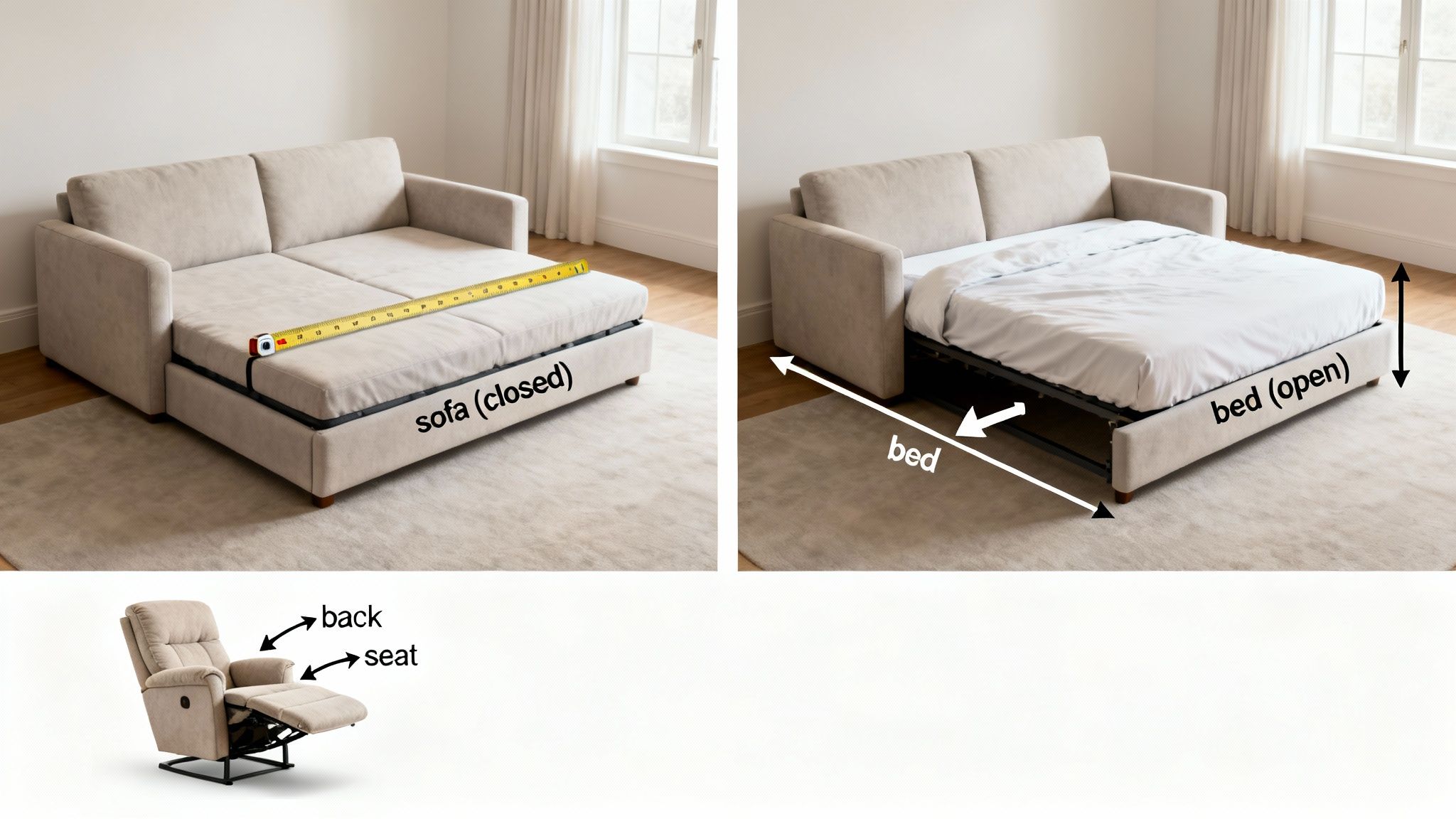
When you're dealing with furniture that transforms, a single set of measurements just won't cut it. The trick is to think about the furniture in all its possible states—both when it's still and when it's in motion.
Measuring Your Versatile Sofa Bed
A sofa bed is a true space-saver, but its dual-function design means you absolutely have to measure it twice. This is non-negotiable if you want a cover that works seamlessly, whether you're sitting on it or pulling out the bed for guests.
You'll need to capture its dimensions in two distinct configurations:
- Closed (Sofa Position): First, measure it exactly like you would a standard sofa. Take the total width from outer arm to outer arm, the height from the floor to the top of the backrest, and the depth from front to back. These are your baseline numbers.
- Open (Bed Position): Next, fully extend the bed mechanism. Now, measure the total length it takes up, from the back of the sofa frame right to the very end of the extended mattress. Don't forget to also measure the width of the mattress itself.
This second set of measurements ensures the cover has enough give to accommodate the frame when it's unfolded. It stops the fabric from pulling tight or, worse, getting caught and obstructing the mechanism when you convert it.
Capturing both sets of dimensions is the only way to guarantee a functional fit. A cover that's too restrictive can strain the seams and even damage the sofa bed's folding mechanism over time.
Sofa beds are a popular choice for smaller spaces and rental properties. Standard models are typically 120-140 cm wide as a sofa, unfolding to a length of 180-200 cm as a bed. Our stretchy, durable zip-on covers are specifically designed to handle this transformation with ease.
For a few extra styling tips, you might like our guide on decorating with covers for sofa beds and chaise longues.
Getting Recliner Dimensions Right
Recliners present a unique challenge because nearly every part moves on its own. A standard, one-piece cover simply won't work; it would either tear or bunch up the moment you lean back. The solution is to measure each section as a separate component to fit a specialised, multi-piece recliner cover.
Think of your recliner as a collection of individual parts rather than a single chair. You'll need to measure each one separately:
- Backrest: Measure the width across the widest point and the height from the seat cushion to the very top.
- Seat: Get the width and depth of the seat cushion itself.
- Footrest: Extend the footrest fully and then measure its width and length.
- Armrests: Measure the length from front to back and the width across the top.
Our multi-piece recliner covers are designed with exactly this in mind. Each piece is crafted to fit a specific part of the chair, with generous elasticated edges that stay put as the chair moves. This approach ensures complete coverage and a snug fit, no matter how far back you recline. It’s the best way to get that custom-like appearance while protecting your favourite chair from daily wear and tear.
Common Measuring Mistakes and How to Avoid Them
Getting the dimensions for a sofa cover can feel straightforward, but a few common slip-ups are the difference between a perfect fit and a frustrating mess. We’ve seen it all over the years, and trust me, even the most careful person can overlook one or two small details that throw everything off.
Think of this as your preventative checklist. By knowing where people usually go wrong, you can measure with confidence and nail that smooth, tailored fit on your very first try. Let’s walk through the most frequent mishaps and how to get them right.
The Puffy Arm Problem
One of the biggest culprits we see is with sofas that have large, rounded, or heavily padded arms, like a classic Chesterfield. The mistake is simple: measuring the sofa’s width in a straight line from the outside of one arm to the other, completely ignoring the curve or bulk of the armrests themselves.
This straight-line measurement cheats you out of several crucial centimetres. When the cover arrives, it’ll be incredibly tight across the front, putting a real strain on the seams and making it impossible to tuck in properly.
The Fix: You have to measure up and over the curve of the armrest. Start your tape measure at the outermost point of one arm, follow its contour all the way across the seating area, and then trace the contour up and over the other arm. This is the only way to capture the true surface area the fabric needs to cover.
Forgetting the Full Frame Width
It’s so easy to just focus on the seating area—the cushions where you actually sit—and use that as your main width measurement. This is a critical error because a sofa cover is designed to encase the entire piece of furniture, frame and all.
If you only measure the seat cushions, you’ll end up with a number that’s massively smaller than the sofa’s total width. The result? A cover that’s far too small to even pull over the armrests.
Our stretch fabrics are designed with a generous amount of give, but they can't overcome a measurement that is 20-30 cm too short. Capturing the full outer width from armrest to armrest is non-negotiable for a successful fit.
Ignoring the Overall Back Height
Another frequent oversight is measuring the height from the top of the seat cushions to the top of the backrest. While that number is useful for knowing proportions, it isn’t the main height dimension you need for a cover. The cover has to be tall enough to go from the floor all the way over the top of the sofa’s solid back frame.
If you only measure from the cushion upwards, you’ll end up with a cover that’s too short, leaving the bottom of your sofa exposed or creating a constant battle with it riding up.
Here’s how to get it right every time:
- Place your tape measure on the floor, right behind the sofa.
- Extend it straight up to the highest point of the sofa's solid back frame.
- Don't stop at the top of the back cushions, as they can squish down and give you a false reading.
This single measurement ensures you have enough fabric for complete, floor-to-top coverage. By sidestepping these common pitfalls, you’re not just taking numbers; you're guaranteeing a stress-free installation and a beautiful, refreshed look for your living space.
Couch Dimensions: Your Questions Answered
When you're trying to figure out if a new sofa will work in your space, a few questions always seem to pop up. Let's get them sorted with some straightforward, practical answers so you can measure with total confidence.
How Do I Know if a Sofa Will Fit Through My Door?
This is the big one, isn't it? The make-or-break measurement. First, grab your tape measure and get the height of your doorway. Easy enough. Next, you need the sofa's diagonal depth. To get this, run your tape from the top back corner of the sofa frame down to the bottom front corner.
If that diagonal measurement is less than your doorway's height, you should be able to pivot it through on its side. Don't forget to measure the width of any hallways or tight corners on the way, too!
What Is the Difference Between Seat Depth and Overall Depth?
It’s easy to get these two mixed up, but they tell you very different things. The overall depth is the total footprint of the sofa—its measurement from the very front edge right to the absolute back of the frame. Think of it as the total space it will occupy in your room.
Seat depth, on the other hand, is the part you actually sit on. It’s the distance from the front edge of the seat cushion to the point where it meets the back cushion. This is the number that tells you how much room you have for lounging.
As a rule of thumb, it’s a good idea to leave at least 45 cm (18 inches) of clear walking space around your furniture. Knowing a sofa’s overall depth is absolutely crucial for planning a room that flows properly and doesn't feel cramped.
Are Sofa Bed Dimensions Different from Standard Sofas?
Yes, and forgetting this can lead to a real headache! When it's closed, a sofa bed’s measurements are usually pretty similar to a standard couch. The critical difference is its open depth.
You absolutely must measure the full length from the back of the sofa all the way to the end of the mattress when it's fully extended. This makes sure you have enough room for it to actually function as a bed without bumping into your coffee table or the opposite wall.
Ready to put those measurements to good use? The Sofa Cover Crafter offers a beautiful range of stretchy, stylish covers designed to fit a huge variety of sofa sizes and shapes perfectly. Find your ideal match and give your living space a fresh new look today at https://thesofacovercrafter.co.uk.