



Round sofa chairs can look inviting in photos, but they are not automatically the right pick for every room or every routine. The useful question is whether the curved shape earns its floor space in your layout: some models give you generous seat width for reading or lounging, while others take up more visual and physical room than a standard armchair without feeling noticeably easier to use.
How We Evaluated Round Sofa Chair Designs and Covers
To refresh this guide, we assessed round chair designs and cover options using six practical criteria rather than trend language alone: room-fit practicality, ease of movement around the chair, seat comfort for the intended use case, cover fit on curved forms, cleaning demands, and clear rule-out factors. In practice, that meant asking:
-
Does the chair's diameter make sense for the room, or will it block circulation?
-
Can someone get in and out comfortably, especially if the chair has a deep wraparound back?
-
Is it better as a short-stay accent seat, a reading chair, or an everyday TV seat?
-
Will a cover stay smooth over curved arms, rounded backs, and separate seat cushions?
-
How hard will the chosen fabric be to clean in a pet, child, rental, or high-sun household?
-
What would make us reject the chair or fabric choice entirely?
I also treated labels cautiously because retailers use them loosely. A "cuddle chair," "snuggler," "barrel chair," and "swivel accent chair" may overlap in size and silhouette, but they do not behave the same way in a room. Where a claim depends on design history, furniture use, or planning guidance, I've linked the source directly.
A design made for curved seating is not new. Circular conversation seating appeared in 19th-century France in forms such as the borne settee and divan de milieu, where the shape encouraged social interaction in formal rooms and hotel interiors. That heritage still matters today: curved seating is often used as a visual focal point, but that same exposed outer arc also means upholstery wear is more visible than it is on a straight sofa, a point echoed in LAGO's curved sofa design notes.
Why Round Sofa Chairs Are a Modern Design Staple
A round sofa chair is usually a generously proportioned seat with a curved or circular footprint, a deep sitting area, and a back that wraps around more than a standard armchair. That sounds simple, but naming gets messy fast. Some models are sold as cuddle chairs because they are wide enough to lounge in sideways; some resemble a tub or barrel chair because the back curves into the arms; some include a swivel base; and some oversized versions edge into loveseat territory. A papasan also reads as round, but it is structurally different because the bowl-shaped frame and loose cushion create a far more casual, low-slung sit.
That distinction matters when you're buying or covering one. A standard armchair usually has a clearer front edge, flatter arms, and a more predictable rectangular frame. A barrel or tub chair often shares the rounded back but tends to be more upright and compact. A cuddle chair is usually broader and more lounge-oriented. A swivel chair changes how the piece works in a room because you can rotate the seat toward conversation, TV, or a window without dragging the whole chair. In other words, these labels overlap, but they are not interchangeable.
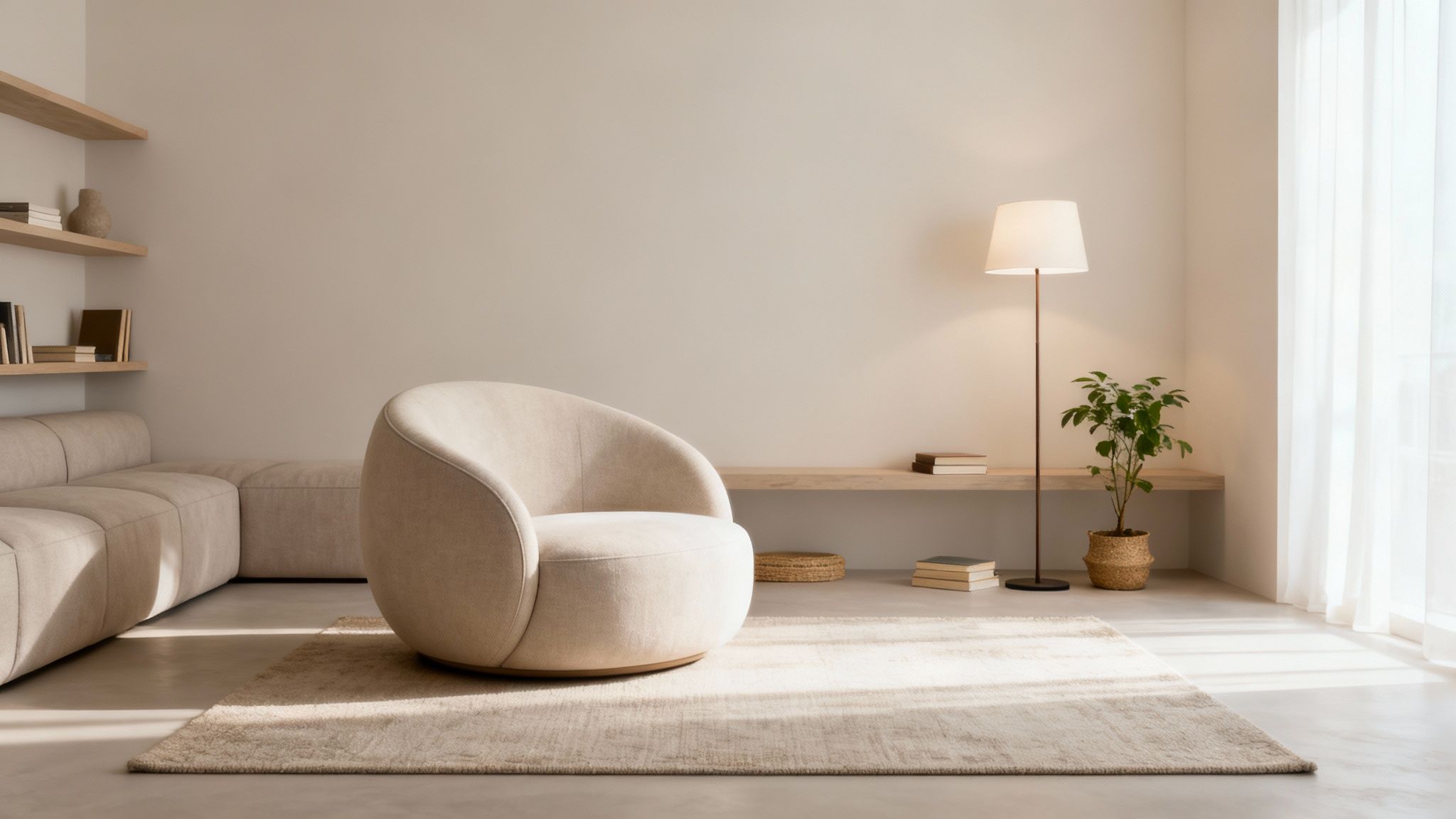
The reason this shape keeps showing up is not just that curves look softer. In interiors, rounded furniture can reduce the visual dominance of hard edges and create smoother movement lines through a room, an effect discussed by the Interaction Design Foundation in its design principles on curvature and visual flow. Ergonomically, wraparound seating can also feel more supportive for reading or short lounging because the back and arms create a contained sitting posture, though comfort still depends heavily on seat height, depth, and cushion firmness; the British Institute of Interior Design's room planning advice and Herman Miller's seating guidance both underline that proportions matter more than style labels.
What the Shape Does Well
The best round chairs earn their keep in three ways:
-
They create a conversation-friendly seat. Because the chair is not visually directional in the same way as a square armchair, it can soften a seating group and feel less confrontational in smaller arrangements.
-
They offer strong usable width. Many models feel roomier across the seat than they first appear, especially cuddle-chair styles that let one person tuck up a leg or sit diagonally.
-
They work as a focal point. Curved silhouettes stand out quickly, which is why they are often used in bedrooms, lounges, salons, and larger living rooms.
I find buyers either love or regret the shape: if you want one seat to visually soften a room and feel a bit special, a round chair can outperform a plain armchair. If you just need practical daily seating beside a sofa, the same chair can feel oversized for the job.
Where the Tradeoffs Show Up
The compromises are predictable once you look past the styling.
-
Footprint versus seat width: a rounded shell can take up more floor area than a squared-off chair with similar internal seat space.
-
Corner use: some compact barrel forms tuck into corners well, but oversized circular models often waste corner depth because the back curve leaves dead space behind them.
-
Access and egress: deep wraparound designs can be brilliant for lounging and slightly awkward for older adults or anyone who prefers a higher, easier perch.
-
Daily-use reality: statement models often prioritise silhouette over all-day support. A chair can look luxurious and still be too low, too deep, or too reclined for long evening use.
For maintenance, curved upholstery also exposes wear differently. The front edge, outer arc, and arm transitions are all visible from more angles than they are on a boxy chair, so covers and easy-clean fabrics matter more here than they do on a standard occasional seat. If upkeep is part of your decision, there's more from Atticus Cleaning Services on why professional upholstery cleaning can extend the life of heavily used furniture.
Best Use Cases
A round chair tends to work best when you want one of these outcomes:
-
a reading or bedroom chair that feels enveloping
-
a flexible perch in an open-plan room, especially with a swivel base
-
a statement seat in a bay window or awkward alcove
-
an oversized lounge chair for one person rather than formal two-person seating
It works less well when your main priority is maximum seating capacity per square metre, very crisp corner placement, or an upright seat that's easy for everyone in the household to use.
What Is a Circular Chair Called?
There isn't one perfect furniture term, which is why product pages can be confusing. A circular chair may be called a round sofa chair, cuddle chair, snuggler, barrel chair, tub chair, swivel chair, or occasionally a love chair sofa when it's wide enough for two people or sold as a compact loveseat alternative.
Here is the plain-English difference:
-
Circular chair / round chair: broad descriptive terms for a chair with a curved footprint or rounded seat.
-
Cuddle chair / snuggler: usually a wider, deeper chair designed for lounging; often closer to a small loveseat in feel.
-
Barrel chair / tub chair: more upright styles where the back curves around into the arms.
-
Swivel chair: describes the base, not the shape; it may be round, barrel-shaped, or only lightly curved.
-
Love chair sofa: a marketing term sometimes used for an oversized single seat or a very compact two-seater.
You may also see retailer-specific names such as "Lucy chair" or "circular cushion chair." Those are usually branding shortcuts rather than technical categories. When I compare listings, I ignore the headline and go straight to four facts: outside width, inside seat width, back height, and whether the base swivels. Those tell you more than the product name ever will.
Solving Space and Style Challenges in UK Homes
In UK homes, the question is not whether a round chair is stylish. It is whether the diameter, clearance, and traffic path make sense in rooms that are often narrower than the inspiration photos suggest. This is especially relevant in flats, terraces, and open-plan living spaces, where one badly placed chair can interrupt movement across the whole room.
The broad claim that curved furniture always saves space is not reliable. Sometimes it does the opposite. A rounded shell can make a room look softer while still consuming more circulation area than a compact square chair. The House of Commons Library's housing statistics and planning guidance referenced by the UK government's National Design Guide both reinforce the same practical point: in smaller homes, efficient use of floor area matters because circulation and usability are inseparable.
A Simple Room-Planning Framework
Use this five-part check before you buy:
-
Room size: measure the usable floor area after accounting for radiators, door swings, media units, and sideboards.
-
Chair diameter or outside width: use the widest point, not the cushion width.
-
Traffic path: protect the route people walk, especially between doors, sofas, and dining or kitchen zones.
-
Nearby table spacing: allow enough reach and knee clearance so a side table is useful rather than cramped.
-
Ideal use case: decide whether the chair is for reading, TV watching, occasional guests, or filling a visual gap.
As a working rule, I would want roughly 60-75 cm of circulation clearance on the main walking side of the chair and around 35-45 cm between the chair and a side table or coffee table edge. Those figures align with common residential planning guidance used by interior designers and furniture planners, including recommendations discussed by the Designer Society of America on furniture spacing and practical room-layout standards summarised by RIBA's home design resources. If you cannot maintain that walkway, the chair is probably too large or wrongly positioned.
Where a Round Chair Works Best
Bay windows: A rounded chair often sits more naturally in a bay than a square armchair because the curve echoes the architecture. Keep enough space to access curtains or blinds and avoid pushing the back hard against the window if condensation is a problem.
Corners: Compact tub and barrel styles can work well here. Oversized cuddle chairs usually need more breathing room, otherwise the back curve leaves a wedge of wasted space behind the frame.
Open-plan rooms: A swivel version often earns the premium. If the chair needs to relate to the sofa, TV, and kitchen in the same day, rotation improves usability without forcing you to drag furniture across the floor.
Bedroom seating zones: A round chair can make sense at the end of a circulation route or beside a window, especially when you want a softer silhouette than a bench or accent armchair.
I have the least patience for giant circular chairs in narrow living rooms with one main walkway. They can photograph beautifully and still become the object everyone sidesteps daily.
When a Swivel Version Is Better
Choose a swivel base when:
-
the chair sits between two functional zones
-
you expect to alternate between conversation and screen viewing
-
the room has a view worth turning toward
-
the chair is deep enough that re-angling the whole piece would be annoying
Choose a fixed base when:
-
the chair will stay anchored in one reading corner
-
the room is small enough that rotational clearance offers no real benefit
-
cover fit matters more than movement, since fixed shapes are usually simpler to fit cleanly
Small-Room Reality Check
Before committing, tape the chair's footprint on the floor. Then walk the room as you normally would: entering, sitting, opening storage, reaching tables, and passing other people. I still think this is the quickest test because floor plans lie less than product photography. If the taped outline forces you to pivot awkwardly or clip a coffee table, the chair is telling you no.
Ultimately, a round chair can be excellent in UK homes when it is selected by measurement rather than mood board. For more inspiration on maximising your layout, you might be interested in our guide on choosing furniture for small spaces.
Choosing the Right Fabric for Your Lifestyle
The fabric on a round chair does more than change the colour. It affects how warm the seat feels, how easily a cover follows curved lines, whether pet claws snag the surface, and how soft or bulky the chair reads from across the room. On rounded furniture, that visual effect is stronger than on straight-edged pieces because the entire silhouette is one continuous form.
Instead of starting with sales terms, start with the household.
Pets
For homes with cats or dogs, the safest route is usually a tight-weave, washable fabric or a fitted stretch cover with enough tension to avoid loose ridges.
-
Best traits: snag resistance, easy spot cleaning, low lint retention, and a snug fit over curved arms.
-
Watch for: boucle, open weaves, and some velvets that show claw tracks or trap fur.
-
Comfort tradeoff: smoother fabrics can feel slightly less plush, but they are easier to maintain.
The Good Housekeeping Institute's fabric testing advice consistently favours tighter weaves and easy-clean surfaces for pet-heavy homes. In my experience, curved chairs punish loose covers faster because pets tend to jump onto the same rounded front edge repeatedly.
Kids
If the chair will deal with drinks, snacks, crayons, and frequent climbing, prioritise washability and spill resistance.
-
Best traits: removable cover, waterproof or water-resistant barrier, mid-weight fabric that does not feel plasticky, and good seam recovery after washing.
-
Watch for: pale delicate fabrics in high-use family rooms and heat-retentive plush finishes that become uncomfortable in warmer months.
-
Visual effect: practical fabrics can still suit a rounded silhouette if the fit is smooth; bunching makes even a nice chair look tired.
Waterproof covers earn their place. Performance upholstery standards from the Association for Contract Textiles and general fibre-care guidance from the Textile Institute recommend assessing abrasion resistance, cleanability, and stain response rather than relying on the word "family-friendly" alone.
Formal Lounge
For a lower-traffic sitting room, fabric can do more aesthetic work.
-
Velvet: visually rich, warm to the touch, flattering on curved silhouettes because it emphasises the sculptural shape.
-
Jacquard: adds pattern and depth, helpful if you want the chair to read as a decorative feature rather than a plain block of colour.
-
Watch for: pile marks, directional shading, and more careful cleaning requirements.
A formal room is where plush finishes make the most sense, but they are less forgiving under constant use. I like velvet on rounded chairs when the piece is occasional seating; on an every-night TV chair, it can start to show wear paths quickly.
Rental Property
Landlords need reset speed more than fabric romance.
-
Best traits: neutral colour, machine-washable cover, quick drying, and enough stretch to refit cleanly after cleaning.
-
Watch for: fabrics that hold odour, show every pressure mark, or require specialist care between tenancies.
-
Best visual strategy: choose texture lightly, not heavily; too much texture can make replacement panels or covers harder to match later.
For practical furniture refreshes between tenancies, removable covers are often easier to manage than deep upholstery cleaning alone, though both may be useful depending on condition.
Low-Light and High-Sun Rooms
Light changes how fabric behaves visually.
-
Low-light rooms: textured jacquards and matte finishes can stop the chair from looking flat, but dark plush fabrics may swallow detail.
-
High-sun rooms: lighter colours show less fading unevenness, and tighter weaves usually cope better than delicate decorative fabrics placed in direct sun.
-
Heat factor: velvet and heavier plush fabrics often feel warmer; smoother blends and lighter weaves feel easier in sunny conservatory-style spaces.
UV exposure is a real issue for upholstery near windows, and the National Institute of Standards and Technology's materials guidance and general fade-prevention advice from major textile care bodies both support limiting prolonged direct sunlight where possible.
Which Fabric Types Tend to Work Best on Curved Chairs?
For rounded frames, these are the usual tradeoffs:
-
Spandex blend or high-stretch knit: best for cover fit, smooths curves well, low wrinkling, easy installation; less luxurious in feel than premium upholstery fabrics.
-
Waterproof performance fabric: strongest practical choice for family use, often slightly heavier, can retain more heat depending on backing.
-
Jacquard: decorative and forgiving of minor wear, but some patterns fight the chair's shape if the fit is not tight.
-
Velvet or plush pile: beautiful on statement chairs, soft and warm, but higher maintenance and more likely to show pressure shading.
Editorial Note
After looking at customer feedback patterns on curved seating, I keep coming back to the same conclusion: high-stretch, mid-weight fabric is usually the safest cover choice for a round chair. It follows the back curve better, creates fewer tension lines around the arms, and is less likely to twist oddly on asymmetrical cuddle-chair shapes than thicker decorative fabrics.
Understanding what different materials can do is key. To help you make the best decision for your home, check out our detailed guide on how to choose the best fabric for your sofa.
Cover Fabric Suitability Guide
This table breaks down how our primary fabric types stack up, helping you find the perfect fit for your home and lifestyle.
| Fabric Type | Best For | Key Features | Audience Match |
|---|---|---|---|
| Spandex Blend | Achieving a sleek, custom-like fit on curves | High elasticity, wrinkle-resistant, smooth finish | Anyone wanting a modern, seamless look for their chair. |
| Waterproof | Homes with kids, pets, or frequent guests | Repels liquid spills, easy to clean, soft texture | Families, pet owners, and landlords seeking durability. |
| Jacquard Texture | Adding decorative flair and hiding wear | Woven patterns, durable, rich texture | Style-conscious homeowners and seasonal decorators. |
| Plush Velvet | Creating a luxurious, cosy feel | Ultra-soft, elegant sheen, comfortable and warm | Individuals looking to add a touch of sophisticated comfort. |
How to Measure Your Round Chair for a Perfect Fit
Measuring a curved chair is straightforward once you stop treating all round styles as the same shape. A low accent tub chair, an oversized cuddle chair, and a swivel lounge chair can all look "round" while needing different dimensions to avoid a poor cover fit. The biggest mistake I see is people measuring only the cushion because that feels intuitive; covers fit the frame, not just the softest part.
The Measurements That Matter Most
Take these dimensions with a flexible tape measure:
- Widest outside width – Measure the broadest point from outer arm or outer side to outer arm or outer side. This is usually the most important number for selecting size.
- Inside seat width – Measure the usable seat area between the inner arms or inner side bolsters. This tells you whether the chair is a compact barrel style or an oversized cuddle seat.
- Back height – Measure from the floor to the highest point of the back. For low-profile accent chairs, this helps you avoid a cover that sits too loosely above the shoulder line.
- Arm height – Measure from floor to the top of the arm at its highest point. Rounded arms vary more than buyers expect.
- Seat depth – Measure from the front edge of the seat to where the back cushion or inner back begins.
- Base shape – Note whether the chair has a skirted base, exposed legs, plinth base, or swivel pedestal. This affects where elastic hems and securing straps can sit.
How to Measure Different Round Chair Types
Swivel bases: Measure the upholstered body separately from the base if the cover is only meant to wrap the seat shell. If the swivel pedestal flares outward, note its widest diameter too. Ignoring the base is one of the fastest ways to order a cover that rides up.
Loose seat cushions: Remove the cushion if possible and measure both the frame and the cushion. Some covers are designed to wrap over everything; others sit better when the cushion is refitted on top.
Wraparound backs: Follow the full outer curve across the back rather than taking a straight shortcut through space. A deep curved back often needs more fabric than buyers expect.
Low-profile accent chairs: Pay close attention to arm height and back height. Covers made for taller lounge chairs can bunch badly on low sculptural seats.
Oversized cuddle chairs: Record both the outside width and the inside seat width. These chairs often have broad outer arms and a deceptively large internal sitting area, so one number alone does not tell the fit story.
Manufacturer sizing guides vary, but upholstery measuring conventions broadly prioritise outside width, overall height, seat dimensions, and arm profile, which is consistent with general guidance from SofaSaxon's upholstery measuring notes and other furniture-fit references. Our stretchy fabrics give some tolerance, but rounded forms still punish vague measuring.
Your Step-by-Step Measuring Guide
To get that snug and secure fit, work in this order:
- Start with overall height from floor to highest back point.
- Measure widest outside width across the chair's broadest point.
- Measure inside seat width and seat depth.
- Measure arm height if the chair has pronounced arms.
- Check the rear curve and base shape before choosing size.
If your chair sits between sizes, I generally lean toward the size that comfortably covers the outer frame dimensions rather than the tighter option. Stretch fabric can recover from slight excess; it cannot invent width where none exists.
Common Measuring Mistakes That Cause Poor Fit
- Measuring cushion width instead of frame width
- Ignoring the chair's rear curve
- Forgetting to account for a swivel pedestal or plinth base
- Measuring only the front view and not the deepest side profile
- Assuming all rounded chairs are symmetrical when many are not
Effortless Installation for a Flawless Finish
When your new cover arrives, putting it on is straightforward and really satisfying. We've designed them to be easy to use, so you can refresh your chair in minutes.
First, drape the cover over your round sofa chair, making sure the tag is at the back. Gently pull the fabric down and around the chair, smoothing it over the arms, back, and seat. The elasticated hem should tuck neatly underneath the base, holding everything in place.
The secret to a truly seamless look is all in the details. Use the included foam inserts to tuck any extra fabric deep into the crevices between the seat cushions and the chair's frame. This anchors the cover, stops it from shifting, and creates a crisp, tailored appearance.
This simple tucking process makes all the difference. It gets rid of wrinkles and ensures the cover stays put, even with daily use. For an extra layer of security, our covers also come with under-sofa clips that provide a really firm hold.
The whole journey, from measuring to fitting, is a simple DIY project that delivers seriously impressive results. For detailed instructions on different furniture types, see how to measure your sofa.
This process flowchart shows the key steps to consider when choosing the perfect cover for your lifestyle, material preferences, and functional needs.
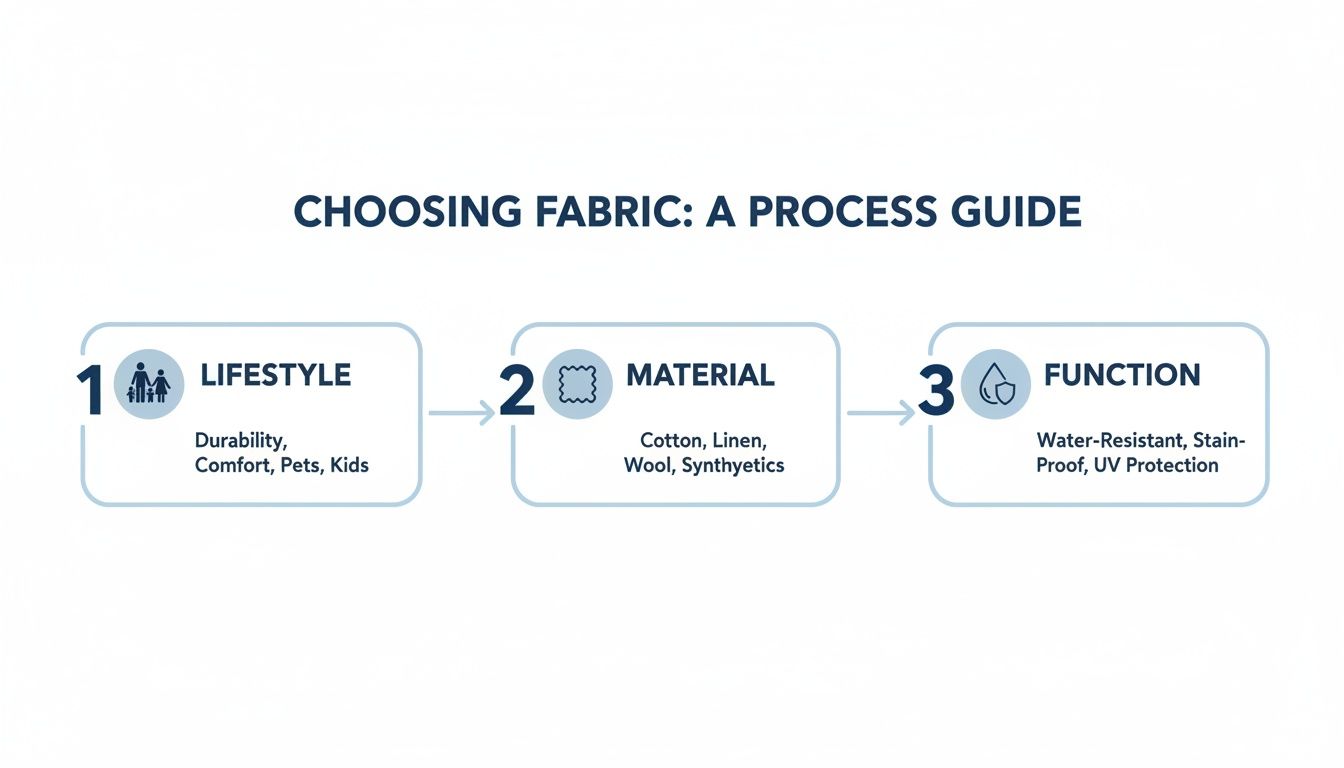
This visual guide highlights that the best choice balances daily life demands with material feel and specific features like waterproofing.
Styling Your Chair for Different Looks and Seasons
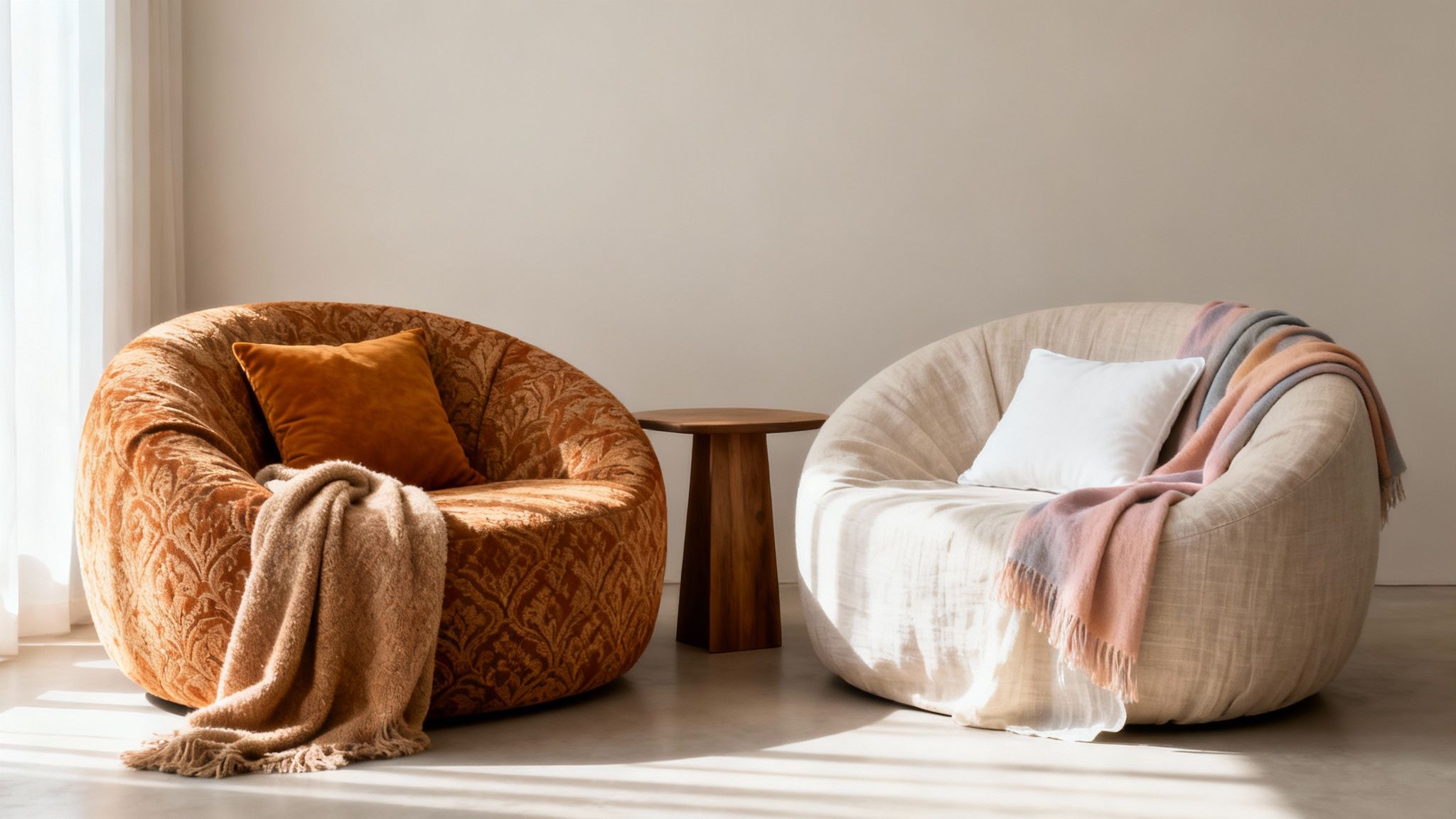
A round sofa chair is so much more than just a place to sit; it's a canvas for your creativity. With the right styling, this one piece of furniture can adapt to different needs, moods, and even the changing seasons. The secret is to treat it as a dynamic part of your decor, one you can easily transform with a simple cover change, a few cushions, or a well-chosen throw.
The Family-Proof Cosy Corner
In a busy family home, a round sofa chair often becomes the most fought-over spot for story time, movie nights, and quiet moments. The styling challenge here is to create a look that is both inviting and highly resilient. Durable, washable covers are not just an option; they are a necessity.
- Choose a Robust Cover: Go for a high-quality waterproof or jacquard cover. These materials are designed to handle spills and constant use while still feeling soft and comfortable.
- Layer with Washable Throws: Add a soft, machine-washable throw blanket. It adds an extra layer of cosiness and can be chucked in the wash after a sticky-fingered snack session.
- Use Tough Cushions: Pick cushion covers made from hard-wearing fabrics like canvas or a thick cotton blend. They'll stand up to being used as pillows, forts, and everything in between.
This approach creates a designated "cosy corner" that feels welcoming without causing you any stress. It's a space where life can happen, and you don't have to worry about permanent stains or damage.
The Landlord’s Secret Weapon
For landlords and property managers, a round sofa chair is a fantastic asset that can make a rental property feel more premium and inviting. Of course, protecting that investment from tenant wear and tear is important. An easily swappable cover is the perfect solution, acting as both a shield and a styling tool.
A fresh, clean sofa cover can instantly make a rental property feel brand new between tenancies. It’s one of the most cost-effective ways to refresh a room, protect your furniture, and attract high-quality tenants.
By keeping a few different coloured covers on hand, you can quickly update the look of the property to appeal to new viewers. A neutral grey or beige provides an elegant, blank canvas, while a subtle colour can add a memorable touch of personality. This simple swap protects the original upholstery and ensures the chair remains a desirable feature for years to come.
The Seasonal Decorator’s Dream
If you love to refresh your home’s decor as the seasons change, a round sofa chair is your best friend. Its prominent, sculptural shape means that even a small change can have a massive impact on the entire room's atmosphere. A slipcover lets you embrace seasonal trends without having to commit to expensive new furniture.
Here’s a simple seasonal styling plan:
- Autumn/Winter: Switch to a cover in a warm, rich colour like deep green, burgundy, or a textured charcoal grey. A jacquard fabric adds wonderful depth. Layer it with plush velvet cushions and a chunky knit throw for the ultimate cosy vibe.
- Spring/Summer: Swap to a cover in a light, airy colour—think soft blues, pale greens, or a crisp off-white. A smooth spandex blend fabric feels fresh and clean. Pair it with botanical-print cushions and a lightweight linen or cotton throw to complete the look.
This simple act of changing the cover, along with a few accessories, completely transforms the mood of your living space. For more great ideas on how to enhance comfort and style, check out this definitive guide on choosing cushions for sofas. It’s an easy and affordable way to keep your home feeling current and beautifully styled all year round.
Simple Care for a Long-Lasting Fresh Look
One of the best things about using a high-quality cover for your round sofa chair is just how wonderfully simple it is to look after. Keeping your furniture looking fresh and inviting doesn't have to be another chore on your to-do list. With a few straightforward habits, you can make sure your cover looks fantastic for years to come.
This effortless upkeep is a real lifesaver in a busy home. Instead of stressing about every little spill or mark, you can relax, knowing the solution is quick and easy. It turns furniture care from a source of worry into a simple, satisfying task.
Simple Steps for Machine Washing
When it’s time for a proper clean, you’ll be glad to know that most of our covers are designed to be machine washable. A deep refresh is convenient. Following these simple guidelines will protect the fabric's integrity, colour, and stretch, making sure it comes out looking as good as new.
To get the best results, always wash the cover on its own to stop it from snagging or picking up colour from other items.
- Temperature Matters: Wash your cover in cold water, ideally at or below 30°C. Hot water can shrink the fabric or damage the delicate elastic fibres that give you that perfect, snug fit.
- Gentle Detergent is Key: Stick to a mild laundry detergent. It's best to avoid harsh chemicals like bleach or fabric softeners, as these can break down the fabric's protective qualities and mess with its texture and colour.
- Choose a Gentle Cycle: Select the delicate or gentle setting on your washing machine to minimise any stress on the seams and the material itself.
Drying and Spill Management
Proper drying is just as important as washing. To keep the fabric’s shape and elasticity intact, it’s always best to air-dry your cover. Tumble drying, especially on a high heat setting, can cause the material to shrink or weaken over time. Just hang it on a line or over a drying rack until it's completely dry before you pop it back on.
And for those inevitable everyday spills, our waterproof covers offer immediate peace of mind.
The real beauty of a waterproof cover is how quickly you can deal with a mess. Most liquids will just bead up on the surface, giving you a crucial window to simply wipe them away with a damp cloth before they even have a chance to soak through.
This immediate, hassle-free cleanup is ideal for homes with kids or pets. Refitting the cover after a wash is just as simple as putting it on the first time; just stretch it back over your chair, tuck the foam inserts into the crevices, and enjoy your instantly refreshed seating.
Frequently Asked Questions
Thinking about a cover for your round sofa chair but still have a few questions rolling around? You're not alone. Let's run through some of the most common things people ask, so you can choose your cover with total confidence.
Will a Standard Armchair Cover Fit My Round Sofa Chair?
Almost certainly not. Your round sofa chair, especially if it's a cuddle or swivel style, has a unique curved shape that a standard armchair cover just isn't designed for. Trying to force it will likely result in a saggy, awkward mess.
That’s why getting the measurements right is so important. Our stretchy spandex blend covers are forgiving and designed to hug curves beautifully, but you still need the right starting size. Measuring your chair's diameter and height first is the only way to guarantee you get that perfect, close fit you're looking for.
Are the Waterproof Covers Still Soft and Comfortable?
Absolutely. We get it – "waterproof" can sometimes sound like "stiff and plasticky," but that's not the case here. Protection shouldn't mean sacrificing comfort.
Our waterproof covers are made with a special inner layer that stops liquids in their tracks, but the fabric you touch is designed to be soft and inviting. You get complete peace of mind about spills without losing that cosy, sink-in feeling you love about your favourite chair.
The goal is practical elegance. Our waterproof fabrics prove that durable, protective solutions can still be beautifully soft and inviting, making them ideal for busy family homes where comfort is key.
How Do I Stop the Cover from Slipping on a Leather Chair?
This is easily the biggest worry when putting a fabric cover on a smooth leather surface, but it's a solved problem. Our covers tackle this in two smart ways. First, the high-stretch fabric and strong elasticated hem create a naturally snug grip around the base of the chair.
More importantly, every cover comes with free foam inserts. These are your secret weapon. By tucking them deep into the crevices of your chair—like between the seat cushion and the arms or back—you securely anchor the cover in place. This simple step is incredibly effective at stopping any annoying shifting, even on slick leather round sofa chairs.
Ready to give your round sofa chair a stunning and practical makeover? Explore the full collection of stylish, easy-fit covers at The Sofa Cover Crafter and find the perfect match for your home today. Visit us at The Sofa Cover Crafter to browse colours and fabrics.