



You're trying to cook while someone does homework at the table, a guest needs somewhere to sit, and a child has left a sticky cup on the nearest cushion. The right sofa for a kitchen diner isn't the most attractive one. It must divide the room without blocking movement, tolerate food and everyday mess, and remain comfortable enough for meals, work and relaxing.
Key Takeaways Sofas for Kitchen Diners: A Practical Buyer's Guide
- Start compact: A two-seater or banquette-style sofa suits most kitchen diners.
- Choose for hard use: Durability and easy cleaning matter more than in a living room.
- Keep circulation clear: Leave room to move around the cooking and dining area.
For most UK homes, I'd start with a compact two-seater or banquette-style sofa, not a large corner unit. Measure the circulation space first, then choose a tightly woven, washable or wipe-clean finish. The sofa's job is to support the room's routines, not make the kitchen feel like an overcrowded lounge.
Table of Contents
- Key Takeaways Sofas for Kitchen Diners: A Practical Buyer's Guide
- What Counts as a Sofa for a Kitchen Diner
- Why Kitchen Diners Need a Different Kind of Sofa
- How to Measure and Plan the Layout
- Which Sofa Types Work Best in a Kitchen Diner
- What Fabrics and Finishes Work Best for Kitchen-Diner Sofas
- How Sofa Covers Fit and Which Shapes They Suit
- How to Style and Maintain a Family-Proof Kitchen-Diner Sofa
- Frequently Asked Questions About Kitchen Diner Sofas
What Counts as a Sofa for a Kitchen Diner
A kitchen-diner sofa is upholstered seating positioned inside, or directly beside, an open-plan cooking and dining area. That includes compact two-seater settees, banquette benches, corner units, chaise sofas and, where the layout supports it, sofa beds.
The specification is more demanding than for a conventional living-room sofa. A kitchen-diner sofa sits near cooking steam, food spills, hot pans, muddy shoes and busy walkways. People may use it while eating, supervising children, working on a laptop, chatting to the cook or hosting guests. A beautiful but delicate sofa can look out of place within weeks if its fabric and position don't match those routines.
I'd make the decision in this order:
- Size against the room. The sofa must leave clear routes between the kitchen, dining table, doors and storage.
- Fabric against daily use. Choose a surface that can handle grease, crumbs, drinks and repeated cleaning.
- Shape against traffic flow. A chaise or corner sofa can zone a large room, but the same projection can obstruct a compact one.
For landlords and hosts, the commercial furniture guidance from Simply Hospitality is useful background when comparing durability, cleanability and furniture suited to repeated use. Domestic furniture still needs to feel comfortable and homely, but the operating conditions are closer to hospitality than to a rarely used formal sitting room.
The best sofas for kitchen diners therefore balance comfort, resilience and circulation. Style comes after those three tests.
Why Kitchen Diners Need a Different Kind of Sofa
A kitchen-diner sofa now has to perform several jobs. It can be a casual dining perch, a homework seat, a laptop spot and overflow seating when guests arrive. Treating it like a lounge sofa with a table nearby misses the way many households use the room.
A 2024 YouGov survey found that 42% of Britons eat dinner on a sofa or armchair, while 45% eat at a dining table. Among UK adults who eat with household members, 39% do so on sofas and armchairs, and 67% watch something while eating their main evening meal, according to the YouGov survey. The figures don't mean every kitchen diner needs sofa seating, but they do show why formal table-and-chair assumptions no longer describe every eating area.
A separate UK poll reported that 31% of respondents considered the dining room the room their family used least, while 79.4% named the living room as the place where they spent the longest time together, as reported by Property Reporter. The practical conclusion is straightforward. A kitchen-diner sofa must support informal, shared use rather than imitate a rarely occupied formal dining room.
What should change in the specification
A firmer seat usually works better than a deep, sink-in lounge cushion when people are getting up with plates or moving between the table and kitchen. Medium seat depth, supportive foam and arms that don't spread too far into the room are more useful than oversized proportions.
I'd prioritise:
- A manageable seat height, so adults can sit down and stand up without wrestling with a low cushion.
- Firm, shape-retaining cushions, which cope better with repeated sitting and casual dining.
- Low or narrow arms, especially where the sofa sits beside a table or needs to preserve a sightline.
- A resilient cover, because sauce, tea, juice and pet dirt are part of the brief.
- A contained footprint, so the sofa zones the room without becoming another obstacle.
| Requirement | Living-room sofa | Kitchen-diner sofa |
|---|---|---|
| Primary use | Lounging and watching television | Seating, dining, homework and hosting |
| Cushion feel | Deep and soft can work well | Supportive and easier to rise from |
| Arms | Broad arms may be acceptable | Narrow or low arms preserve space |
| Cover | Decorative upholstery may be enough | Washable, removable or wipe-clean is preferable |
| Position | Can occupy a dedicated seating zone | Must protect routes between cooking and dining |
For an existing sofa, Sofa Cover - Velvet - Dark Green - Adaptable & Expandable is described as a dark green velvet cover with an adaptable design, a protective layer and machine-washable fabric. Treat such a cover as a maintenance layer, not permission to ignore the sofa's underlying shape or the room's clearances.
How to Measure and Plan the Layout
A kitchen-diner sofa should occupy no more than roughly two-thirds of the wall it sits against, with at least 80 cm of clear walkway in front and 100 cm between the sofa back and a kitchen or dining area, according to this UK sofa sizing guide. Use those figures as a planning baseline, then test the actual furniture and movement patterns in your home.
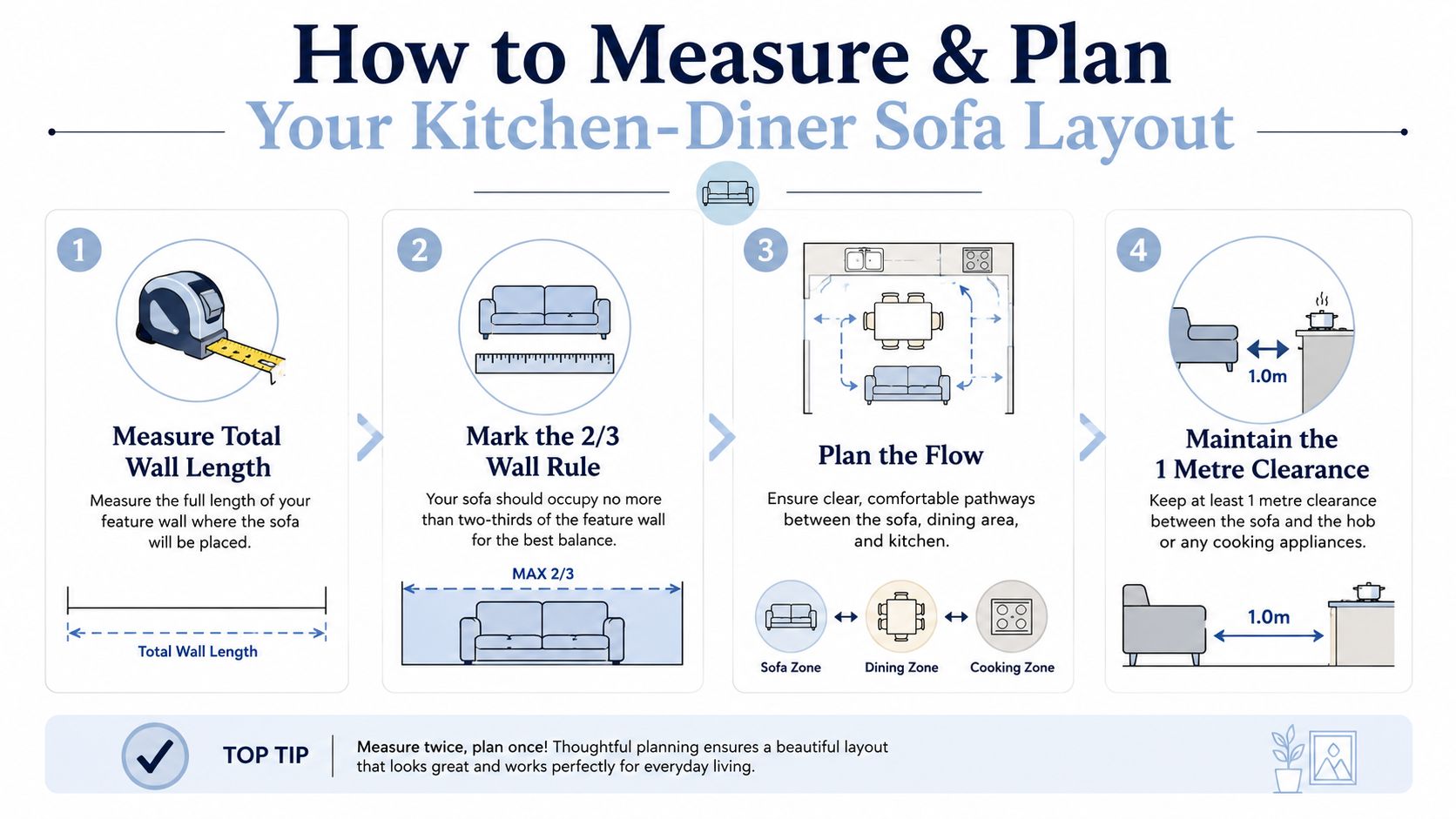
Measure the room in the order people use it
Start with the total wall length, then mark doors, windows, radiators, sockets and fixed kitchen units. Measure the dining table with every chair pulled out, not pushed neatly underneath. A six-seat table measuring 1,800 x 900 mm needs 900 mm behind the chairs on every open side, according to this open-plan kitchen-diner planning guide.
Check appliance and door swing arcs as well. An oven door, dishwasher or tall cupboard can turn an apparently generous gap into a collision point. If the sofa sits near an island, leave a clear route between the seating edge and the island or table. Don't plan from the sofa's nominal width alone. Include arms, feet, cushions and the way people pull chairs back.
A room-planning guide gives a comfortable passing allowance of 90 cm for one person, 100 cm for two people, and 110 cm or more for homes with children, wheelchair users or heavy traffic. It also places most UK living-room sofa depths at 90 to 100 cm, with shallow sofas around 85 to 95 cm and deep sofas around 100 to 115 cm, as outlined in this room-size and sofa-measuring guidance.
Use a floor template before ordering
Mark the proposed sofa footprint with masking tape or sheets of cardboard. Walk from the cooker to the table, open the oven, pull out a dining chair and pass behind the sofa while carrying something. If any route feels awkward with an empty room, it will feel worse once bags, toys and laundry appear.
Your tape-measure checklist should include:
- Room width and wall length, including alcoves.
- Door and appliance swing arcs, especially the oven and dishwasher.
- Dining table footprint, with chairs extended.
- Radiator and window-sill depth, which can limit sofa projection.
- Socket positions, so the sofa doesn't crush plugs or force cables across walkways.
- Cover allowance, because a removable cover can add around 10 to 15 cm to the practical footprint.
For further reference, compare the sofa dimensions for your home with the manufacturer's exact measurements, and use this couch dimensions guide when checking whether a protective cover will alter the fit.
A workable combined kitchen, dining and living space is often described as around 30 to 40 m², while below 25 m² one zone may lose out, according to the renovation guide cited above. Don't treat that as a pass or fail rule. The tape template matters more than a headline room size.
Which Sofa Types Work Best in a Kitchen Diner
For most kitchen diners, I rank banquette seating first, a compact two-seater second, and a corner sofa only when the room has enough width to absorb its projection. Chaise sofas and sofa beds have specific uses, but they create more compromises than many buyers expect.
| Sofa Type | Best For | Footprint | Dining Pairing | Verdict |
|---|---|---|---|---|
| Two-seater settee | Compact or narrow diners | Controlled and easy to place | Works beside a small or medium table | Best general choice |
| Corner sofa | Broad open-plan rooms | Large, with a projecting return | Can serve a generous dining zone | Use only where routes remain open |
| Banquette bench | Table against a wall | Efficient along one side | Excellent for breakfast and family dining | Best zoning solution |
| Chaise sofa | L-shaped rooms with a spare corner | Long projection at one end | Works only if the foot avoids the through-route | Comfortable but layout-sensitive |
| Sofa bed | Guest accommodation or annexe | Heavier and deeper | Poor for everyday dining unless rarely opened | Choose for sleeping, not dining |
Two-seaters and banquettes
A two-seater sofa suits a narrow kitchen diner because its arms and back are easier to keep within the seating zone. It can offer occasional guest seating without taking over the room, and it pairs neatly with a table when one side of the dining arrangement remains open.
A banquette bench is the cleverer option when the table sits against a wall. It anchors the dining area, saves the space needed to pull out chairs on one side and copes well with the breakfast-lunch-supper cycle. Use a wipeable, closely woven upholstery, particularly where children sit or food is likely to fall between the cushion and wall.
Corner and chaise designs
A corner sofa earns its place when the diner stretches beyond 4 m and the kitchen run is short. In a smaller room, the return can consume the walkway, interfere with a high chair and make the kitchen feel cut off from the seating area.
A chaise sofa works in an L-shaped diner if the chaise points into a dead corner. It fails when the foot projects into the main route to the kitchen. Floating cushions, shallow seats and irregular corner sections also make covers harder to fit and give crumbs more places to collect.
Sofa beds
A sofa bed is sensible where the kitchen diner forms part of a permanent guest room or annexe. It isn't the right default for everyday dining. The mechanism adds weight and depth, and the bed must open fully without striking the dining table, island or kitchen units.
Don't buy a shape first and hope the room adapts. Draw the sofa, table, chairs and island together, then check whether the sofa creates a clear boundary or narrows every route.
What Fabrics and Finishes Work Best for Kitchen-Diner Sofas
Fabric matters more than silhouette in a kitchen diner. A modest two-seater in a tightly woven, washable fabric will usually outperform an impressive corner sofa covered in delicate loose linen.
I favour performance weaves, solution-dyed acrylics and treated cottons where the sofa sits close to cooking activity. These fabric families can offer a tighter surface and more practical resistance to everyday marks. Removable, machine-washable covers are the single most useful feature for a family kitchen diner, provided the care label permits the proposed wash programme.
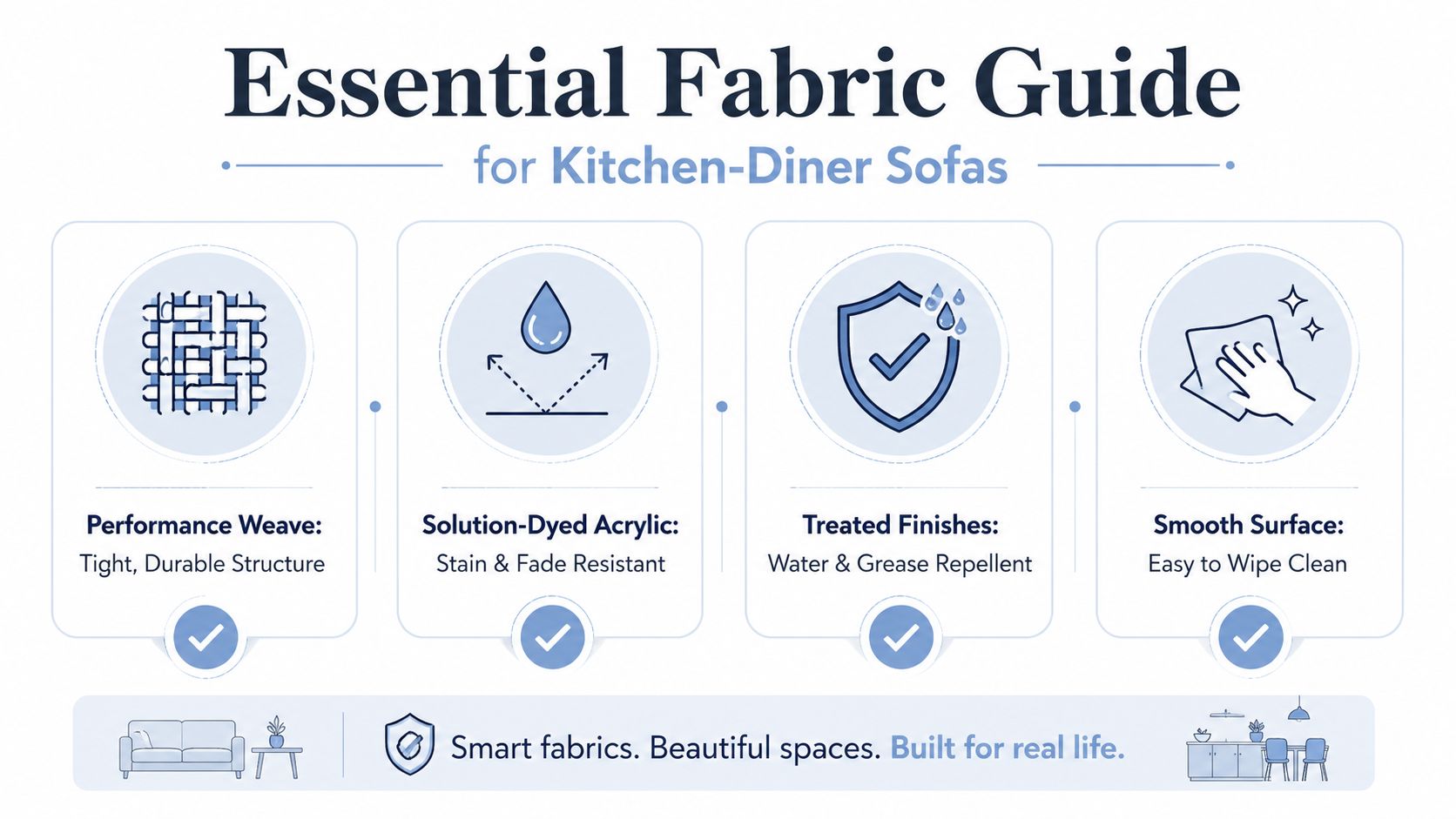
The sensible fabric shortlist
A tightly woven performance fabric has fewer obvious loops for crumbs and claws to catch. A treated finish can help with initial spills, but it doesn't replace prompt cleaning. Solution-dyed acrylics are worth considering where sunlight, pets and frequent use all feature in the room.
Velvet looks refined, but its pile can show marks and directional shading. Loose linen has a relaxed appearance, yet it can crease and absorb spills quickly. Both may suit a low-use sitting area. I wouldn't choose either for the main perch beside a working kitchen unless you're willing to protect and maintain it carefully.
Leather and faux leather are easier to wipe after a spill, though they can feel cold at breakfast and sticky in warm weather. They also show fingerprints and arm marks readily. Choose them for cleaning convenience, not because they're automatically more comfortable or more durable in every household.
Practical rule: If you can't identify how the fabric should be cleaned before buying the sofa, don't place it in the highest-risk part of the room.
Upholstery must also meet UK fire-safety requirements. The Furniture and Furnishings (Fire) (Safety) Regulations 1988 require filling materials to meet ignition tests, upholstery composites to resist cigarettes and covers to be match-resistant, with permanent labelling and supplier compliance records, as explained in the FIRA flammability guide. Check the permanent label before purchase, including on second-hand furniture.
Use this in-store checklist:
- Tight weave: Look for a compact surface with no loose loops.
- Cleaning label: Confirm the exact wash temperature and cycle.
- Removable cover: Check that the main seat and back areas can be removed.
- Finish: Ask whether the fabric has a water or stain-repellent treatment.
- Colour: Mid-tone, dark or patterned upholstery hides everyday tea and food marks better than pristine pale fabric.
- Fire label: Confirm the required permanent label is present.
Many covers are machine washable, but the care label controls the temperature and cycle. Wool, velvet and chenille may need gentler treatment or professional cleaning, according to this UK upholstery-care guidance.
For more help comparing upholstery options, use this guide to the best fabric for a sofa.
How Sofa Covers Fit and Which Shapes They Suit
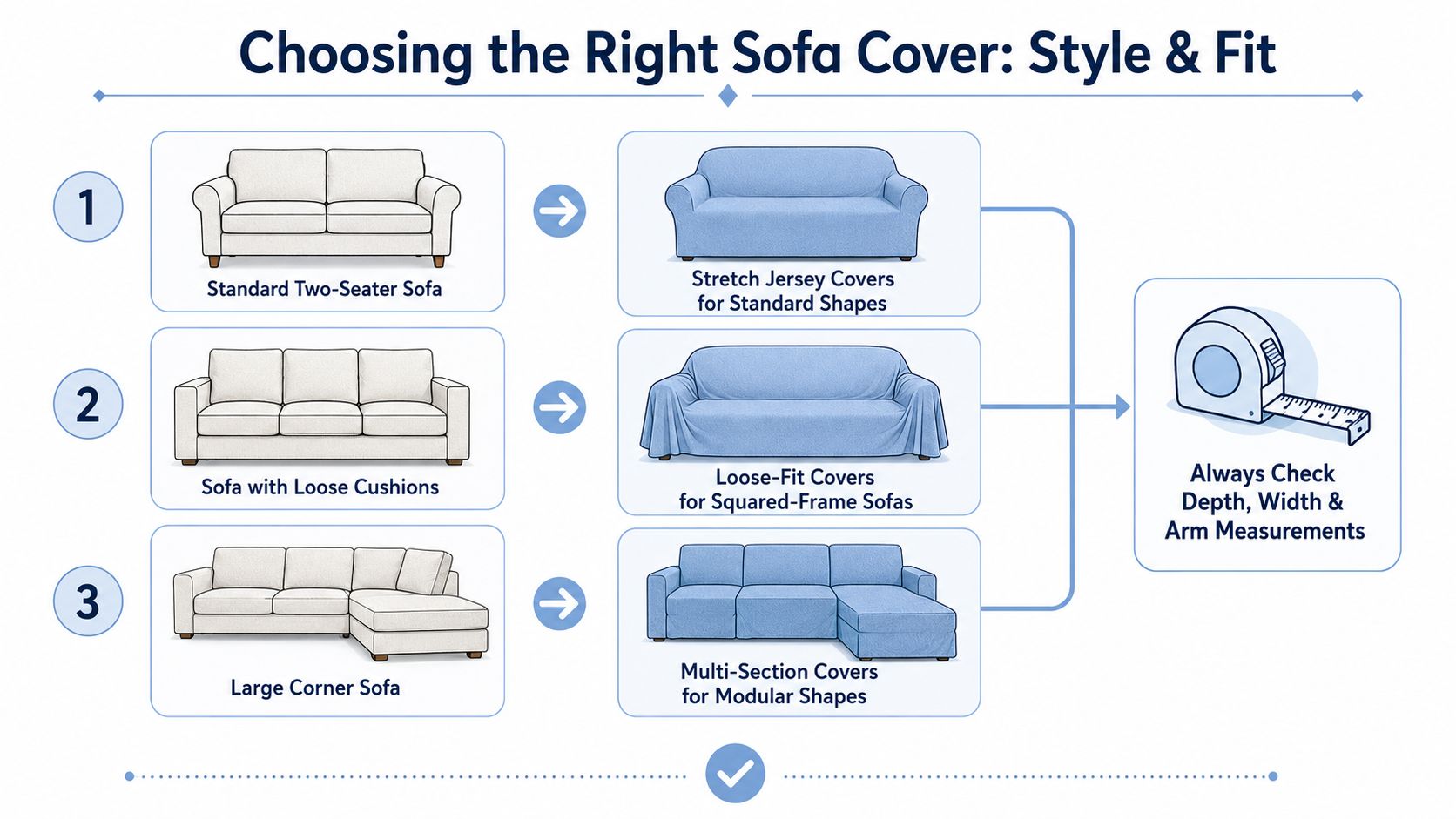
Stretch jersey covers suit standard two-seaters and armchairs with square arms, but they don't reliably fit chaise ends or deep corner units. Cover choice depends on the sofa's measurements, arm profile, cushions and moving parts, not just its advertised seating capacity.
Match the cover to the sofa shape
Stretch covers are forgiving on conventional, fairly symmetrical sofas. They can work well where the arms are square and the cushions follow a standard outline. They are a poor choice for a chaise projection, deep corner return or a sofa with unusual fixed arms.
Loose slipcovers with ties and elasticated hems suit classic frames, skirted sofas and squared shapes. They tolerate thicker fabric and can look intentionally relaxed, but they need anchoring points to stop the material shifting as people sit, eat and stand.
Custom-made covers are the safest route for corner sofas, L-shaped units, sofas with wooden bun arms and sofa beds. A sofa bed needs particular care because the mechanism must fold beneath the fabric. A standard stretch cover may catch, restrict movement or fail to cover the separate sections properly.
Measure before you order
Take the measurements in this sequence:
- Longest width: Measure across the back at its widest point.
- Seat depth: Measure from the front edge of the seat to the back cushion.
- Arm height: Measure from the floor or seat base to the top of each arm.
- Overall height: Measure to the highest point of the back cushion.
- Leg height: Record the gap between the floor and the sofa base.
Photograph the sofa from the front, both sides and the back. Three clear angles can reveal a sloped arm, exposed wooden bun arm, separate chaise section or floating cushion that a measurement list misses.
A corner sofa with floating cushions and shallow seats is one of the worst candidates for a generic one-piece cover. Choose a multi-section or made-to-measure solution instead.
The cover must also work with the room. A loose drape can soften a formal shape, but extra fabric may interfere with dining chairs or collect crumbs at floor level. Check the covered dimensions before ordering, not just the uncovered sofa measurements.
How to Style and Maintain a Family-Proof Kitchen-Diner Sofa
A kitchen-diner sofa needs a care routine that fits around real life. Clean small marks quickly, protect the high-risk seat and keep replacement textiles ready.
Wipe grease, sauce and coffee splashes as soon as you notice them, using the method approved for the fabric. Vacuum weekly with the upholstery attachment, paying attention to the seat gap, arm junctions and the floor beneath the front edge. Each quarter, deep-clean with a fabric-safe product or wash removable covers according to their labels. The guidance on protecting furniture from stains is useful when building that routine.
Make protection part of the styling:
- Use a longer throw: Place it over the seat nearest the hob or dining table.
- Choose washable cushion inners: They make family use less stressful.
- Hide pet wear intelligently: Dark or patterned fabrics work well where animals settle.
- Add a side table: Keep mugs, laptops and plates off the sofa without adding another large piece of furniture.
- Keep the palette practical: A mid-tone sofa can connect the kitchen and living zone without displaying every mark.
Rotate and flip seat cushions monthly, where the sofa design allows it. This spreads wear from habitual dining perches instead of leaving one favourite spot visibly compressed.
Keep a spare cover set in the same fabric if the sofa receives heavy family or guest use. A stained cover can then be removed and replaced mid-week, which is far more practical than taking the sofa out of action while waiting for a single cover to dry.
Frequently Asked Questions About Kitchen Diner Sofas
How close can a kitchen-diner sofa sit to a hob or oven?
A kitchen-diner sofa should stay outside the main cooking and appliance-opening routes, with clear circulation between the sofa, island and dining area. Use a fabric suited to grease and spills, and preserve the planning clearances described earlier rather than relying on a fixed distance from the hob.
Is a two-seater or corner sofa better for a small kitchen diner?
A two-seater sofa is usually better for a small kitchen diner under 3 m by 3 m because it preserves routes and sightlines. A corner sofa is only sensible if its return doesn't obstruct the dining chairs, island or kitchen access.
Can banquette seating replace a sofa in a narrow kitchen diner?
Banquette bench seating can replace a sofa when the table sits against a wall and the room needs efficient dining capacity. It provides a firm, contained perch, but it won't offer the same lounging depth or flexibility as a conventional sofa.
Do sofa covers fit corner sofas and chaise sofas?
Generic stretch sofa covers suit standard two-seaters and three-seaters more reliably than corner sofas or chaise sofas. Corner, L-shaped and sofa-bed configurations usually need multi-section or custom-made covers, with measurements checked before ordering.
Choose the sofa by drawing the room's routes first, then protect the upholstery against the mess your household creates. For washable, practical covers, throws and cushion covers designed for sofas, corner sofas, armchairs and sofa beds, visit The Sofa Cover Crafter and use the fitting guides before you order.
