


Ask whether cotton is the right fibre for a sofa throw and the answer is usually yes. A cotton throw is a light, breathable layer you can lift off, wash and put back without changing the upholstery underneath, which is why it suits warm rooms, homes with pets and anyone who would rather wash a throw than a whole sofa. What decides whether that throw stays in use, though, isn't the word cotton on the label. It's length.
This guide works through the decisions in the order you'll meet them: what a cotton throw does and doesn't do, how to size one against your own sofa, which weave to pick, how to wash it without shrinking it, how it sits over a fitted cover, and how to swap it through the seasons. It's candid about the trade-offs, including the ones that make people stop using a throw they've already bought.
Table of Contents
- Is a Cotton Throw Right for Your Sofa?
- How Long Should a Sofa Throw Be?
- Which Cotton Throw Style Should You Choose?
- How Do You Wash a Cotton Throw Without Shrinking It?
- Can a Cotton Throw Go Over a Sofa Cover?
- How Do You Layer a Throw Through the Seasons?
- What Are the Common Cotton Throw Pitfalls?
- Choose a Light, Washable Throw by Length and Colour
- Frequently Asked Questions
Is a Cotton Throw Right for Your Sofa?
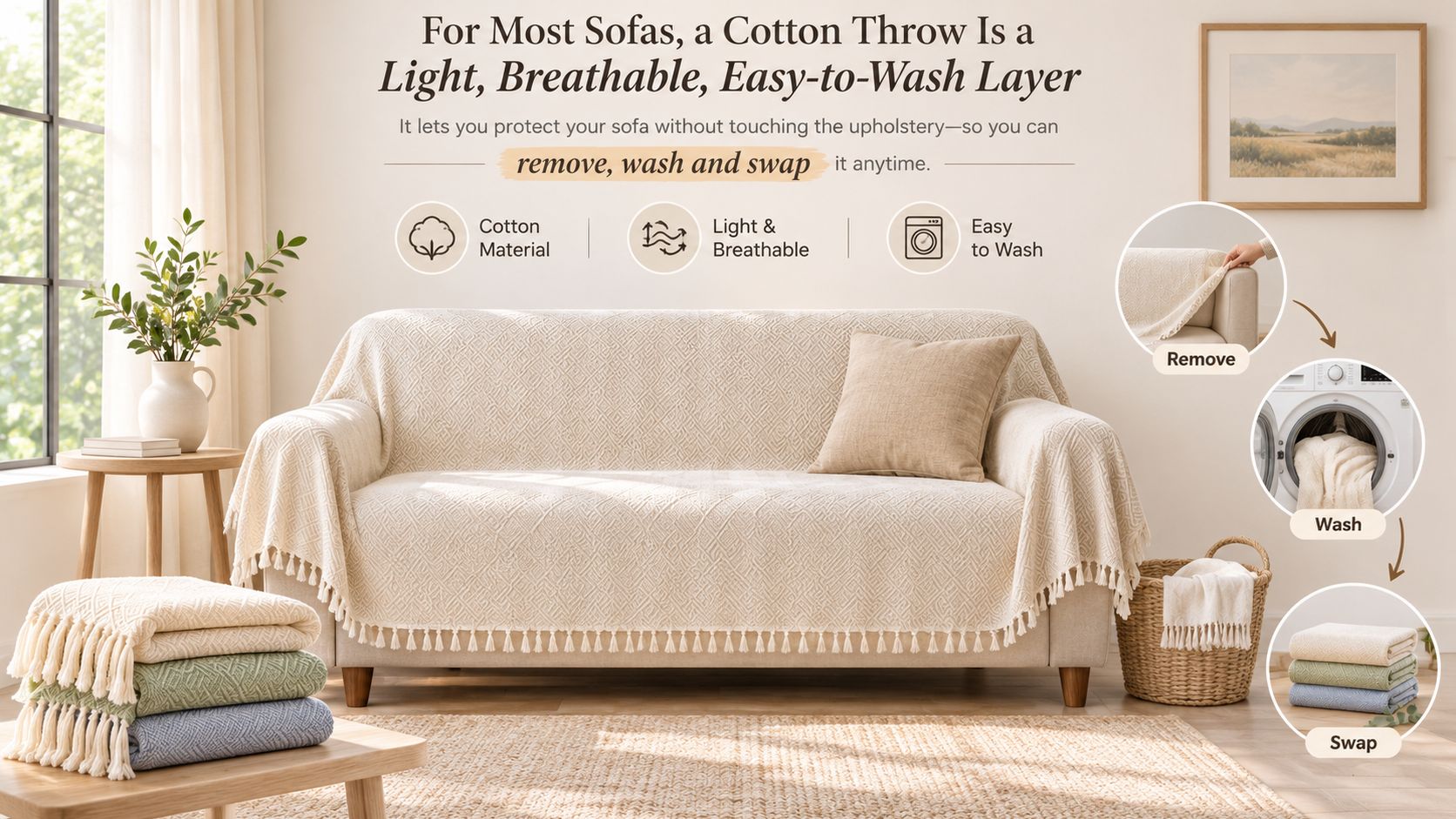
A cotton throw is right for most sofas when you want a light, breathable layer that lifts off, washes and goes back without altering the upholstery, and it's the wrong choice if what you need is a fitted cover that protects every surface and stays exactly where you put it.
People reach for cotton for four reasons. It feels cool against the skin in a warm room, where wool and velvet start to feel heavy. It drapes in a lighter, flatter way, so it softens a hard-edged frame without adding bulk. It goes in a domestic machine, which matters in a house with children or pets. And it takes colour well, so a plain woven throw can carry a seasonal shade without looking like furnishing fabric.
The limits are just as real, and they're the ones people discover a fortnight after buying. A throw is a loose layer. It slides on smooth upholstery and on stretch covers, it rucks up when someone sits down, and it doesn't protect the parts of the sofa it never reaches. A cotton throw is not a fitted cover, and it doesn't replace protection built into the furniture itself.
There's also a supply question worth asking before you add another textile to the house. As WWD reported on WRAP's home-textile findings, the average UK household owned approximately 57 home-textile items, including around eight cushion covers, and 21% of those items had not been used in the past year. The dormant fifth is the interesting number. A throw earns its place by being used and washed, not by joining a pile.
Renters, pet owners, landlords and people who redecorate twice a year each want something different from a cotton throw sofa layer, and those differences show up in sizing, weave and washing routine. If you're still settling the sofa itself, our guide to sofa cover materials explains how the common upholstery fabrics behave in daily use.
How Long Should a Sofa Throw Be?
Length decides more about daily life with a throw than fibre does. A sofa throw needs enough cloth to cover the run of back or arm you want to dress and to drop as far down the sofa as you want it to hang. If you're after a light, easy-wash layer, pick the shortest length that still covers the spot, because a shorter throw is lighter to lift, easier to fold and dries through far faster between washes.
Cotton throw sizes fall into three workable bands, and each band behaves differently in the hand, in the machine and on the drying rack.
| Typical size | Where it suits | Handling | Drying between washes |
|---|---|---|---|
| 130 × 170 cm | Single seats or accent styling | Lightest to lift and fold | Dries through fastest |
| 150 × 200 cm | 2–3 seater sofas | A manageable two-hand lift | Quick to dry through |
| Extra-large | Full coverage or sofa beds | Heaviest and bulkiest to wash | Slowest to dry through |
Use the table as a starting point for placement. Two sofas of the same width can take the same throw differently depending on how deep the seat is, how high the back stands and whether the arms are rolled or square. The drop works like hem length on a curtain: decide where you want the cloth to finish, then measure to that point rather than guessing from the sofa's overall width.
How do you measure a sofa for a throw?
Measure the run you want to cover along the back or arm, measure the drop from the top of the back to your finishing point, then pick the smallest size band that covers both figures.
- Measure the run. Run a tape along the back or arm, edge to edge of the area you want dressed.
- Measure the drop. Hold the tape at the top of the back and let it fall to your finishing point, whether that's the seat or partway down the front.
- Check the surplus. Choose the length that covers both figures without so much spare that it puddles on the floor or bunches behind the seat cushions.
Err toward the shorter length when your figures sit between two bands. Spare cloth adds weight and laundry time without adding useful coverage, and surplus tucked behind cushions is the part of a throw that works loose first.
Corner sofas and recliners need their own approach, because a single rectangular throw can't follow an L-shape or stay clear of a reclining mechanism. Our guide to throws for corner sofas covers where a throw should sit on an L-shaped frame. No size is guaranteed to suit a particular sofa shape, so measure the spot before you buy rather than after.
Which Cotton Throw Style Should You Choose?
Waffle, woven, knitted, muslin and tasselled are the five common cotton throw styles, and the choice between them comes down to how the cloth is built, because the weave decides how light the throw feels, how much texture it adds and how well it survives daily use.
| Style | How it is built | Weight and feel | Best for | Watch for |
|---|---|---|---|---|
| Waffle | Raised honeycomb grid | Light, airy, textured | Warm-weather layers and a casual look | Loose grid can catch on claws |
| Woven | Flat, tightly interlaced threads | Crisp, smooth, light to medium | Neat, tailored look and easy brushing | Creases easily and can look plain |
| Knitted | Looped stitches with slight stretch | Soft, relaxed, medium | Cosy layers and comfort seating | Can pill or stretch out with use |
| Muslin | Loose, open gauze-like weave | Very light and sheer | Airy summer layers | Snags and tears more easily |
| Tasselled | Any base weave with fringed or tasselled edges | Varies with the base weave | Decorative accent and styling | Tassels can catch on claws and tangle in the wash |
What does weave weight mean in practice?
An open weave feels lighter and moves more air, while a tight weave drapes smoothly and brushes clean. The waffle grid holds small pockets of air, which is why it reads warm in winter and still feels light in July. A flat woven cotton sits crisply and lets you shake off pet hair and crumbs in one go, though it creases where it folds and looks plainer than a textured cloth.
Knit is the softest of the group and the one that changes most with use. Looped stitches give it stretch, so it settles into a seat shape, but that same looseness can pill where arms and pets rub it. Muslin is the lightest and the least hardy, so keep it for styling rather than for a sofa that gets sat on all day. Tassels are decoration rather than performance: they finish an edge beautifully and tangle the moment they meet a washing machine drum.
My rule of thumb is simple. For a light, washable layer through the warmer months, start with waffle or woven. For a relaxed, cosy look in a room that's used for lounging, knit or tasselled earns its place.
If you prefer a motif to a plain weave, remember that a pictorial design changes the way a throw reads against cushions and a sofa, so hold it against both before you commit to pattern.
How Do You Wash a Cotton Throw Without Shrinking It?
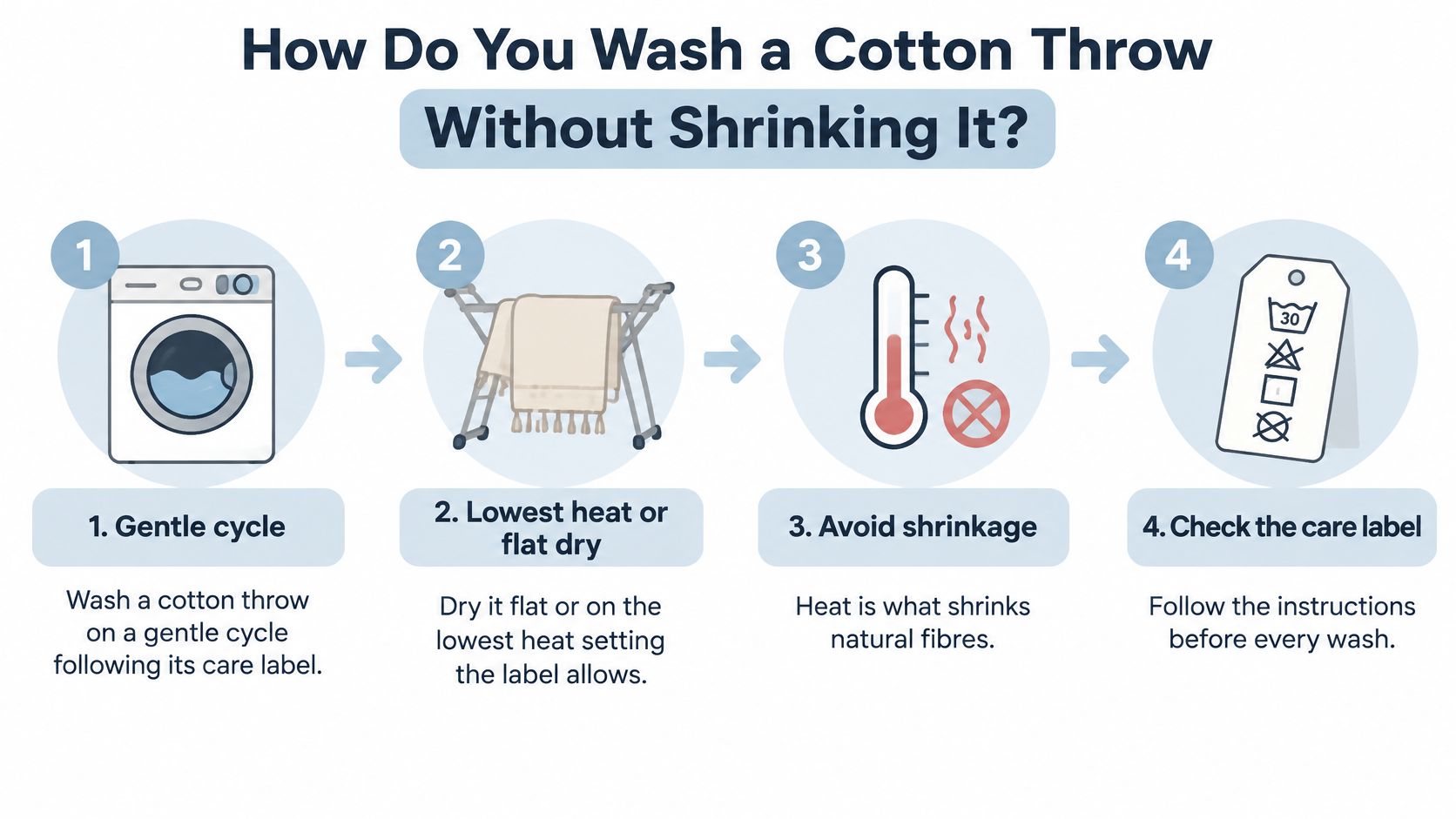
Wash a cotton throw on a gentle cycle following its care label, then dry it flat or on the lowest heat setting the label allows, because heat is what shrinks natural fibres. The label outranks every general rule here, including mine.
- Read the care label before anything else. It tells you what the fibre, the finish and the trims will tolerate, and it's the only instruction written for your specific throw.
- Shake it out outdoors or over a bin. Hair, crumbs and dust lift off dry far more easily than they rinse out wet.
- Treat stains before washing. A little mild detergent worked in and blotted, not scrubbed, gives the cycle a head start and saves a second wash.
- Bag it or wash it alone. A laundry bag keeps a large throw from wrapping around itself and protects tassels and fringed edges from tangling.
- Use a mild detergent and skip bleach unless the label specifically allows it, because bleach weakens cotton fibres over repeat washes.
- Don't overload the drum. A packed machine can't rinse detergent out properly, and residue stiffens the cloth.
- Take it out promptly and reshape by hand. Wet cotton tends to dry in whatever shape it's left in.
- Dry flat or on a rack away from radiators. Direct heat is the usual cause of shrinkage, so use a tumble dryer only on the no-heat or lowest setting the label allows.
- Steam or iron only on the setting the label gives. A cool press through a damp cloth smooths creases with far less risk than a hot iron straight onto the surface.
What should you do when the care label has worn off?
Treat an unlabelled cotton throw as delicate: wash it alone on the gentlest cycle your machine offers, skip the dryer entirely and dry it flat. You're guessing at that point, so take the cautious option and accept a slower turnaround.
Drum space matters as much as the cycle. A 180 × 420 cm throw needs room to move, while a shorter length rinses cleanly in a part-load and comes out far easier to handle. If the throw shares a wash with sofa covers, our guide to washing sofa covers without shrinking them covers the same heat principle for larger pieces.
Can a Cotton Throw Go Over a Sofa Cover?
Yes, a light cotton throw can sit over a fitted sofa cover, provided the throw's colour family and texture work with the cover and the throw lies loose on top of it rather than being tucked into the cover's seams. The throw is the top layer, not a substitute for the cover beneath.
Which colour throw works over a coloured cover?
A tonal cotton throw one or two shades away from the cover keeps a calm, deliberate look, while a deeper or lighter contrast adds depth without competing. The rule that saves most rooms is undertone matching: warm beige with warm beige, cool grey with cool grey. Get that wrong and both layers look muddy, however well each one works alone.
Texture decides whether the pairing sits flat or fights. A smooth cover takes a textured waffle or knit throw happily, because the contrast is doing the work. A slippery or stretch cover needs a grippier knit, or the throw will slide off the moment someone sits down. A heavily textured cover under a chunky knit looks busy, so choose a flatter weave there.
Dressing what's already in the room has a practical edge. WRAP's bulky-waste study, as reported by letsrecycle.com, estimated furniture at about 42% of UK bulky waste and textiles at a further 19%, and found that 32% of bulky items taken to household waste and recycling centres could be reused in their current condition. A throw over a cover is a small version of that habit: refresh the top layer, keep the piece.
Tie the whole sofa together with cushions so the colours repeat rather than sit in one corner. Our pillow covers collection has the tones that pair with a throw without matching it exactly. For the covers themselves, the Heavy Cotton Loose Covers guide explains how a heavier cotton cover behaves under a light layer. When the cover comes off for washing, lift the throw first and set it aside.
How Do You Layer a Throw Through the Seasons?
Layer a throw through the seasons by changing colour and weave rather than furniture: lighter colours and lighter weaves in spring and summer, richer shades in autumn and winter, with the sofa itself kept neutral so the throw and cushions carry the season.

A neutral sofa works like a stage set: it stays put while the costume changes. Cotton earns its place on the warm half of the year because it sits comfortably in the heat, and deeper textures such as faux fur and velour earn theirs once the cold arrives.
A throw and a few cushion covers do the job in five minutes. My swap: in spring, out go velvet and wool, and in come linen and cotton in lighter colours. In autumn, reverse it and bring in rust, mustard and deep green. Keep the sofa itself neutral and let the throw and cushions carry the season.
That routine works with whatever throws and cushion covers are already in the cupboard. Fibre is the flexible part; length is the lever that decides how easy the habit stays. The summer throw is the one washed most often, since it sits against bare arms through the warm months, so keep that layer short. A shorter throw is lighter to carry to the machine and dries through far faster between washes than a full-length one.
For summer colours and lighter weaves, the guide to lightweight summer sofa throws covers that side in more detail.
Styling matters as much as colour. Most rooms want one of each look: a relaxed drape on the seating where people sit, and something neater folded over the back.
A throw thrown loosely over one corner looks like someone lives there. One folded into a perfect square looks like a hotel.
When the autumn swap happens, carry it into the rest of the room too, because a throw alone will not carry a colour change if the cushions and rug stay in summer mode.
What Are the Common Cotton Throw Pitfalls?
The three pitfalls worth knowing are treating a loose cotton throw as a compliant permanent upholstery cover, choosing a length too large to wash and dry often, and buying a throw that slides off a smooth or stretch cover because nothing grips it.
The first one matters most for landlords and short-term rental hosts. Under the Furniture and Furnishings (Fire) (Safety) Regulations 1988, a cover supplied with furniture generally has to pass the relevant match test, and the exception for cotton-type fibres applies only where the textile holds at least 75% cotton, flax, viscose, modal, silk or wool and the furniture has a compliant fire-resistant interliner. Fibre content alone doesn't demonstrate fire compliance, so a loose throw laid over existing upholstery is not evidence that anything meets the standard.
UK fire-safety guidance for upholstered furniture lists four requirements: filling materials that meet specified ignition standards, upholstery composites that resist cigarettes, covers that resist matches or use an approved interliner, and a permanent label (Bromley Council's fire-safety leaflet). That label should be durable, firmly attached to an external surface and present on loose and stretch furniture covers, though it can be combined with a care label. Never treat an uncertified throw as a substitute for regulated upholstery.
Length is the second trap. A throw sized for the whole back of a long sofa gets washed rarely, because lifting and drying it is a job rather than a habit. Pet owners have a different risk: claws snag loose waffle grids and muslin, and hair clings to textured surfaces, so a tighter weave that brushes clean earns its keep. Renters should check the tenancy terms before relying on a throw for protection, since a removable layer may not satisfy an agreement that names the furniture's condition.
Choose a Light, Washable Throw by Length and Colour
Length, not fibre, is the lever that decides how often a throw gets washed. A large throw works like a bath towel: the bigger it is, the heavier it comes out of the machine and the longer it sits on the airer. We have no cotton range and don't list our throws by fibre, but all of them lift off for washing, but a short length goes in the machine on a whim while an extra-large one turns into a Saturday job.
Every one of our sofa throws comes in four sizes: 180 × 130 cm, 180 × 230 cm, 180 × 300 cm and 180 × 420 cm. The shorter sizes are lighter to handle and dry right through between washes far faster, while the longer ones are the choice for full coverage or a sofa bed, where the smaller sizes run out of cloth. The decision is mostly about coverage and washing habits.
| Range | Colourways |
|---|---|
| Mousoon Sofa Throw | Milk Tea, Off-White |
| Elligate Sofa Throw | Khaki, Off-White |
| Coveri Sofa Throw | Caramel, Khaki, Green Tea |
| Norka Sofa Throw | Espresso Brown |
| Soft Tassel Sofa Throw | Sandy Tan, Dusty Grey, Pistachio Green |
The Mousoon Sofa Throw in Milk Tea accounts for 428 units, 10% of the units ordered in the Sofa Throw type, and it shows why neutrals work so well: a warm beige accepts cushions in either direction, so you can restyle the seating area without replacing the throw. Strong greens and browns anchor a scheme instead, which suits a room where the cushions stay fixed.
A throw is a removable layer that helps with pet hair and claws, food and drink spills, fading from sunlight and everyday wear. It doesn't extend a sofa's life, and it won't cover the parts of the sofa it never touches.
Because colour, dimensions, drape and feel can't be judged properly before delivery, the returns rule matters. Under GOV.UK's guidance on accepting returns and giving refunds, UK online buyers normally have 14 days from receiving goods to tell the seller they want to cancel, then another 14 days to send the goods back, with a refund within 14 days of the seller receiving the item and the standard delivery charge generally refunded too.
Work through four checks before ordering. Length, compared against the run and drop you measured. Colour, held against both the sofa and the cushions you already own. The care label, since that decides how often the throw can realistically be washed. Storage, because an extra-large throw needs somewhere to live between seasons while a 180 × 130 cm folds into a drawer. Compare the full range in our Sofa Throw collection once those four are settled.
Frequently Asked Questions
How often should you wash a cotton throw on a sofa?
Wash a cotton throw that's used daily every few weeks, and sooner if pets sit on it, people eat on the sofa or someone in the house has allergies. A throw that's lifted off and aired between washes lasts longer between full cycles. Shorter lengths go in the machine more often because they're easy to handle.
Will a cotton throw stay put on a leather sofa?
A cotton throw on a leather sofa will slide unless something holds it, because leather is smooth and most weaves have nothing to grip. Fold the throw over the arm and tuck the end between the seat cushion and the frame, or choose a textured knit rather than a flat woven cotton.
What weight of cotton throw suits year-round use?
No single weight figure makes a cotton throw a year-round one, so judge by how openly the cloth is woven and how it falls when you pick it up. A waffle or loose woven cotton traps a little air and still breathes in warm weather. A dense flat weave reads warmer and heavier, which suits winter better than summer.
If you're refreshing a sofa rather than replacing it, we sell sofa covers, sofa throws and cushion covers that lift off, wash and go back on. Our throws come in four lengths and a small, steady set of colours, so choosing takes minutes once you know the run of sofa you're dressing and how often you want to wash. Visit our Sofa Throw collection to compare lengths and colours side by side.
