


Retailer listings love the phrase "perfect fit," and that promise misleads chesterfield buyers more than anyone. A stretch cover is tensioned fabric: it spans the deep buttoning in a smooth plane and holds only where the tuck grips, worked down into the seat and arm creases. Treat it as a fitted layer with clear limits, and it does the job well.
Table of Contents
- Will a Stretch Cover Fit a Chesterfield Sofa?
- How to Measure a Chesterfield for the Right Cover Size
- Does a Stretch Cover Fit an L-Shaped Chesterfield?
- Which Fabric and Colour Suit a Chesterfield Cover?
- How Do You Stop a Chesterfield Cover From Slipping or Wrinkling?
- Can You Machine-Wash a Chesterfield Sofa Cover?
- Is a Stretch Cover Fire-Safe on a Chesterfield?
- What Should You Check Before Ordering a Chesterfield Cover?
Will a Stretch Cover Fit a Chesterfield Sofa?
A stretch cover pulls across the buttoning, bridges the tufted dips, and sits on the outer roll of each arm. The same cover you'd buy for any straight sofa goes on here. What comes back is a softened version of the original finish.
Fabric under tension takes the shortest path across a surface. Over deep buttoning, the cover spans the dips instead of dropping into them, much like a smooth cloth stretched over a quilted bedspread. It follows the roll of a scroll arm the same way it follows any arm, because it reads the outside curve rather than the detail underneath.
What the Buttoned Surface Looks Like Under a Stretch Cover
You'll see a smooth, softened chesterfield silhouette. The outline stays recognisable: rolled arms, back shape, and the general bulk of the piece all remain. The buttons don't show through, and the tufted pattern disappears under a plain face.
Plenty of buyers expect the buttoning to stay visible under fabric. It won't. If the deep-buttoned look is the whole point of your sofa, a stretch cover works against it. If you want the shape without the buttoned surface, or a different colour over worn upholstery, the trade makes sense.
Deep buttoning does a practical job: it pulls the upholstery down and holds loose stuffing such as horsehair in place inside the frame. A cover laid over the top hides that working detail along with the dips it creates.
What the Cover Can't Reproduce
A stretch sofa cover on a chesterfield won't reproduce crisp piping, fine seams, or sharp button lines. Those details soften or disappear under tension. Judge it as a cover doing its job, since it was never cut for this sofa.
Two things decide whether a stretch sofa cover is even a candidate for your chesterfield:
- Every contact surface is upholstered: The cover needs padded, fabric or leather covered surfaces to grip and tuck against. A bare wooden arm, exposed frame panel, or hard decorative trim gives the fabric nothing to hold onto.
- The sofa falls inside a size band: Width, measured properly across the rolled arms, has to sit within a band on the sizing chart. A seater count alone doesn't settle it, because chesterfield proportions vary far more than the label suggests.
Configuration matters more than shape. A corner, recliner, or sofa-bed chesterfield only takes a stretch cover when the listing states that configuration explicitly. Measure first, check the upholstered surfaces second, and only then think about fabric and colour. I'd treat any seller promising a certain fit on an unmeasured chesterfield with suspicion.
How to Measure a Chesterfield for the Right Cover Size
Measure a chesterfield for a stretch sofa cover across the outside of both rolled arms at the widest point of the roll, with the tape held level, then match that figure to a size band. Scroll arms bulge outwards past the seat, so a reading taken between the arms, or across the seat cushions, understates the fabric the cover needs. A stretch cover is tensioned fabric: it bridges the deep buttoning rather than settling into it, and the tuck at the seat-back junction is what holds it. Measure the frame's outer envelope, and let the tape run point to point without dipping into the hollows between buttons.
The Measuring Steps in Order
- Start at the left arm's widest point: Place the end of the tape on the outside of the left rolled arm where the roll sticks out furthest, and hold the tape level rather than letting it sag or angle down.
- Run it straight to the right arm: Finish on the outside of the right arm at its widest point of roll, and record that outside arm-to-arm width as your sizing figure.
- Match the figure to a band: Find the band your width falls into in the table below, rather than rounding towards the size you expected to buy.
- Take the wider size on an edge figure: If your measurement sits right on a boundary, go up a size, because stretch fabric pulls in but it doesn't let out.
- Check height and depth as well: Record height from the feet to the highest point of the back or arms, and depth from the front edge to the furthest point at the back, including protruding arms and legs.
Our fuller guide to measuring a sofa for a cover walks through the general method, and the chesterfield adjustment is that widest-point-of-the-roll measurement.
| Seater band | Notes |
|---|---|
| 1 seater, 90 to 130 cm | Check depth and height against the cover's guide |
| 2 seater, 135 to 175 cm | A compact frame can still measure wide once both scroll arms are included |
| 3 seater, 180 to 220 cm | Chesterfield widths vary a lot within this band; measure your own sofa |
| 4 seater, 225 to 300 cm | Wide rolled arms can push the outside width up quickly |
| 5 seater, 305 to 360 cm | Offered on the Luma Sofa Cover only |
Why the Seater Label Misleads
Rolled arms, deep buttoning, and cushion thickness move individual chesterfields well away from any typical three-seater figure. Two sofas both sold as three-seaters can need different bands.
An undersized cover has to stretch harder to bridge the same buttoned surface, and that excess tension drags fabric out of the seat-back junction and throws diagonal wrinkles across the seat. A snug guess costs you twice.
Photograph your tape against the arms if you're ordering for a property you don't visit daily. It takes seconds and settles disputes later.
Does a Stretch Cover Fit an L-Shaped Chesterfield?
Start with the listing. If it does not name corner compatibility, treat the cover as straight-sofa only; a one-piece straight cover is tensioned along a single run, and an L-shaped chesterfield asks that same fabric to turn, bridge the buttoning and stay tucked around a corner it was not cut to follow.
A straight-sofa stretch cover therefore cannot be assumed to fit an L-shaped corner sofa. The corner return changes the fabric pattern, seam placement and amount of material required. On a chesterfield the problem is sharper still: the cover is held by tension and tucks rather than fitted seams, so any shortage shows first at the turn, the seat-back junction and the rolled arm ends.
What to Measure Instead
Measure the main wall run and the return wall run separately, then the full depth and the exact corner position. Add the return's projection from the main run, for example the depth from the front edge of the long seat to the front edge of the shorter return, plus how each rolled arm terminates at the outer ends. Record whether the layout is left-hand or right-hand as you face the sofa and match that to the stated configuration.
A candidate needs corner compatibility in plain words, either a named left-hand or right-hand layout or a universal corner configuration expressly confirmed by the manufacturer. Compare every figure to the cover guide before ordering, and expect a stretch cover to smooth and protect the shape rather than reproduce crisp corner tailoring or deep button definition.
Which Fabric and Colour Suit a Chesterfield Cover?
Velvet is the sensible starting point for most chesterfield sofa covers. Its weight lets it drape into the rolled scroll arm rather than float over the curve, and the sheen sits naturally with the heritage shape. Stiff weaves behave differently on that arm: they tent over the roll, and the cover ends up reading as borrowed rather than fitted.
In the range, the Velvet Sofa Cover comes in Brown, Pink, Light Grey, Navy Blue, Orange, Lake Blue, Dark Green, Beige and Grey. The Velvet Sofa Cover in Dark Green shows the effect at its strongest, a deep colour over a traditional silhouette. Treat each product page as the final word on shades.
| Fabric | Best use on a chesterfield | Watch out for |
|---|---|---|
| Velvet (Brown, Light Grey, Beige, Grey, Dark Green and more) | Drapes into the scroll arm and suits the heritage look | Pile shows pressure marks and paw prints; offers no spill protection |
| Heavy jacquard (Jacquard, Diamond Jacquard, Crosshatch) | Busy rooms and pet households | Check how the weave drapes over the rolled arm before ordering |
| Pebble-Textured Waterproof Sofa Cover | Households needing liquid protection | Check the drape over the rolled arm before ordering |
The Trade-Offs Behind the Table
Velvet's weakness is its pile. It shows pressure marks where people sit and paw prints where pets settle, and the direction of the pile visibly shifts with the light. Some households read that as character; others read it as mess. Velvet also carries no water-repellent finish, so anyone needing spill protection should look at the Pebble-Textured Waterproof Sofa Cover rather than expecting velvet to do that job.
For busy rooms and pet households, the heavy jacquard weaves, Jacquard, Diamond Jacquard, and Crosshatch, hide everyday disruption better because the pattern breaks up marks. Where liquid protection is the actual requirement, only the Pebble-Textured Waterproof Sofa Cover qualifies, and no velvet or jacquard cover should be treated as if it were waterproof.
Whichever fabric wins, the deep buttoning sets the limit of what the cover can do. A stretch cover bridges the tufts and is held in place by the tuck into the crevices; it never reproduces the tufting itself. A thicker pile sits higher over the depressions and rounds the silhouette off further. The sofa will still read as a chesterfield. The surface will not read as upholstery.
Colour follows the room. Dark green velvet against dark wood gives a library feel that suits the chesterfield's history. Beige or light grey in a brighter living room lets the softened silhouette sit in the background. Brown velvet is the warm, classic pairing, closest in spirit to the leather originals.
How Do You Stop a Chesterfield Cover From Slipping or Wrinkling?
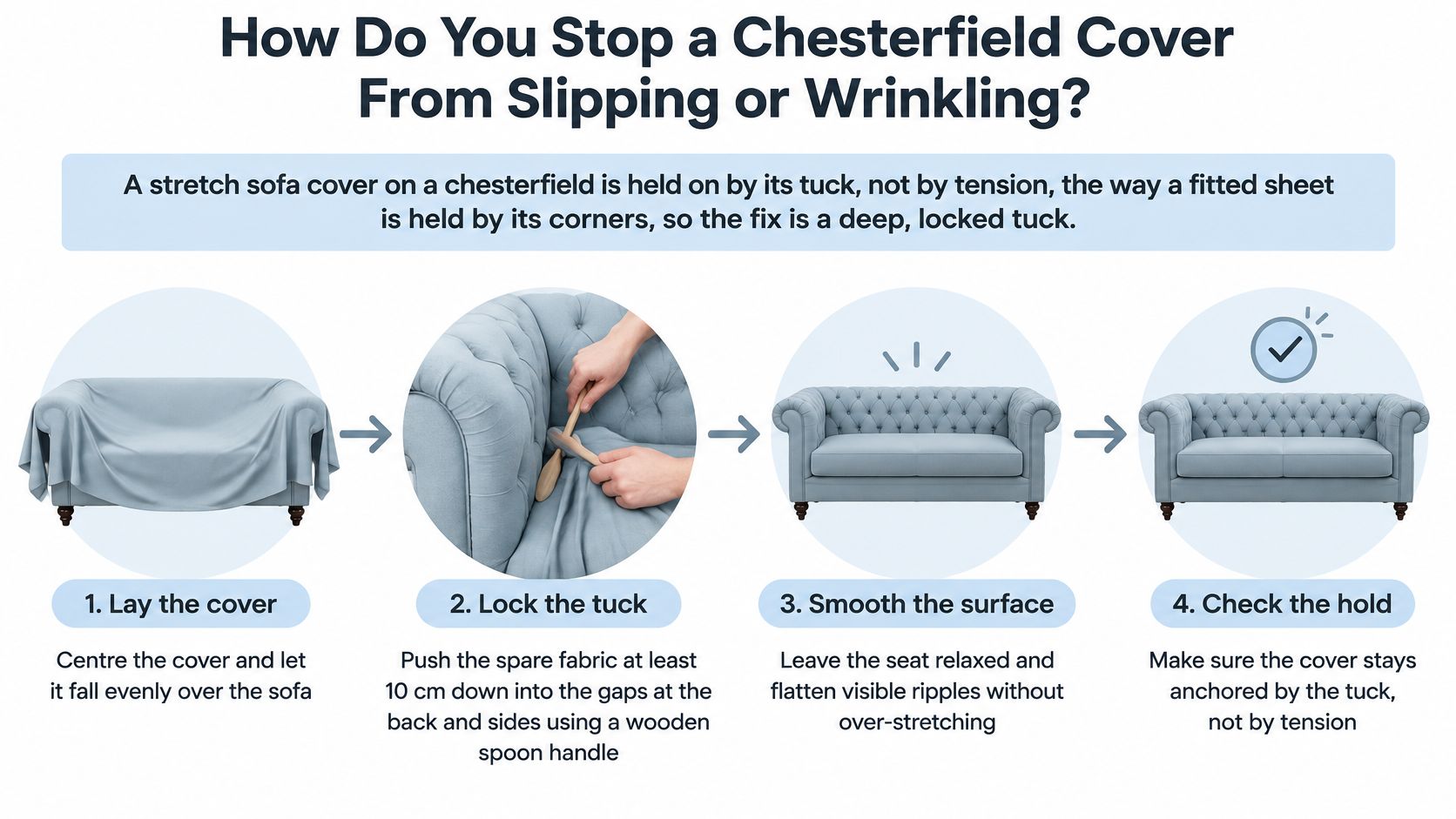
A stretch sofa cover on a chesterfield is held on by its tuck, not by tension, the way a fitted sheet is held by its corners, so the fix is a deep, locked tuck. Slipping usually traces back to the opposite instinct. People pull the cover drum-tight across the seat to smooth every wrinkle, then the first person sits down and the fabric pops straight out of the crevices.
Treat the cover like a fitted sheet, not a T-shirt. Tension across the seat is stored energy waiting to pull the tuck free. Slack, pushed deep into the gaps and locked there, is what anchors the whole thing.
The Fitting Sequence That Holds
- Lay the cover over the back and arms first: Centre the stretch sofa cover on the chesterfield and smooth from the top down, settling the fabric over the scroll arms before you touch the seat.
- Leave the seat relaxed: Don't pull the seat area tight. Visible softness here is working slack, not a fitting error.
- Push the spare fabric deep: Work at least 10 cm of fabric down into the gaps at the back and sides of the seat, using the handle of a wooden spoon to drive it deeper than your fingers can reach. 10 cm is the minimum worth aiming for.
- Lock the tuck in place: Push a Foam Rod in on top of the tucked fabric so it wedges the material into the crevice. A rolled towel does the same job in a pinch.
- Finish the crevices last: Go round the seat and arm crevices once everything else is in place, so later adjustments don't disturb the tuck.
Loose seat cushions don't belong under the main cover if you can avoid it. They shift independently and drag the fabric with them. Put them back in their own fitted Sofa Cushion Covers so each cushion moves as a finished piece rather than as loose fill under a stretched sheet. Our general advice on stopping sofa covers from slipping covers the same tucking principle for standard sofas.
The Leather Chesterfield Variant
A leather chesterfield makes every step above harder, because smooth leather gives the cover very little friction to work with. The fabric wants to travel across the seat every time someone sits down or stands up. Tucking technique matters more here, not less.
Place Anti-Slip Sofa Pads on the seat under the cover before fitting starts, so the fabric has something to bite against. Tuck deeper than you would on fabric upholstery, lock every tuck with Foam Rods, and re-check the whole seat after the first day of use, because that's when a leather fitting reveals whether it will hold. The rolled arms depend on the same locked tuck at their inner crevices, so don't skip the arm-to-seat junctions.
This article doesn't cover leather cleaning or conditioning, because that's a separate job from covering the sofa. For that side of ownership, see our piece on chesterfield brown leather sofa care and styling.
Diagnostic rule: Diagonal wrinkles running from the seat-back join mean the cover is over-tensioned, so ease fabric back towards the seat. A cover that pops out after sitting means the tuck was too shallow, so go deeper and lock it again.
Can You Machine-Wash a Chesterfield Sofa Cover?
A chesterfield sofa cover can be machine-washed only when its own care label or instructions say so, because being removable doesn't by itself prove that a cover is machine-washable. That distinction matters. Plenty of removable upholstery covers are dry-clean only, and assuming otherwise ruins fabric permanently.
Upholstery-care guidance generally says cushion covers shouldn't be washed or dry-cleaned unless the manufacturer's instructions specifically permit it. That matters for coloured or patterned velvet, which can fade or bleed if it's cleaned outside its instructions.
- Read the care label first: Confirm the permitted wash method, detergent limits, and drying advice before the cover comes off.
- Strip the non-fabric parts: Remove Foam Rods and Anti-Slip Sofa Pads, and care for each separately following its own guidance.
- Wash and dry exactly as directed: The label governs the cycle, not your usual laundry habit.
- Refit and re-tuck once dry: Work through the fitting sequence again rather than pulling the cover on and hoping.
Our notes on washing sofa covers without shrinking them cover refitting technique in more detail. Washability applies to the cover fabric only, never automatically to the sofa's own upholstery or to every detachable part. If a stain sits on the original upholstery underneath rather than the cover, that's a different job, and it helps to vet local upholstery cleaning providers carefully before anyone applies cleaning products to a chesterfield's fixed fabric.
Is a Stretch Cover Fire-Safe on a Chesterfield?
In the UK, the Furniture and Furnishings (Fire) (Safety) Regulations 1988 cover loose and stretch covers as well as the upholstered furniture they go on. The sofa itself must also carry its permanent label, and the government guidance on the 2025 amendment to the Regulations confirms that the permanent label obligation stays in place.
The practical point for a chesterfield is simple: when you fit any cover, keep the sofa's original permanent label where it can still be found rather than burying it under fabric.
What Should You Check Before Ordering a Chesterfield Cover?
By this point the measurement and fabric questions are settled, so the final check is a decision rather than another tape-measure exercise. A stretch cover on a chesterfield is tensioned fabric: it bridges the deep buttoning and stays put because the tuck holds it in the seat and arm creases. What it cannot do is follow the tufted contour the way upholstery or a fitted cover does, so judge it on the smooth silhouette it produces.
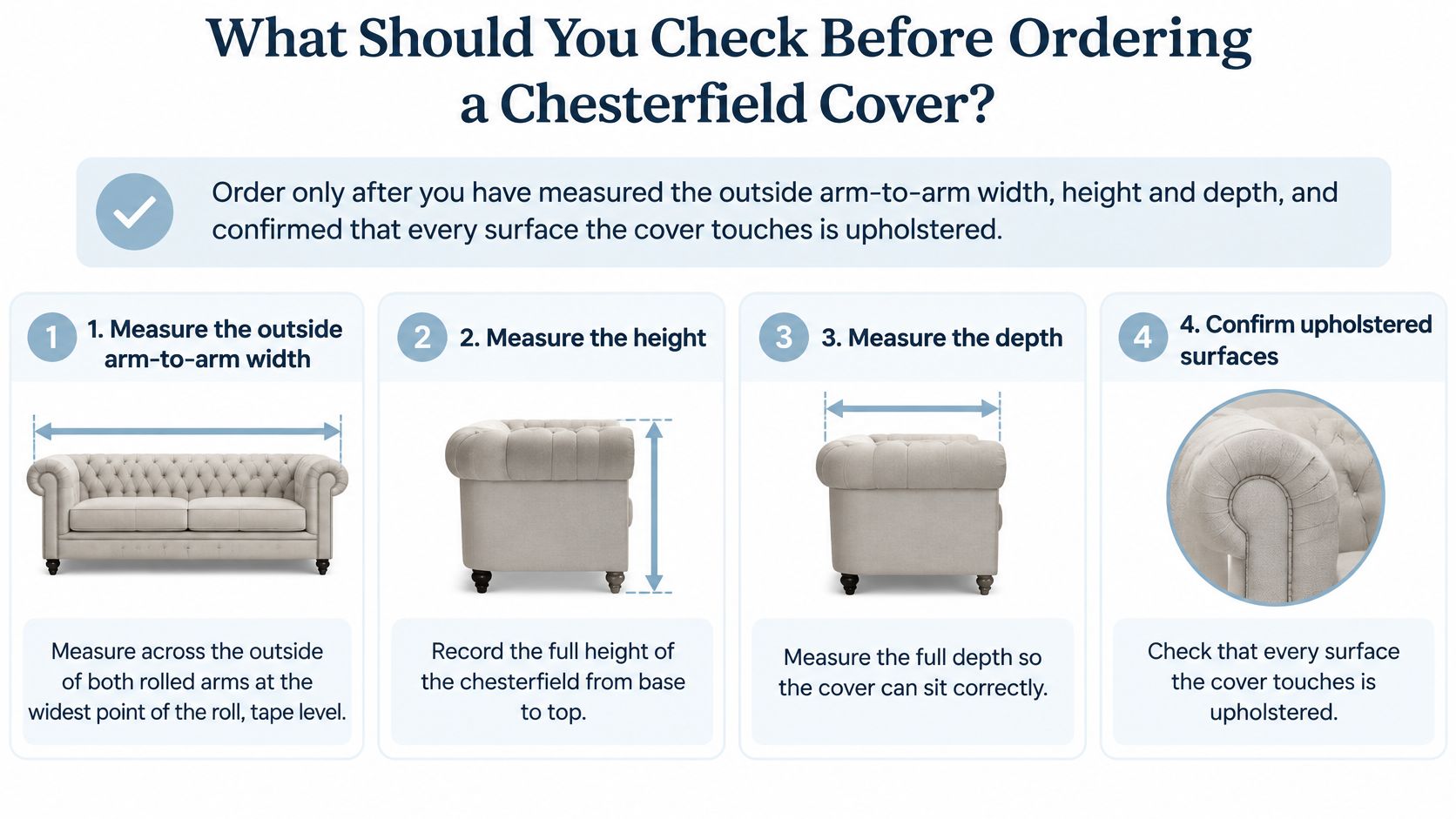
Two things deserve a last look before you order.
- Configuration on the listing, not on the sofa. Corner, recliner and sofa-bed chesterfields change the shape a standard cover is cut for. If the listing does not name your configuration, treat it as excluded.
- The accessories, not just the cover. If leather or deep rolled arms mean you will want Foam Rods or Anti-Slip Sofa Pads for the tucking work, add them to the same order so everything arrives together.
We serve customers across the United Kingdom and the Republic of Ireland, and the practical last step is matching your measured outside width to a size band in the sofa covers collection.
If your chesterfield measures inside a band and presents upholstered surfaces for the fabric to grip and tuck against, a stretch cover in velvet, jacquard, or the Pebble-Textured Waterproof finish gives a refreshed silhouette without reupholstery. Measure across the widest point of both arms, pick your band, and browse the full range at The Sofa Cover Crafter.
