



A sticky leather sofa is often not dirty at all. The same tacky feel has three separate causes, and they need opposite treatment: residue on real leather, a polyurethane coat breaking down on bonded or PU leather, and plasticisers moving to the surface on vinyl. Wiping harder, or adding more polish, can make the wrong cause worse. The first job is to name the material, then test one hidden patch, before you decide whether a gentle clean is even possible.
Table of Contents
- What Makes a Leather Sofa Feel Sticky?
- How Can You Tell Real Leather From Bonded, PU or Vinyl?
- How Can You Tell Build-Up From a Failing Coat?
- How Do You Remove Build-Up From Real Leather?
- Can a Sticky Bonded or PU Sofa Be Cleaned Back?
- What Can You Do With a Sofa That Cannot Be Fixed?
- Preventing Stickiness on Every Leather Type
- When Should You Call a Professional About a Sticky Sofa?
What Makes a Leather Sofa Feel Sticky?
A sticky leather sofa is tacky for one of three separate causes, and each needs the opposite treatment: build-up on real leather, a breaking-down polyurethane coat on bonded or PU leather, or plasticiser migration on vinyl.
People often treat every tacky seat as a cleaning job. The material changes the remedy. As a comparison of leather and leatherette explains, polyurethane coatings can become tacky as moisture-driven hydrolysis breaks down the polymer, while PVC and vinyl more commonly lose plasticisers and then turn stiff and crack. Heat, humidity, sunlight, body oils and harsh cleaners speed that change. None of these is ranked as the usual case. They do not share a fix.
| Leather type | Likely cause | Where it shows up | How it feels |
|---|---|---|---|
| Real leather | Skin oil, hair products and layered polish or conditioner residue | Headrest, arm tops and seat front | Tacky film that holds dust |
| Bonded or PU leather | Polyurethane coat breaking down with heat, humidity and body oils | Seat centres, armrests and front edges | Tacky first, then cracking and flaking |
| Vinyl | Plasticisers migrating to the surface | Broad surface of the panels | Tacky film, later stiffness |
Real leather picks up what people leave behind. Skin oil, hair products and leftover polish or conditioner sit on the headrest and the tops of the arms. That film holds household dust, so the arm feels sticky even when the hide underneath is sound.
Bonded and PU leather are a coat over a base, not an open hide. When heat, humidity and body oils break that polyurethane down, the surface goes tacky before it cracks and flakes. The tack is the start of coat failure, not a layer of dirt waiting to be lifted.
Vinyl stays supple because of plasticisers, the softeners in the material. Those softeners can migrate outward and leave a film across the panels. Later the same loss of softener can leave the vinyl stiff.
Think of a thin smear on a kitchen worktop. Crumbs stick to the smear, not to the clean laminate beside it. A residue film on a sofa arm collects dust in the same way.
Practical rule: The material decides the treatment. A product made to soak into a hide has nowhere to go on a plastic coat, so it stays on top as a greasy film.
The next step is to identify which surface you have before any cloth touches the seat.
How Can You Tell Real Leather From Bonded, PU or Vinyl?
Check the care label and the purchase specification for the material name, because real leather, bonded or PU leather and vinyl each need different treatment, and the label is the fastest way to tell them apart.
If the label is missing or only says "leather look", work through this checklist.
- Look for a uniform printed grain. The same pattern repeated on every panel points to a coated or synthetic surface, not the irregular grain of a natural hide.
- Check the high-contact areas. Seat centres, armrests and front edges take the flex. Peeling, flaking or a film that breaks up there is how a coat fails first.
- Look at a worn edge or the underside. A fabric-like backing means the face is a coating over a textile or a reconstructed base.
- If you still cannot tell, treat the sofa as coated. Skip any water-based test on a finish that might be natural leather until the maker, or a professional, confirms the material.
The reason this matters is simple. Cleaning that suits real leather can soften a coated face, and a conditioner that suits a hide leaves a greasy film on a coat. Once you have a working identification, a single hidden-patch test shows whether the tack is removable residue or the coat itself.
How Can You Tell Build-Up From a Failing Coat?
Test a hidden patch of the sticky sofa with a barely damp cloth and one drop of mild soap, then read the result: if the tack disappears and the surface feels smooth, the sofa has build-up, and if the tack returns within a day or the cloth picks up colour, the coat itself is breaking down.
Run this only on material the identification check has allowed. Do not wet natural leather whose care label forbids water.
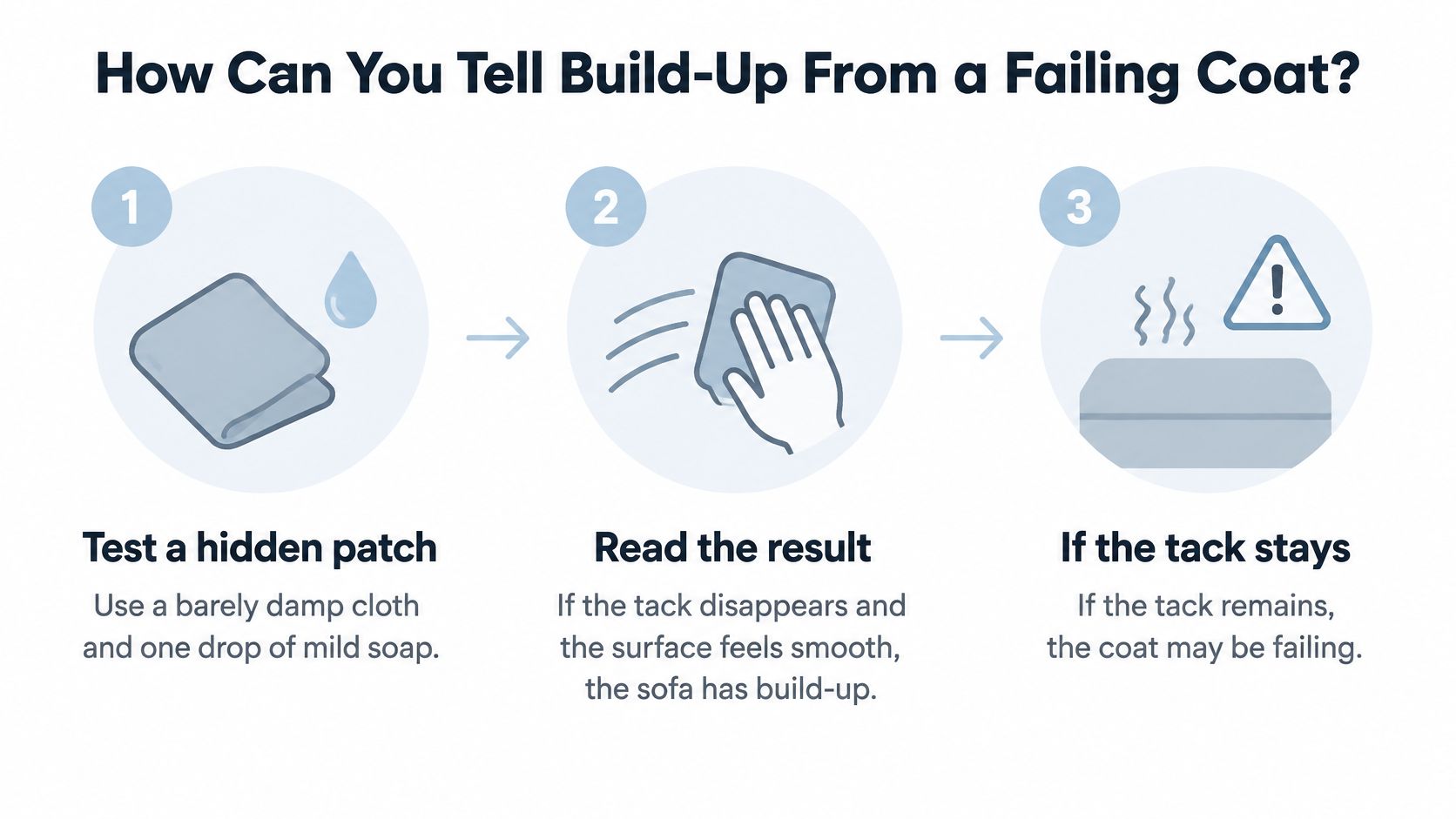
The hidden-patch steps
- Pick a hidden spot. The underside of a cushion or the back panel keeps any mark out of sight.
- Wring a soft cloth until it is barely damp. Extra water is what drives into a finish and softens it.
- Add one drop of mild soap and wipe a small patch for a few seconds. Light strokes only. You are sampling the film, not scrubbing it off.
- Rinse the cloth, wipe the same patch and dry it at once. The full removal routine for real leather sits in the next section. This pass is only a test.
- Check the patch the next day. Returning tack, or colour on a clean white cloth pressed against the patch, means the surface itself is giving way.
| Test result | What it means | Next step |
|---|---|---|
| Tack gone, surface smooth, no return | Build-up residue | Clean gently, dry at once and follow the removal steps for your leather |
| Tack returns within a day | Coat breaking down | Stop wiping and move to the options |
| Colour transfers to the cloth | Coat or finish failing | Stop wiping and move to the options |
| Flaking or peeling | Coat has failed | Conceal or cover the area, and consider a professional opinion |
Run the test once. A second wipe on a failing coat lifts more of the softened surface, so the patch looks worse than it did before you started.
If the tack clears and stays clear, you are dealing with build-up and a careful clean is worth doing. If it comes back, or the cloth is stained, stop. Cleaning will not rebuild that coat.
How Do You Remove Build-Up From Real Leather?
Wipe the sticky area of real leather with a soft cloth barely dampened with water and one drop of mild soap, rinse with a cloth in clean water, and dry the area straight away.
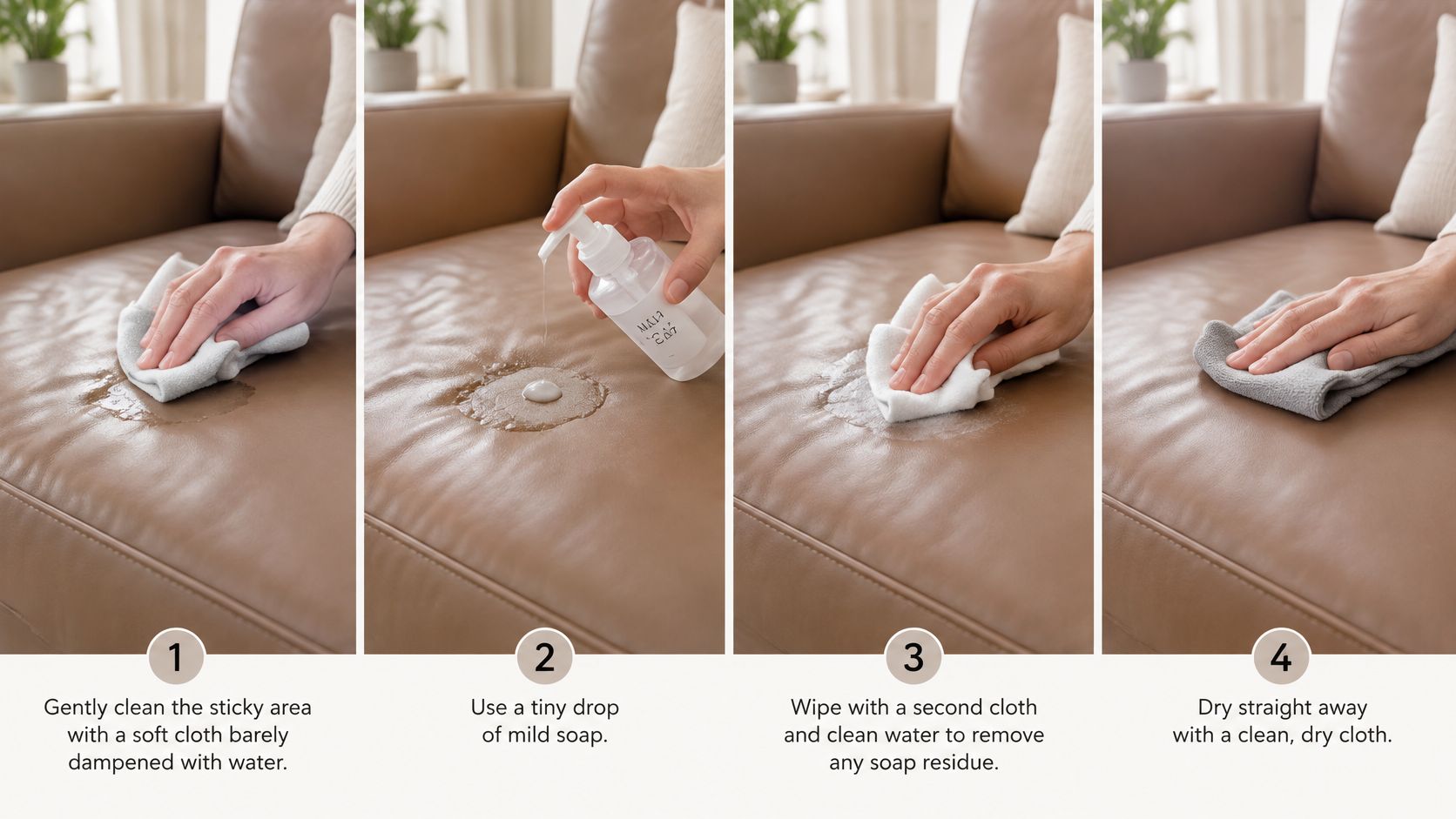
This routine is only for build-up on real leather that the care label allows you to dampen. It is not a treatment for a coat that is already failing.
Work one small section at a time
- Confirm the label. You need real leather, and water must be allowed. A coated sofa does not belong in this routine.
- Wring the cloth until it is barely damp. Saturation drives water into the hide. A dry-looking cloth still cleans a surface film.
- Wipe from the clean edge into the tacky area. Light strokes on one small section keep you from pushing residue across a wider panel.
- Rinse the cloth in clean water, wring it well, and wipe the same section. That second pass lifts the soap so it does not dry into a new film.
- Dry at once with a dry soft cloth. Do not use a hairdryer or any other heat source. Heat dries the surface unevenly and can mark the finish.
- Let the leather air-dry fully before anyone sits. Sitting on damp hide presses body oil straight back into the area you just cleared.
- Leave conditioning out of this session. Excess product is often what made the headrest tacky. Routine care belongs with prevention, not with the clean.
Leather should never become saturated: use only a lightly dampened cloth, and let the leather air-dry completely. Test any method on a concealed area before treating the whole sofa, and avoid hairdryers, because heat can damage the leather.
Heavy wetting is the main risk in this job. A barely damp cloth removes a surface film. A wet cloth feeds water under the finish, and that is how a healthy panel ends up stained or stiff.
If the area does not clear after one careful pass, stop. Do not scrub. A second, harder pass is how a sound surface gets damaged, and a mark that will not lift may be finish failure rather than residue. Furniture stains need a method matched to the material, not more force.
For the wider routine on sound leather, use this guide to the best way to clean a leather sofa. Keep today's job limited to the tacky build-up.
Can a Sticky Bonded or PU Sofa Be Cleaned Back?
No, cleaning cannot restore a bonded or PU sofa whose polyurethane coat has started to break down, because every wipe lifts more of the softened surface.
The polymer has changed. No cleaner puts that chemistry back. What looks like dirt is softened coating, so the cloth comes away with colour or a smear, and the seat feels tacky again the next day.
Vinyl has a different cause and the same limit. A careful wipe can lift the film that plasticisers have left on the surface. The tack can return while those softeners keep moving outward. You have not repaired the panel. You have cleared today's film.
What not to put on a failing coat
- Conditioners and oils. They are made to soak into a hide. On bonded or PU leather there is nothing to soak into, so they sit as a greasy film that holds dust.
- Solvent-based wipes and multi-surface sprays, including alcohol-based ones. They soften a polyurethane or pigmented topcoat. The surface goes tacky first and cracks later.
- Silicone polishes. They look slick on day one, then grab dust and skin oil.
- Baby wipes. They are made for skin. On a leather finish they can strip oils and colour.
- Abrasive pads. Scrubbing removes more of the softened surface with every pass.
Signs the coat is past cleaning are plain: tack that returns after a careful test, colour on the cloth, cracking, flaking or peeling. A gentle routine for coated surfaces that are still sound is in this faux leather cleaner guide. It will not restore a failed coat.
Once those signs are there, the honest choices are concealment or keeping skin off the surface, not another bottle.
What Can You Do With a Sofa That Cannot Be Fixed?
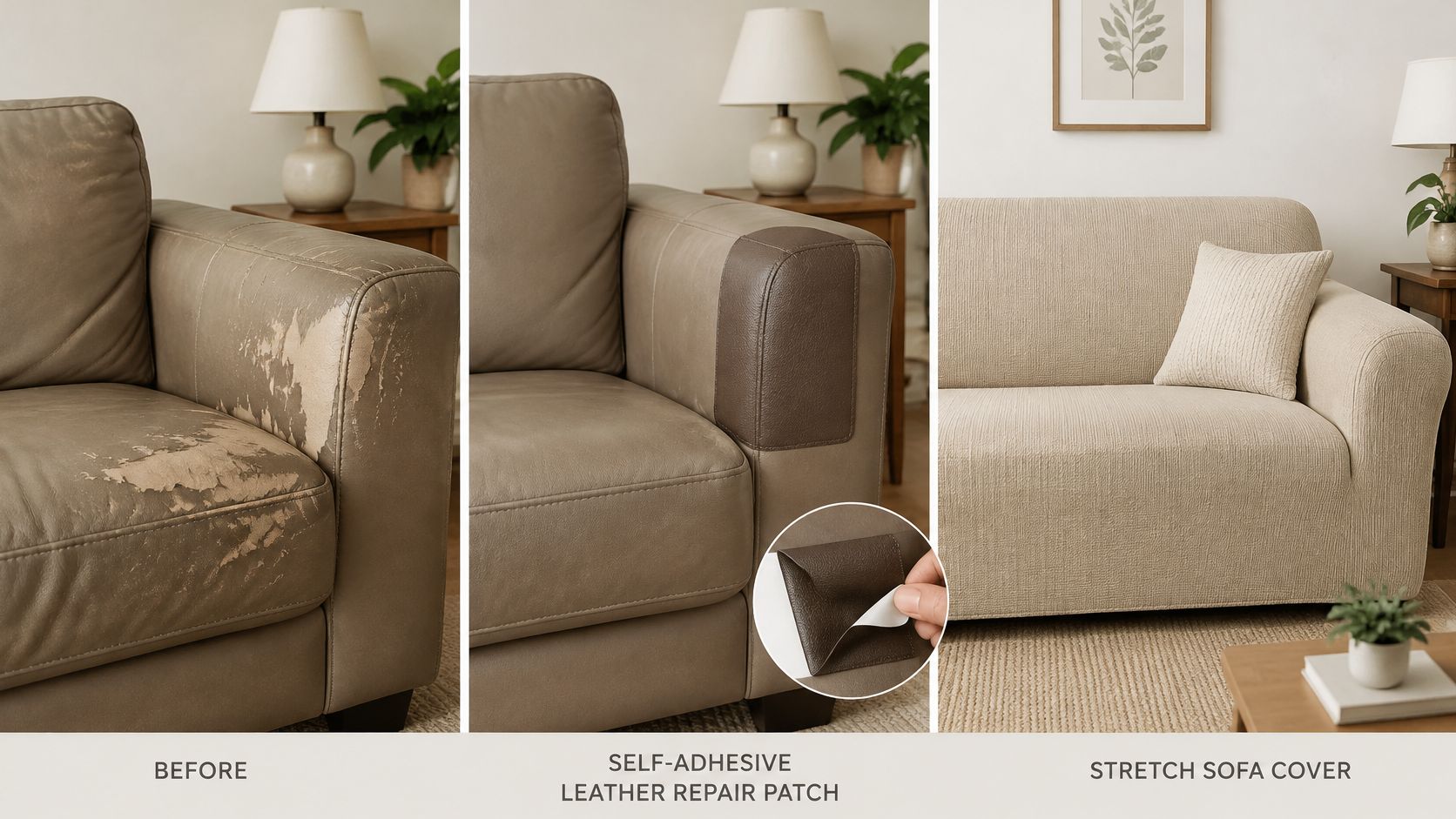
For a bonded or PU sofa whose coat has failed, the two honest options are a Self-Adhesive Leather Repair Patch, which conceals the worst area, and a stretch sofa cover, which keeps skin off the surface, and neither repairs the coat.
| Option | What it does | What it needs | Limits |
|---|---|---|---|
| Self-Adhesive Leather Repair Patch | Conceals the worst area when cut to shape | Clean, dry, residue-free leather; conditioner residue stops it bonding | Hides the damage and does not restore the coat |
| Stretch sofa cover | Keeps skin and body oils off the surface; the cover is washed, not the sofa | Correct fit for your configuration and a deep tuck on smooth leather | Does not repair the sofa; confirm fit for L-shaped or recliner shapes before buying |
| Sofa throw | Protects the headrest or the arm you lean on most | Fabric that stays in place | Covers only the spot it sits on |
Patch, cover or throw
A Self-Adhesive Leather Repair Patch is a concealment, cut to the worn patch on leather that is clean, dry and free of residue. Conditioner left on the surface stops the adhesive bonding. It does not rebuild the coat around it.
A stretch sofa cover is the piece that goes in the wash. It keeps skin and body oils off the tacky face. It does not repair the sofa, and it does not lengthen the life of a failed coat. Covers slide on smooth leather, so a deep tuck locked with Foam Rods, plus Anti-Slip Sofa Pads under the seat cushions, helps the fabric stay put. Measure your own sofa before you buy. If a cover does not suit an L-shaped or recliner sofa, do not force it. Use throws on the contact areas instead.
One example in the sofa covers collection is the Sofa Cover - Velvet - Dark Green - Adaptable & Expandable, a machine-washable velvet cover made to adapt across a range of sofa sizes. Fit is still not certain for every corner or recliner, so check the listed shape against your sofa. Corner shapes are in the corner sofa cover collection. A listed corner shape still needs checking against your own sofa before buying.
A sofa throw from the sofa throw collection only covers the headrest or the arm it sits on. That is often the spot that went tacky first.
Choosing among covers for a leather sofa is set out in this guide to slipcovers for leather couches. If you are weighing a full recover instead, this note on whether reupholstering a sofa is worth it is the decision to make with a professional, not a promise that any repair will hold.
Preventing Stickiness on Every Leather Type
Prevention on real leather, bonded leather, PU and vinyl works on three drivers, skin, heat and residue, and it lowers the risk of a new film but cannot reverse a coat that has already failed.
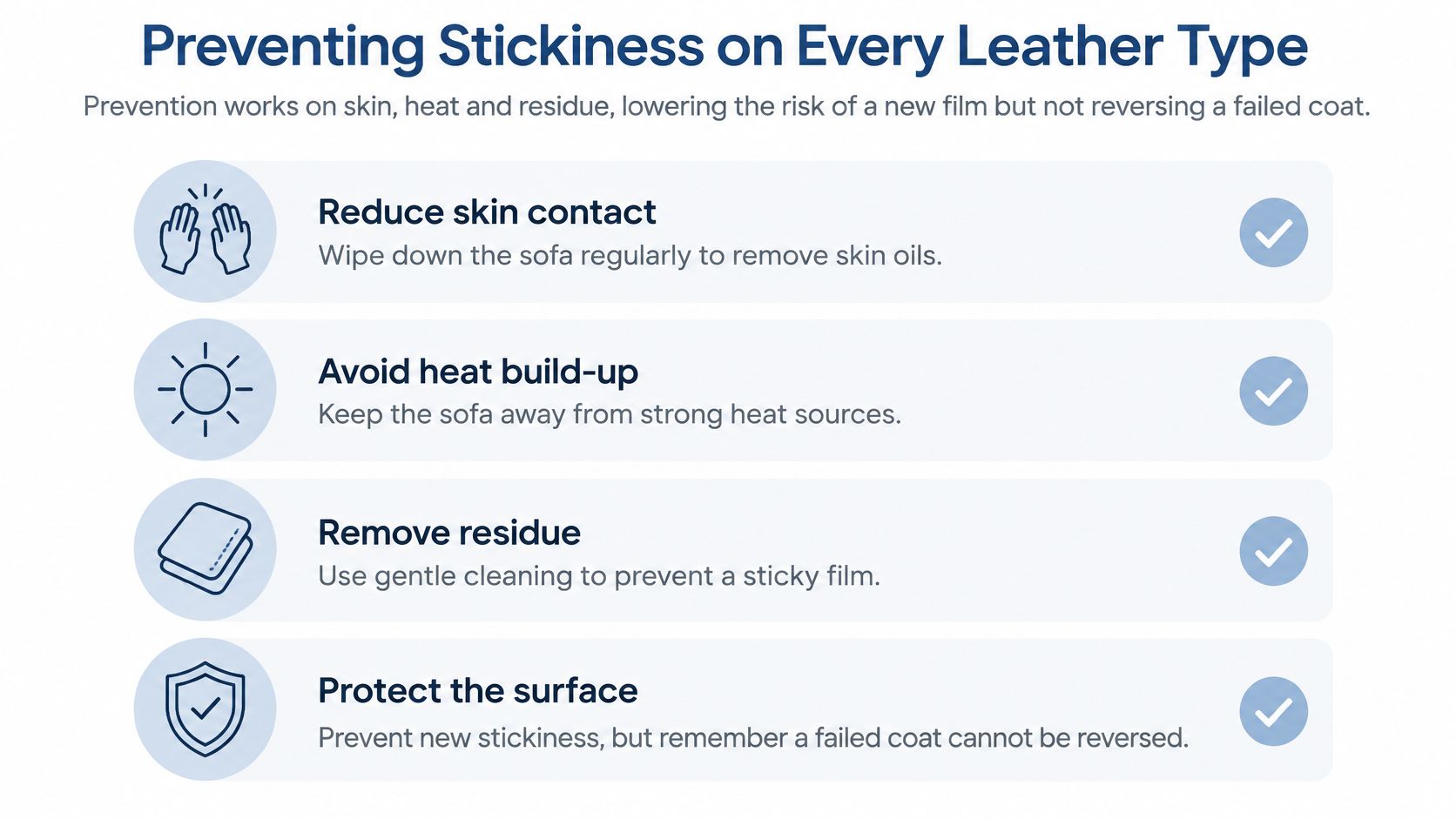
- Skin. Wipe the headrest, arm tops and seat front with a barely damp cloth far more often than the rest of the sofa. Little and often stops a film forming.
- Heat. Keep the sofa out of direct afternoon sun and away from radiators and fireplaces. Heat speeds the reactions that make bonded, PU and vinyl tacky.
- Residue on real leather. Condition sparingly and buff off whatever is not absorbed. The excess is what turns sticky. On bonded, PU or vinyl, skip conditioner entirely.
- Products. Avoid strong household cleaners and spray polishes. Treat everything on the do-not-try list as off limits, including conditioners on a coat, solvent wipes, silicone polish, baby wipes and abrasive pads.
- Throws. Place a machine-washable throw over the headrest or the arm you always lean on, so the throw can be washed when the sofa cannot. Ideas for that placement are in this guide to throws for leather couches.
Household detergents, spray polishes, waxes and general stain removers can build up in layers on leather and leave a sticky surface. Follow the sofa maker's care instructions, and test anything on a hidden area first.
Prevention is not a cure. It only lowers the chance of a new film on a surface that is still sound.
When Should You Call a Professional About a Sticky Sofa?
Call a professional upholsterer or leather restorer when the tack on a leather sofa returns after the hidden-patch test, when the surface is flaking or peeling, when you cannot identify the material, or when the damage covers large areas or the sofa is valuable to you.
A professional can assess the sofa and advise on repair. Nothing here promises that a repair will work. Before you call, gather the care label, the purchase details and photos of the worst area, so the assessor can name the material quickly.
If you decide not to repair, keep skin off the surface instead. Our sofa covers are machine-washable. Foam Rods push into the gaps around cushions so a tucked cover sits more neatly on smooth leather and everyday creases lie flatter. Start with the sofa covers collection, and check the listed shape against your own sofa before you buy.
The Sofa Cover Crafter makes stretch sofa covers, corner sofa covers and sofa throws that keep skin and spills off a tacky surface while you wash the cover, not the coat. Foam Rods and anti-slip pads help a cover stay tucked on smooth leather, and a throw can sit on the headrest or the arm you lean on most. If your sofa cannot be cleaned back, browse the options in the sofa covers collection and measure your own sofa before you choose.
