



A biro has just left a dark line on the arm, and the instinct is to scrub it. To get ink out of a leather sofa, first work out whether the leather is finished or unfinished, then blot only if a sealed topcoat is holding the ink on the surface. If the hide drinks liquid, or the mark has dried into a worn edge, stop. Anything strong enough to dissolve ink can dissolve the finish it sits on, and a specialist, a small cover-up, or a full sofa cover is the honest fallback when the mark will not shift.
Table of Contents
- What Kind of Leather Does Your Sofa Have?
- How Do You Remove Fresh Ink From Finished Leather?
- How Do Ballpoint, Gel and Printer Ink Differ on Leather?
- Which Household Products Should You Keep Away From Leather?
- What Can You Do When Ink Has Set on Leather?
- Protect the Arms Before the Next Mark
What Kind of Leather Does Your Sofa Have?
Start with one drop of water in a hidden spot, under a seat cushion or on the back panel. What that drop does identifies your finish before you touch the ink. A drop that beads and sits on the surface means a sealed topcoat, so fresh ink is probably resting on that film. A drop that darkens the leather and soaks in quickly means an unfinished hide, and ink will have wicked into the fibres the same way.
The sofa in front of you is likely to be one of three finishes. Pigmented leather has a sealed, coloured topcoat. Aniline and nubuck carry no protective film, so anything liquid sinks straight in. Bonded or PU leather is a plastic coat over a fibre backing, and it fails differently: the surface goes soft or sticky rather than losing colour.
Whichever method you try on a sealed finish, watch the cloth as you work. The moment it picks up the sofa's own colour, the finish is coming off. That is the stop signal: colour transfer means you are stripping the coating rather than lifting the ink, and continuing only makes the patch bigger.
Professional upholstery-cleaning guidance draws the same line. On smooth, finished leather, ink and felt-pen marks may sometimes be improved with extremely careful, spot-only treatment, but solvents can damage the finish. On absorbent leather such as aniline or suede, removing these stains may be impossible because the ink penetrates the material. A leather repairer may then need to re-dye and re-finish the area, which is specialist work.
Check the care label, the purchase paperwork, or the maker's details before you use anything. Products meant for protected or pigmented leather should not be used on aniline, pull-up, nubuck, or suede. Coated faux surfaces are a separate job, covered in our guide to a faux leather cleaner. If you are unsure which finish you have, treat the leather sofa as unfinished and stop.
| Leather finish | Water-drop result | What it means for the ink | First move |
|---|---|---|---|
| Pigmented (sealed topcoat) | Drop beads and sits on the surface | Ink usually sits on the coating and may lift if treated while fresh | Blot, then test a leather-formulated remover on a hidden spot |
| Bonded or PU (plastic coat) | Drop sits, then the surface goes soft or sticky | Solvents soften the coat and can spread the mark | Avoid solvents and seek specialist advice |
| Aniline or nubuck (unfinished) | Drop darkens the leather and soaks in quickly | Ink has wicked into the fibres and acts like a dye | Stop and call a leather specialist |
How Do You Remove Fresh Ink From Finished Leather?
On finished, pigmented leather, blot fresh ink with a dry cloth, never rub, and start with the mildest method on the smallest area. While the mark is still wet it sits on the topcoat, which gives you a short window to lift it cleanly. Once it dries, it wicks into anything porous, and longer rubbing only takes more finish with it.
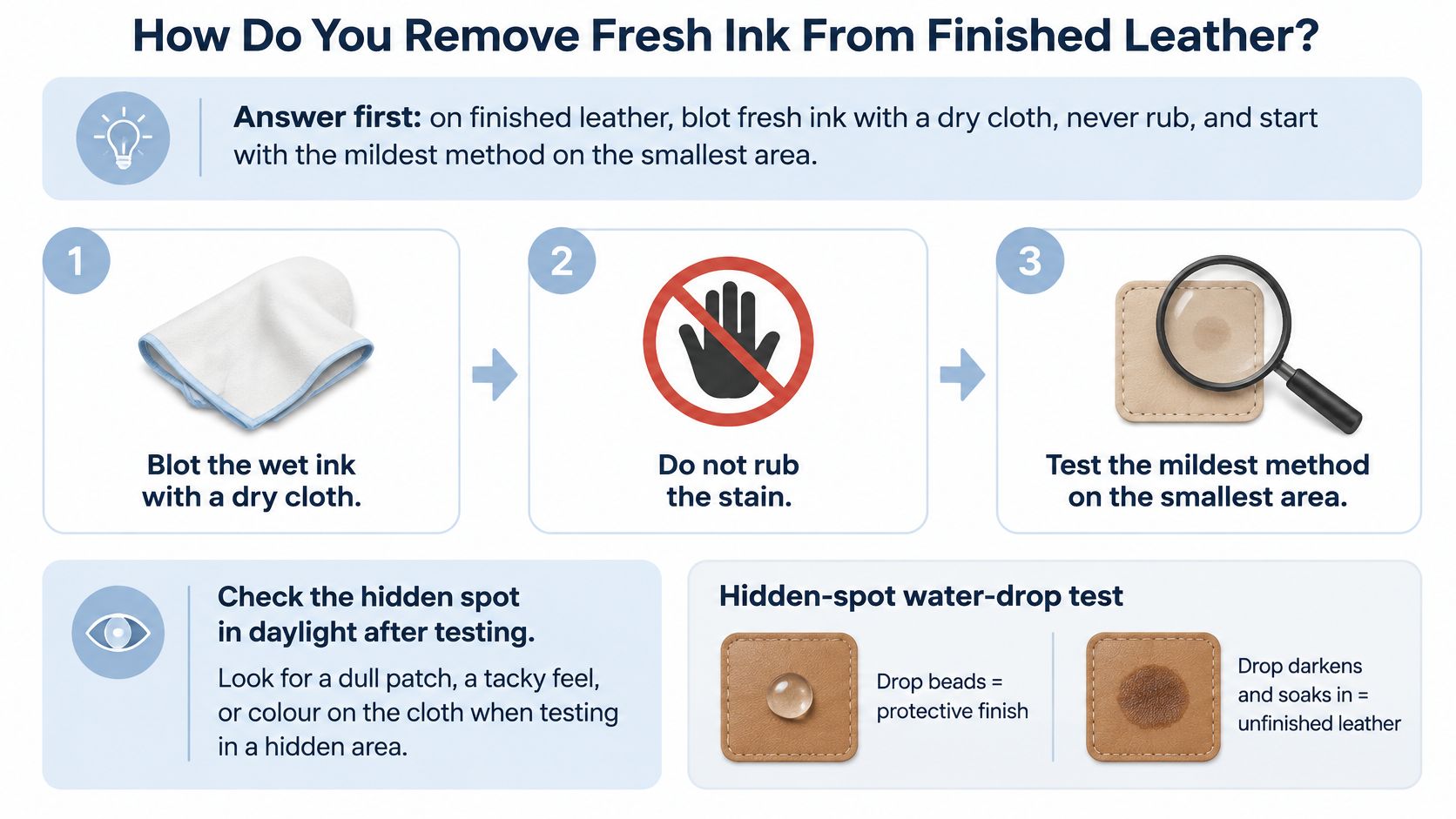
Leather UK care guidance recommends a formulated leather ink remover for finished or pigmented leather, and it advises against household hacks because solvents can damage the protective finish. We do not sell leather cleaners or ink removers, so there is no product of ours to recommend here. Buy a leather-specific product from a leather-care supplier, read the label, and test it on the same hidden spot. Let that spot dry fully and look at it in daylight. A dull patch, a tacky feel, or colour on the cloth means the finish is reacting.
- Blot the wet ink. Press a clean dry cloth or tissue onto the mark. Wiping smears it sideways into grain lines you then have to chase.
- Clear loose dirt. Wipe with a barely damp cloth, then let the area dry before any remover goes on.
- Load a cotton bud, not the sofa. Put a small amount of leather-formulated ink remover on a bud or cloth. Do not paint it across the arm.
- Dab inward. Work from the outside of the mark toward the centre, and switch to a clean section of cloth often so you are not pushing lifted ink back down.
- Stop on colour transfer. The moment the cloth picks up the sofa's own colour, that is the finish coming off, not the ink. I would stop there even if a shadow of the mark remains.
- Lift the residue. Wipe with a lightly damp cloth. Do not flood the grain.
- Dry, then condition. Let the area dry naturally. Condition only after the surface is fully dry, using a product the leather-care supplier says suits pigmented leather.
Do not scrub, and do not use acetone, bleach, household detergent, or hairspray. Those can spread dye, strip pigment, or leave a gloss mismatch. If a shadow is still there once the surface dries, treat it as set ink rather than repeating the pass.
How Do Ballpoint, Gel and Printer Ink Differ on Leather?
A fresh biro line, a gel smear and an inkjet speck can look like the same dark mark, but they behave differently once leather is involved. Check the finish first: if a hidden test leaves colour on the cloth or a dull, tacky patch, stop there because the coating is moving rather than the ink. Once the surface is stable, ink type tells you how little moisture and pressure the mark will tolerate.
| Ink type | What is different on leather | Safest adjustment | Stop and reassess if |
|---|---|---|---|
| Ballpoint | Usually stays a surface line while fresh, then becomes riskier as it dries into worn grain | Use the fresh-ink routine unchanged: dry blot first, then the smallest amount of remover | Colour reaches the cloth, the patch turns dull or tacky, or a shadow remains after drying |
| Gel pen | Water-based, so pressure and added moisture push it outward | Blot only with a dry cloth and keep the area dry until the lift is complete | A widening ring or feathered edge appears after any moisture |
| Printer ink (inkjet) | Often dye-based and quick to wick into porous or worn patches | Run the hidden-spot water test first and treat dried droplets as set rather than fresh | The grain darkens fast, the speck spreads, or finish colour transfers |
The practical split is simple. Ballpoint is the fresh mark most likely to respond to gentle lifting. Gel punishes pressure and water. Printer ink punishes delay and porosity, especially where the surface has lost its protection. If a dried splatter, a spreading gel halo, or any colour transfer appears, treat it as a set-ink or finish problem instead of adding more remover.
Which Household Products Should You Keep Away From Leather?
A kitchen or bathroom product that dissolves ink on paper will often dissolve the leather finish at the same rate. On a pigmented topcoat, the finish is frequently as soluble as the mark itself. That is why the first sign of trouble is the sofa's own colour appearing on the cloth: at that point it is the finish lifting, not just the ink.
Rubbing alcohol deserves its own warning because it is a common home recommendation for ink stains. It can dissolve ballpoint dye, and it can just as easily disturb the finish and leave a pale, dull patch, which makes it a poor default on finished leather. A safety data sheet for an isopropyl alcohol surface disinfectant, supplied through the NHS, lists eye irritation and possible drowsiness or dizziness from vapours, and directs users to avoid skin contact and work in a well-ventilated area away from ignition sources. If a product on your shelf lists isopropyl alcohol among its ingredients, the label applies in full.
Run any candidate product through the hidden-spot test from the finished-leather section before it touches the mark, and stop the moment the cloth picks up colour. The safer tools are a leather-formulated remover from a leather-care supplier and a soft, dry or barely damp cloth used without scrubbing.
| Product | Why it harms the finish | Safer choice |
|---|---|---|
| Rubbing alcohol | Can lift dye and leave a pale patch, and its vapour is a hazard indoors | Do not use on finished leather; use a leather-formulated remover from a leather-care supplier |
| Acetone or nail-polish remover | Dissolves the topcoat | Do not use |
| Hairspray | Leaves a tacky film and can lift colour | Do not use |
| Bleach | Strips pigment from the leather | Do not use |
| Vinegar or baking soda | Alters the finish and the dye | Do not use |
| Abrasive pads or scourers | Scratches the topcoat and exposes the fibres | Use a soft dry or barely damp cloth |
What Can You Do When Ink Has Set on Leather?
A mark that has sat overnight behaves differently from a fresh line. On finished leather you can still try a leather-formulated remover once, working in short passes and checking the cloth after each one. On aniline, nubuck, bonded or PU leather, dried ink is already past the surface, so that same cloth test matters even more.
The rule is simple. A faint ink transfer on the cloth is progress, but the moment the cloth picks up the sofa's own colour, the finish is coming off with the mark. Stop there. Dullness, a tacky feel or a change in the gloss tell you the same thing.
A leather specialist can assess a set mark and, where needed, re-dye and re-finish the area, which is a useful place to start if you want the mark assessed rather than rubbed again.
You have four honest options, in this order.
Live with the mark. A faint line on a worn arm is often less visible damage than a pale halo of stripped colour around it.
Call a specialist. The right call for aniline, nubuck, bonded or PU leather, and for any piece where the repair cost is justified.
Conceal a small area. Our Self-Adhesive Leather Repair Patch is a peel-and-stick sheet, 50 × 120 cm, that you cut to the shape of a worn or damaged spot. The leather underneath needs to be clean, dry and free of residue, and the sheet goes down pressed from the centre outwards so air does not trap at the edges. It conceals damage under a new surface. It does not remove ink or re-colour leather, and nobody can promise it will be invisible on your sofa.
Cover the sofa. Stretch sofa covers and corner sofa covers hide a mark you have decided to leave. A cover does not fit every couch shape, so check the listed dimensions against your sofa before you buy. One option in the range is the Sofa Cover - Velvet - Dark Green - Adaptable & Expandable, a velvet cover made to suit a wide range of sizes, still measured against your sofa rather than assumed to fit. Covers slide on smooth leather, so tuck the fabric deep into the gaps and lock the tuck with Foam Rods, which hold the fabric in place and smooth everyday creases. Anti-Slip Sofa Pads under the seat cushions add grip where the cover meets the leather.
Routine cleaning of the whole sofa is a different job from ink, and it is covered in our guide to the best way to clean a leather sofa. Marks on fabric upholstery follow another method, set out in how to remove stains from a sofa.
Colour on the cloth means the finish is leaving with the ink. That is the stop signal, not progress.
Protect the Arms Before the Next Mark
Start with the arm tops, the headrest and the front seat edge, because pens, cuffs and hands meet the leather there all day. Worn patches take ink faster than sealed leather, so give those places first claim on protection.
Lay a sofa throw over the arm where pens and hands land. It takes the first contact, and its edge can fold over the front lip where cuffs rub. Our throws are large, easy-care pieces, made to sit between the leather and everyday spills, pets and wear. A throw guards the arm against the next pen; a mark already in the leather still needs the ink method. For fit and drape on smooth upholstery, see throws for leather couches.
Keep caps on pens. Keep printer cartridges and their packaging off the sofa while you refill them. Check pockets before you sit, especially when children do homework there.
If a mark is already set, use the set-ink options. If it is still new, blot first, follow the fresh-ink steps, and only on finished leather. If the cloth picks up the sofa's own colour, stop; the finish is coming away.
If the ink will not shift, The Sofa Cover Crafter can help you cover the damage without more rubbing. We make stretch sofa covers, corner sofa covers and sofa throws, with foam rods to hold a tucked cover in place. Visit our sofa covers to compare sizes against your sofa before you buy.
