



The best steam cleaner for a sofa isn't the hottest or most powerful machine. It's a cleaner that delivers low, steady, adjustable steam through an upholstery tool, putting as little water as possible into a fabric sofa that's confirmed as steam-safe. Maximum power is a poor buying shortcut when the main risks are damaged fabric and wet cushion foam.
We don't sell steam cleaners and haven't tested any, so this isn't a model ranking. It's a practical guide to choosing the right type of machine, recognising when steam is the wrong tool, and keeping washable stretch covers away from heat.
Table of Contents
- Which Steam Cleaner Is Best for a Fabric Sofa?
- Can You Steam Clean Any Fabric Sofa?
- Which Steam Cleaner Features Matter Most for Sofas
- How to Test and Steam a Sofa Safely
- Why Does a Steamed Sofa Stay Damp?
- How Do You Look After a Steam Cleaner Between Uses?
- Should You Steam a Stretch Sofa Cover?
- Should You Buy a Steam Cleaner, Hire a Professional or Use a Washable Cover?
Which Steam Cleaner Is Best for a Fabric Sofa?
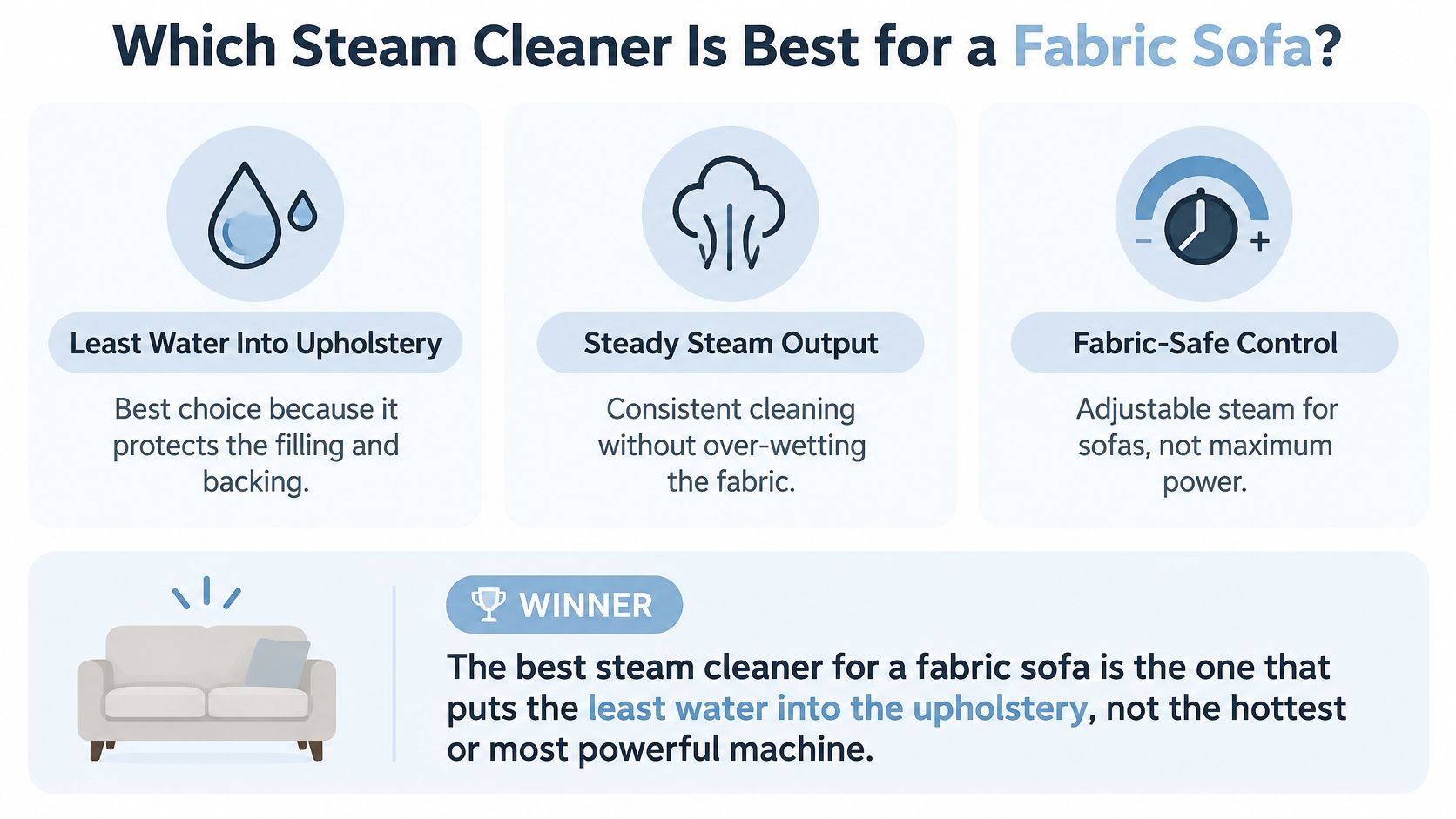
The best steam cleaner for a fabric sofa is a controllable, low-moisture machine with a proper upholstery attachment, provided the sofa manufacturer permits steam cleaning. Best means safest for the upholstery, backing and filling, not strongest on a specification sheet.
Start with the job rather than the machine. A narrow armrest needs a tool you can position accurately; a whole seat needs comfortable reach and a clean bonnet that won't redistribute loosened dirt.
Steam cleaner choice by sofa task
| Sofa task | Best-fit approach | Avoid |
|---|---|---|
| Spot-cleaning a fabric cushion or arm | Handheld or compact steam cleaner with a narrow upholstery nozzle | Full saturation of the cushion |
| Refreshing a whole fabric seat | Compact cylinder cleaner with a washable microfibre bonnet | High-pressure floor machine |
| Dust mites and pet dander | Thorough vacuuming first, then low-moisture steam where approved | Steam alone as the fix |
| Pet hair | Dry removal with a reusable lint roller before any steam | Steaming hair into the weave |
| Stretch sofa cover | No steam; take it off and follow its care label | Any steamer on the cover |
The useful comparison is how much control each machine gives you over moisture.
Why upholstery needs its own cleaning approach
Sofas deserve different treatment from hard floors because upholstery holds material within a porous surface. In a study covering domestic and public indoor environments, University of Manchester researchers found that house-dust-mite allergen Der p 1 exceeded 2,000 ng/g of fine dust in 30% of sampled upholstered seats.
The same study identified cat allergen concentrated in upholstered seating. That supports taking sofa maintenance seriously, but it doesn't establish that a domestic steam cleaner will remove every allergen or make a sofa suitable for someone with allergies.
Pet accidents also need a different decision from general surface refreshing. Eco Clean Solutions' guide to choosing an extractor for pet stains is useful for understanding why loosening surface dirt and extracting contamination aren't the same task.
Buying rule: Choose the machine that lets you stop moisture delivery precisely, rather than the machine that makes the biggest claims about power.
Steam isn't a complete allergen solution. Fabric compatibility, drying, ventilation and follow-up vacuuming still matter, and the sofa's care instructions take priority over the cleaner's attachment list.
Can You Steam Clean Any Fabric Sofa?
Steam only if the manufacturer's label or care instructions explicitly allow water and heat. Pile fabrics, velvet, suede, leather and dry-clean-only upholstery are usually unsuitable unless the instructions clearly approve steaming.
Check beneath loose cushions, along the seat base or under the sofa for its care label. Photograph it so you can compare the sofa's requirements with the steam cleaner's instructions.
La Redoute's fabric-sofa care guide explains the W, S, WS and X cleaning codes. Treat a water-cleanable code as the start of the check, not the approval: look for specific guidance on heat before steaming.
Care labels and steam verdicts
| Care label | What it allows | Steam verdict |
|---|---|---|
| W | Water-based cleaning | Steam may suit after manufacturer confirmation and a hidden-spot test, using light passes |
| S | Solvent-based cleaning only | Don't steam; use an approved solvent-based method or professional cleaner |
| WS | Water-based or solvent-based cleaning | Steam only with heat approval and a successful test; choose an approved alternative if testing shows risk |
| X | Vacuum only | Don't steam or wet; vacuum only |
| Dry-clean only | Professional cleaning only | Don't steam |
| Velvet, suede, leather or pile with no code | Usually unsuitable for steam | Don't steam unless the care instructions clearly allow it |
| No care label | Unknown | Don't guess; contact the manufacturer or hire a professional |
Why a water-cleanable label isn't enough
Heat and moisture can change texture, move dye or shrink fabric, even when water-based cleaning is allowed. A patch that looks smooth while damp may show changes only after drying.
Velvet needs particular care because steaming can affect the direction or condition of its pile. Follow this guide to cleaning a velvet sofa rather than applying advice for ordinary woven fabric.
A missing label leaves the fabric's response uncertain. Its visible surface does not show how the backing, dyes, adhesives or filling will react. For rented furniture or short-let furnishings, keep written care instructions with the property inventory to help avoid disputes over damage.
S or X means the steamer stays in the cupboard. With W or WS, confirm heat compatibility and test a hidden area before treating visible upholstery.
Which Steam Cleaner Features Matter Most for Sofas
The steam-cleaner features that matter most for sofas are steady adjustable output, a fabric-safe upholstery tool, manageable tank size, comfortable handling and sufficient hose reach. Treat these as a shopping checklist rather than assuming a floor-cleaning machine will work well over a seat.
Steam cleaner features to compare
| Feature | What to check | Trade-off |
|---|---|---|
| Steady steam control | Adjustable output that holds a low, even flow | Gentler passes may need more targeted work, not repeated wetting |
| Upholstery nozzle | Narrow head for cushions, arms and seams | Covers a small area per pass |
| Washable microfibre bonnet | Removable head cover you can wash and dry between sessions | Needs washing and full drying after use |
| Tank size | Enough capacity for the intended area without awkward refilling | Small tanks need refills; large tanks can tempt prolonged steaming |
| Weight and hose length | Comfortable tool weight and a hose that reaches the far arm | More reach doesn't necessarily mean easier handling |
| Handheld or cylinder | Handheld for spot work; cylinder for whole seats | Cylinder units generally need more storage; compare actual specifications |
Match the format to your reach
A handheld cleaner suits arms, cushion edges and small approved areas. Remember that you're holding the water as well as the machine: assess the filled weight, not just the empty specification.
A cylinder cleaner leaves the tank on the floor while you move the hose and tool. Check whether the hose reaches the backrest without pulling the base against furniture, and whether the trigger is comfortable when your wrist is bent.
An extraction machine is a different proposition. It applies cleaning liquid and recovers moisture with suction, while a steam-only machine doesn't automatically collect the soil it loosens. Extraction may recover more water, but a wetter cleaning process can still leave more moisture to dry than controlled vapour.
Soft-furnishing cleaning guidance distinguishes steam treatment from vacuum extraction and stresses fabric compatibility and moisture removal. Don't assume a product described as an upholstery cleaner generates steam.
A large tank doesn't force you to soak a sofa, and a small tank doesn't prevent it. Output control and technique decide how much water reaches the filling.
Score machines on control, attachments and handling before considering their headline power.
How to Test and Steam a Sofa Safely
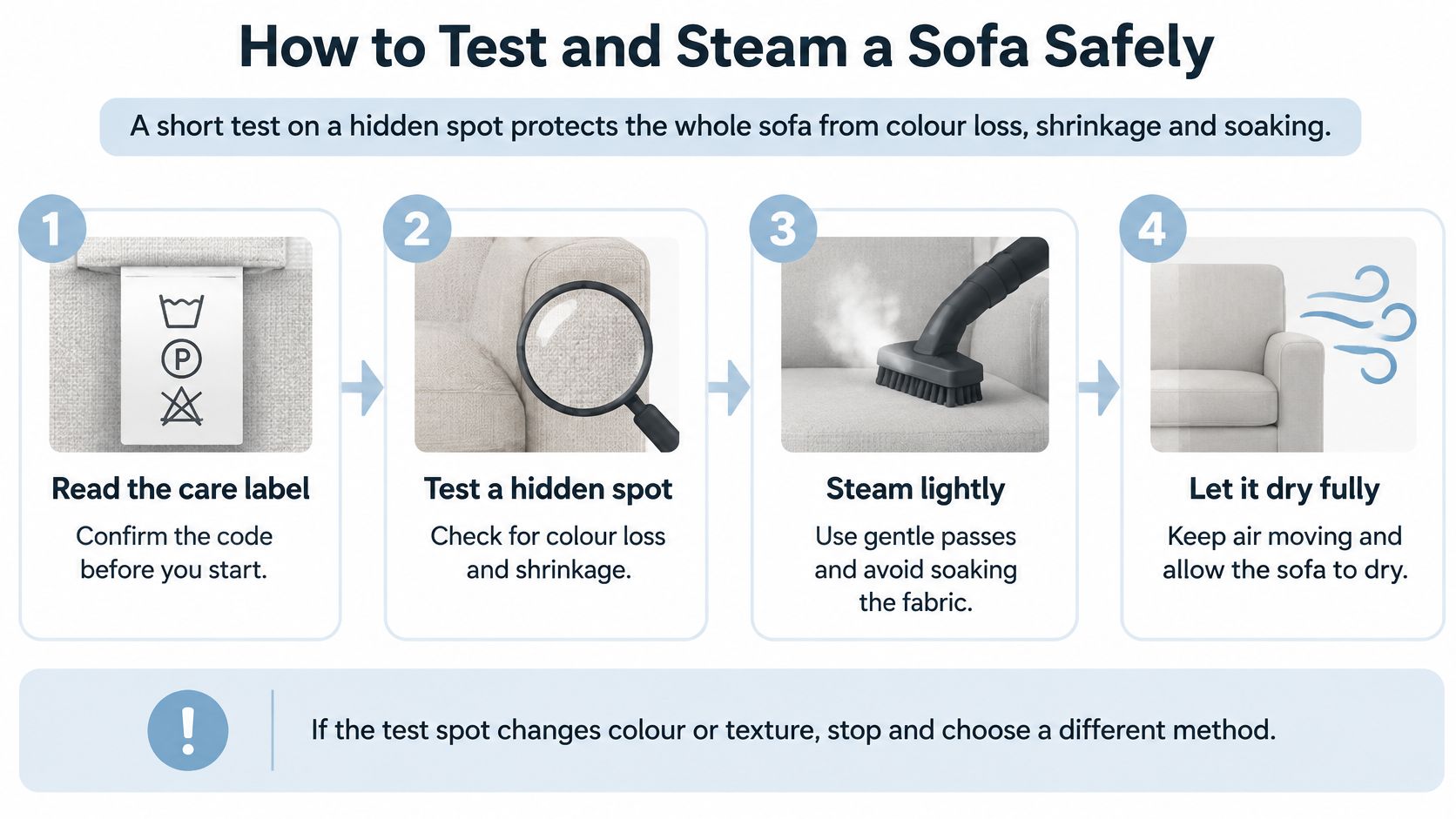
A hidden-spot test on a fabric sofa checks for colour loss, shrinkage and texture changes before you expose the visible upholstery to steam. The test only makes sense after the manufacturer has confirmed the cleaning method is suitable.
Evans Vanodine's soft-furnishing guidance warns that live steam can affect colour-fastness and fabric shape. Keep moisture delivery controlled and allow treated upholstery to dry completely before assessing the result.
Use this sequence as a reminder of the key checks.
Test before treating visible fabric
- Read the care instructions. Confirm permission for water-based cleaning and heat, not merely a familiar-looking fabric name. The usual mistake is treating an upholstery attachment as proof that every sofa is compatible.
- Vacuum with suitable particle filtration. Remove loose grit from the seat, seams and cushion edges before introducing moisture. Leaving dust behind can turn loose soil into a smeared residue.
- Choose a hidden area. Use matching upholstery beneath a cushion or behind the seat, not a different underside lining. Fit the upholstery tool and apply a brief, controlled pass at the lowest suitable output.
- Check colour and let the patch dry. Press a clean white cloth against the tested area without rubbing, then examine the dried fabric for shrinkage, stiffness, flattened texture or a changed sheen. Stop if dye transfers or the patch feels different.
Work lightly rather than chasing a wet result
- Keep the nozzle moving. Use short, narrow, overlapping strips and release the trigger when you pause or reposition. Lingering over a mark is a common way to drive moisture past the face fabric.
- Treat one area at a time. Check the surface and the bonnet as you work, replacing a dirty bonnet rather than spreading residue. Don't scrub harder or increase output because an old stain remains visible.
- Stop before the fabric becomes wet. A lightly damp surface is the limit, not a target to keep adding to. Let the sofa dry fully before sitting on it or replacing decorative textiles.
For preparation and maintenance beyond steam treatment, follow our full fabric-sofa cleaning routine.
The accompanying video offers another visual reference for the process, but your sofa's instructions remain the deciding authority.
Judge the result only when dry
Take before-and-after photographs from the same position in the same light, including close-ups of the marked areas. Wet upholstery often looks darker, so an immediate photograph can misrepresent the outcome.
Record visible staining, residual odour and how long drying takes. Dirty extraction water shows that material was removed, but it doesn't quantify how clean the sofa is.
The hidden-spot test passes only when the white cloth shows no colour transfer and the fully dried fabric looks and feels unchanged.
Why Does a Steamed Sofa Stay Damp?
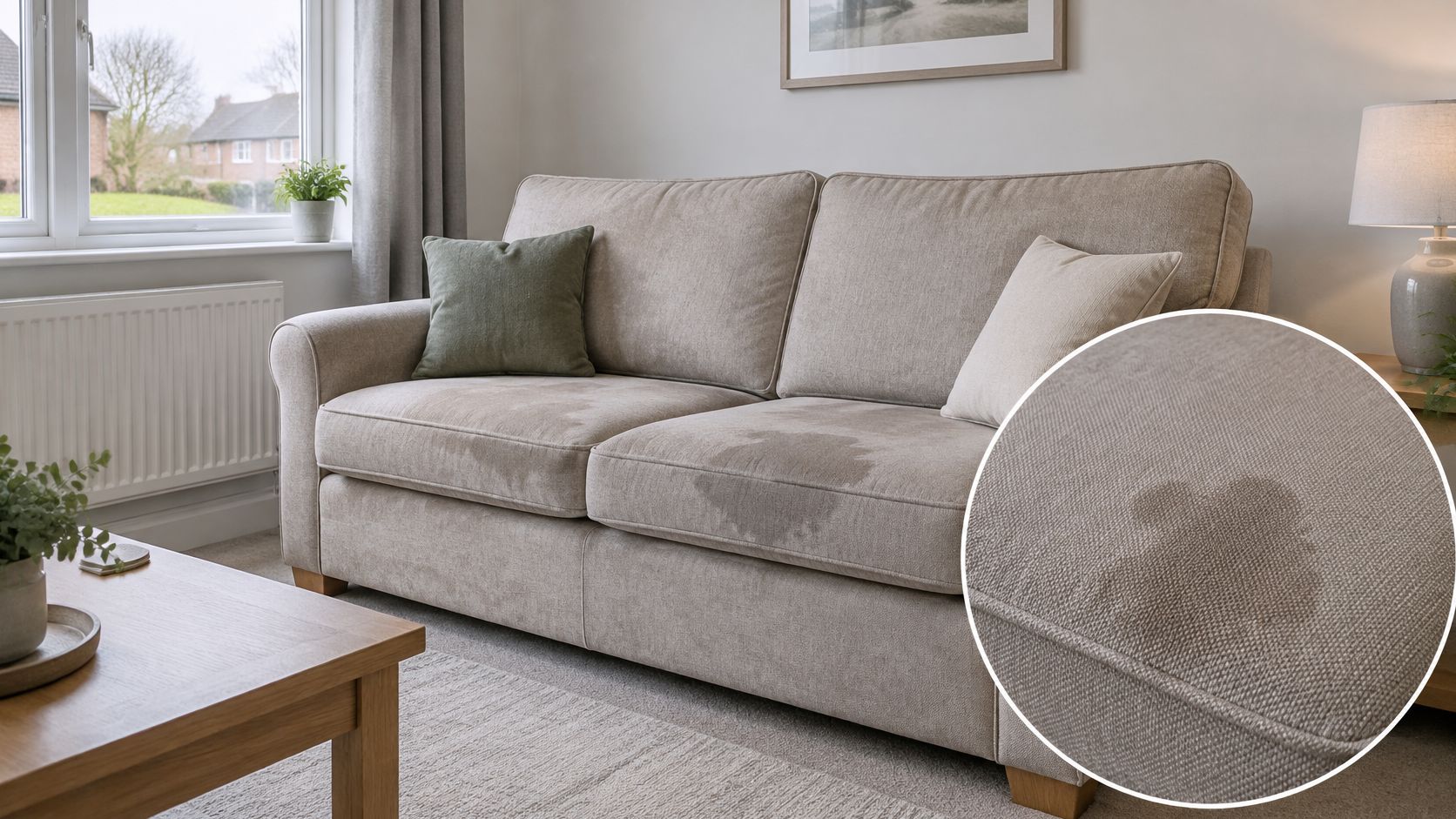
A steamed sofa stays damp when too much moisture reaches the foam and backing and can't escape readily; more steam doesn't mean a cleaner sofa. As moisture wicks back towards the surface during drying, it can carry dissolved soil with it and make a stain reappear.
Thick cushions, dense foam, humid winter conditions and poorly ventilated flats make moisture management harder. A dry-feeling face fabric doesn't establish that the filling beneath it is dry.
Good Housekeeping's fabric-sofa advice warns that saturating upholstery can encourage mould and recommends ventilation and complete drying before reuse.
A returning mark can reflect moisture movement rather than a need for another round of steam.
Give moisture a route out
- Separate loose cushions. Where the sofa design permits, lift them away from the base so air can reach more than the upper surface.
- Ventilate the room. Open windows when conditions allow and run a fan across the seat, rather than leaving damp upholstery in still air.
- Leave textiles off. Heavy throws, pillows and protective covers restrict airflow when placed back too soon.
- Avoid concentrated heat. Don't push cushions against radiators or try to bake the surface dry.
- Check beneath the surface. Feel accessible cushion edges and undersides; if you can't establish that the filling is dry, don't return the sofa to use.
Watch for musty odour, dark patches or persistent dampness days later. Don't disguise these with fragrance or repeatedly wet the same area.
Established mould needs a different response from ordinary dirt. Very mouldy cushions or fabrics may need to be discarded, and salvageable materials require appropriate cleaning and complete drying rather than another superficial refresh.
If you can't provide reliable drying conditions, postpone wet cleaning rather than hoping the sofa will dry between uses.
Thorough vacuuming, permitted spot treatment and a removable washable cover can be a lower-moisture maintenance route. A cover must only go onto dry upholstery; it isn't a way to hide trapped moisture.
How Do You Look After a Steam Cleaner Between Uses?
A steam cleaner stays reliable when you empty and dry it as its manual directs, clean the accessories and follow the specified descaling schedule and water requirements. Safe shutdown comes first, especially with a pressurised tank.
- Cool and depressurise safely. Switch off and unplug the machine, then wait until the manual says the tank can be opened. Empty leftover water only where the manufacturer instructs you to do so.
- Wash the microfibre bonnet, or replace it if it's worn. Let it dry completely before storage so you don't begin the next job with a dirty, damp contact surface.
- Inspect the nozzle. Wipe away residue and check for blockages using the manufacturer's approved method. Don't force a sharp object into the outlet.
- Check the hose and cable before the next session. Kinks, cracks, leaks or damaged insulation are reasons to stop using the cleaner.
- Store dry and secure. Keep the unit upright where specified, with accessories clean and the cable loosely arranged rather than tightly bent.
Keep maintenance predictable
Use the water type stated in the manual and descale only with an approved method. Mineral build-up can interfere with consistent output; adding household chemicals to a tank without permission can create another problem.
For rental turnovers, store the cooled, dry machine and clean bonnets in a labelled box. Record which sofa was treated, the method used and when it was released for use, while scheduling cleaning with enough separation from the next booking.
Uneven output from a neglected cleaner defeats the purpose of buying precise steam control.
Should You Steam a Stretch Sofa Cover?
A heat mark or slack patch can leave a stretch cover sitting unevenly. Keep the cover out of the steam path: heat may reduce the recovery of elastane fibres, and a steamer is difficult to use without concentrating heat on one spot.
The Sofa Cover Crafter's stretch covers are machine-washable. Remove the cover and follow its care label rather than steaming it in place.
Wash the removable layer instead
- Remove dry pet hair first, then take the cover off the sofa.
- Machine wash it cold on a gentle cycle. Do not bleach it.
- Line dry, or tumble dry on low. Avoid high heat.
- Refit the cover once dry, smoothing the fabric evenly instead of pulling hard at one seam.
See the guide to washing sofa covers without shrinking for more on handling and drying. Check the care label on each item, since instructions can differ between textiles.
For pet hair, use the reusable sticky lint roller on the dry cover before washing. This removes loose hair without adding moisture.
Check the size guide before ordering a cover. Arm shape, backrest arrangement and moving sections all affect fit, and stretch fabric may not suit every sofa configuration. Remove the cover before steaming fixed upholstery, and only proceed if the sofa's manufacturer permits water and heat.
Should You Buy a Steam Cleaner, Hire a Professional or Use a Washable Cover?
The right option depends on what needs attention: fixed upholstery, a difficult stain or routine protection. Buy a steam cleaner only if the sofa's care instructions permit steam and you can dry it fully. For everyday spills and wear, a removable washable cover avoids routinely adding moisture to the fixed fabric.
Cleaning routes compared
| Route | Best for | Main trade-off | Suits |
|---|---|---|---|
| Own low-moisture steam cleaner | Regular refreshes on fabrics approved for water and heat | Requires careful technique and full drying | Owners with W or WS labels and confirmed steam permission |
| Professional upholstery cleaning | Deep cleaning, unknown fabrics or missing labels | Requires a booking and a separate charge per visit | Landlords and hosts who need advice on suitable treatment |
| Washable stretch cover | Daily protection and quick resets | Does not clean the fixed upholstery underneath | Families, pet owners and short-let hosts |
| Water-resistant cover, if the listing states it | Spills and pet mess | Check the finish and fit on the listing and size guide | Renters and hosts wanting spill defence |
Choose a route, not a power tier
A handheld cleaner can keep the initial commitment modest, but check its tank capacity and control over moisture. A compact cylinder may provide more reach and attachments. An extractor also recovers liquid, which affects the drying process.
If you hire a professional, ask what method they plan to use and how long drying is expected to take. For a UK home needing a wider deep clean alongside upholstery care, you can find intensive house cleaning. Check that any provider you contact serves your area and can advise separately on upholstery treatment.
Keep rental furnishing care documented
The UK government's sleeping-accommodation fire-safety guide explains that sofas and sofa beds fall under the Furniture and Furnishings (Fire) (Safety) Regulations 1988 and warns that flame-retardant treatments can have a limited wash life. Follow the manufacturer's or supplier's cleaning instructions. If treatment status is uncertain, seek confirmation from a UKAS-accredited organisation.
Water-repellent sofa covers provide extra defence against spills and pet mess. Check the product listing, since not every washable cover has this finish.
The Sofa Cover Crafter offers machine-washable sofa covers, cushion covers and pillow covers for everyday protection. Check the product details and size guide to choose a washable layer that fits your sofa.
