



Skip the candle mountain. A hygge living room is calm and lived-in, built from warm low light, natural materials, soft textures and a sofa for curling up.
Buying more blankets is decorating. Living here means the room works on a Tuesday with a muddy dog and a friend who stays for tea. Start with lamps, washable covers and seat placement. Throws help the mood. Heat and ventilation do the warming.
Table of Contents
- What Does Hygge Mean in a Living Room?
- Where Should Lighting Start in a Hygge Living Room?
- How Do You Set Up the Sofa as the Hygge Centre?
- Which Textures and Colours Build a Warm Hygge Palette?
- How Should a Throw Be Draped and Which Length Should You Buy?
- How Many Cushions Should You Use and Which Covers Suit Them?
- How Do You Keep a Hygge Room Cosy All Year?
What Does Hygge Mean in a Living Room?
In a living room, hygge means comfort over show: a calm, lived-in space made from warm low light at several points, natural materials, soft textures and a sofa you can curl up on.
Candles and a folded blanket can look the part in a photograph. They don't make the room easy to use. Ease comes from how you place the seat, where the light falls, and whether someone can sit down without rearranging a display. Treat the mood as something you build room by room rather than in a single shopping trip.
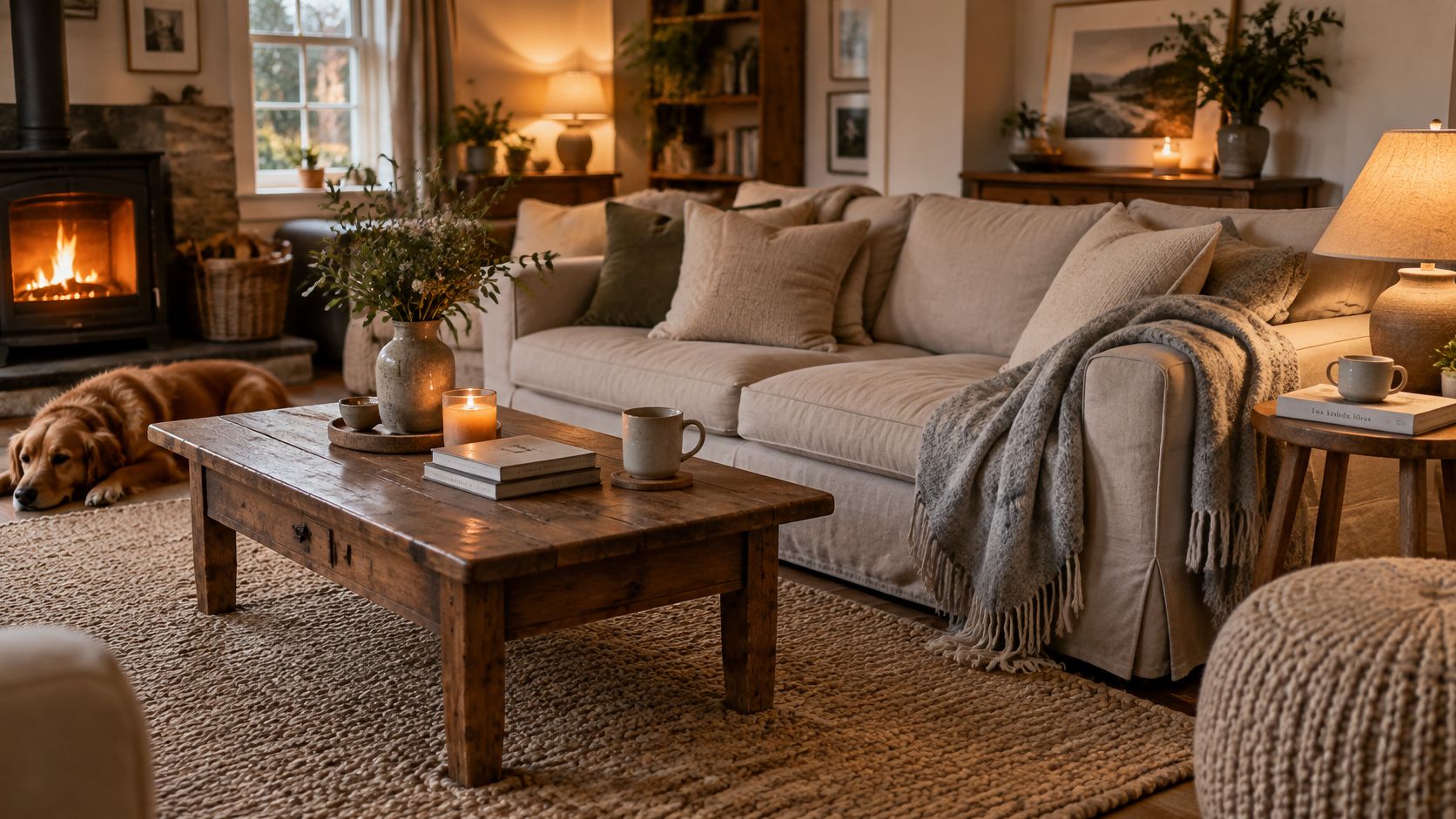
Because the living room is already the room people love and use most, a throw, a few cushion covers and better lamps change more than a new coffee table. You're improving a room that already matters. That's cheaper, and it's reversible, which matters if you rent, host guests, or share the sofa with children and pets.
The order that actually works
Work in this order, and stop when the room feels easy.
- Light first. Several low, warm lamps before you touch the sofa.
- The sofa next. Place it so people can talk, with air behind it and one seat left free.
- Texture, then colour. Three different surfaces beat three matching shades.
- One throw, draped loose. Length is the only size decision that matters.
- Odd cushions. Mixed covers, not a matched set.
- A five-minute reset. Loosen, ventilate, and change a layer with the season.
By the end you'll know what to buy, where to put it, and what to leave alone. You won't need a new sofa, and you won't be styling a room you then feel you can't sit in.
Where Should Lighting Start in a Hygge Living Room?
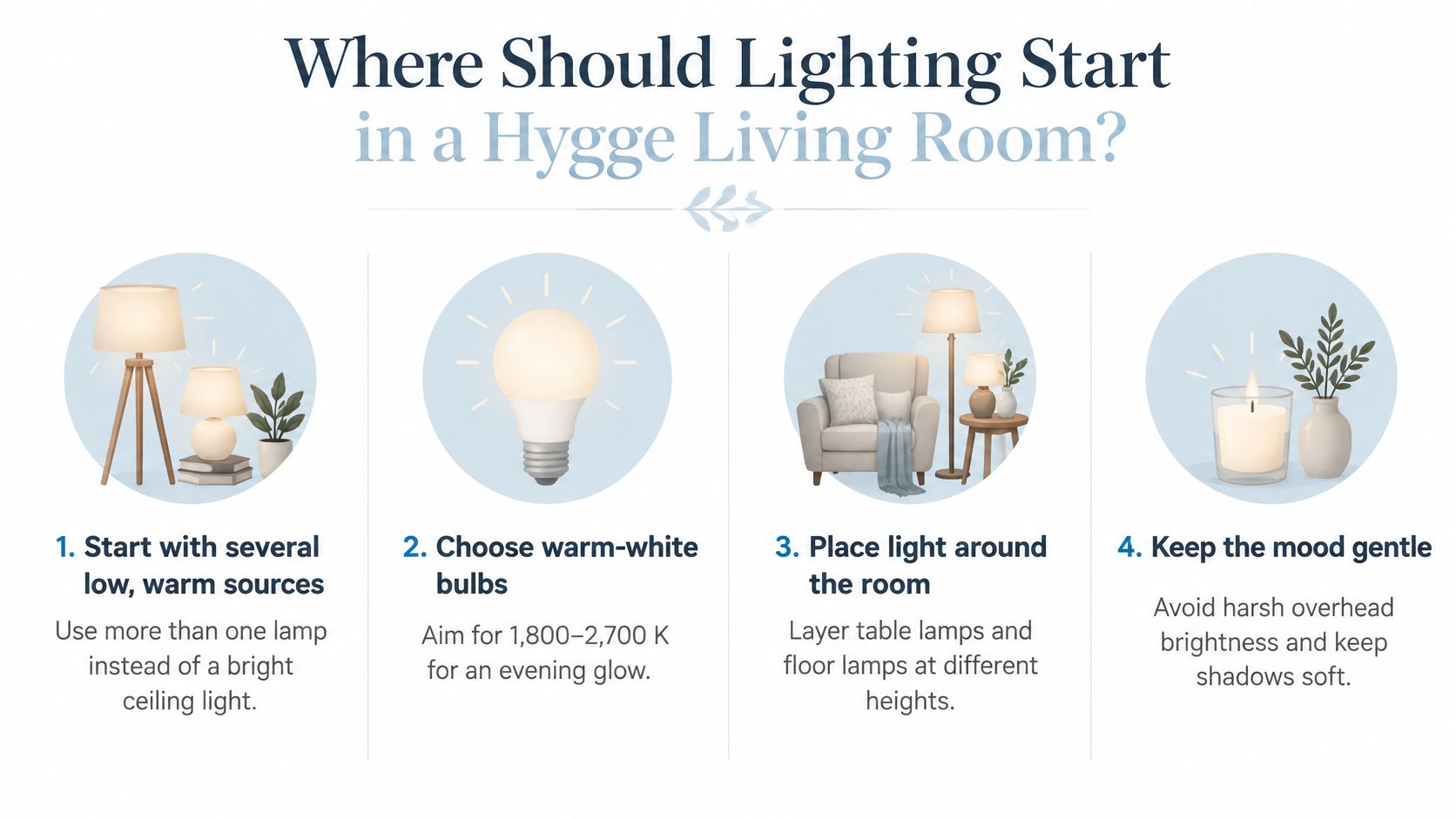
Lighting in a hygge living room starts with several low, warm lamps, not one bright ceiling light.
A single overhead fitting flattens the room and makes every texture look the same. Warm light in small pools does the opposite. People sit inside the pool, the corners stay quiet, and that shelter costs less than new furniture.
In the Brighton lighting-colour study, a chamber held at 18°C tested three colour temperatures on 60 people: 1,800 K warm light scored the highest early comfort vote, 1.13 after ten minutes, against 0.96 for 4,000 K neutral and 0.78 for 6,500 K cool, with overall thermal acceptability at 82.32%. The gap between the three shrank as time passed, so read it as a limit: lamps support a warm room. They don't replace the heating.
Where each lamp goes
Put the first lamp on a side table at the end of the sofa, about seated eye height. Put a second lamp lower, on the floor in a corner or behind the sofa if the cable is safe, so the light comes from a different height. A third can sit near a chair further back.
Fit warm-white bulbs around 1,800–2,700 K for the evening, on dimmers, so you can drop the level once everyone has settled. Keep one brighter, neutral lamp by the seat where someone reads or does a puzzle. Ask the warm lamps to do that job as well and you'll turn them up and lose the mood.
Switch the ceiling light off after dusk. If your ceiling is tall and the downlights feel harsh, the same principle is covered in lighting for high ceilings: spread the sources, don't fight the height with one bright point.
Lamps and candles are general fittings, not something this shop sells. If you use candles, treat each one as a small extra pool of light and keep it off the textiles. One or two is enough. A mantel full of them is a display, and you'll stop lighting them.
How Do You Set Up the Sofa as the Hygge Centre?
Set the sofa up as the hygge centre by placing it where people can sit and talk, with a clear view of the lamps, a small gap off any external wall, and one seat left visibly open.
Face it towards the people in the room. If the only seat with a view of the screen is the one everyone wants, the room becomes a queue. Angle it so two people can look at each other without twisting, and so the side-table lamp sits in their sightline. Treat that lamp as part of the seating.
Leave a gap, and don't block the heat
Pull the sofa a little off an outside wall, because a heavy back pressed against cold plaster traps still air where damp collects. The WHO Europe damp and mould brochure, published by Wolverhampton City Council, recommends moving furniture slightly away from the wall so air can pass behind it. The same rule applies to radiators and vents. A throw draped down the back is fine. A throw stuffed behind the sofa against a cold wall is not.
Practical rule: If you can't slide a hand between the sofa and the wall, it's too close.
Leave one seat clear of cushions. A sofa that is fully dressed looks finished and slightly closed. An open seat says someone can land there with a book, and it gives you somewhere to put the throw when you stand up.
For the base, use a neutral stretch cover from the sofa covers collection and let the throw and cushions carry the colour. A quiet base is easier to live with than a patterned one you'll tire of, and a washable cover is what makes a sofa survivable in a house with kids, pets or regular guests. Check the listed fit before you buy. A cover will not suit every L-shape, recliner or unusual frame, and guessing is how people end up with a cover that bags at the arms.
If the seat itself feels tired, this guide on making a sofa more comfortable covers the fixes that don't involve a new frame. Placement and a washable layer come before any new foam or cushions you don't need.
Which Textures and Colours Build a Warm Hygge Palette?
A warm hygge palette is built on texture first, then a few shades from one family, plus a single dark anchor so the room doesn't look washed out.
Most people refresh a sofa by changing the colours. The bigger change is putting different surfaces side by side. Velvet next to a bobble cover next to a smoother throw gives the lamp something to catch. Flat, matching sets don't.
"Texture, not colour. A sofa with three textures looks more expensive than one with three matching colours, because each texture catches the light differently."
One family, then one dark note
Build the sofa in shades of the same family, like oatmeal, sand, caramel and chocolate, so the room looks layered rather than flat. "Beige" began as the French word for undyed natural wool, which is why those tones sit easily beside wood, jute, linen and stone. You don't have to own all of those. A timber side table and a sand-coloured throw are enough to start.
Velvet's pile is the fastest way to make a plain sofa look deliberate. The pile tips towards the lamp and away from it, so a deep brown or green reads richer at night than the same colour in a flat weave. Use that on the cushions, not on every surface, or the room goes glossy.
Quiet throw colours that stay inside this family:
- Norka Sofa Throw: Moon Beige, Eggshell, Espresso Brown.
- Mousoon Sofa Throw: Milk Tea, Off-White.
- Herpome Sofa Throw: Honey Brown, Cloud Grey.
- Coveri Sofa Throw: Caramel, Beige.
- Elaris Sofa Throw: Cream White.
Then add one dark anchor. A black lamp, a dark wood side table or a charcoal cushion. That's what stops a neutral room looking pale and unfinished. The lamp and the table are ordinary household pieces, not shop lines here. If you want the reasoning on how cloth behaves in the hand, this note on the texture of fabrics is the longer version. Pick three textures. Stop.
How Should a Throw Be Draped and Which Length Should You Buy?
Choose the length for the sofa you own, then drape it where a hand would reach for it. Hygge is use, not styling, so the throw should look ready for knees, feet and guests rather than arranged for a photo.
Every throw is 180 cm across. That figure doesn't change. You're choosing a length, not a shape. The short one is an arm throw. The long one is a full-back throw. Buying "the biggest" on a two-seat sofa only gives you cloth on the floor.
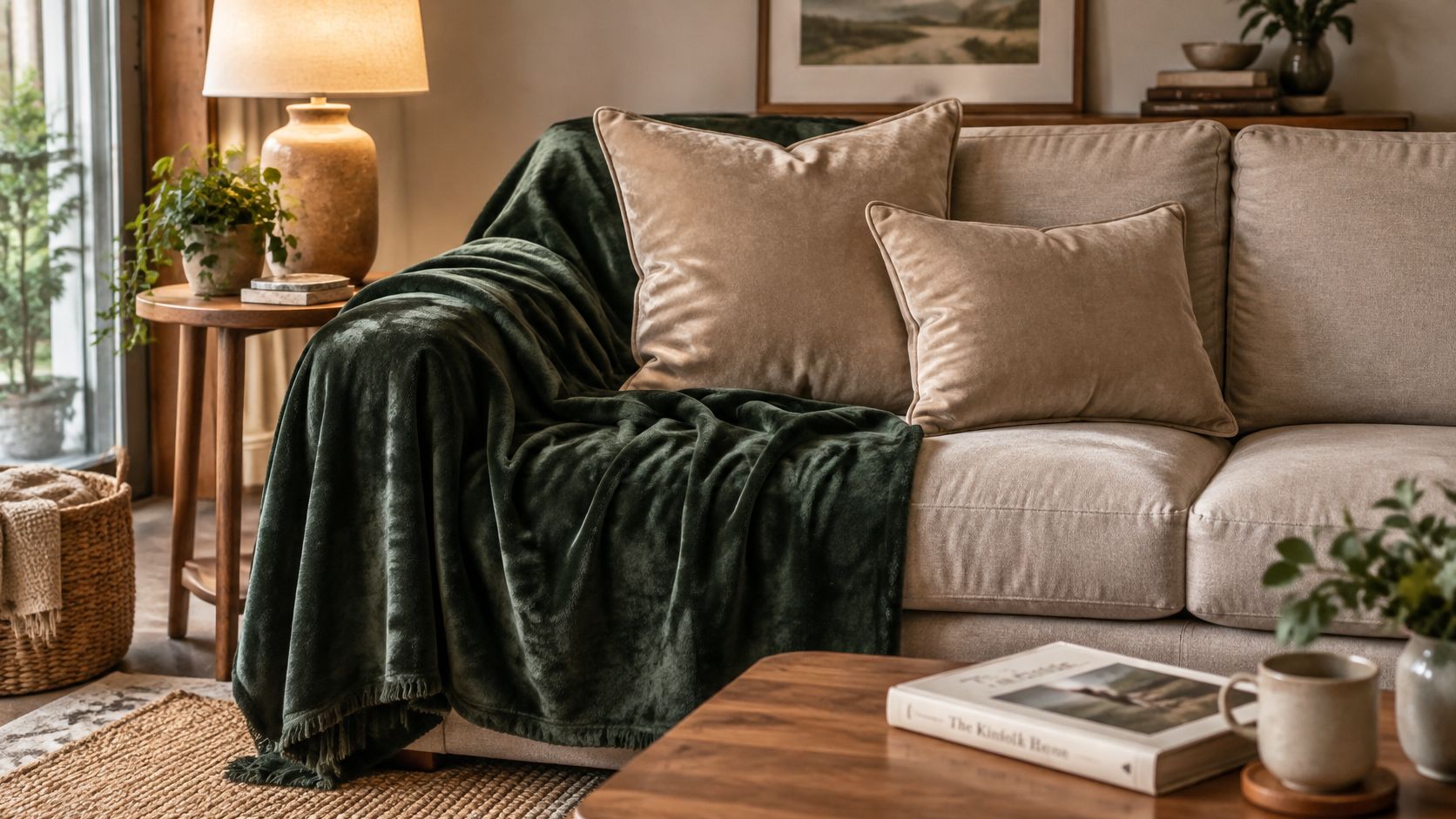
| Length | What it does on the sofa |
|---|---|
| 180×130 cm | Folds over one arm or one corner. The lived-in size. |
| 180×230 cm | Covers a standard seat and drops over the arm. |
| 180×300 cm | Suits a mid-sized sofa without pooling on the floor. |
| 180×420 cm | Runs the full back of a large sofa. |
Drop it from the back corner so one end hangs longer than the other. Don't centre it. Don't tuck both ends. If you want it over a lap later, the corner drape is already in reach.
"A throw thrown loosely over one corner looks like someone lives there. One folded into a perfect square looks like a hotel."
Renters and families should pick cloth they can wash and move, then place it where evening sitting happens. A throw helps a room feel softer, though it does not do the work of heating or ventilation.
The throw to start with
The lead piece is the Soft Tassel Sofa Throw, a tasselled chenille in Coffee Brown, Pistachio Green, Sandy Tan and Dusty Grey. Chenille's short, soft pile tends to feel warmer on contact than a smooth, flat cloth, which is why it suits a throw you reach for in the evening. Coffee Brown or Sandy Tan sits inside the oatmeal-to-chocolate family. Pistachio is the one break in colour if the room is already all sand.
For a quieter cloth with no tassel, stay with Norka, Mousoon, Herpome, Coveri or Elaris in the shades listed above. Same four lengths, same width. Browse the full set in sofa throws and match the length to the sofa before you match the colour. The wrong length reads accidental even in a good colour, while a plain throw in the right length looks intentional.
How Many Cushions Should You Use and Which Covers Suit Them?
Use an odd number of cushions on the sofa, usually three, in mixed textures such as a velvet pillow cover beside a bobble-textured pillow cover, so the seat looks arranged rather than matched.
Two matching cushions read as a pair you bought in a hurry. Four, lined up, read as a hotel bed. Three lets you mix a smooth pile with a nubbly one and still have a corner free for the throw. Put the largest visual weight, usually the darkest velvet, at the outer end, and the lighter bobble cover towards the open seat.
Both covers are 45 × 45 cm. The Velvet Pillow Cover comes in Brown, Beige, Orange and Dark Green, among other shades. The Bobble-Textured Pillow Cover comes in Beige, Brown, Dark Brown and Forest Green, among others. We sell the covers only. You need your own pads to fill them. A cover without a pad is a flat square, and it won't hold the corner of the sofa.
If the room is already sand and caramel, take Beige or Brown velvet and a Dark Brown bobble. Orange is the one warm interruption, used once, not as a set. Dark Green velvet echoes a green throw without matching it. For a cooler note, a single pale blue cushion sits well against warm woods. Use that as a contrast lesson, then come back to the brown family if you want the room quiet.
Washable covers matter more than a new colour story if children, pets or guests use the seat. A spill becomes a cover in the wash, not a ruined pad.
Hosts and renters get the same benefit from the other direction. Covers come off at the end of a stay or a tenancy. Nothing is fixed to the wall. The pillow covers collection is the place to pick the velvet and the bobble together, so the textures arrive as a pair rather than an afterthought.
How Do You Keep a Hygge Room Cosy All Year?
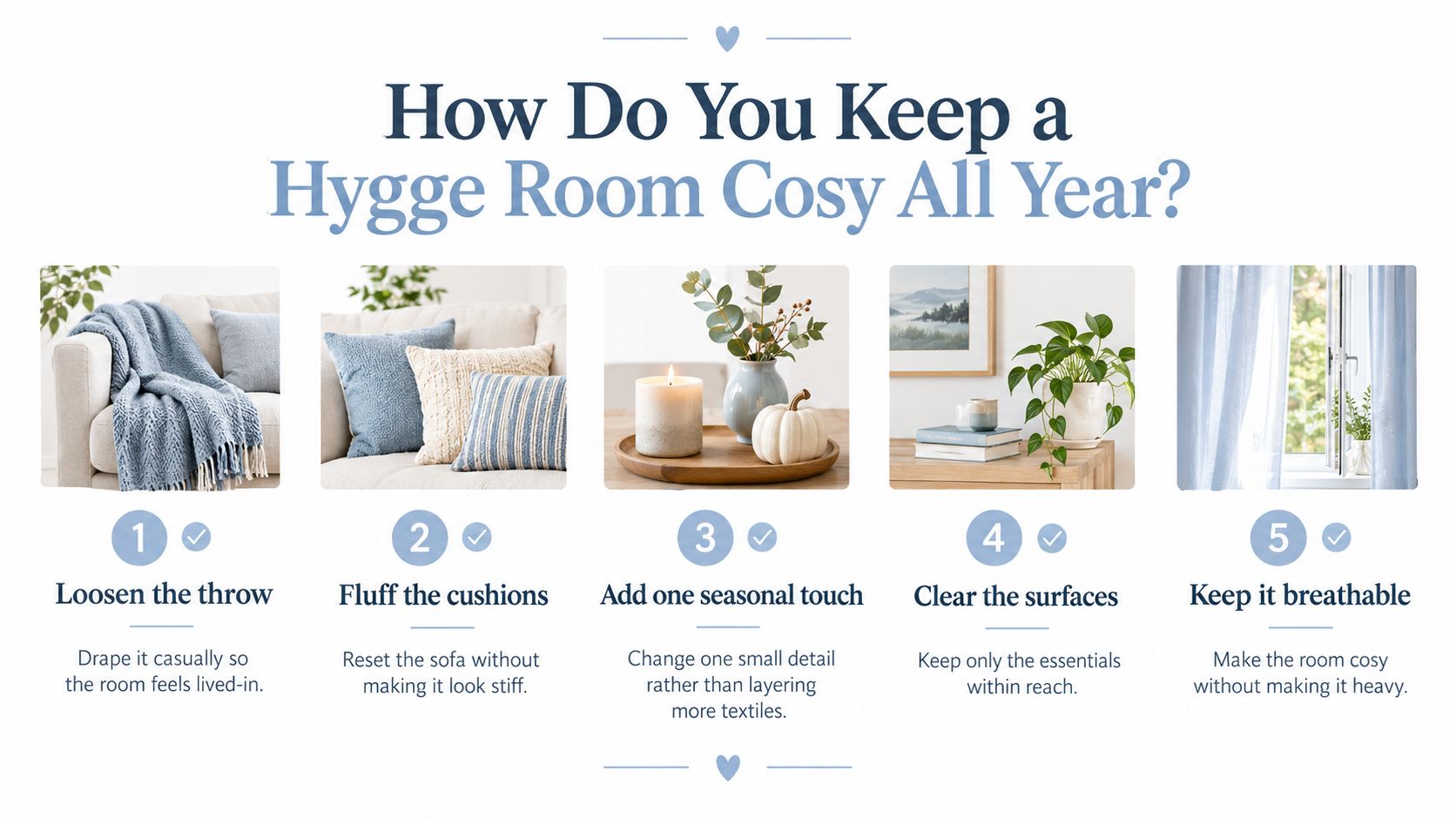
Keep a hygge living room cosy all year with a five-minute evening reset and one small seasonal swap. Reaching for another throw every time the room feels flat only hides the underlying problem.
It's half past six. You walk in, the ceiling light is on, and the throw is in a neat rectangle from the morning. Switch the ceiling off. Turn on the side lamp, then the corner lamp, and leave the reading lamp off until someone sits with a book. Pull the throw off its square and drop it over the near arm, longer at the front. Punch the velvet cushion back into its corners and lean the bobble one against it. Check the radiator isn't wearing a cushion, and that the gap behind the sofa is still a gap.
Open a window for a few minutes, or use the trickle vents. The Centre for Sustainable Energy recommends keeping indoor humidity between 40% and 60%, and warns that mould becomes more likely above 60%. Throws don't remove moisture. A cheap hygrometer by the seating tells you when to ventilate before you add more cloth. Kitchen and bathroom fans should run whenever there's steam, and airbricks stay clear.
Set the thermostat, then add a throw
The Met Office winter home advice says to heat your home to at least 18°C, notes that slightly above that could be good for your health, and stresses this matters most for people aged 65 or over, people with reduced mobility, and people with heart or lung conditions. Set the thermostat so the sitting room holds that line. If it already sits above it, lower the thermostat by 1°C for a week, never below 18°C, and see whether a throw on the seat is enough to stay comfortable. If it is not, the room needs heating, not more cloth.
The English Housing Survey reported that 13% of households couldn't keep the living room comfortably warm in winter, and 12% said the home became uncomfortably hot at some point. Thick layers don't fix a cold house, and they can make a mild evening stuffy. In warmer months, take the longest throw off and keep the short one on the arm. When the room feels chilly, put the longer layer back. For the seasonal dressing itself, use the existing notes on winter decor ideas and autumn decor ideas rather than rebuilding the room twice a year.
Start with a neutral base if the sofa needs a calm ground, and add one throw in the length that matches the seat. Do that before you buy a fourth cushion.
The Sofa Cover Crafter sells washable sofa covers, sofa throws and cushion covers for a living room you can sit in, including the Soft Tassel chenille and quiet neutral throws sized by length. If the sofa is the centre of your hygge living room, start with a calm base and one loose throw rather than a new suite. Browse our sofa throws and pick the length that fits the seat you have.
