



Choose the 1 seater stretch armchair cover size for a standard upholstered chair measuring 90–130 cm across the outside of both arms, then choose the fabric for the chair's job. That width band is the starting point, not a promise that every chair shape fits.
Perhaps the chair still feels comfortable, but the arms look tired, the dog has claimed the seat, or the colour no longer suits the room. If you searched for “armchair covers The Range”, we're an independent shop, aren't affiliated with that retailer and don't sell through it. Our advice is straightforward: establish whether your chair suits a stretch cover, then decide whether appearance, claws, cleaning or accidents should determine the cloth.
Table of Contents
- What the Armchair Cover Range Actually Covers
- Does a Stretch Cover Fit Any Armchair Shape
- Which Fabric Should You Choose for Your Armchair
- Which Armchair Cover Actually Survives Pets and Spills
- Do Reclining Armchairs Need a Different Cover
- How Do You Fit an Armchair Cover So It Stays Put
- What Should an Airbnb Host Buy for an Armchair
- Frequently Asked Questions About Armchair Covers
What the Armchair Cover Range Actually Covers
Our armchair covers are the 1 seater size of our stretch sofa covers, rather than a separate collection of miniature sofa products. Every fabric family offered in that size can be considered for a compatible standard upholstered armchair.
That includes Velvet, Jacquard, Diamond Jacquard, Original Jacquard, Crosshatch, Flecked, Bobble-Textured, Luma, Gridelle and Classic Stretch, alongside the printed designs. You'll find those choices within our stretch sofa cover collection, selecting the armchair-sized option on the individual product.
Start with the chair's job
Don't treat all those names as interchangeable colour collections. A decorative reading chair and the family dog's favourite seat need different surfaces, even when their measurements match.
- Accent chair: Start with appearance and how the fabric follows the arms.
- Busy household chair: Prioritise a surface that suits frequent use and your cleaning routine.
- Pet chair: Decide whether liquid accidents or claws and hair are the main problem.
- Moving chair: Check the dedicated recliner category rather than choosing by width alone.
A stretch cover follows the existing upholstered shape through fabric tension and tucking; a loose cover uses a different construction and fit.
The compatibility graphic provides a broad visual overview, but its wingback and tub-chair labels aren't product-specific fit approval. Don't order for wings, a high back or an unusually curved shell without explicit compatibility information for that cover.
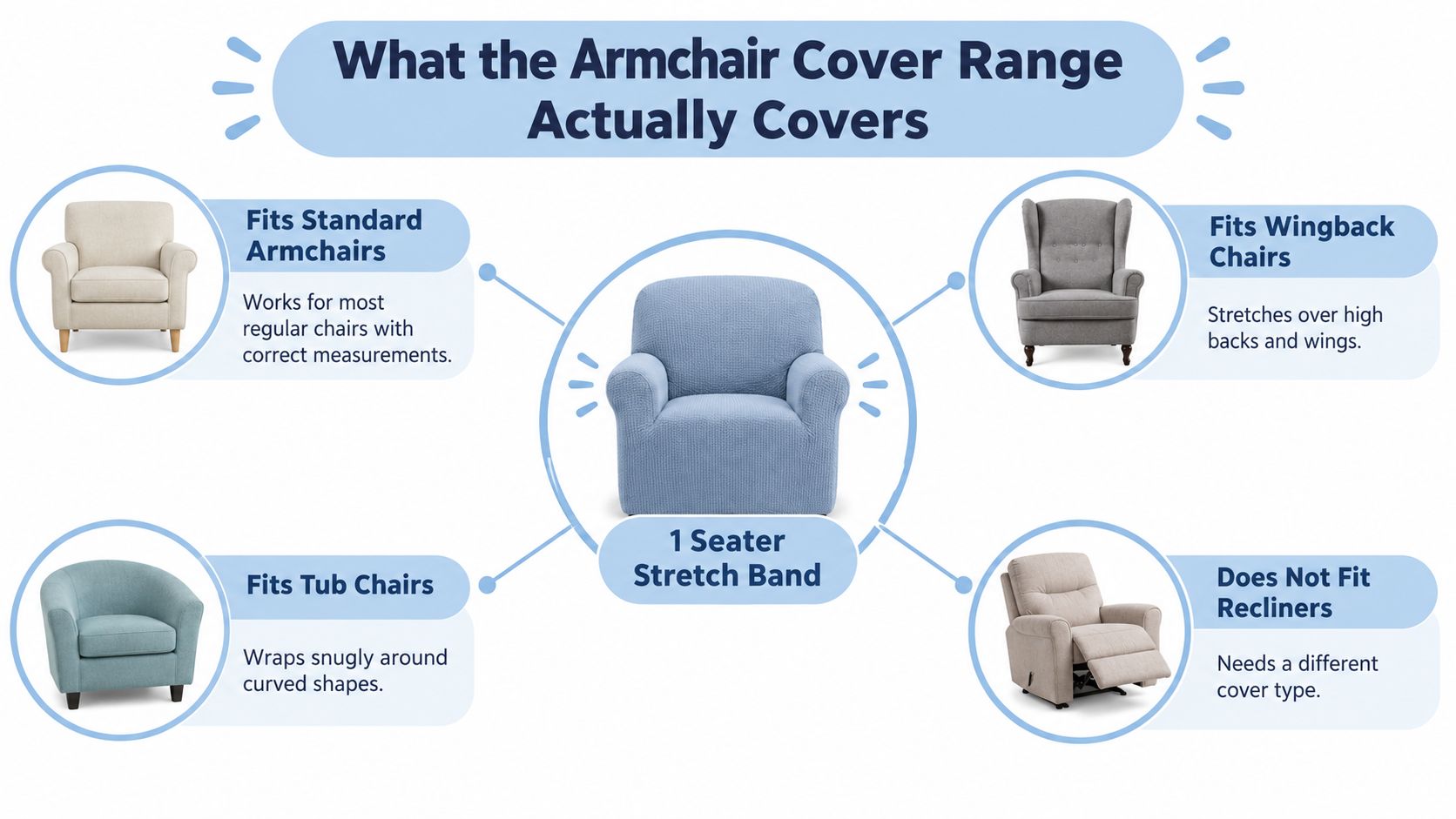
Buying rule: A fabric family tells you what you're choosing to live with. A size chart tells you whether you should order it.
A removable cover can refresh and protect a sound chair, but it can't correct collapsed padding or a loose frame. Keep that distinction clear before spending time choosing a texture.
Does a Stretch Cover Fit Any Armchair Shape
No, a 1 seater stretch armchair cover is intended for a compatible standard upholstered armchair, not every chair shape: a recliner needs its own dedicated cover, and wings or a high back need checking against the product's chart. Measure the whole chair before choosing a fabric, because a familiar-looking silhouette can hide a deep seat or bulky arms.
Measure the outside, not the sitting space
Place the tape across the outside of both arms at the widest point. Don't measure only the cushion, follow the curve over the back, or use the gap between the arms as the overall width.
Our stretch chair cover guidance supports that measurement-first approach. Compare your result with the selected product's chart, then check the remaining dimensions rather than assuming width settles everything.
Use the collection view to identify the product and its sizing information before ordering.
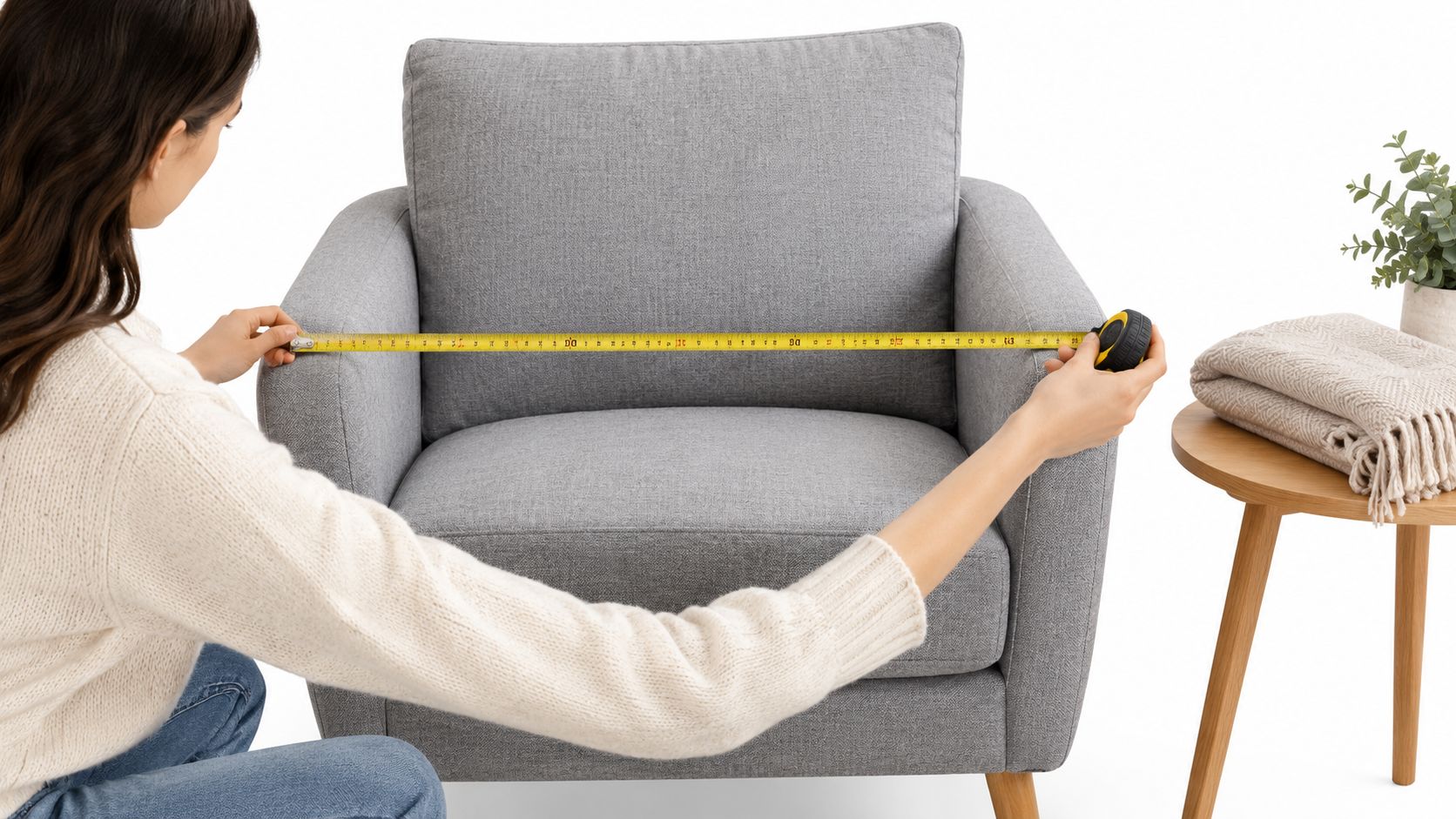
- Overall width controls tension: Excessive stretching leaves less fabric available around the arms and back.
- Seat depth controls the tuck: A deep sitting area can consume fabric you need at the seat junctions.
- Seat height affects coverage: The fabric must reach around the chair without pulling the lower edge upwards during use.
- Back and arm shape affect distribution: Wings, pronounced curves and unusual proportions need their own compatibility confirmation.
These relationships matter more than a generic “standard armchair” label. Excessive tension can increase seam loading and leave upholstery exposed, which is why the chair's dimensions and the product's own instructions matter more than the label.
For example, the Velvet Sofa Cover in Dark Green is a machine-washable velvet option, but its adaptable construction isn't permission to ignore the chair's shape. Choose the correct size first and assess its velvet surface separately.
If your chair falls outside the stated chart or has no usable seat crevices, stop before ordering. More stretch isn't a reliable correction for the wrong geometry.
Which Fabric Should You Choose for Your Armchair
Choose Velvet for appearance and drape, woven jacquard for a busy chair exposed to claws and hair, Classic Stretch for a plain washable surface, and Pebble-Textured Waterproof for spills and accidents. Those are different priorities, so pick the main problem before comparing colours.
Armchair Cover Range at a Glance
| Fabric family | Best for | Trade-off |
|---|---|---|
| Velvet | A decorative chair, especially with rolled arms | Shows pressure marks and paw prints |
| Jacquard, Diamond Jacquard and Original Jacquard | A busy chair where a flat patterned surface is useful | The woven figure has a more visible character than plain cloth |
| Classic Stretch | A smooth, plain face and straightforward washing routine | Doesn't provide the patterned disguise of jacquard |
| Pebble-Textured Waterproof | Liquid accidents and spill protection | Raised texture gives claws something to hook |
| Crosshatch, Flecked, Bobble-Textured, Luma and Gridelle | Choosing a particular surface or decorative effect | Don't infer waterproof performance from texture |
| Printed designs | Bringing a visible pattern into the room | A printed design isn't the same construction as a woven jacquard |
Velvet is my choice for a rolled-arm accent chair. It drapes into that curve particularly well and gives the surface a soft, directional appearance. Choose it because you like the pile, not because you expect the surface to remain visually unchanged after every sitting.
The jacquards have a figure woven into the cloth on a stretch base. That distinction matters: “jacquard” describes how the figure is made, while “stretch” describes the base's ability to accommodate the chair.
Choose construction before colour
Classic Stretch is the plain-face alternative. I'd choose it when the room already contains strong patterns, or when the owner wants an uncomplicated cover to remove and wash rather than another decorative feature.
Printed designs offer a different route to pattern. Don't confuse a printed motif with a woven figure, and don't assume either description establishes liquid protection.
Our sofa cover material guide can help you compare those constructions without treating every stretch textile as the same cloth.
Choose the surface for the person or animal using the chair. Choose the colour for the room afterwards.
For the other named families, judge the actual product photographs and description rather than assigning performance from the name. “Bobble-Textured”, for example, tells you to pay attention to the surface; it doesn't establish a claw-resistance rating or a waterproof barrier.
The sensible shortlist is narrow. Decide whether you need a decorative pile, a woven figure, a plain face or the Waterproof line, then compare the colours available in that group.
Which Armchair Cover Actually Survives Pets and Spills
The strongest pet-chair choices in our armchair-sized range are Pebble-Textured Waterproof for accidents, the woven jacquards for claws and hair, and Classic Stretch for a smooth wash-and-go routine. None should be treated as claw-proof, and those recommendations solve different problems.
Choose a liquid barrier for accidents
If your dog settles into a spill rather than moving away, choose the Pebble-Textured Waterproof Sofa Cover. A dog's weight can press liquid through a water-repellent finish; the waterproof layer is the relevant feature when liquid protection is the priority.
Find the product in our Waterproof sofa cover collection. Its 1 seater size chart uses inches, so follow that chart rather than transferring a centimetre measurement without checking the units.
The compromise is the raised pebble surface. Raised texture gives a claw something to hook, so I wouldn't choose it solely because a pet uses the chair if liquid accidents aren't the actual concern.
The visual below offers a general comparison, but its velvet and water-resistant descriptions shouldn't override the product-specific recommendation: skip velvet for a heavily used pet chair, and don't treat water resistance as waterproofing.
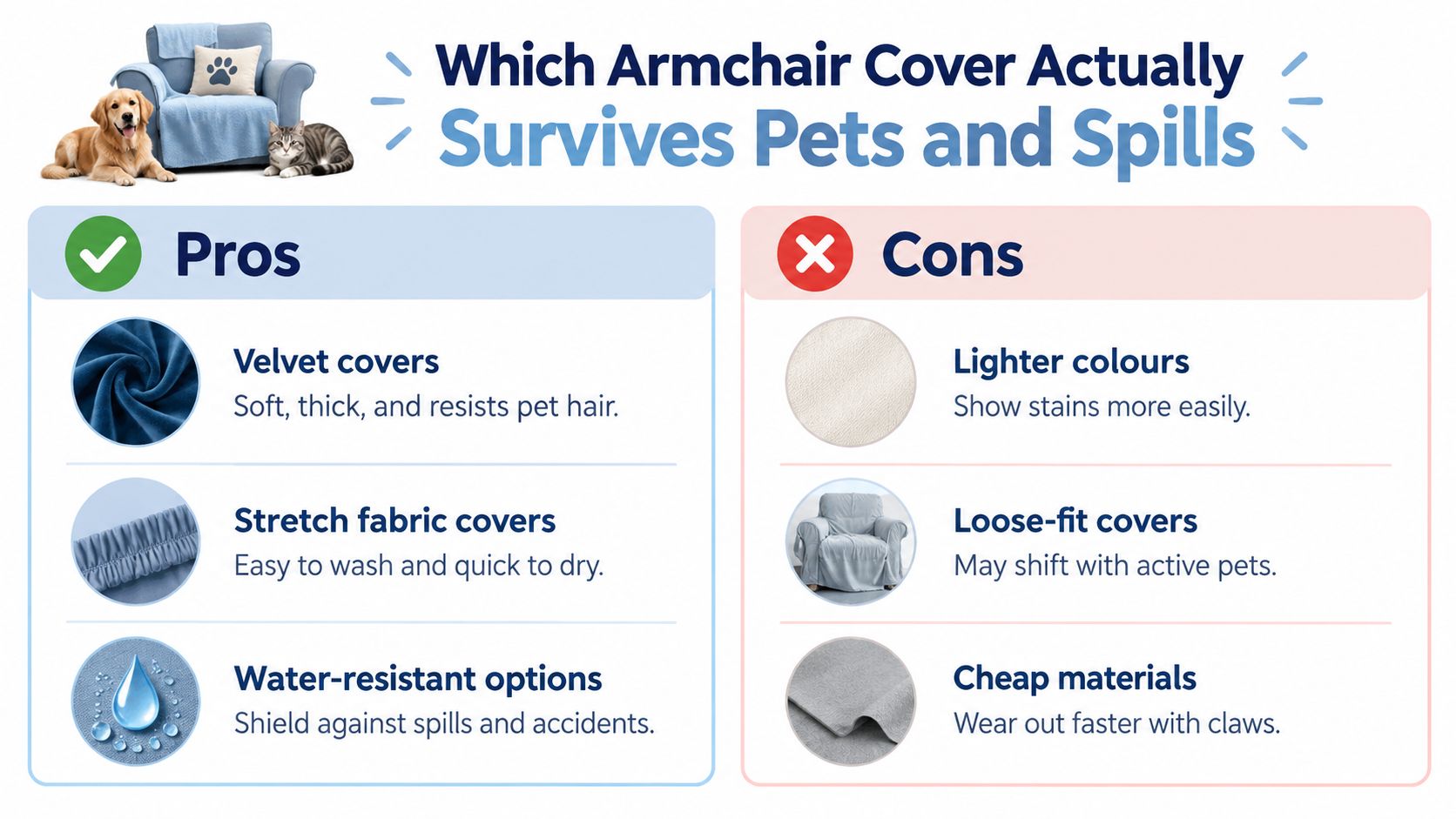
Choose the flatter face for claws and hair
For a chair where the main nuisance is hair and catching claws, I'd favour Jacquard, Diamond Jacquard or Original Jacquard. Their tight, flat faces give claws less to catch, while the woven figure helps disguise hair and small pulls better than a plain colour.
That's a practical preference, not a promise against scratching damage. A pet that actively digs at upholstery can still damage a cover.
Classic Stretch suits a different owner: someone who wants a smooth plain surface and is prepared to remove the cover for cleaning. Follow the supplied care instructions rather than assuming that “machine-washable” permits any programme.
- Frequent accidents: Prioritise the waterproof layer.
- Hair and incidental claw contact: Prioritise a flat woven face.
- Simple removal and cleaning: Consider Classic Stretch.
- Visible paw-print frustration: Avoid velvet's pile.
The Waterproof Sofa Cushion Cover is another option when the chair has a lift-out seat cushion and you only need to cover that cushion. It doesn't protect the whole armchair.
Our waterproof chair cover advice provides more context for that decision. Whatever you choose, remove a cover after contamination and inspect beneath it; a covered surface isn't proof that the underlying upholstery is clean.
Do Reclining Armchairs Need a Different Cover
Yes, reclining armchairs need a dedicated recliner cover because the footrest, mechanism and moving back change the chair's shape during use. A standard 1 seater stretch armchair cover isn't a supported fit for a recliner.
The chair below illustrates the separate furniture category, not a fitted example of the product.
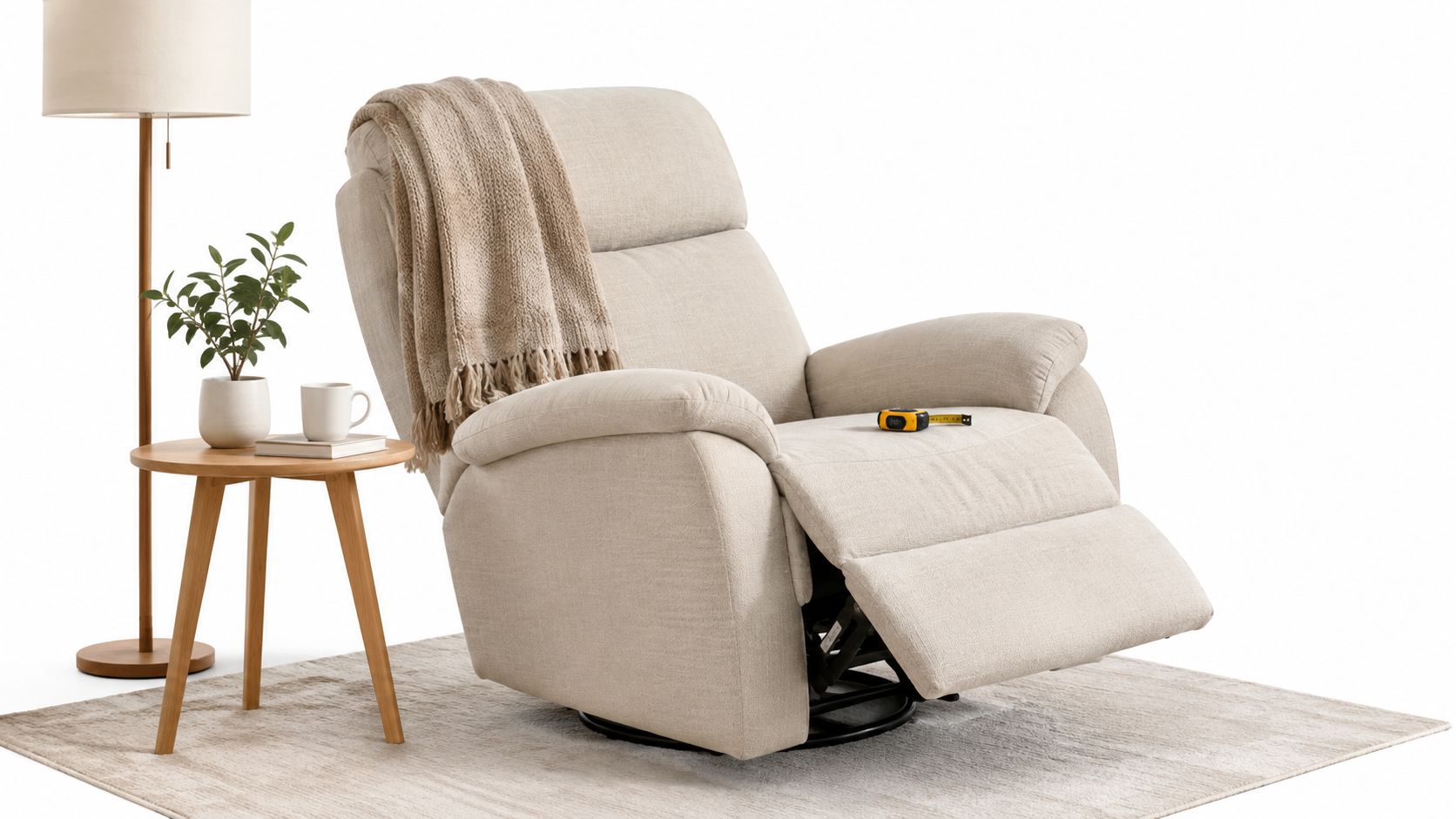
Choose the Interwoven Recliner Cover, available in Normal Size S, M, L and XL, through our reclining armchair cover collection. Those are separate size options, not extensions of the standard stretch-cover width band.
Check the chair while it moves
Compare the recliner with the dedicated product's measurement instructions before ordering. Avoid assuming the correct size from the chair's closed appearance. Do not pick the largest option just to leave extra fabric.
- Back movement: Check that the fitted material doesn't pull tight as the back changes position.
- Footrest travel: Keep fabric clear of the opening and closing mechanism.
- Controls and access: Leave operating controls accessible.
- Final inspection: Stop using the cover if fabric catches or obstructs movement.
The important distinction is movement, not bulk. A wide stationary chair and a reclining chair can look similar from the front but place different demands on a covering.
There's no recliner substitution within the standard stretch range. If the chair reclines, choose the dedicated product and its size chart rather than trying to make a stationary-chair cover work.
How Do You Fit an Armchair Cover So It Stays Put
A stretch armchair cover stays in place through a deep, balanced tuck, not through foam shaping inserts or under-chair clips. We sell neither foam shaping inserts nor under-chair clips or strap kits for these covers.
The anchoring points are the junction between the seat and back, plus the junctions between the seat and each arm. That's where surplus fabric belongs, rather than gathered across the visible sitting surface.
Build the tuck before smoothing the finish
- Orient the cover: Identify the front and back from the product instructions before pulling the fabric over the chair.
- Distribute the fabric: Position the cover evenly around the back and arms instead of stretching everything towards one side.
- Work into the seat junctions: Push surplus fabric into the back and arm crevices.
- Sit and stand: Check whether ordinary use draws the tuck out, then redistribute the cloth before adding accessories.
Don't keep pulling the hem down if doing so empties the seat crevices. You need enough fabric at those anchoring points for the cover to remain seated when someone gets up.
Foam Rods are sold separately. Press them into the same crevices after tucking to help retain the surplus fabric; they're tuck retainers, not inserts for building out the chair's shape.
Fitting check: If you need an accessory to compensate for the wrong dimensions, reassess the size rather than adding more hardware.
Use pads for cushion movement
Anti-Slip Sofa Pads are also sold separately. They sit beneath the seat cushion to help the cushion and cover move together, which addresses a different problem from loose fabric at the back.
After fitting, check the seat, arms and lower edge under normal use. A smooth photograph taken before anyone sits down isn't enough to judge a working fit.
Remove and refit the cover carefully rather than dragging it by a seam. If the fabric remains overstretched, the upholstery stays exposed or the tuck repeatedly disappears, revisit the chair's dimensions and shape.
The accessories support a correctly chosen cover. They don't turn an unsupported chair into a compatible one.
What Should an Airbnb Host Buy for an Armchair
An Airbnb host should choose a coordinating mid-tone, use one colour across properties where practical, and keep two covers per chair in the same size and colour. That's my operational recommendation: a spare makes changeovers simpler than relying on the used cover being ready in time.
For a sound chair with tired-looking arms and a worn-looking seat, I'd start with a plain surface that suits the room. Choose the fabric according to the actual exposure rather than assuming guest accommodation always needs the same cloth.
Set up a repeatable changeover
- Keep the replacement ready: Remove the used cover and fit the clean spare without making laundry the final task before arrival.
- Photograph the base chair: Record its condition before covering it so inspections have a useful reference.
- Inspect beneath the cover: Check padding, seams and frame stability rather than assessing appearance alone.
- Keep the presentation consistent: Use a coordinating mid-tone for a restrained appearance in listing photographs.
For broader hosting preparation beyond furniture, Global vacation rental tips from Global provide additional context for organising a property for guests.
Keep the chair's fire-safety label visible
A removable armchair cover doesn't replace the base chair's compliant upholstery or permanent safety label. The UK furniture fire-safety regulations address covers other than permanent covers, loose and stretch covers included, as well as upholstered furniture.
Keep the chair's permanent label accessible and don't confuse a removable retail display label with permanent compliance information. The government's furniture fire-safety amendment guidance explains the distinction between display-label changes and continuing safety obligations.
Washable and waterproof aren't fire-performance claims. A cover manages appearance and cleaning; it doesn't repair damage or establish the underlying chair's compliance.
Frequently Asked Questions About Armchair Covers
Which 1 seater cover do buyers order most?
The Velvet Sofa Cover in Dark Green is our most-ordered 1 seater cover, accounting for 15% of 1 seater units ordered. That's a first-party ordering figure, not a performance test or proof that velvet suits every household. Use popularity as reassurance about the colour choice, not as a reason to disregard your chair's daily use.
Do you publish fabric weights or GSM figures?
We don't publish fabric weights or GSM figures for any cover in the range. There isn't a verified weight comparison to give between our jacquards and Classic Stretch, so don't choose between them on an assumed thickness. Compare their construction, visible surface and intended job instead.
Has a buyer reviewed the Gridelle cover on an armchair?
Yes, Logan J. described the Gridelle Sofa Cover (Blue) as “really well made and fits like a glove on my armchair”. You can view the Gridelle Sofa Cover in Blue, but that individual experience isn't a fit guarantee for another chair.
The practical order is to shortlist by the chair's job, confirm the product's measurements, then choose the colour. Keep a spare if regular use makes removal and cleaning part of the routine.
The Sofa Cover Crafter offers armchair-sized stretch covers across plain, woven, textured and printed families, alongside dedicated Waterproof and recliner options. Browse our stretch sofa and armchair covers to choose the fabric for your chair's daily use, then check the selected product's size chart before ordering.
