



Your sofa cover looks neat until someone sits down, then the fabric pulls out behind the cushions. A stretch sofa cover that fits properly needs the right size band, spare fabric in the seat gaps and a secure tuck, not a tighter pull across the seat. The useful distinction is fits when fitted versus stays fitted after use.
Table of Contents
- Why a Stretch Cover Actually Stays Put
- Which Size Band to Pick in One Measurement
- How to Fit the Cover So It Stays Tucked
- Sofa Shapes That Need a Different Move
- What to Do on the Sofa After Day One
- Putting the Fit Together
Why a Stretch Cover Actually Stays Put
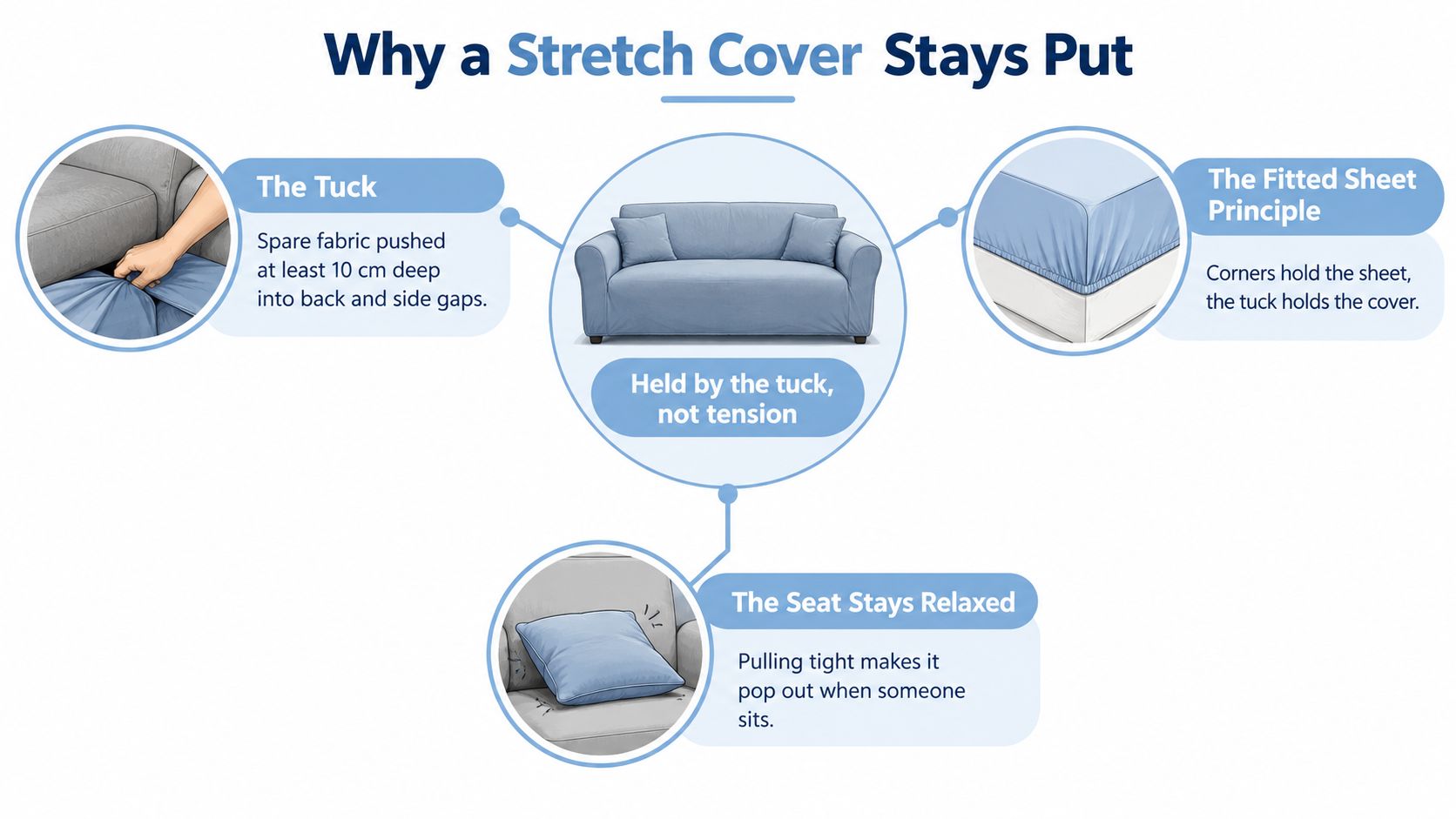
Pulling a stretch cover tight across the seat is the habit to stop. You can smooth away every wrinkle and still leave a cover that springs out of the crevices when the cushion compresses.
The anchor is the tuck, not tension alone. Spare fabric needs to follow the seat into the back and side gaps, rather than bridge across them like a stretched membrane.
Think fitted sheet, not T-shirt. The corners hold a fitted sheet; the tucked fabric holds a stretch sofa cover.
That comparison changes how you fit the cloth. You're not trying to stretch the cover until every surface looks flat. You're arranging enough material over the frame to cover the shape while keeping some available for the gaps.
The diagram shows the relationship between the relaxed seat and the hidden anchor.
Should a stretch sofa cover look completely taut?
A stretch sofa cover shouldn't look completely taut across the seat, because the cushion needs room to compress without pulling fabric out of the tuck. Aim for an orderly surface with some give, not a drum-tight panel.
A small fold near a low-tension area is less troublesome than a strained seam. Judge the fit by what happens when you sit down, not only by how the empty sofa photographs.
- Useful slack: Fabric can follow the cushion down when someone sits.
- Excess tension: Cloth slopes straight from the backrest to the seat instead of entering the gap.
- A usable anchor: Spare fabric sits inside a real crevice rather than resting along its opening.
Size still matters. Tucking can organise spare cloth, but it can't create missing material or make an unsuitable shape compatible. Choose the band first, then use the sofa's existing gaps to hold the cover.
Which Size Band to Pick in One Measurement
Measure across the outside of both arms at their widest point, with the tape level. Don't measure only the sitting area, and don't add an allowance for the arms afterwards.
That outer width selects the stretch-cover band. The arms are already included in the measurement, and the band accounts for the stretch. Choosing by the number of people who sit on the sofa is less reliable than reading the tape against the product chart.
What if my sofa width is on the edge of a band?
A stretch sofa cover at the edge of its stated width band should be selected in the wider size, subject to checking the product chart and the sofa's other dimensions. The practical rule is that spare cloth can be tucked in, but an undersized cover can't provide material it doesn't have.
Don't treat the gaps between the published bands as an automatic fit promise. If your measurement falls outside a stated range, check the product's sizing information before ordering rather than rounding it into a band.
Our sofa measuring guide covers the additional dimensions when the frame needs a closer check. Width picks the starting size, but a particularly deep seat, broad arm or unusual back still deserves attention.
- Lift-out seat cushions: Measure width and depth with each cushion laid flat. Depth decides whether to use Standard or Deep cushion-cover sizing.
- L-shaped sofas: Measure each run separately. Corner covers are ordered as a pair of seater sizes, not from one measurement around the whole L.
- Different chart units: The Pebble-Textured Waterproof Sofa Cover is sized in inches. Read that product's own chart rather than applying the centimetre bands below.
The Sofa Cover - Velvet - Dark Green - Adaptable & Expandable is a velvet stretch option with machine-washable fabric. Its colour and texture don't change the need to check the stated size before ordering.
Stretch sofa cover size bands by arm-to-arm width
| Size band | Width across arms | Notes |
|---|---|---|
| 1 seater | 90-130 cm | Measure outside arm to outside arm |
| 2 seater | 135-175 cm | Use measured width, not seat count alone |
| 3 seater | 180-220 cm | Check the product chart at the upper edge |
| 4 seater | 225-300 cm | Confirm depth and back shape as well |
| 5 seater | 305-360 cm | Additional size available in the Luma Sofa Cover |
How to Fit the Cover So It Stays Tucked
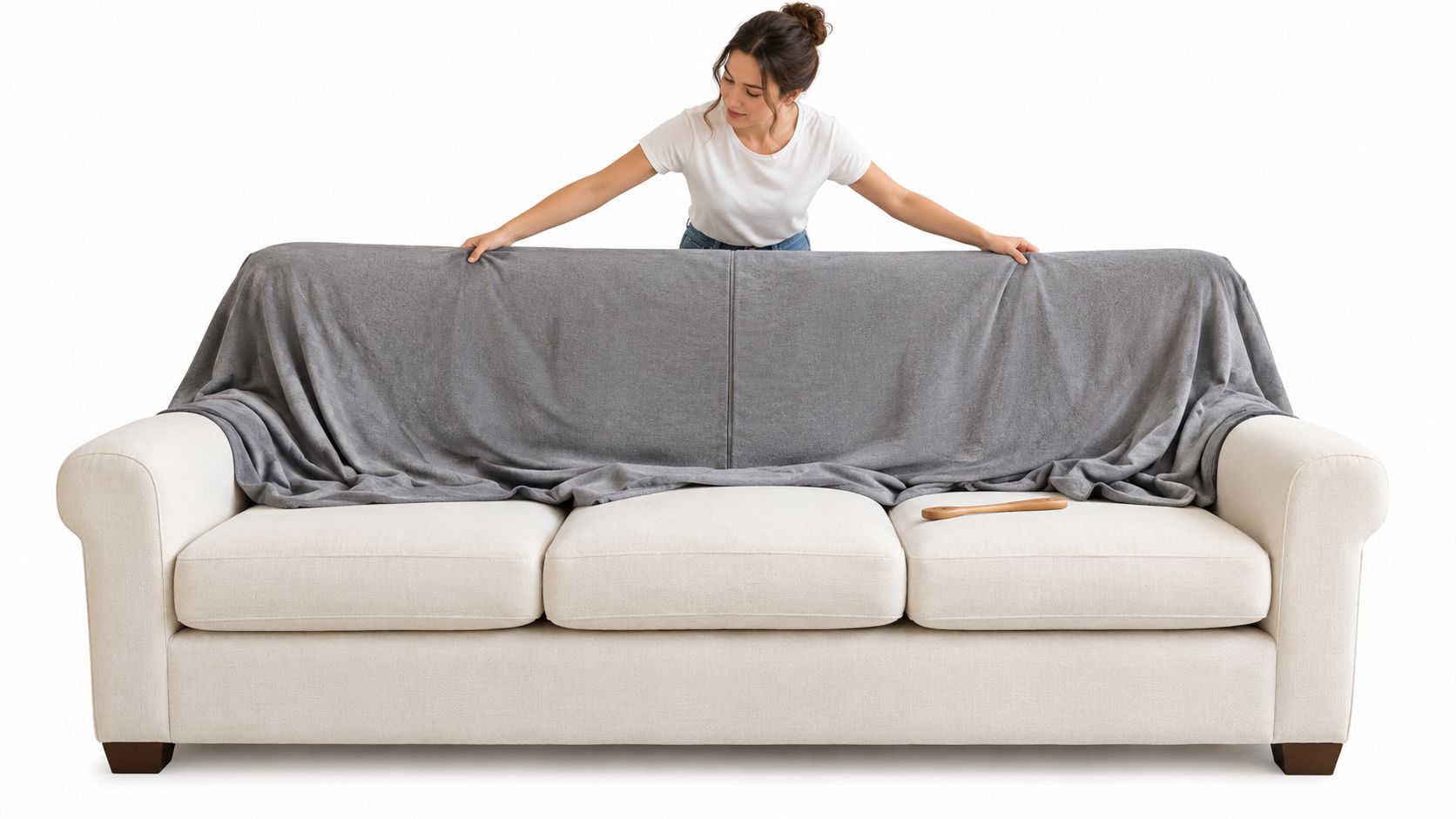
Start at the back of the sofa. Drape the cover over the top edge, centre the fabric and align the seams with the frame's corners before arranging the arms.
Don't pull everything towards the front hem. That leaves the seat-back junction short of cloth before you've even begun tucking.
The fitting position below shows the cloth being arranged around the sofa rather than stretched across it.
How deep should I tuck a stretch sofa cover?
A stretch sofa cover should have spare fabric tucked at least 10 cm deep into usable back and side gaps, without forcing fabric into stitched upholstery or a closed seam. Leave the seat relaxed while you feed the excess down.
Use your hands to distribute the fabric first. Then use the smooth handle of a wooden spoon to guide it further into the crevice where your fingers can't comfortably reach.
Work along the gap rather than stuffing a large bundle into one corner. A balanced tuck lets the seat retain its shape without a lump pressing against the cushion.
Where do the Foam Rods go?
Foam Rods go into the same seat crevice on top of the tucked fabric, where the gap can retain them below the sitting surface. Their job is to lock the tuck, not replace it.
If a rod immediately rises out, stop pulling the cover tighter. Release some seat tension, redistribute the cloth and check that the gap is deep enough to hold the insert. A rod can't correct an undersized cover or a frame with nowhere to tuck.
Sit in each seat, lean against the back and stand up normally. Watch the junction behind the cushion: the fabric should remain inside the gap rather than jump out as soon as the cushion moves.
Check the arms too. If one side tightens while the other becomes baggy, rebalance from the centre instead of dragging more fabric towards the tight side.
“It fitted our three-seater perfectly, snug enough without any awkward folds or slips”
Arlo K., Velvet Sofa Cover (Grey)
That buyer's experience describes a good outcome, not a guarantee for every sofa. Your own sitting check is what tells you whether the cover has enough slack and a secure anchor on your particular frame.
Sofa Shapes That Need a Different Move
Loose, plump pillow-back cushions are awkward because the surface you're trying to cover moves whenever someone leans against it. Pulling harder over those cushions usually fights their shape rather than controlling it.
Remove the loose back cushions and fit the stretch cover over the frame first. Then replace the cushions on top in separate covers that match their dimensions and shape. Don't assume a seat-cushion cover will also fit a back cushion.
Can a stretch cover follow a deeply grooved fixed back?
A stretch sofa cover can follow a grooved fixed back only where there's enough fabric and a usable recess to position the cloth without straining it. Push the material gently into each existing groove instead of leaving it stretched across the opening.
A wooden spoon handle helps guide the fabric into the recess. Don't use the tool to pry apart upholstery or force material into a stitched seam.
Smooth, high curved backs can be less awkward than they look because they don't have moving pillows or abrupt divisions. Even so, a curve isn't proof of compatibility. Check back height and the product's intended dimensions before assuming the cover will reach.
- Moving cushions: Separate the frame covering from the cushion covering.
- Fixed grooves: Follow the recess instead of bridging over it.
- Smooth curves: Distribute fabric evenly and check reach before tightening.
Does an L-shaped sofa need a left-hand or right-hand cover?
Our corner sofa covers don't have separate left-hand and right-hand versions; an L-shaped sofa is covered with a pair of seater sizes, one for each run. These aren't made-to-measure covers.
A 2 seater and 3 seater pairing is an example, not a default for every corner sofa. Use the corner sofa dimensions guide to check how your configuration should be measured.
What to Do on the Sofa After Day One
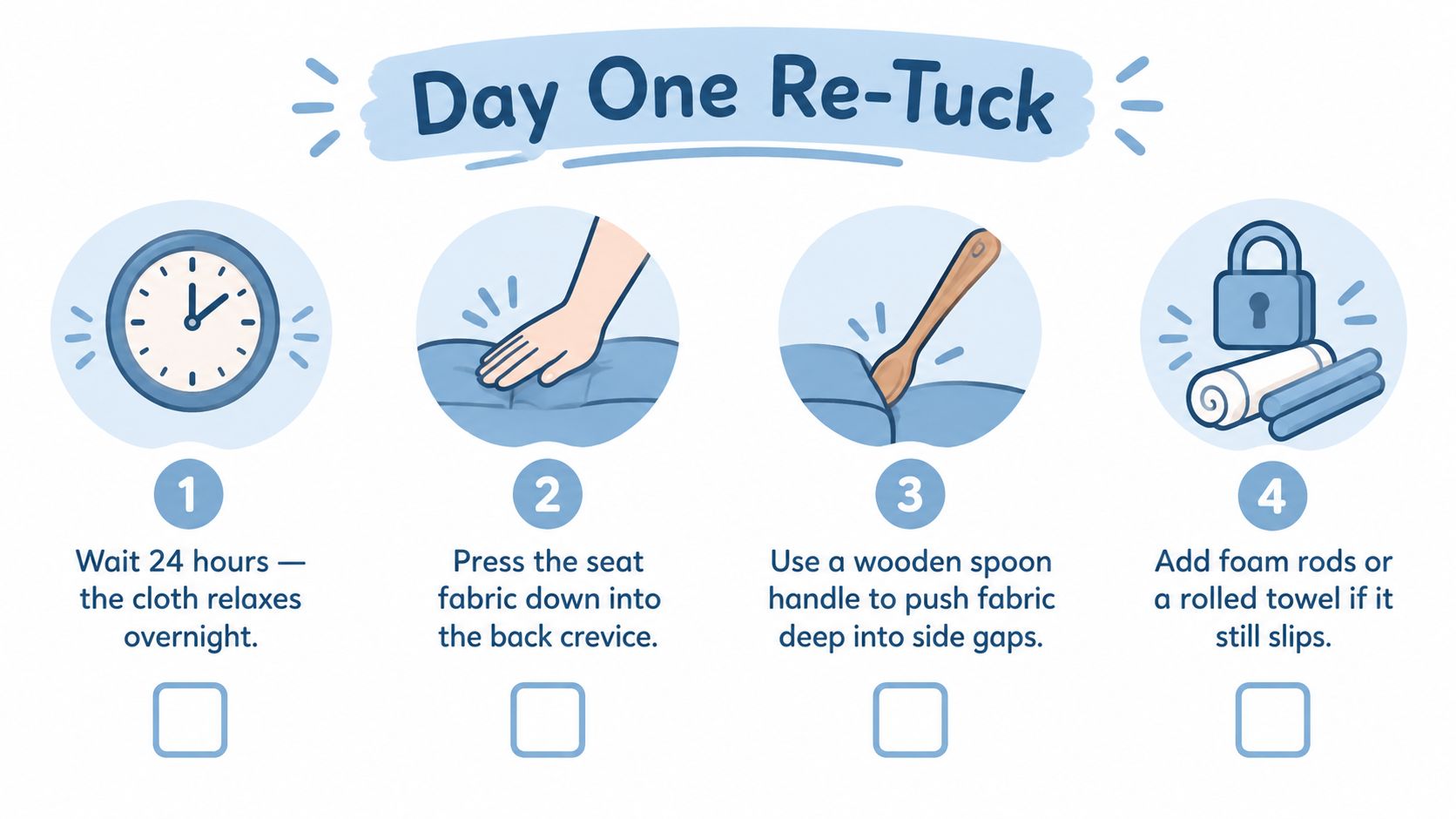
Stretch cloth relaxes during the first day of use, so give the cover one re-tuck the next morning rather than pulling it harder during the initial fitting. Inspect the places that loosened and adjust those areas.
This is the difference between finishing an installation and checking it after use. You don't need to strip everything off because a side fold has appeared; you need to find what moved beneath or beside it.
After-use check: Watch the cushion as well as the cover. If both travel forwards together, the cushion is part of the problem.
What stops loose seat cushions dragging the cover forwards?
Anti-Slip Sofa Pads beneath loose seat cushions help stop the cushions creeping forwards and carrying the stretch sofa cover with them. Put the pad beneath the cushion, where that movement begins, rather than trying to solve it with another pull at the back.
Keep the cushion in its normal position before checking the cover. If you tuck around a cushion that has already shifted forwards, you're fitting to the wrong starting position.
What changes when the sofa is leather?
A stretch sofa cover on smooth leather needs more deliberate anchoring because the cloth has less surface grip than it has against fabric upholstery. Use a deeper available tuck and secure it with Foam Rods or a rolled towel where the crevice can retain them.
A non-slip rug underlay on the seat beneath the cover is another possible grip layer, but only if the underlay is suitable for the sofa's leather finish. Check compatibility before putting an unknown backing against leather, and don't assume that every rug product is suitable for upholstery.
The next-day check focuses on restoring the anchor rather than adding tension.
- Fabric upholstery: Check the existing tuck before adding another accessory.
- A travelling seat cushion: Stabilise the cushion beneath the cover.
- Smooth leather: Check the anchor and any compatible grip layer together.
After washing, follow the care instructions for your cover and refit the cover only when it's completely dry. The easy maintenance guide offers further care guidance without treating every fabric as identical.
There's no meaningful universal number for how long a cover stays put. The anchor depends on the sofa underneath, the cushion movement and how people use the seats. Match the correction to that cause rather than treating all slipping as the same fault.
Putting the Fit Together
A stretch cover is held by a secure tuck, not by stretching the seat until it looks flat. Begin with the outer arm-to-arm width, then check whether the sofa gives you somewhere to anchor the spare fabric.
For a straightforward frame, the practical combination is a 10 cm deep tuck, Foam Rods in the crevice and a re-tuck the next morning. If the cushion itself moves or the upholstery is slick, address that underneath instead of tightening the cover above.
Which cover range should I check?
The stretch sofa cover range is the starting point for Velvet, Jacquard, Diamond Jacquard, Crosshatch, Flecked, Luma and Classic Stretch options. Choose the product chart before choosing the colour.
- Corner configurations: Browse corner sofa covers for a pair of sizes matched to the separate runs.
- Lift-out seat cushions: Check sofa cushion covers, including Standard S-XL, Deep S-L, Chaise Narrow and Chaise Wide.
- Fitting accessories: Use Foam Rods for the tuck and Anti-Slip Sofa Pads for creeping seat cushions.
Choose the part that solves the actual problem. A cushion pad and a foam rod act in different places; neither makes an incompatible cover fit.
The Sofa Cover Crafter is a different company from Sure Fit, the US slipcover brand named in the search term. We don't make, sell or stock that brand's products, and we aren't affiliated with it.
The Sofa Cover Crafter offers stretch sofa covers, corner-cover pairs, separate cushion covers and fitting accessories for the jobs described above. Visit the sofa covers collection with your arm-to-arm width and cushion measurements ready, then check the relevant product chart before choosing your cover.
