



If you already own an extra long sofa, the key question isn't which sofa to buy, it's what cover will fit it and stay put. This is a covering guide for long sofas, not a furniture-shopping guide, and the difference matters because a straight cover that looks generous on paper can still fail on the arms, the depth, or the junctions. For a sofa that's pushing the top end of the size range, measurement and fit are the whole job.
Table of Contents
- Understanding the Extra Long Sofa Cover Fit
- How to Measure Your Sofa for a Cover
- Decoding Sofa Cover Size Bands
- Straight Covers vs Corner Sofa Solutions
- Fitting Wide Sofa Covers Without Wrinkles
Understanding the Extra Long Sofa Cover Fit
An extra long sofa cover only works when the sofa's outside width sits inside a published size band. The measure that matters is the span across the outside of both arms, because that is how straight stretch covers are cut. If the sofa runs past the top of the band, the fabric will not keep stretching in a way that preserves fit.
That is where the top end of the range gets tricky. UK sofa size guides place a typical three-person sofa around 175 to 220 centimetres, with about 215 centimetres as the common length, while long sofas usually sit around 220 to 254 centimetres and anything above 254 centimetres is commonly treated as extra-long. Once you are shopping for a cover rather than a new sofa, you are already outside the easy middle of the market.
A standard three-seater cover often fails on an extra long sofa because several measurements start to matter at once. The outside arm-to-arm span, the depth, and the arm shape all affect whether the cover sits flat or pulls out of place.
The larger label does not solve access problems either. A sofa that measures over 2.54 metres can still be awkward to move through stair turns, hallways, doorways, or lifts, even if the room itself can take it. Fit and access should be checked together.
For buyers who want a stretchy finish rather than a made-to-measure textile, the broad catalogue route is here: sofa covers. Product choice still matters at this end of the size range, because fit and fabric behaviour need to line up. One example is the Luma Sofa Cover in Light Grey, which is sold as an adaptable, expandable cover rather than a fixed-size textile, and is the range that carries the 5 seater 305 to 360 centimetre size.
How to Measure Your Sofa for a Cover
Start with the widest outside point of the sofa, from the outer edge of one arm to the outer edge of the other, and keep the tape level. Record that centimetre figure straight away. That is the number that matters for a straight stretch cover. Measure the frame, not the seat cushions, and do not add extra for the arms, because the cover band already accounts for the full outside width.
Split the job into two checks. First, measure the sofa itself. Second, match that figure to the width band before you order. A sofa that measures 300 centimetres sits at the top of the 4 seater 225 to 300 centimetre band, so it belongs there, not in a looser oversize category.
Once the tape goes past 300 centimetres, the straight options narrow fast. The Luma Sofa Cover is the only range here that goes further, with a 5 seater 305 to 360 centimetre band in Beige, Orange, Light Grey, Serene Blue, and Neutral Grey. Beyond 360 centimetres, there is no straight cover in this range, and the problem is no longer one of preference, it is one of fit.
For a second check, the usual furniture-measuring discipline applies here: measure the actual frame, not the size you expect. The site guide how to measure sofa is useful for the same reason, because the mistakes on very long sofas usually come from measuring the wrong span.
A cushion width measurement tells you how the sofa feels to sit on. It does not tell you whether a straight cover will clear the full frame.
If you want the fitting rule in one line, use this: over 300 centimetres, the Luma 5 seater is the straight-cover answer, and over 360 centimetres there is no straight answer in this range.
Decoding Sofa Cover Size Bands
A stretch cover is cut for a specific width range, so the band is a hard ceiling, not a suggestion. The fabric will pull in to a narrower frame, but it won't keep stretching past the top of its band and still sit neatly. That's why a 1 seater at 90 to 130 centimetres, a 2 seater at 135 to 175 centimetres, a 3 seater at 180 to 220 centimetres, and a 4 seater at 225 to 300 centimetres are all different fits rather than loose guesses.
For most extra long sofas, the important threshold is the 4 seater ceiling. Most straight covers stop there. The published 5 seater only appears in the Luma range, and it runs from 305 to 360 centimetres, which is why the top end of the market needs a separate band instead of a generic oversize label.
What happens when the measurement lands on the edge
If a sofa measures exactly 300 centimetres, choose the 4 seater band, not the smaller one. If the sofa goes past 300 centimetres, the 5 seater is the only straight option in the range. That is not a styling preference, it's a fit limit.
A banded cover behaves like a fitted sheet. It can adapt inside its range, but once the frame is wider than the band allows, the fabric has nowhere left to go.
The clearest way to think about this is in terms of the whole width run. A long sofa doesn't care what the label on the seat says, it cares about the outside arm-to-arm measurement. That's why seat counts can be misleading on large frames, especially if one sofa has broad arms and another has slim arms but the same nominal seating capacity.
For readers comparing the upper end of the range, the broader size article on large sofa covers is the right companion read. It sits below the extra-long ceiling and helps separate a generous large-sofa fit from the specific top-end cases that need a 4 seater or the Luma 5 seater.
A straight cover also isn't a solution for every shape. Once the sofa becomes deeper, more modular, or more angular, a wider band alone won't solve the geometry. That is where corner and sectional logic starts to matter more than raw length.
Straight Covers vs Corner Sofa Solutions
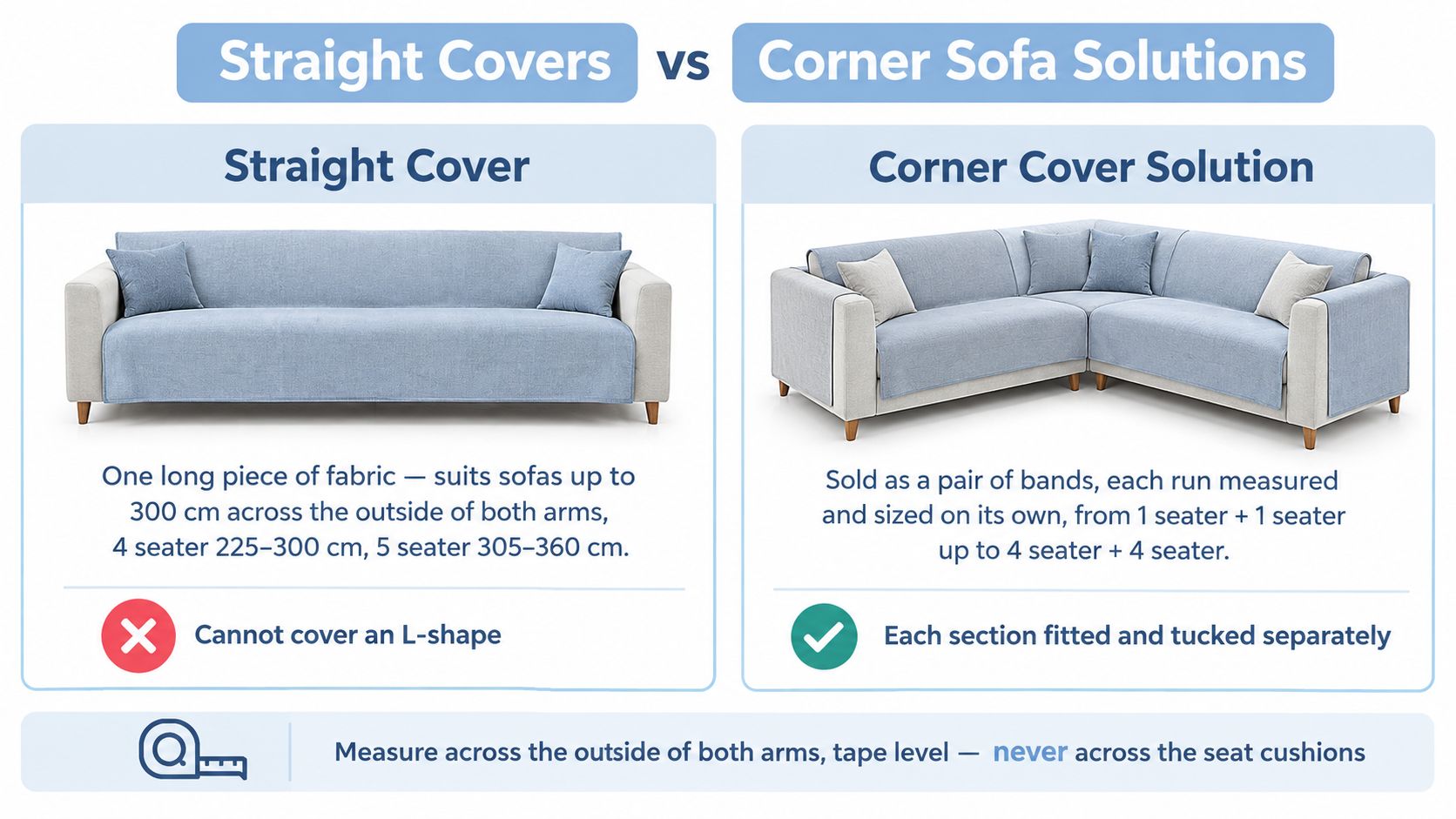
A long L-shape sofa needs two measured runs, not one straight cover. The same is true of a chaise-end layout, because the corner junction changes the way the fabric has to sit. A single long piece of fabric can't properly follow two directions at once, so the fit has to be broken into separate bands.
Why the corner run has to be sized separately
Each leg of a corner sofa gets measured on its own, then matched to the appropriate pair of bands. The corner cover collections include the Classic Stretch Corner Sofa Cover, Velvet Corner Sofa Cover, Luma Corner Sofa Cover, Flecked, and Crosshatch, with pairings that run from 1 seater and 2 seater up to 4 seater and 4 seater. That is a different fitting problem from a straight extra long sofa, even if the room view makes the two shapes look similar.
This distinction is an easy one to get wrong. People look at the full L-shape and want one oversized textile to drape over all of it. In practice, that leaves awkward tension at the junction and excess material where the turn happens. The cleaner result comes from treating each section as its own measurement and its own fit.
For a chaise-end or corner layout, the dedicated collection is corner sofa cover. That keeps the search focused on a paired solution rather than forcing a straight cover to do work it wasn't cut for.
What about a long sofa bed
A long sofa bed is a separate product type again. Sofa beds are sized by S 160 to 180 centimetres and L 180 to 200 centimetres, not by seater count, so a 4 seater straight cover is the wrong starting point. The dedicated route is sofa bed covers, because a convertible frame needs its own sizing logic.
If the seat cushions come off, count them before ordering cushion covers. On a long sofa, that often means several separate pieces, and the cushion cover sizes are Standard S, M, L, XL, Deep S, M, L, Chaise Narrow, Chaise Wide, and some ranges also include Backrest and Headrest covers. That's the level where a neat result starts, counting what comes off instead of assuming the main cover will solve everything.
Fitting Wide Sofa Covers Without Wrinkles
A wide stretch cover stays on by tuck, not by brute tension. The biggest fitting mistake is pulling the fabric tight across the seat like a T-shirt, because the first sit-down pushes it straight out of the crevices. Leave the seat relaxed and treat the cover like a fitted sheet, anchored in the gaps rather than stretched flat over every surface.
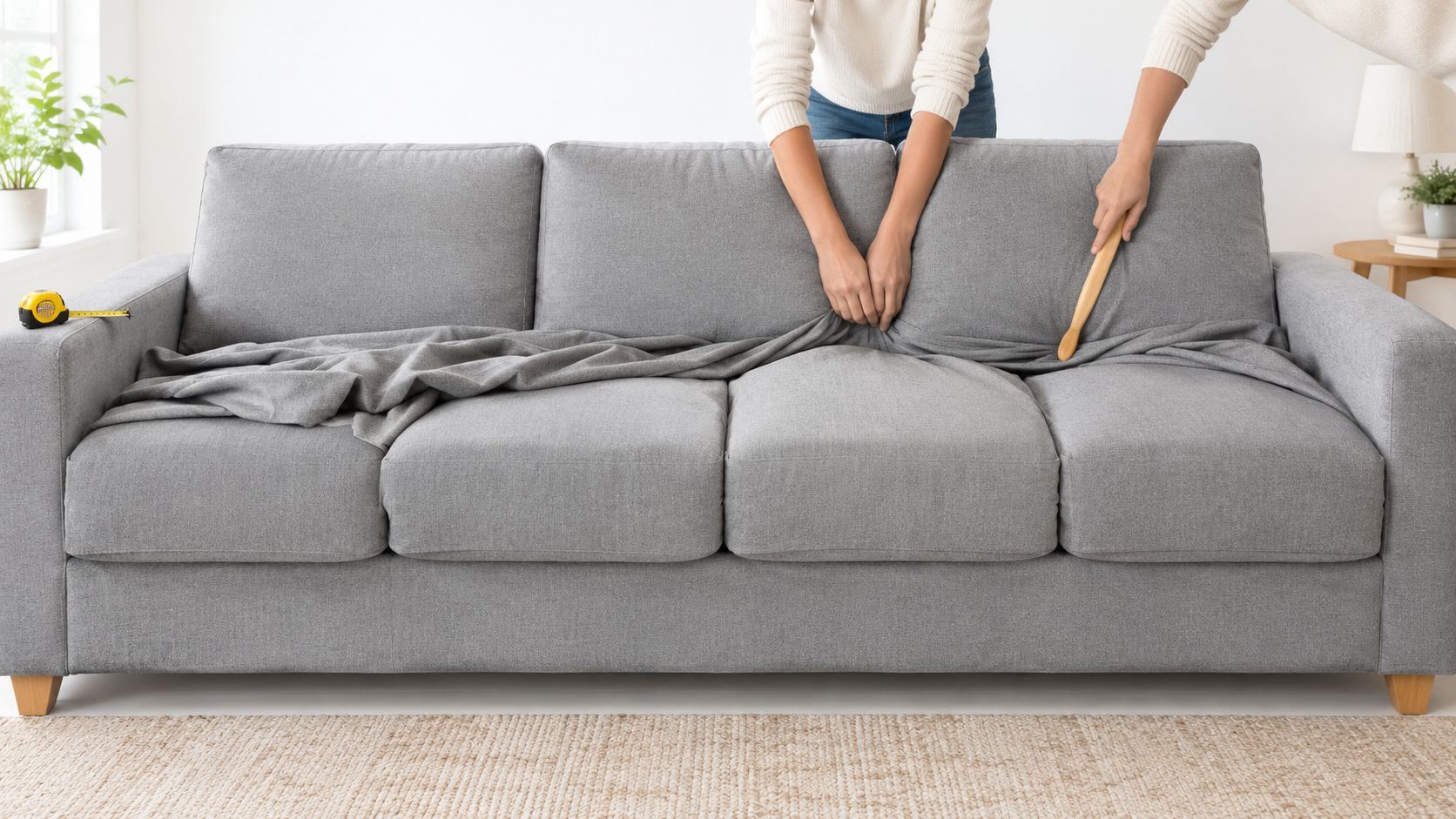
Push the spare fabric at least 10 centimetres into the gaps at the back and sides. A wooden spoon handle helps get the material deep into the crevice without tearing at the fabric. If the tuck still slips, place a foam rod or a rolled towel on top of it so the fabric has something to bite against.
For practical support on a wide sofa, our guide to foam inserts for sofas covers the tuck in more depth. A foam rod is the cleaner answer when the sofa has a stubborn seat-to-back gap, and the same logic is why Foam Rods and Anti-Slip Sofa Pads exist as separate add-ons rather than afterthoughts.
Work in sections from one end. Do the back first, then the arms, then the front hem, and finish with the crevices. On an extra long sofa, trying to dress the whole piece in one pass usually creates more slack than control, which is exactly how wrinkles and pop-outs begin.
The hold also depends on leaving the surface relaxed instead of over-tightened. A taut cover looks neat for five minutes and then loses its grip where people sit most. The better finish is slightly softer at the top and firm at the seams, because the seams and tucks do the actual work.
A long sofa needs the right cover, the right band, and the right tuck, in that order. If you're ready to size one properly, visit The Sofa Cover Crafter and choose from the straight, corner, or sofa-bed routes that match your actual sofa shape. That's the fastest way to avoid a return and get a cover that stays in place on day one.
