



Shoppers searching for armchair headrest covers are often looking for a draped antimacassar-style cloth, and we do not make that. We also make no arm caps and no headrest pad that straps onto a fixed chair back. We make fitted stretch solutions instead, so the right answer depends on whether your chair has a removable headrest cushion, a reclining mechanism, or a fixed armchair body.
If the headrest lifts off, the right product is a headrest cushion cover. If the whole chair reclines, the right product is a full recliner cover. If the chair is a standard fixed armchair, the right product is a 1 seater stretch cover for the whole chair, not a separate headrest skin. That's the part most buyers miss.
Table of Contents
- Why Fitted Stretch Covers Outperform Draped Cloths
- Does Your Armchair Have a Removable Headrest Cushion
- Which Full Chair Cover Fits Your Specific Armchair Type
- What UK Fire Safety Rules Mean for Removable Covers
- How to Install a Stretch Cover Without Visible Wrinkles
- Washing Instructions and UK Consumer Return Rights
Why Fitted Stretch Covers Outperform Draped Cloths
A draped cloth only works if you don't mind putting it back in place all day. A fitted stretch cover stays where the chair moves, which is why it suits a headrest cushion, a recliner, or a fixed armchair far better than a loose throw.
Many who ask for armchair headrest covers want the look of an antimacassar. Victorian households used those cloths to protect chair backs from hair oil, and the same basic instinct still makes sense, but the product type has changed. If the chair has a removable headrest cushion, a fitted cover protects the contact zone without hanging over the edge and slipping to the floor. If the chair is a recliner or a fixed armchair, the whole-chair route is the honest one.
Practical rule: choose the cover for the chair's structure, not for the look you had in mind.
The range here splits cleanly into three working solutions. A stretch headrest cushion cover fits a removable cushion only. A recliner cover fits a moving armchair body. A 1 seater stretch cover fits a standard fixed armchair. That's also why a loose cloth, arm cap, or strap-on head pad isn't in this range, because those are different products with different fit problems.
If you want the wider discussion of loose versus fitted styles, the comparison in stretch fit vs loose fit covers is the right next stop. For a headrest, though, the main advantage of a fitted cover is simple, it protects the high-wear area without becoming a stray layer you keep re-tucking.
Does Your Armchair Have a Removable Headrest Cushion
A headrest cushion cover only works if the headrest lifts off the chair frame. If the head section is stitched in, bolted in, or part of the recliner mechanism, the cover won't fit and you need a full-chair option instead.
Check the chair before you buy
Lift the head section gently. A removable cushion comes away as its own piece, usually with a clear edge all the way round. A fixed headrest stays attached to the chair back or recliner frame, so a cushion-size cover has nowhere to sit.
That distinction matters because a fitted cover is a skin over the cushion, not a replacement for the chair structure. The Luma Sofa Cushion Cover is the only headrest-specific option in the range, sold in Headrest S and Headrest L in Neutral Grey, Light Grey, Serene Blue, Beige and Orange. It's made for a removable headrest cushion, not for a fixed chair back.
For a visual reference point, the sofa cushion covers collection shows the kind of stretch cover logic used across the range, but that logic still doesn't turn a fixed headrest into a removable cushion. The fit starts with the chair, not the fabric.
Choose size from the cushion, not from the chair
Measure the removable cushion itself, then match it to the stated headrest size. If the cushion sits close to the size boundary, choose the roomier option, because stretch fabric pulls in but doesn't let out. A cover that starts too tight is the one that works loose when somebody leans back into it.
A pale headrest cover will show hair oil and make-up marks sooner than a mid-tone. That's not a defect, it's just how light shades behave on a high-contact point.
If the head section doesn't come off, don't force a cushion cover onto it. Move on to a whole-chair cover instead, because a fixed headrest needs a different fit strategy.
Which Full Chair Cover Fits Your Specific Armchair Type
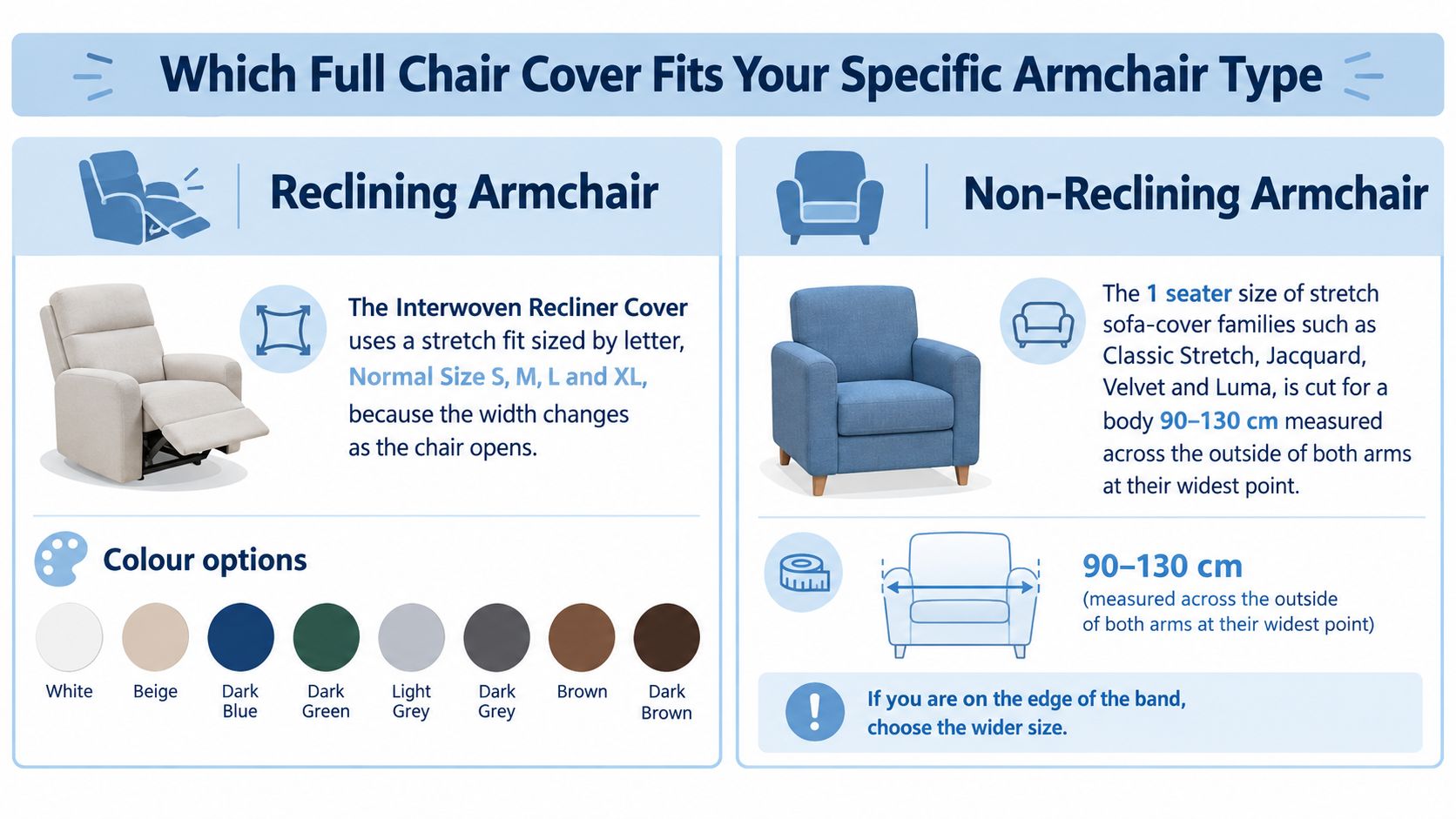
A fixed headrest means you need a full-chair cover, and the right choice depends on whether the armchair reclines. Recliners need letter sizing because the width changes as the mechanism opens, while standard armchairs use a measured 1 seater body size.
Reclining armchairs need a moving-fit cover
The Interwoven Recliner Cover, in our recliner and armchair covers collection, comes in Normal Size S, M, L and XL, with colour options White, Beige, Dark Blue, Dark Green, Light Grey, Dark Grey, Brown and Dark Brown. That letter sizing makes sense because a recliner changes shape as it opens, so a centimetre-only approach misses the true fit.
A recliner cover is the right answer when the chair's back, foot section, or seat depth shifts with the mechanism. In that case, a headrest-only cover doesn't solve the problem, because the wear pattern spreads across the whole moving shell. The moving parts decide the sizing logic, not the colour or the upholstery pattern.
Fixed armchairs use the 1 seater band
A standard non-reclining armchair needs the 1 seater size from the stretch sofa-cover families. That size is cut for a chair body 90 to 130 cm measured across the outside of both arms at their widest point, tape level. If the measurement lands on the edge of the band, take the wider size, because stretch fabric pulls in but does not let out.
The families with a 1 seater size are Classic Stretch, Jacquard, Velvet, Crosshatch, Flecked, Bobble-Textured, Luma, Veloura, Arquette and Diamond Jacquard. Use that route when the armchair body is fixed and the head section is part of the main chair shape rather than a separate cushion.
A snug-looking cover isn't the same as a correct fit. On a chair that moves, the wrong size will show itself the first time someone sits down.
If you need the full measuring walkthrough for a fixed armchair, the dedicated armchair covers guide is the better place for that detail than this headrest-focused article.
What UK Fire Safety Rules Mean for Removable Covers
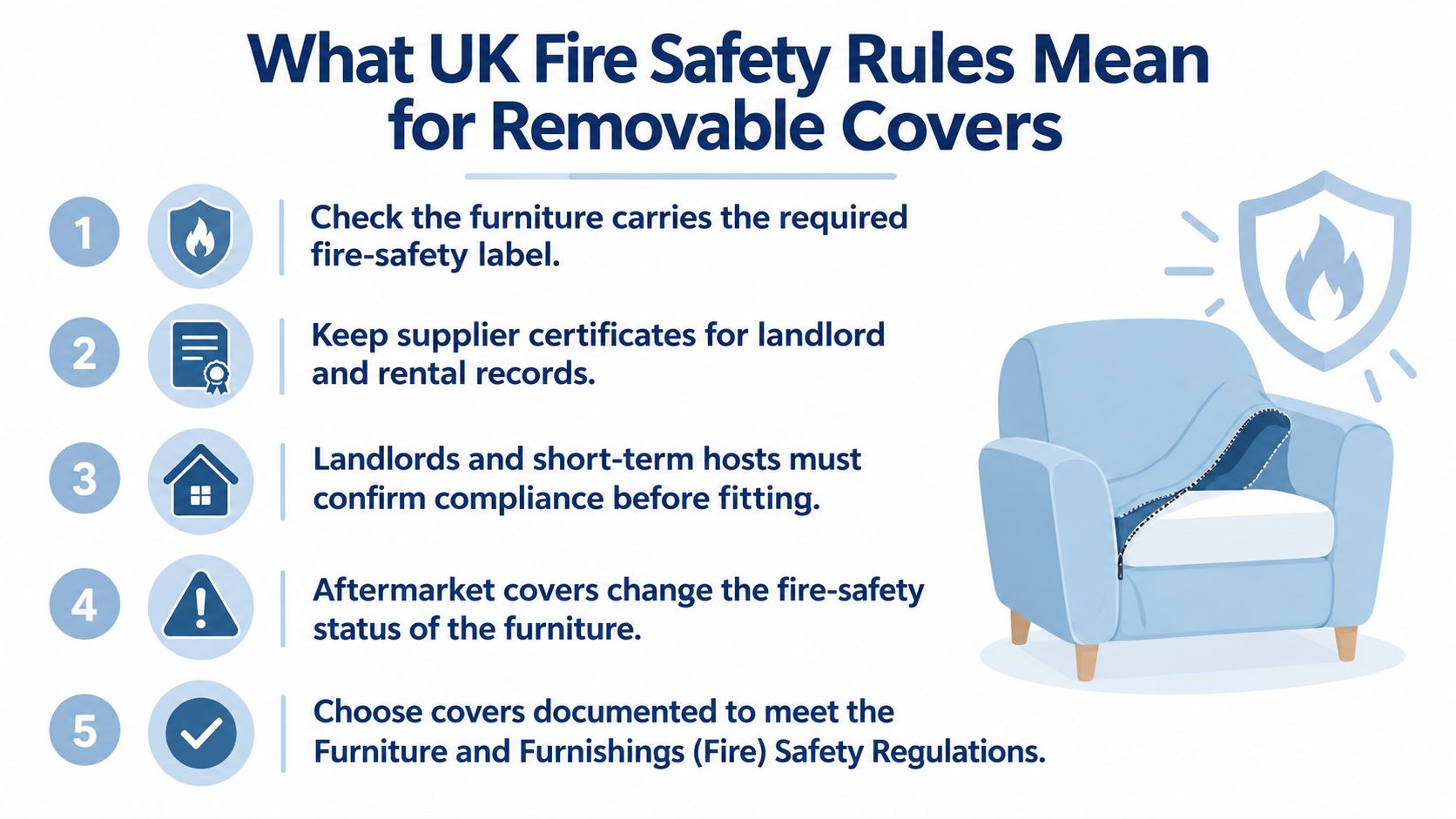
An aftermarket cover changes the compliance question, so a removable armchair cover has to be treated as part of the furniture system, not as a decorative extra. The cover fabric, seams, elastic, and any backing all matter, especially where the chair is used in rented or guest accommodation.
The cover can change the chair's status
The Furniture and Furnishings (Fire) (Safety) Regulations 1988 apply to upholstered chairs and to loose covers supplied for furniture. That means the chair's original compliance doesn't automatically cover a replacement headrest cushion cover or a stretch cover fitted over the whole chair.
The safest approach is to preserve the chair's permanent safety label, keep supplier documentation, and avoid assuming that “machine-washable” or “waterproof” means fire-safe. A cover should not hide the original furniture's compliance information, and it should not be sold or used as if the base chair alone settles the question.
How to Install a Stretch Cover Without Visible Wrinkles
Wrinkles on a stretch cover usually mean the slack is sitting in the wrong place. The fix is not to pull harder, it's to hide the extra fabric where the chair can hold it.
Fit the headrest cover in your hands first
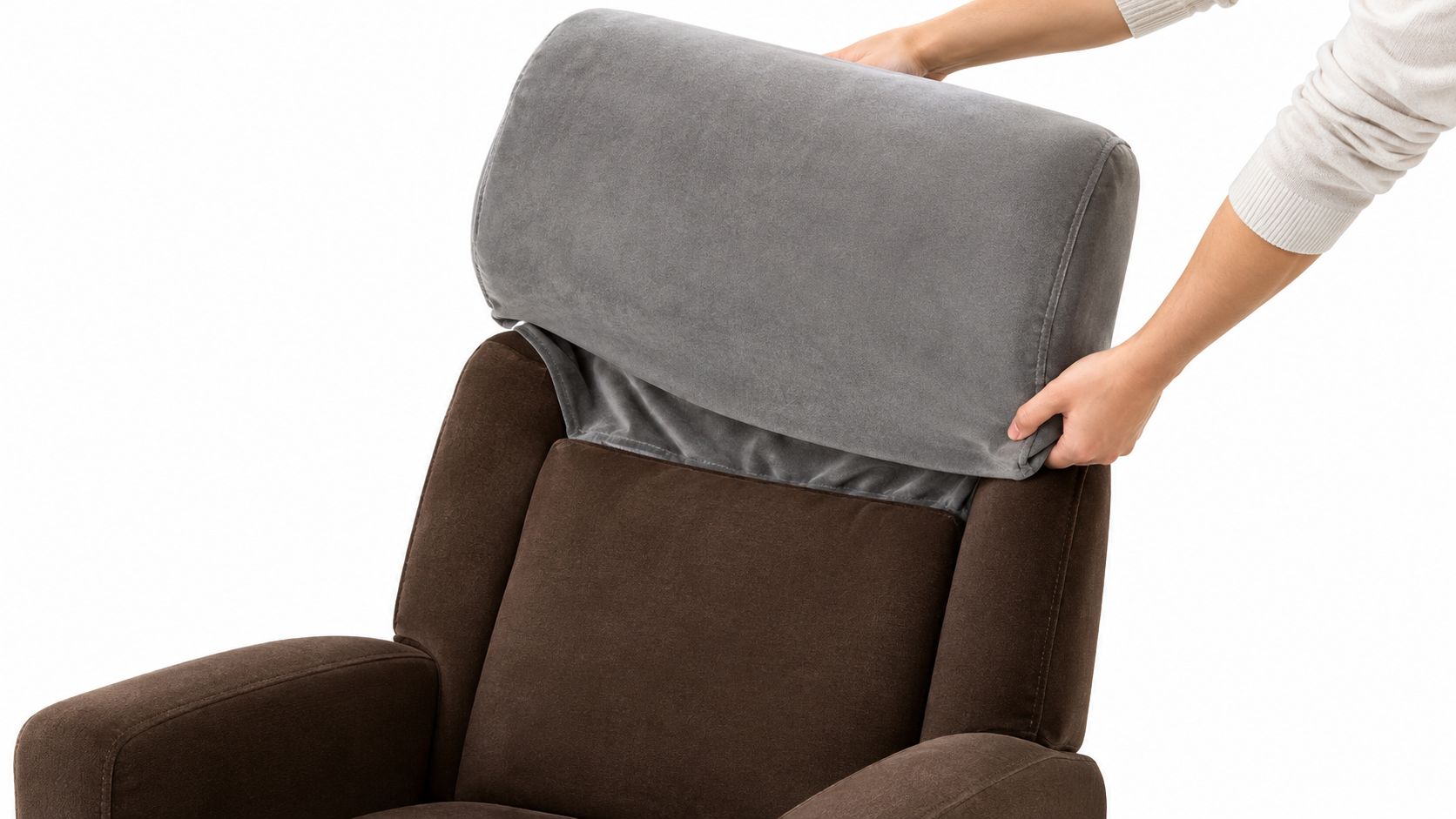
For a removable headrest cushion, take the cushion off the chair before you start. Fit the cover around the cushion in your hands, line the seams up with the cushion edges, then work the remaining slack round to the back face, the side that presses against the chair. Once the cover sits evenly, drop the cushion back into the chair so the chair holds the slack where it belongs.
That method matters because a headrest cover that's fitted while the cushion is still fixed usually traps surplus fabric on the show face. The visible side then looks uneven, even though the size is technically right.
Lock a full chair cover into the creases
For a whole armchair cover, push the surplus deep into the crevice where the seat meets the back and where the seat meets each arm. Foam Rods help hold that tuck, and Anti-Slip Sofa Pads support the grip underneath. We sell both separately, and they're useful when the chair surface is smooth enough to let fabric drift.
The technique is shown more broadly in the stretch chair cover guide, but the principle stays the same. Slack belongs in the crease, not under tension. Pulling harder only stores tension in the fabric, and that tension pops back out the first time somebody sits down.
Wrinkle-free comes from placement, not brute force.
Washing Instructions and UK Consumer Return Rights
A removable cover should be washed exactly as the maker says, because fibre content and care instructions are not the same thing. UK textile-trading guidance treats fibre-content labelling as required information, while care guidance is practical instruction, so the washing temperature, drying method, and ironing advice are the real rules you follow.
Wash for fit, not just for cleanliness
Heat, the wrong detergent, aggressive bleaching, or careless tumble-drying can alter stretch and ruin the fit even when the fabric still looks fine. That matters on a headrest cover because the same piece that traps oil and make-up also has to return to a clean, snug shape after laundering.
If you'd rather outsource the laundering side, a local wash-and-fold laundry service can be a practical way to keep household washing moving, provided the cover's care label allows that handling. For the product itself, the main rule is still the same, follow the stated washing instructions rather than guessing from the fibre.
Return the right way if the fit is wrong
If a cover is faulty, damaged, not as advertised, or not fit for purpose, UK consumer guidance says the buyer is entitled to a full refund within 30 days of purchase. A correctly described cover that doesn't suit your preferred colour or look is a different case: for an online order, the 14-day cancellation right under the Consumer Contracts Regulations applies instead.
Check the measurements before you remove tags or wash the cover. Once a cover has been handled beyond simple inspection, the return path can become much narrower. If the description promised one thing and the item supplied is materially different, that's a conformity issue, not just a styling disappointment.
For washing details and care logic in one place, the how to wash chair covers guide is useful background.
If you're trying to match the right cover to a real chair, The Sofa Cover Crafter has the fitted options that solve the problem, from removable headrest cushions to full recliner and 1 seater armchair covers. Visit The Sofa Cover Crafter to compare the range and choose the cover that fits your chair's structure, not just the look you had in mind.
