



Sofa throws and matching cushions from this range coordinate by colour, never by print, because the throws are standalone designs while the pillow covers are made to match sofa-cover families. The practical set is therefore one throw, one shared colour family and cushions that introduce a different texture or pattern scale.
You've probably reached the same irritating point as many sofa shoppers: the throw you like has no obvious cushion twin, while the cushion cover you've found belongs to a sofa-cover collection rather than the throw collection. That isn't a missing product. It's how the range is organised, and once you shop by colour instead of searching for an identical print, building a coordinated set becomes much simpler.
Table of Contents
- How Sofa Throws and Matching Cushions Actually Coordinate
- Does Choosing a Neutral Throw Colour Really Give More Cushion Options
- Can Texture Mixing Really Replace Matching Prints
- What Cushion Sizes and Throw Draping Actually Look Good On
- How to Refresh the Living Room With a Throw and Cushion Set
How Sofa Throws and Matching Cushions Actually Coordinate
A coordinated set from this range is a colour match, not a print match. The pillow covers are designed around SOFA COVER families including Crosshatch, Diamond Jacquard, Linear Geometric, Gridelle, Crossmere, Veloura, Jacquard, Bobble-Textured, Flecked, Velvet, Classic Stretch and Printed one-offs. The sofa throw collection, by contrast, contains standalone designs such as Elligate, Melareve, Coveri, Herpome, Norka, Striniara, Soft Tassel, Mousoon, Atlas Geo, Yeluxe, Mistara and Pomelle, with no cushion twin for each throw.
That difference changes the buying order. Don't begin by looking for the same motif twice. Choose the throw for its colour and overall scale, then select pillow covers that repeat or sit beside that colour in a suitable texture.
What belongs in the same shopping basket
The pillow covers are available as one piece or two pieces, in 45 cm x 45 cm, with prices ranging from £7.90 to £19.90. Sofa throws range from 180 x 130 cm to 180 x 420 cm, with prices from £27.90 to £104.90. Those sizes and prices describe separate product groups, so a “set” means a styling combination you build, not a boxed throw-and-cushion product.
There's one important naming distinction. Sofa Cushion Covers are the fitted seat-cushion kind, available in Standard, Deep, Chaise, Backrest and Headrest sizes, while scatter pillow covers are loose decorative covers for cushions. The range doesn't sell cushion inserts or fillings, so check that your existing inserts fit the 45 cm x 45 cm pillow covers before ordering.
A simple workflow works well:
- Select the throw colour. Treat it as the largest visible accent.
- Choose one cushion colour family. Use the same colour, a lighter tint or a deeper shade.
- Add contrast through texture. A textured throw with smoother cushions, or a smoother throw with more tactile cushions, creates separation.
- Check scale. Keep one large-scale piece and make the remaining patterns smaller or quieter.
The constraint is useful. Because you aren't trying to duplicate a print, you can choose a throw for how it sits on the sofa and choose cushions for how they support the sofa cover underneath.
Does Choosing a Neutral Throw Colour Really Give More Cushion Options
Yes, a neutral sofa throw gives you more cushion options because the throw can support several colour families without competing with them. Choose the throw first, then build the cushion palette around its undertone rather than trying to make every item identical.
A mid-tone neutral is usually the most forgiving anchor. Sandy tan, warm beige, soft grey and similar restrained shades can sit beside deeper greens, warmer browns or muted blue accents, provided the undertone doesn't fight the room. Very pale throws can disappear against a light sofa, while a highly saturated throw can limit the cushions you'll want later.
The Soft Tassel Sofa Throw in Sandy Tan is a useful example of that role. A verified buyer review from Samuel J. says: “The sandy tan colour is spot on for matching with everything, and the tassels just make it feel even more special.” The point isn't that every room should use Sandy Tan. It's that a flexible throw colour can carry more than one cushion scheme.
Build the palette in related shades
The safest route is tone on tone. Choose two or three shades from one colour family, such as sage, olive and forest, then vary the surface rather than forcing one fabric across the whole sofa. A throw in the middle shade can connect a lighter cushion at the front with a deeper cushion at the arm.
This approach looks designed because the eye registers the shared colour before it analyses the individual motif. It also gives you room to change one cushion cover later without making the throw unusable.
The same reasoning applies if you're considering a stronger sofa foundation. A Dark Green Velvet Sofa Cover can establish a deep green base, while a throw and pillow covers can repeat that family in lighter or more neutral tones. The cover is a stretch fit made for one- to four-seater sofas.
Think beyond a single décor moment
A throw earns its place when it works with more than one arrangement. A neutral or softened colour lets you move from a calm, near-monochrome cushion scheme to a richer combination without replacing the largest textile.
That also gives removable textiles a practical role. A sofa is a long-term purchase, while a throw and a set of cushion covers can change the look of the room whenever you want a new scheme, without replacing the sofa itself.
Can Texture Mixing Really Replace Matching Prints
Yes, texture mixing can replace matching prints when the throw and cushions share a colour family and use different visual scales. The two controls that matter most are pattern scale and sheen, not whether every item came from the same design.
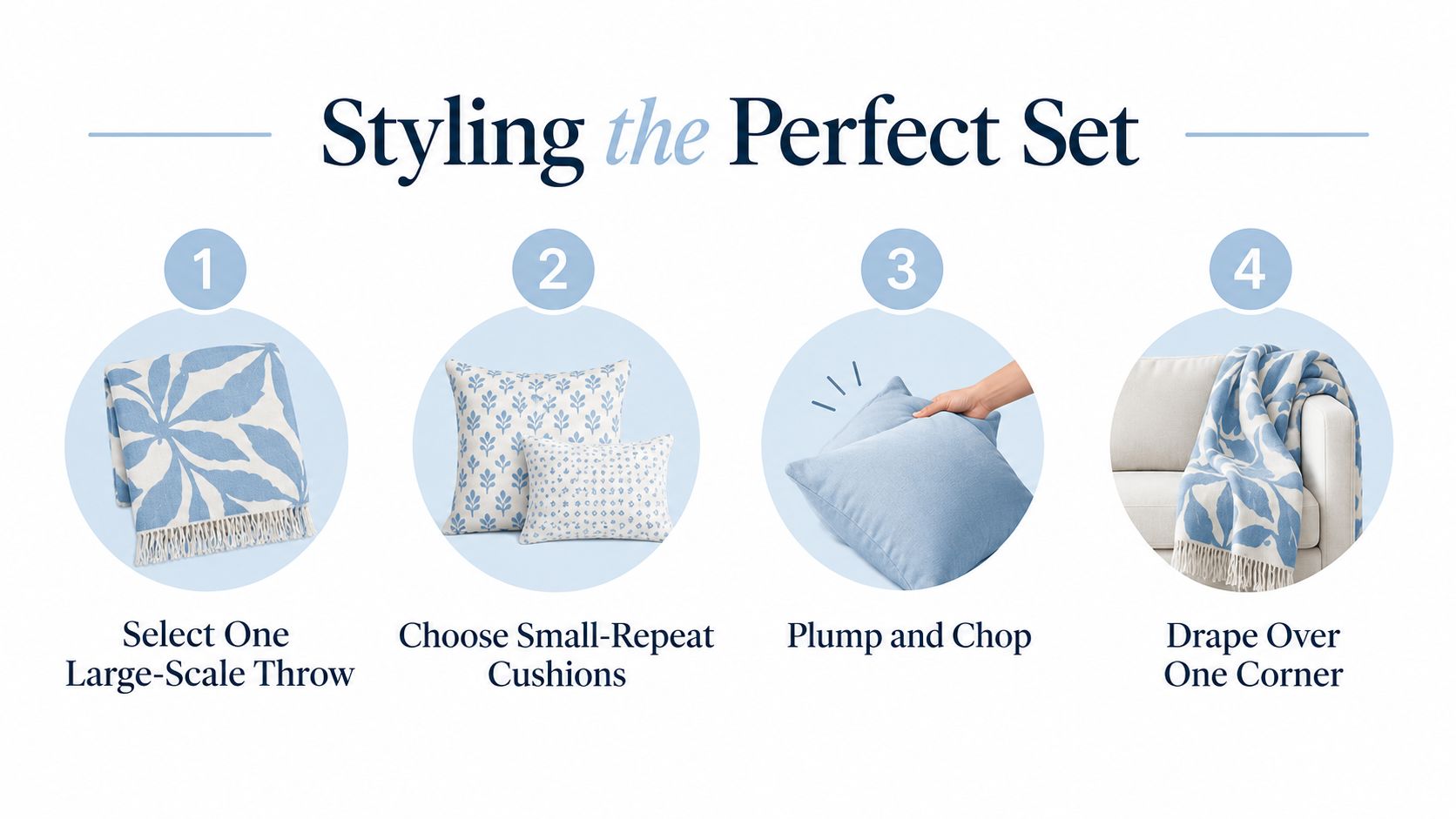
Start with scale. Use one large-scale piece, then keep the remaining patterns small-repeat or relatively quiet. Two large patterns compete because both demand attention from the same distance. A large geometric throw with small-repeat cushions can look deliberate, while two equally bold patterns in unrelated colours often look accidental.
Practical rule: Change the scale, keep the colour. One large-scale piece is enough.
That large-scale piece is often best placed on the throw because you can fold it away or move it within seconds. You're making a visual statement without committing the whole sofa cover to a dominant pattern.
Why sheen matters more than fibre
The next decision is surface behaviour. Velvet has a directional pile, so the same cushion can read dark from one side of the room and light from the other depending on which way the pile faces. A flat-woven jacquard has no such direction and holds one tone more consistently through the day.
Place the textured or directional piece where light crosses it rather than hitting it head on. That angled light reveals the surface without making the colour shift look like a mismatch. Keep the surrounding pieces flatter if the anchor already has strong movement.
The practical sequence is straightforward:
- Choose one anchor texture: Use velvet, a pronounced weave or a tactile throw as the piece that catches attention.
- Keep nearby surfaces calmer: Flat-woven jacquard or less directional cushions give the eye somewhere to rest.
- Repeat the colour, not the fabric: The throw and at least one cushion should share a colour relationship, while a third cushion can be the controlled odd one out.
- Limit the large motifs: Don't put two large-scale patterns together, even when their colours are related.
A balanced mix match furniture guide can help if the wider room includes different furniture finishes, but the sofa itself needs the stricter test: can the throw and cushions be read as one colour group from the doorway?
The same principle applies to the rest of the arrangement. If you want broader cushion ideas, the guide to mix and match cushions covers the wider styling question. For this particular purchase, keep the decision narrower: colour first, one dominant scale, then contrast through sheen.
Furniture reuse gives the method extra weight. Government evidence estimated that more than 861,000 tonnes of furniture, mattresses, carpets and underlay entered England's municipal residual waste in 2017, approximately 3.4% of all municipal waste by weight. It also reported 8.7 million tonnes of consumption-based greenhouse-gas emissions linked to furniture, furnishings and carpets in 2019, nearly 1.5% of the UK total. These figures don't isolate the effect of throws or cushions, but they support protection, repair and reuse as sensible priorities. The UK Waste Prevention Programme sets out that wider context.
What Cushion Sizes and Throw Draping Actually Look Good On
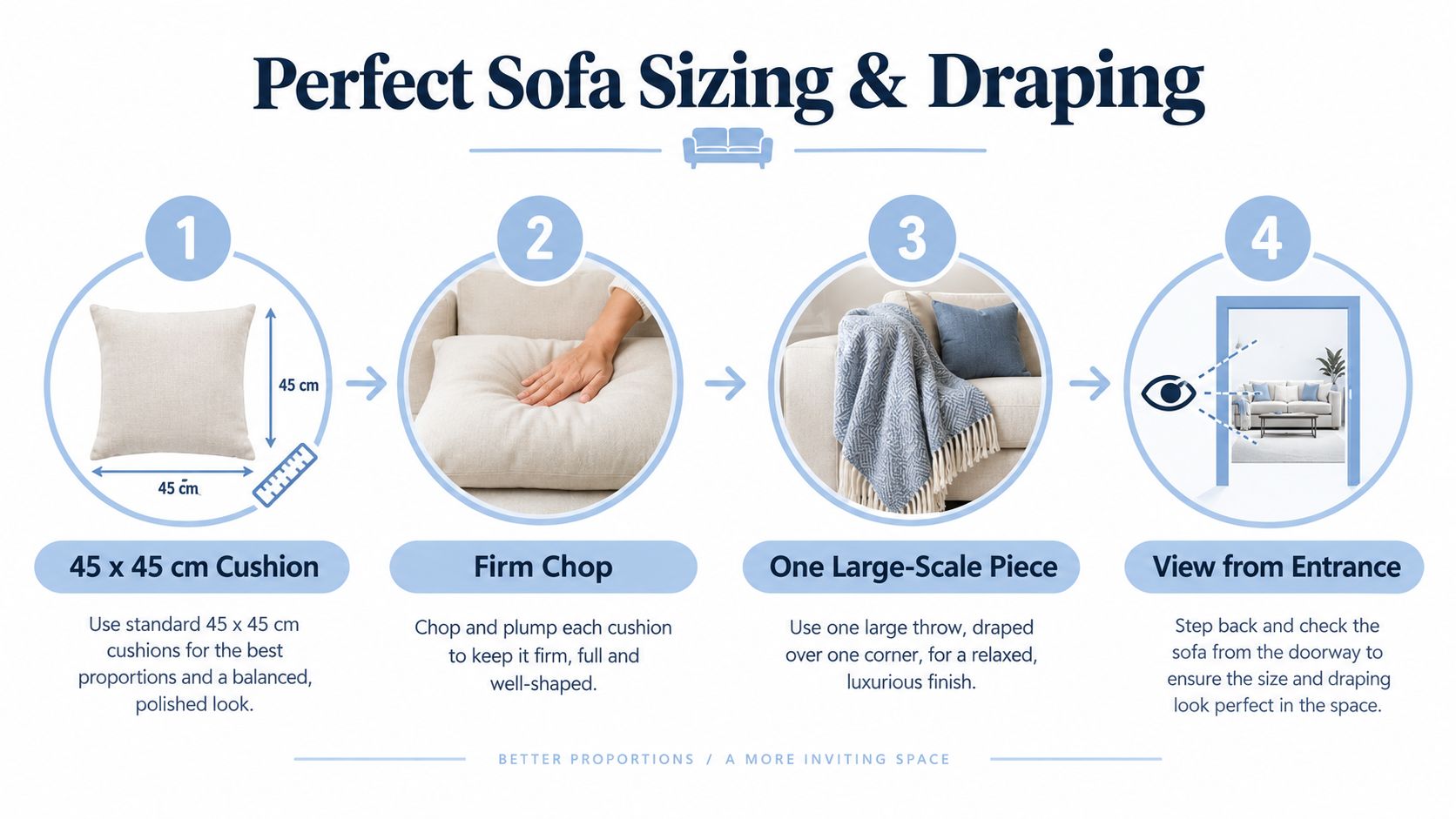
A practical starting point is 45 x 45 cm cushions, with larger cushions behind them and a lumbar cushion at the front when the sofa has enough depth. The arrangement must still be tested against the sofa's actual usable seat, because dimensions are design benchmarks rather than universal fit standards.
UK styling guidance identifies 45 x 45 cm as a widely used sofa-cushion size, 50 x 50 cm as suitable for larger sofas or rear layers, and approximately 30 x 50 cm as a useful front lumbar proportion. On a reasonably deep sofa, larger cushions at the outside and smaller ones inside give the arrangement depth. These are practical references, not guarantees that every sofa will accommodate every layer.
Use the four-piece scale
For a coordinated set, start with the sofa's usable back width and seat depth. Then work from the outside in:
- Put the largest pair at the arms or outer corners.
- Add smaller cushions in front, reducing the size by roughly 5 to 10 cm.
- Use one lumbar accent, approximately 30 x 50 cm, if the seat still has comfortable clearance.
- Repeat the throw's accent colour in only one cushion or trim.
A four-piece arrangement can therefore use larger outer squares and smaller inner squares, with the lumbar piece added only when it improves proportion. On a deep sofa, two larger outer cushions and two smaller inner cushions create depth without demanding that every cover match. On a shallower sofa, the same number may leave too little sitting room.
The correct arrangement is the one that leaves the sofa usable without a cushion-removal routine.
Overfilling causes more problems than under-styling. Too many deep cushions reduce usable seat depth, create unstable pressure points and hide the throw's texture. If the throw disappears behind a wall of cushions, move one cushion aside before buying another.
Drape the throw where it can be seen
Folded throws look tidy, but a neat rectangle can make a soft arrangement feel overly staged. For this colour-led set, drape the throw over one corner, allowing the edge or tassel detail to remain visible beside the cushion stack.
Avoid covering the entire seat. The throw should frame the cushions, not become a second seat cover. If the sofa has a corner configuration, test the placement from the main entrance before committing. The guidance on throws for corner sofas is useful for thinking about visibility and placement around a corner.
For a more tactile look, the principles behind faux fur sofa styling are also relevant, even when your chosen throw isn't faux fur. Let the surface fall naturally, keep the main seating space open and avoid flattening the texture into a rigid fold.
How to Refresh the Living Room With a Throw and Cushion Set
A ten-minute refresh works when you change the cushion colour family, add a throw in a contrasting texture and leave the rest of the room alone. Keep the sofa, rug and walls in place, because the seating is often the first large object visitors notice when they enter.
Start by removing every decorative cushion cover that belongs to the old scheme. Put the new covers on, then add the throw to one corner. Don't introduce another colour just because the sofa looks different. The strength of the result comes from repeating one colour relationship across separate items.
Finish the arrangement, don't overwork it
Plump every cushion and give each one a firm chop across the top. Place the largest pieces at the outside, bring the smaller ones forward and keep the lumbar accent where it doesn't block the main sitting area.
Drape the throw rather than folding it into a perfect stack. One corner should carry the visible texture, while the cushions provide the more structured layer. Take a photograph from the doorway, where a guest would first see the room. That viewpoint quickly exposes a cushion that is too large, a colour that disappears or a throw that has been placed too centrally.
Stylist's check: If you have to move half the arrangement before sitting down, edit the arrangement before adding anything else.
Care matters because the two product types don't share one automatic cleaning routine. UK laundry guidance explains that the temperature on a care-label symbol is a maximum, not a universal recommendation for every throw or cushion cover. Fabric composition, coatings, elastics, zips and printed finishes can react differently to heat, so each care label controls its own washing programme, as UK laundry care-symbol guidance sets out.
Make the set useful between changes
Wash the sofa throw separately from the matching cushion covers and follow each product's instructions. Remove the throw before laundering, close fasteners where the manufacturer advises it and don't assume a cushion-cover programme is suitable for the throw.
That separation makes the set more practical for families, pet owners and furnished accommodation. A throw can be removed after a spill without stripping every cushion, while an individual cushion cover can be replaced or stored without discarding the whole arrangement. For a softer, more luxurious direction, cashmere throw blanket ideas offer another way to think about drape, texture and restraint, although the care requirements of any chosen textile must come from its own label.
The broader pillows and throws for couches guide is useful for general sofa layering. For this purchase, keep the final test simple: the throw should anchor the colour, the cushions should vary the scale, and the textures should make the absence of an identical print look intentional.
The Sofa Cover Crafter offers standalone sofa throws, pillow covers designed around its sofa-cover families and fitted sofa cushion covers in different configurations, so you can build a colour-coordinated set around the sofa you already own. Browse The Sofa Cover Crafter by throw colour first, then select cushion covers in a related shade and contrasting texture.
