



You've probably got a plain two-seater in front of you, or you're looking at one and thinking it needs more life. A patterned 2 seater sofa cover is the fastest way to add that character, and the right pattern can make a small room feel intentional instead of busy. This is about putting pattern on the sofa you already own, because we don't sell sofas and we don't make bespoke or made-to-measure covers.
Table of Contents
- Adding Pattern to Your Existing Two-Seater
- How to Choose a Pattern That Won't Overwhelm a Small Room
- Small Geometrics Versus Large Florals on a Compact Sofa
- Which Fabric Patterns Hold Up Best With Kids and Pets
- Styling a Patterned Two-Seater in a Compact Living Room
- Real Buyer Experience and Final Selection Tips
Adding Pattern to Your Existing Two-Seater
A patterned cover is the practical answer when a plain two-seater feels flat but the sofa itself still works. That's the use case here, whether you're dealing with a dated family sofa, a rental flat that needs more warmth, or a second-hand find that's structurally fine but visually dull.
A stretch cover lets you change the look without buying new furniture, and that matters in a UK market where sofas sit inside a large, fabric-led, design-conscious category. UK interiors coverage lists patterned sofas among this year's trends, treated as focal-point pieces rather than background furniture [womanandhome on sofa trends].
Practical rule: if the sofa is staying, the pattern needs to do the work.
For that reason, the simplest route is usually a patterned sofa cover plus a calm room around it. If you want a quick coordinate, matching Pillow Covers can repeat the same family in a smaller dose, which helps the sofa read as deliberate rather than random [patterned cushion-covers ideas].
A reader looking for a patterned two-seater piece of furniture to buy outright is in the wrong place. What works here is a cover on the sofa you already own, because that gives you the pattern without the cost and commitment of replacing the whole seat.
How to Choose a Pattern That Won't Overwhelm a Small Room
Choose a pattern by fit first, repeat scale second, and room colour third. If the sofa does not fit the cover category, the pattern will not rescue it, so a 2 seater cover is cut for a seat width of 135 to 175 cm and that is the first check to make.
Start with the sofa width
If your two-seater sits outside that 135 to 175 cm band, choose a different size family rather than forcing the pattern to cover a sizing problem. Depth matters too, because a standard buying guide says wall length, obstacle clearance and depth all affect whether a sofa sits well in the room [sofa buying guide].
Match repeat to stretch behaviour
Stretch covers change the pattern under load. The fabric pulls tightest across the seat front and the arm fronts, so a large motif bends where the eye lands first. Small repeats stay readable because the tension is spread across more units, and the pattern keeps its shape better.
A broad floral can work on a flat sample and still fail on a fitted cover. Straight stems skew, petals pinch, and checks lose their balance once the cloth is stretched over corners and seams.
A small repeat survives tension better because each part of the motif stays recognisable when the cloth is pulled.
Pull colour from the room
Choose the cover from something already in the room, like a rug, curtains or a lampshade, so the sofa reads as part of the scheme best colours for small living rooms. That keeps the pattern from competing with every other surface in the room. A patterned 2 seater sofa should feel fitted into the space, not dropped into it.
| Step | What to check | Why it matters |
|---|---|---|
| Measure | Seat width fits the 135 to 175 cm band | Fit comes before style |
| Repeat | Small or medium repeat on stretch fabric | Large motifs distort at stress points |
| Colour | Pull from existing textiles | Keeps the room calm |
Small Geometrics Versus Large Florals on a Compact Sofa
Small geometrics usually work better on a compact sofa because stretch turns them into the least disruptive kind of pattern. Large florals can look lovely on a flat fabric image, but once the cover is pulled tight across the arms and seat front, the motif bends in the exact places your eye notices first.
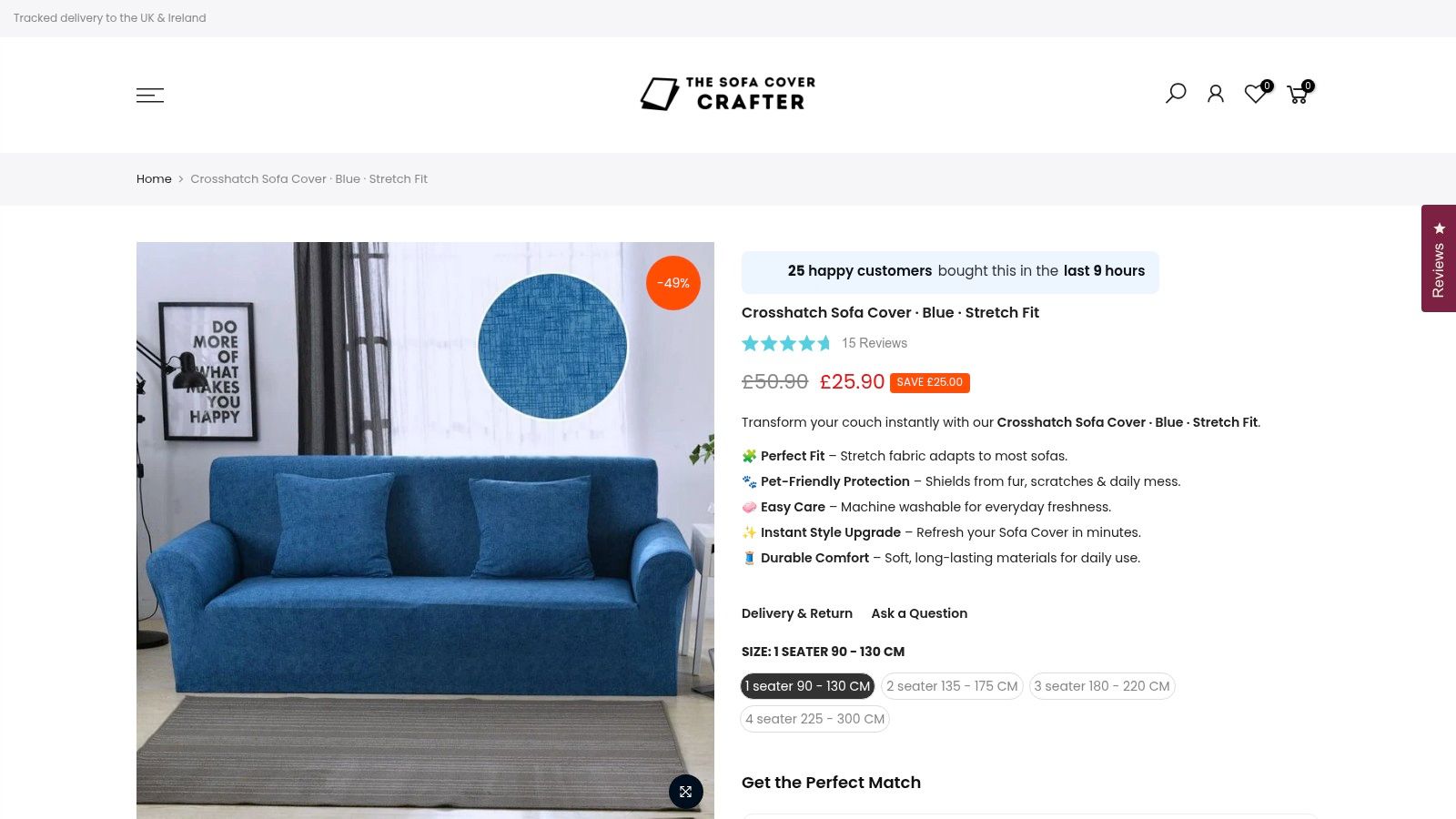
The reason is simple. A stretch cover is under the most tension where the sofa is most handled, so straight lines, oversized petals and broad checks can skew. Small repeats hide that movement because the eye reads the overall texture, not one giant shape.
The catalogue reflects that logic well. The Crosshatch Sofa Cover comes in 8 colourways, the Diamond Jacquard Sofa Cover in 9, and the Linear Geometric Sofa Cover in 3, all of which stay visually clear when the fabric is under tension.
A more textured route can also work. The Jacquard Sofa Cover, Bobble-Textured Sofa Cover, Flecked Sofa Cover, Gridelle Sofa Cover, Crossmere Sofa Cover and Veloura Sofa Cover all suit readers who want pattern without a loud motif. The one-design Printed Sofa Covers such as Vintage, Printemps, Asio, Esagonali, Azrose, Geo Chic, Zenmaze and Lunexa give a more graphic finish, but they need a calmer room and a more forgiving repeat to avoid looking busy under stretch.
| Pattern type | Behaviour under tension | Best suited for |
|---|---|---|
| Small geometric repeat | Holds shape and reads clearly | Compact sofas, busy rooms |
| Large floral motif | Distorts at seat front and arms | Rooms with more visual space |
| Textured woven pattern | Keeps interest without sharp lines | Everyday use, low-fuss styling |
The Sofa Cover - Velvet - Dark Green - Adaptable & Expandable is a plain-texture option for readers who want the sofa to stay quieter while the cushions carry the pattern. That trade-off makes sense when the room already has enough movement elsewhere.
Which Fabric Patterns Hold Up Best With Kids and Pets
A patterned sofa in a family room gets judged by more than colour. Seat fronts, arm tops, and cushion edges take the most strain, so the pattern has to survive movement, paws, and constant settling. Large motifs often fail first on a stretch cover because tension pulls them out of shape, while smaller repeats usually keep their reading clearer.
Woven patterns hold up better than printed patterns in busy homes because the design is built into the cloth rather than sitting on the surface. That matters where daily contact is strongest, because surface print is the first thing to soften or abrade.
UK upholstery durability is commonly checked with the Martindale abrasion test. Upholstery fabric guides rate 15,000 to 25,000 rubs as general domestic, while 25,000 to 30,000 rubs is the heavy domestic bracket for a family sofa sat on every day.
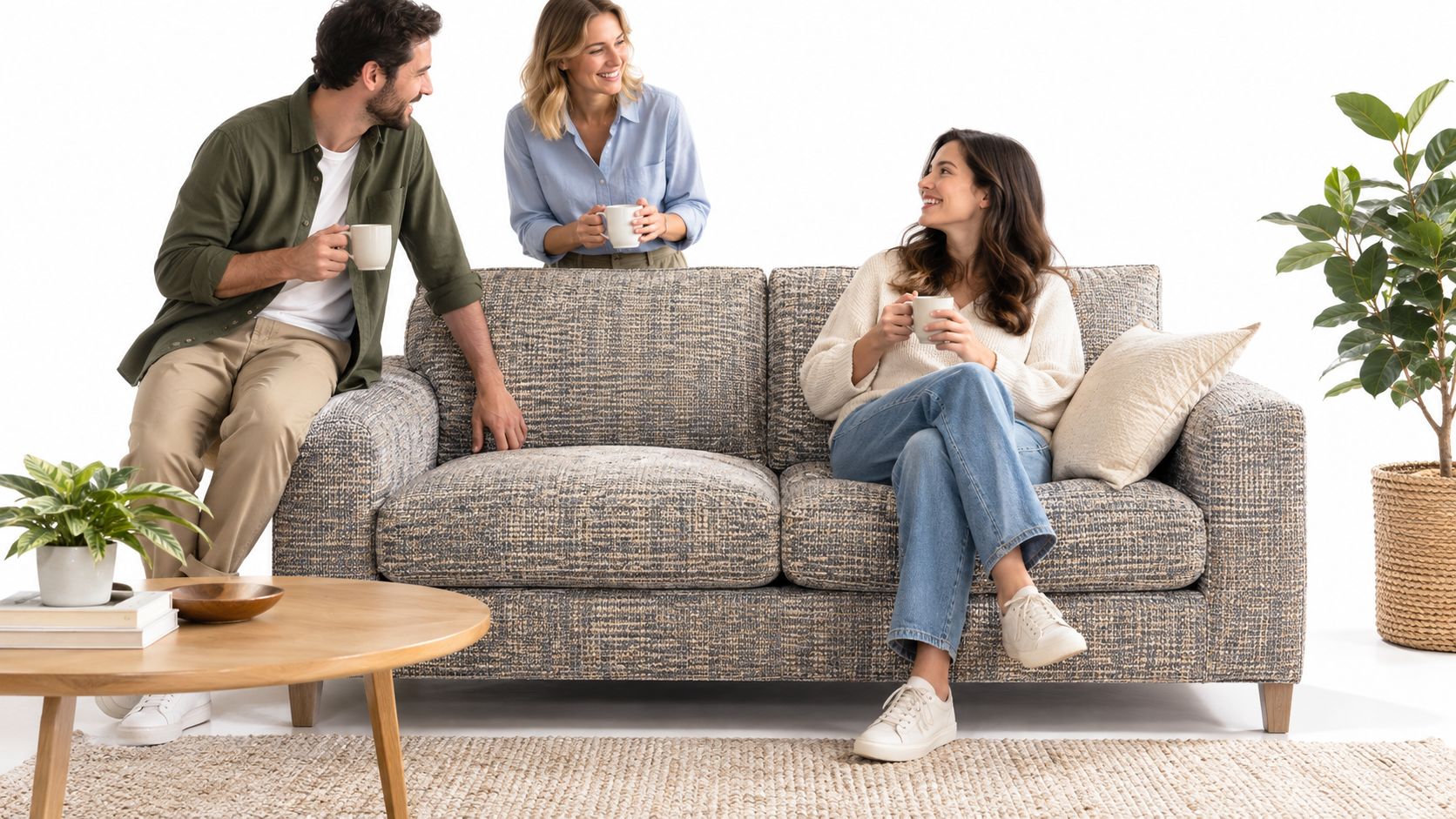
For families, pet owners and landlords, that usually points to woven jacquards and textured weaves. They are the safer bet if the sofa is going to take regular use, see best sofa fabric for dogs for a pet-focused comparison, because the pattern stays integrated as the fabric ages. Printed surfaces can look crisp at first, then lose clarity where hands, paws, and elbows land most often.
Practical takeaway: choose the pattern construction for wear first, then choose the look.
UK fire-safety rules also matter here. The Furniture and Furnishings (Fire) (Safety) Regulations 1988 require domestic upholstered items such as sofas and sofa beds to meet match-resistance and ignition requirements, and they also require a permanent label on most items [Bromley fire-safety leaflet].
If you are comparing options, the key question is whether the cover will keep its shape, stay compliant, and handle school runs, pets, guests, and quick turnarounds without looking tired.
The Sofa Cover Crafter's collection pages make it easier to compare patterned families and plain alternatives in one place, and the sofa-cover range is organised for that kind of practical browsing [sofa covers collection].
Styling a Patterned Two-Seater in a Compact Living Room
A patterned two-seater works best in a small room when everything else stays calmer than the sofa. If the room is already crowded with strong colours, busy artwork and mixed textures, the cover loses its job as the focal point and starts competing instead.
For compact living rooms, a mid-tone background usually gives the best balance. Very pale grounds can flatten the pattern, while very dark ones can make the sofa feel heavier than it needs to feel in a tight layout.
Landlords and Airbnb hosts get a different advantage from the same choice. A pattern hides small marks between cleans, like a drip of coffee, a line of crumbs or general wear, far better than a plain colour, and it also gives listing photos more personality because guests scroll past a lot of neutral seating before anything stands out.
Take photos in daylight, keep the surrounding décor restrained and let the sofa carry the visual interest. When the pattern starts to feel tired, replacing the cover is the sensible move, not replacing the sofa.
Useful styling rule: one patterned sofa, calmer walls, fewer competing prints.
Matching Pillow Covers exist for the repeating families, including Crosshatch, Diamond Jacquard, Linear Geometric, Gridelle, Crossmere, Jacquard, Bobble-Textured and Flecked. That makes it easier to build a joined-up look without hunting for matching cushion covers elsewhere, and it keeps the sofa from feeling like an isolated block of pattern.
For readers who prefer a quieter sofa body, plain families like the Classic Stretch Sofa Cover and Velvet Sofa Cover let the pattern live on the cushions instead. That approach works especially well when the room already has wallpaper, a strong rug or a lot of visual activity elsewhere.
Real Buyer Experience and Final Selection Tips
Camille L., in a verified buyer review of the Crosshatch Sofa Cover in Eggshell, said: "Fits like a glove on my two-seater and the cross pattern gives it a nice touch, super chic."
That's the kind of result people want from a patterned 2 seater sofa cover, a close fit, a clear pattern and a finished look that feels intentional. The quote also underlines the actual selection order, because the cover has to sit properly before the pattern can do its job.
Here's the short checklist I'd use before buying:
- Check the seat width: keep to the 135 to 175 cm 2-seater band.
- Match the repeat: small geometrics and textured weaves handle stretch better than one oversized motif.
- Check the room palette: use colours already present in the space so the sofa integrates cleanly.
The range is built around standard seat sizes, with covers cut for 1 seater 90 to 130 cm, 2 seater 135 to 175 cm, 3 seater 180 to 220 cm and 4 seater 225 to 300 cm. That makes it easier to move from decision to purchase without guessing at fit.
If you only want pattern on the cushions, the plain sofa families and the patterned Pillow Covers give you that mixed approach without forcing the same treatment across the whole sofa. If you want to browse the pattern families side by side, the main collections page and best-sellers page are the quickest places to start [pillow covers collection] [best sellers uk].
The Sofa Cover Crafter offers patterned stretch sofa covers, matching pillow covers and plain alternatives that let you build the look around the sofa you already own. If you want to put pattern on a two-seater without replacing the furniture, visit The Sofa Cover Crafter and compare the patterned families, the size bands and the cushion options in one place.
