


Chenille is a yarn with short tufts of fibre trapped between two twisted core threads and cut so they stand out all round, and the cloth woven from it has a soft, velvety, raised face. That face is what you are stroking when a throw looks plush in a shop or on a product photo.
You are probably deciding whether that softness will still look decent after laps, kids and the odd claw. The same tufts that make the cloth warm and slightly shaded in the folds are also the part that can pull out. Knowing that before you buy is more useful than another adjective.
Table of Contents
- What Is Chenille, Exactly?
- How Is Chenille Made, Step by Step?
- How Does Chenille Feel and Drape?
- Where Did Chenille Come From?
- How Does Chenille Compare With Velvet and Bouclé?
- How Do You Care for Chenille Without Causing Snags?
- Which Chenille Throw Suits Your Home?
What Is Chenille, Exactly?
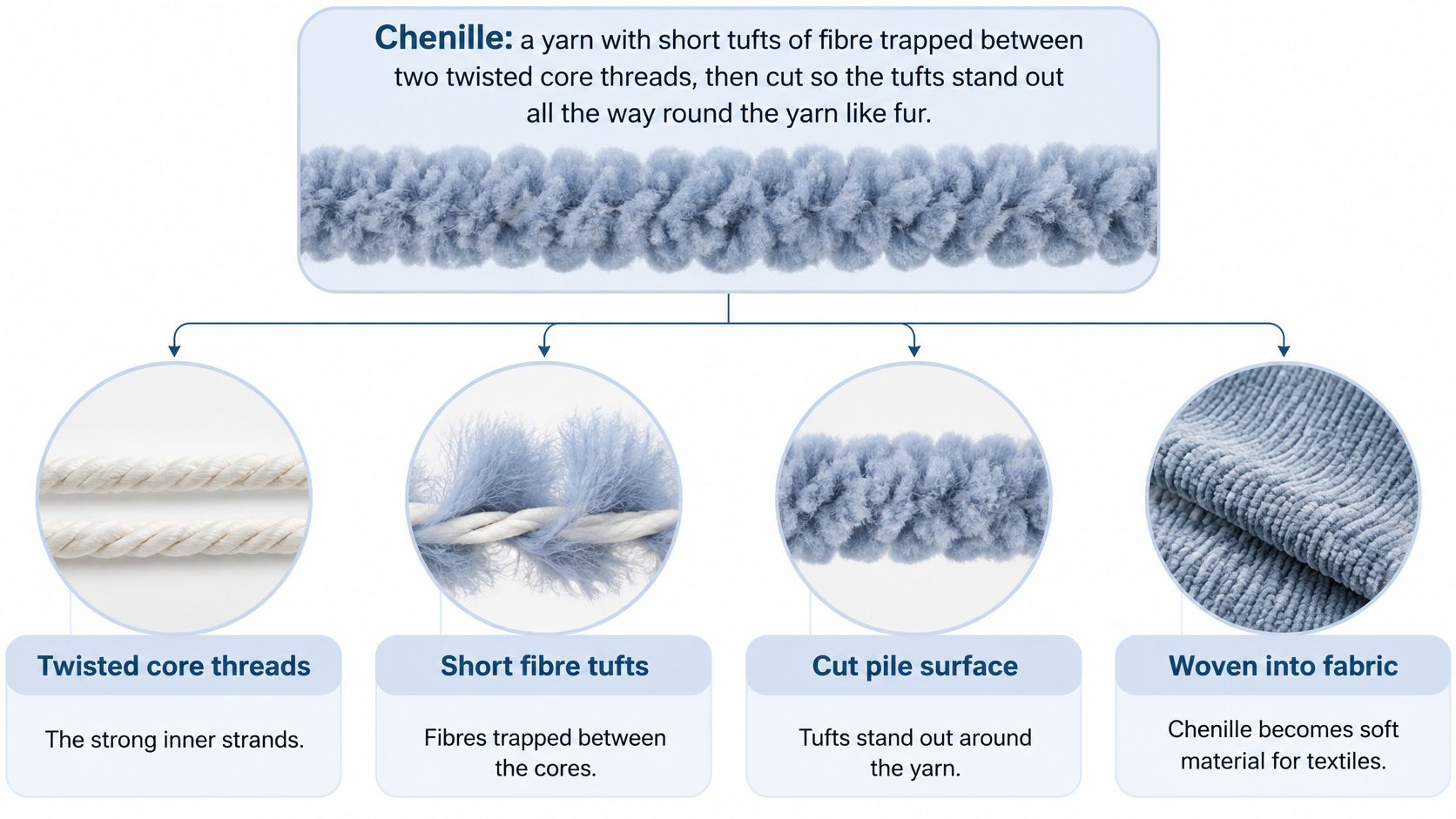
Chenille is a yarn, and the fabric woven from that yarn, with short tufts of fibre trapped between two twisted core threads and cut so the tufts stand out all the way round like fur, giving the cloth a soft, raised, velvety face.
The name is French for caterpillar, and a single strand looks like one. What is chenille is a question about construction, not about one plant or animal fibre. Modern chenille yarn is formed by placing short lengths of yarn between two core yarns, twisting them, and cutting so the short fibres project outward as a pile, roughly at right angles to the core. Cotton is common, but rayon, acrylic, wool, silk and olefin can all be made into chenille, so the fibre-content label tells you what that particular textile is made of.
Three layers you can picture in the shop
Think of the yarn in three layers, then the cloth you touch.
- Twisted core threads: the spine. Two yarns twist together and trap everything else.
- Short fibre tufts: the fur. They stick out all round the core, which is why the strand looks insect-like rather than flat.
- Woven cloth: the surface under your hand. Many of those fuzzy yarns sit side by side, so the face feels raised instead of smooth.
A flat woven cotton and a chenille cotton can share a fibre and feel nothing alike. The cut tuft is the difference. If a label only says “soft touch” and skips fibre content, you still do not know how it will wash, pill or hold dye.
Our chenille piece is the Soft Tassel Sofa Throw, a chenille throw with tassels, in Coffee Brown, Pistachio Green, Sandy Tan and Dusty Grey. It is a loose throw, not a fitted sofa cover.
How Is Chenille Made, Step by Step?
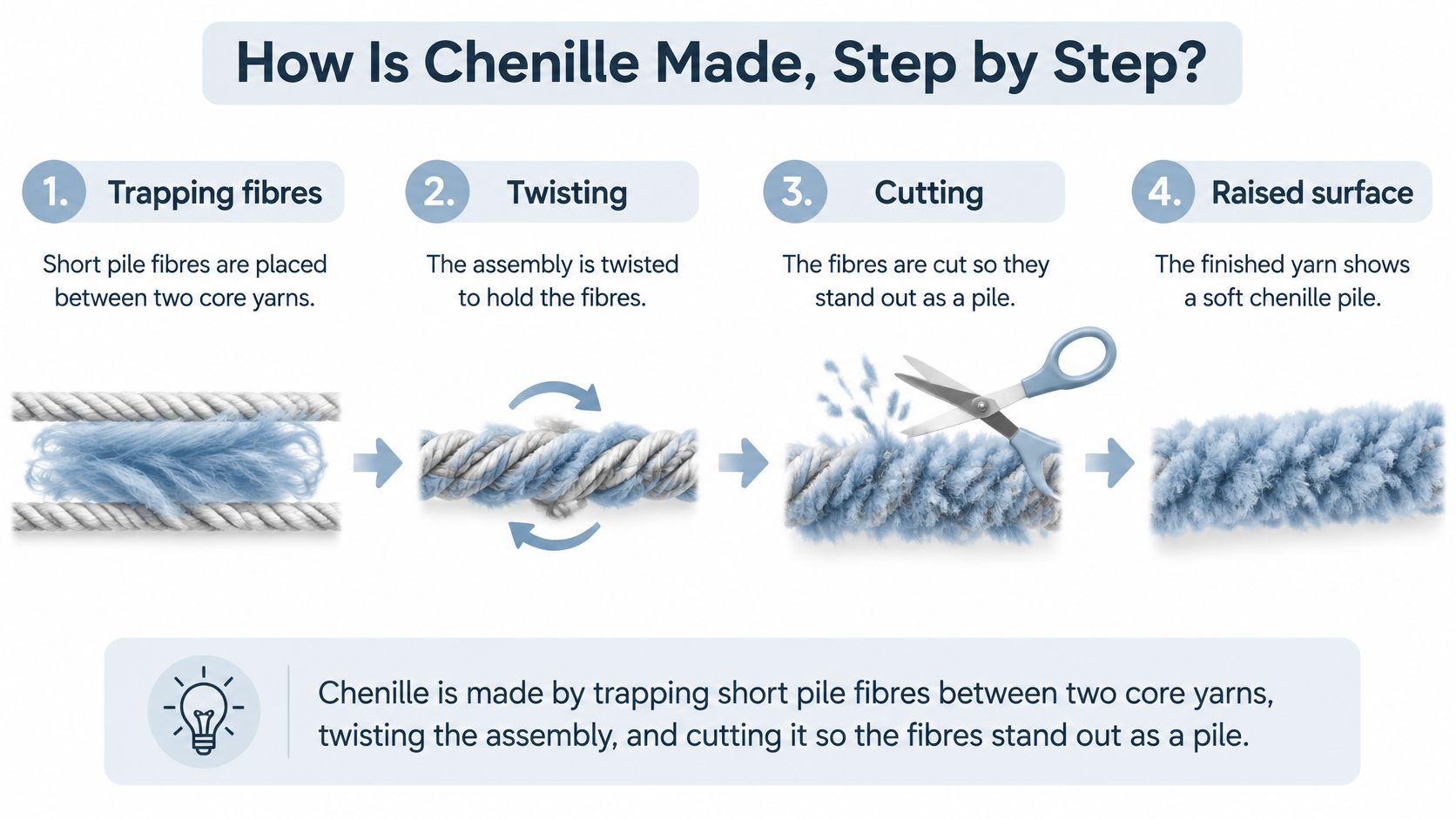
Chenille yarn is made by trapping short pile fibres between two core yarns, twisting that assembly, and cutting it so the fibres stand out as a pile.
The Wikipedia account of chenille fabric describes that geometry: the pile stands at right angles to the yarn's core. Each step exists so the next one can hold.
- Lay two core yarns side by side. They are the only thing that will grip the pile. Without a firm twist later, there is nothing for the tufts to lock into.
- Place short pile fibres between the cores. Those short lengths become the fuzz you feel. Longer pile would flop; shorter pile would feel flatter.
- Twist the cores. The twist traps the pile and sets it at roughly right angles, which is why light skims the surface instead of sinking into a flat weave.
- Cut the wrapped yarn. Cutting leaves the fibre ends standing evenly, rather than loops. That cut end is soft, and it is also a loose end.
- Weave the yarn into cloth. Makers weave the finished chenille yarn into cloth. The original method ran the other way: a "leno" fabric was woven first, then cut into strips that became the yarn.
- Finish the cloth. Brushing and steaming settle the pile so it lies evenly. A patchy finish shows as soon as you stroke it.
That short, upright pile creates a high surface area and directional light, so the same cloth can look a shade lighter or darker when you turn it or brush it the other way. It is not a printing fault.
What to check before you trust the softness
Pressure, friction and repeated brushing can crush the pile, and loose tufts can pull out and show the ground. Choose by fibre composition, pile security and the traffic the textile will take, not by hand-feel alone. Cotton, viscose or rayon, polyester, acrylic, wool, linen and blends are all possible; synthetic blends are generally used where more stability and wear resistance are wanted. For a UK home, a rental or short-term accommodation, read the supplier's abrasion, pilling, colourfastness and cleaning notes. The word chenille is not a performance grade.
How Does Chenille Feel and Drape?
A chenille throw feels soft and velvety, with a raised face that drapes more heavily than velvet and gives warmth without bulk.
The tufts hold a thin layer of still air, so the cloth warms a lap without the thickness of a fleece. Because the cloth is heavier in the hand, folds fall in soft, rounded shapes rather than sharp creases. Each fold turns some tufts toward the light and some away, so one plain colour reads as several shades. That shift is the surface, not a dye fault.
Try it in the shop, or against a window if you already own a piece. Stroke with the pile, then against it. Lift a fold to the light. If the shade changes as the pile moves, you are looking at chenille behaving normally. For a wider map of sofa textures, the guide to the texture of fabrics sets chenille beside other faces without treating every fuzzy cloth as the same thing.
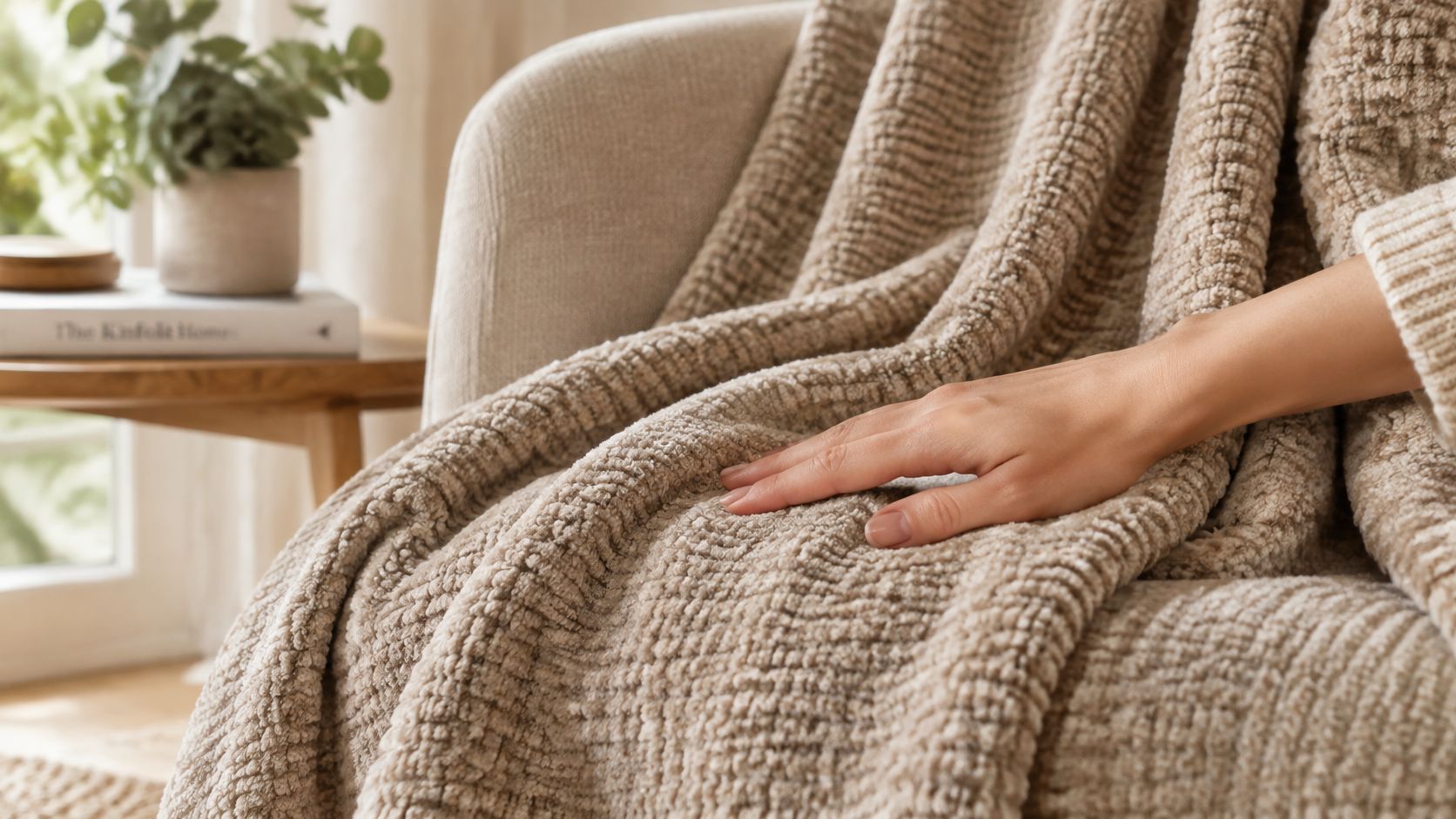
Alexander H., Soft Tassel Sofa Throw in Dusty Grey: "It's made of soft chenille, and you can tell it's quality; feels nice and plush without being too heavy."
That line matches the balance the yarn is built for: plush from the tufts, not heavy from a thick filling. At home it is a throw you wrap around, with a surface that stays soft under the hand as long as the pile is not dragged or crushed flat. It will not feel like a smooth cotton sheet, and it should not feel like a stuffed quilt either.
Where Did Chenille Come From?
Chenille has a long, documented history in furnishing textiles, and British collections record it from the late nineteenth century onwards, once the tufted yarn was already established in Europe.
The Victoria and Albert Museum holds a French brocaded-silk fragment from the 1760s, brocaded with red, white and green chenille and red chenille blossoms, measuring 72 centimetres by 19 centimetres at its largest.
British furnishing use then runs in a clear line.
- Around 1895–1898, Alexander Morton & Co. made a furnishing sample in Great Britain that combined silk, cotton and chenille in a woven double cloth, with fawn chenille motifs on a cerise silk ground, now in the V&A collection.
- Through the middle of the twentieth century, British makers kept chenille inside furnishing cloth, pairing the tufted yarn with cotton, rayon and wool in different mixes.
- The constant across those changes is the cut pile: fibres can swap, colours can deepen, and the cloth still rises into soft ribs that catch light and can catch a claw.
What those dates change for a buyer
The cut tuft defines chenille, not any single material. An older furnishing cloth and a modern throw can share a feel and still differ in fibre, which is why the label still matters more than the word on the swing ticket.
How Does Chenille Compare With Velvet and Bouclé?
Pick up each cloth in a shop and your hand tells you the difference before your eyes do. Chenille feels plusher than bouclé and drapes more heavily than velvet, and the reason sits in the yarn. Chenille's cut tufts are held only by the twist of its core, velvet's pile is woven short and dense, and bouclé's loops are formed in the yarn itself. The same tufts that hold still air and bend to show several shades are the tufts a claw can pull free.
| Feature | Chenille | Velvet | Bouclé |
|---|---|---|---|
| Feel | Soft, fuzzy, raised face | Smooth, dense, short pile | Nubbly, looped surface |
| Drape | Heavy; folds show several shades | Close fall; shade shifts where the pile is brushed | Firmer; holds its shape more |
| Warmth | Tufts hold still air; warm without bulk | Warm; dense pile | Warm; loops trap air |
| Pets | Tufts can hook claws and pull loose | Less likely to pull loose, but can show crushing and marks | Loops catch claws and can pull out |
| Washing | Often washable at home if the label allows; tie or bag tassels | Gentle cycle and flat drying when the label allows; the pile can flatten while damp | Gentle cycle inside a laundry bag and flat drying, so the loops are not caught |
| Main risk | Snags pull tufts into bald streaks | Crushed or flattened marks | Snags pull loops out of the cloth |
Pets and washing, where the choice is made
On pets, the structure decides. Bouclé's loops and chenille's tufts both stand proud of the cloth, so a claw hooks under them and draws them out. Velvet's short dense pile sits lower, so it rarely unravels in a line, but sitting and rubbing crush it and leave shiny marks. If claws visit daily, a chenille throw you can lift off the sofa is a different decision from chenille used as the sofa's own upholstery.
On washing, many chenille throws can go through a home machine when the care label says so, with tassels tied or bagged. Velvet follows its own label, and how far a velvet resists water depends on the finish applied to the cloth, so two velvets can behave differently in the same wash. Bouclé is a looped yarn, and a raised loop caught on the drum pulls out the way a chenille tuft does, which is why a laundry bag earns its place; the textured bouclé sofa throws piece looks at that cloth on its own. Polyester, microfibre and sherpa are separate cloths again, each with its own care and texture.
Chenille for a warm, draped layer. Velvet for a sleek, smooth look. Bouclé for a nubbly, textured look.
How Do You Care for Chenille Without Causing Snags?
A chenille throw can usually be washed at home if its care label allows it, and the way to avoid snags is to cut a loose tuft level rather than pull it.
Washing temperatures come from that label, not from a general guide. The routine below is about friction, which is what works tufts loose.
- Read the care label first. It overrides any general habit, including whether the throw is machine-washable at all.
- Turn the throw inside out, or put it in a large laundry bag. The pile then does not scrub the drum.
- Tie or bag the tassels. Loose tassels knot, and unpicking them yanks the edge.
- Use a gentle cycle and leave room in the drum. A packed load grinds the throw against itself.
- Skip the tumble dryer. Dry the throw flat or over a rail so the pile is not beaten while it is hot and damp.
- Smooth the pile with your hand, all in one direction, once it is dry. That resets the shade and the hand-feel.
Louie M., Soft Tassel Sofa Throw in Coffee Brown: "The tassels are a lovely touch, adding that bit of character, and it’s held up well through a few washes."
The snag you should not pull
The tufts are held only by the twist of the core. A snag or a sharp pull can draw a line of them out and leave a bald streak. Pulling drags the neighbours with it, so one standing loop becomes a track. Snip the loop level with the surface using small scissors. Claws are the usual cause, because they hook tufts the way a fork catches wool. Keep claws off the throw if you want the pile to stay even.
| Symptom | Likely cause | Fix |
|---|---|---|
| Loop or tuft standing up | Snag or claw catch | Snip it level with small scissors; never pull it |
| Bald streak | Tufts drawn out along a pull | Cannot be fully restored; stop the pulling and snip loose tufts level |
| Flattened or matted pile | Pressure, friction or brushing against the pile | Brush gently by hand in one direction and let the pile recover |
| Pilling | Friction between surfaces | Keep the throw off rough surfaces; see the guide to preventing pilling |
| Tassels knotted | Tumbling loose in the wash | Tie or bag tassels before washing; ease knots apart by hand when dry |
| Uneven shade | Light falling on tufts from different directions | Not a fault; smooth the pile one way |
A bald streak cannot be woven back in. Stopping the pull, and levelling what is already loose, is the whole repair. Pilling is a different fault, small balls from fibres rubbing, and it is worth treating on its own rather than with the same scissors habit you use on a tuft.
Practical rule: if a tuft sticks up, cut it flush. Pulling is what turns a speck into a streak.
Day to day, lift the throw before anyone kneels on it with jewellery or a buckle, and check the upholstery cleaning codes if you are also caring for the sofa underneath. A removable throw and a fixed cover do not share one cleaning code.
Which Chenille Throw Suits Your Home?
A chenille throw suits a household with children or pets if you accept that the pile can snag and you follow the care routine.
For a family, the useful part is that you can take it off, wash it when the label allows, and put it back. The risk you are accepting is a claw or a sharp pull. Keep claws off the surface, and snip any loose tuft level. You are not buying an indestructible upholstery cloth. You are buying a soft layer you can replace without reupholstering the sofa.
For styling, the shifting shades suit a plain colour, and the throw layers over a sofa or an armchair rather than trying to mimic fitted upholstery. If you are building a pale winter room, the Cottagestead guide to white winter styling is a useful companion for how light cloths sit together, then you can decide whether a deeper chenille colour should be the contrast.
| Option | Choices |
|---|---|
| Style | Chenille throw with tassels |
| Colours | Coffee Brown, Pistachio Green, Sandy Tan, Dusty Grey |
| Sizes | 180 × 130 cm, 180 × 230 cm, 180 × 300 cm, 180 × 420 cm |
Measure the sofa before you order. The Soft Tassel Sofa Throw is a throw, not a fitted cover, so a listed size is not a promise that it fits an L-shape, a recliner or a particular seater count. Drape it, do not stretch it.
We do not make a chenille sofa cover or a chenille cushion cover. If you want a soft pile on the sofa itself, the nearest pieces are the Velvet Sofa Cover in the sofa covers collection and the Velvet Pillow Cover in the pillow covers collection. Those are velvet, not chenille.
For landlords and short-term accommodation, UK upholstered furniture is subject to requirements on filling ignition, cigarette resistance of upholstery composites, and match resistance of covers, with exemptions and test conditions set out in the Furniture and Furnishings (Fire) (Safety) Regulations.
The Soft Tassel Sofa Throw in Dusty Grey is one of the four colours, and the full set of chenille throws with tassels sits in the sofa throw collection.
The Sofa Cover Crafter makes sofa throws, sofa covers and pillow covers for UK homes that want a softer room without buying a new sofa. If a chenille throw with tassels is the layer you want, start with the Soft Tassel sizes and colours, and use a velvet cover only when you need pile on the sofa itself. Visit The Sofa Cover Crafter to compare the throw with the velvet pieces before you order.
