



W means a water-based cleaner. S means a water-free solvent cleaner only. WS allows either a water-based or a solvent cleaner. X allows no liquid at all, only vacuuming or light brushing.
People read that letter as a stain recipe. It isn't. It's a rule about moisture on fabric that stays fixed to the frame. A removable cover has its own care label, and that label does not rewrite the sofa underneath. If you treat S as "spot clean", you'll reach for water on the one code written to keep water off the cloth.
Table of Contents
- What Do the Letters W, S, WS and X on a Sofa Tag Mean?
- Why Does Water Leave a Ring on Upholstery?
- Where Do I Find the Cleaning Code on My Sofa?
- Which Cleaning Methods Are Safe for Each Code, and What Should You Avoid?
- How Do I Test a Cleaner on a Hidden Spot?
- Should I Remove the Cover or Clean the Sofa in Place?
- When Should You Call a Professional Upholsterer?
What Do the Letters W, S, WS and X on a Sofa Tag Mean?
Those four letters come from an industry convention printed on many upholstery tags. They are guidance for the fabric rather than a legal classification, and no code guarantees that every product sold under it is safe on your sofa. The Learn to Upholster stain guide reads the letters the same way and adds two useful cautions: where two labels disagree, follow the more cautious one, and test any permitted cleaner on a hidden area before you touch a visible mark.
| Code | What it means | Permitted cleaning | Not permitted |
|---|---|---|---|
| W | Water-based cleaning is allowed | Water-based upholstery cleaner, used sparingly | Machine washing, steam or saturating the fabric |
| S | Water-free solvent cleaning only | Water-free solvent cleaner | Any water-based cleaner, including steam |
| WS (also written S/W) | Either approach is permitted | Water-based or solvent cleaner, as the tag allows | Soaking or saturating the fabric under either method |
| X | No liquid at all | Vacuuming or light brushing | Any water, steam or solvent cleaner; anything more is a professional job |
Read each letter as a limit on moisture and the common misreadings fall away. A W tag still forbids steam and a soaked cushion. An S tag calls for a solvent cleaner, the kind that lifts soil without adding water, so a damp cloth works against the tag's whole purpose. Even the lenient WS caps how wet the fabric should get.
The code sits on the manufacturer's care label, often tucked out of sight until you lift a cushion. Whatever letter you find, the hidden-area test comes before the visible mark.
Why Does Water Leave a Ring on Upholstery?
Water leaves a ring on fixed upholstery because you can only wet a patch: the water dissolves soil and loose dye, carries them out through the fabric and the foam, and drops them at the edge of the damp area as it dries.
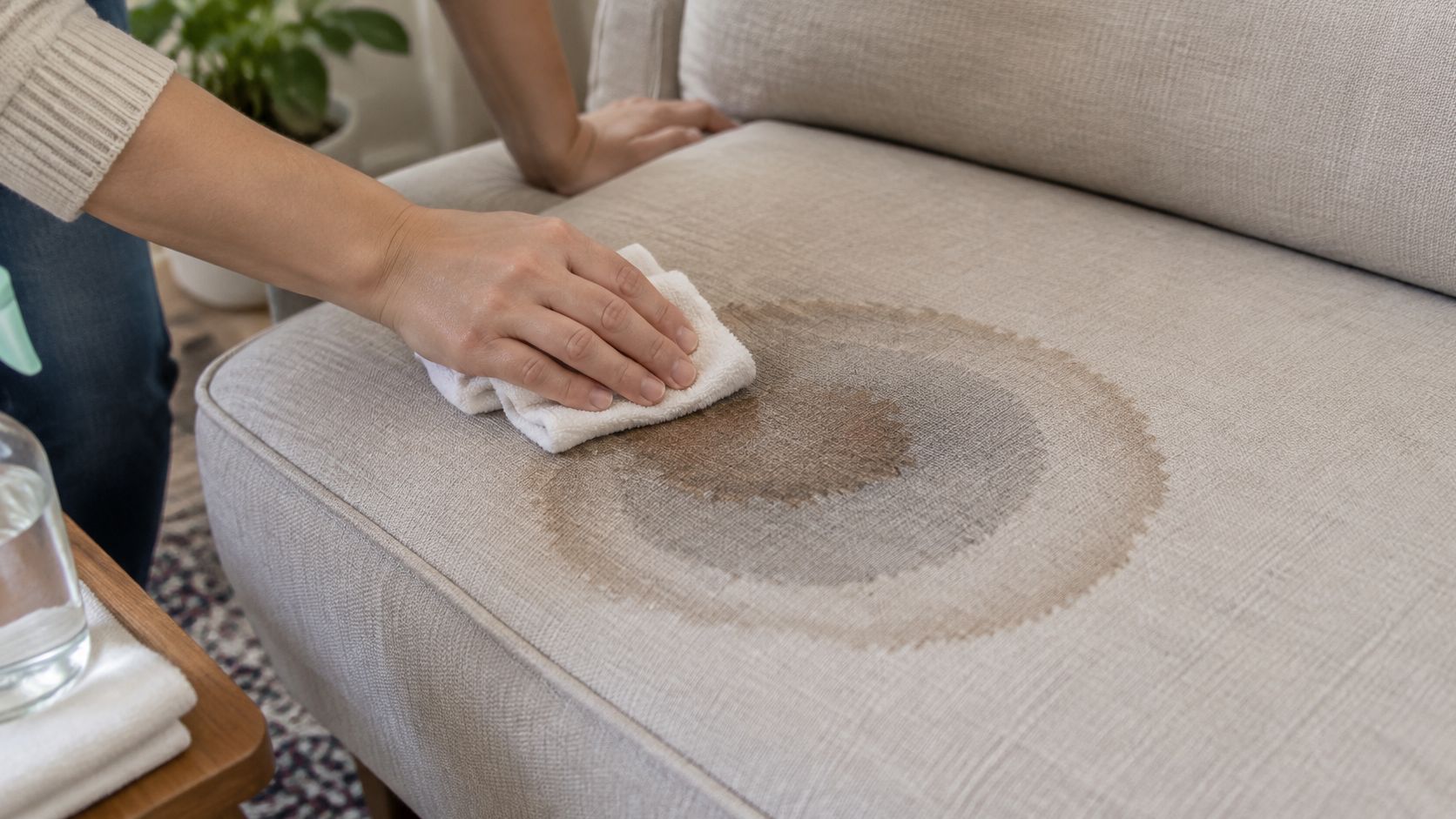
Think of tea on a tablecloth. The middle often dries looking clear, while a darker ring sits where the wet patch stopped. A fixed sofa can't be dunked and rinsed as one piece, so soil has a dry edge to collect against.
The foam makes the ring worse than a cloth on a table.
What the store owner sees: "A spill on a sofa doesn't stay in the fabric; it soaks into the foam underneath. You clean the surface and it looks perfect. Then, as it dries, the moisture creeps back up and brings the stain with it."
That tide-mark ring is what an S code protects against. A water-free solvent method avoids the moisture that ferries soil to an edge. W and WS still carry the same risk if the patch is too large or too wet. The code is a rule about where moisture goes, not a symbol to memorise.
Where Do I Find the Cleaning Code on My Sofa?
The cleaning code on a sofa is usually printed on a manufacturer's care label beneath a seat cushion, along the side of the frame, or on the rear or underside.
Many UK tags use the same practical system: W, S, W-S (or S-W), and X, found on the manufacturer's care label in those spots. Unsuitable moisture can cause shrinkage, dye bleeding, watermarking, backing damage, or a permanent texture change. An unsuitable solvent can affect colour and fibres. Check the furniture label before you apply anything, and contact the manufacturer if the label has been removed.
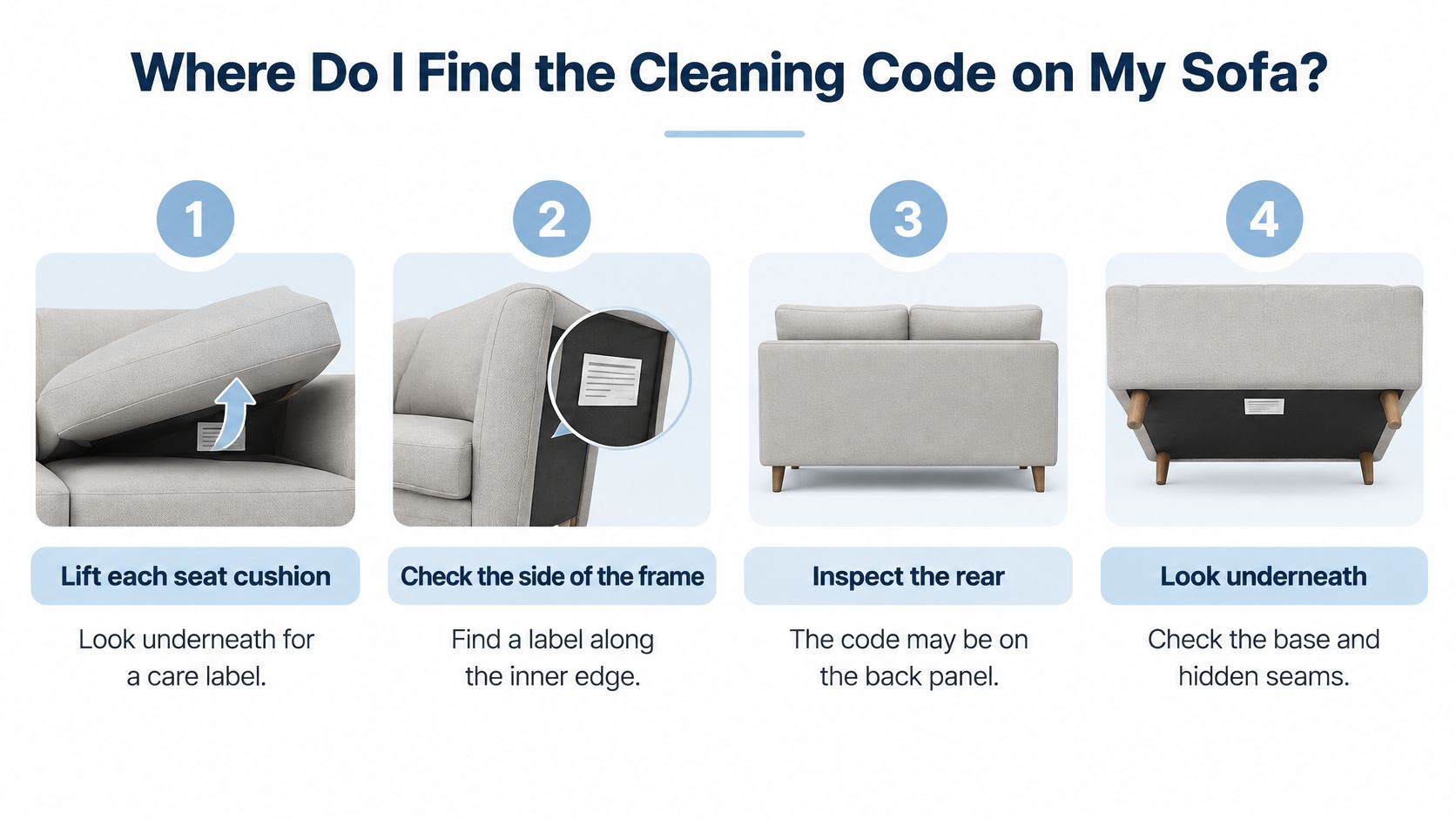
- Lift each seat cushion. Check underneath, then the side seams and the rear panel.
- Read the letter exactly. Note W, S, S/W, WS or X as printed.
- Photograph the label. Do this before any cover goes on, so the original instruction stays on record.
- Find the fire-safety label separately. It is a different label. Don't read it as a cleaning code.
- If the tag is missing or illegible, stop guessing. Ask the manufacturer. Second-hand and rental sofas often arrive with no tag.
- Write the code on a card. Keep it with the sofa's paperwork.
Say the base sofa is tagged W and a removable cover sits on top. Two labels are in play. The sofa's tag governs the base fabric. The cover's own care label governs the cover. A cover's wash instructions do not set the code of the upholstery underneath.
Which Cleaning Methods Are Safe for Each Code, and What Should You Avoid?
The letter on the tag answers one practical question: where may moisture go on this sofa? A W code lets a water-based cleaner reach the fabric surface in small amounts. An S code bars water altogether, so the work happens with a water-free solvent. A WS code permits either route, chosen by the stain. An X code bars liquid of any kind, so routine care stops at vacuuming or light brushing, with anything further left to a professional.
Treat the letters as a risk-control system, because water-sensitive fibres or unstable dyes can develop tidelines, colour migration, shrinkage, or backing distortion when the wrong liquid reaches them. X is a hard stop for domestic wet extraction, steam, detergent, or solvent.
Match the chemistry to the mark
W and S are also a stain-chemistry choice. Water-based systems suit water-soluble soil, but they can permanently alter moisture-sensitive dyes, finishes, or construction. Solvent cleaning can reduce water marking on S textiles, yet a solvent-only process may do little against some water-based stains. Solvent work needs a pre-test, because it can affect water-sensitive fabrics, and solvents may evaporate more slowly than low-moisture wet cleaning.
Once you know which liquid, if any, may touch the fabric, work through the job in this order:
- Vacuum the whole piece before any wet cleaning, so loose soil cannot turn into mud under the cloth.
- Classify the stain as mainly water-soluble, oily, or mixed.
- Use only an upholstery product, and only the liquid or solvent the code permits.
- Blot from the outside inwards. Rubbing spreads the mark and frays the fibres.
- Keep moisture at the surface. Don't saturate cushions or foam, and don't flood the area.
- Ventilate until the fabric is fully dry. A hairdryer can set the mark.
Three mistakes are worth avoiding. Don't mix cleaners, because one product can react with residue from another and shift the colour. Don't let any water or solvent touch an X sofa, since the code already limits routine care to vacuuming or brushing. Don't reach for steam on a W sofa unless that sofa's own instructions allow it, because steam is moisture arriving hot and fast, and the code's water limit applies to it in full.
Fixed fabric and pile need different handling. For the longer routine on fixed upholstery, use the guide to cleaning a fabric sofa. Velvet follows its own rules, covered in the velvet sofa cleaning guide. Landlords and hosts can add the code and its approved method to the property checklist, so a spill gets the right chemistry rather than the nearest spray bottle. The wrong choice can turn a spill into dye transfer, lingering damp, odour, or damage you can't reverse. The Sofa Cover Crafter's covers are machine washable, following the care label on each cover, which takes routine spill duty off the upholstery.
How Do I Test a Cleaner on a Hidden Spot?
Test the permitted cleaner for that sofa on a hidden area, such as the underside of a seat cushion, the rear panel, or the inside of a fold, and judge the result only once the spot is fully dry.
- Choose fabric no one sees. Match the pile and colour of the visible stain if you can.
- Apply a small amount. Use only the method the code allows.
- Blot with a clean white cloth. Don't rub.
- Let the spot dry completely. A fan or an open window is enough. Don't add heat.
- Check the dry cloth. Look for a colour change, a darker edge, a shift in texture, or stiffness.
- Treat the visible stain only if the test stays clear. Start with the smallest amount that might work.
A damp patch often looks fine while it's wet. The ring or the colour shift shows up at the edge as it dries, so an early look gives a false pass. If the test spot looks clear while wet and shows a faint edge once dry, stop. That sofa needs a different approach, not a bigger dose of the same liquid. Set-in marks that fail this test are covered in the guide to removing stains from a sofa.
Should I Remove the Cover or Clean the Sofa in Place?
Remove the cover and wash it for an everyday spill. A ring forms where moisture stops, and a machine-washable cover is wetted and rinsed evenly all over, so there is no drying edge for a ring to set along. The fixed upholstery underneath needs attention only when the spill has got past the cover.
Two labels, two sets of rules. The cover's care label governs the cover. The sofa's cleaning code still governs the upholstery beneath it. Read the sofa's tag before you fit the cover and write the letter down, because a code hidden under a cover is easy to forget.
"A cover stops the spill before it ever reaches the foam, and it goes in the washing machine, which a fixed sofa never can."
| Situation | Remove and wash the cover | Clean the sofa in place |
|---|---|---|
| Everyday spill on a removable stretch cover | Preferred: wash the cover following its own care label | Not needed unless the spill has reached the fixed upholstery |
| Spill has got past the cover into the cushion | Remove the cover first, then treat the cushion | Follow the sofa's own code: W, S, WS or X |
| Sofa's code is X | Remove and wash the cover following its care label | Vacuum or brush only; no liquid |
| Sofa's code cannot be read | Wash the cover following its care label | Hold off on liquids until the code is confirmed |
A cover fits only the configurations its listing names, so check that listing before you order. For sofas where the seat cushions take the marks, separate cushion covers protect the piece that does. Browse sofa covers, sofa cushion covers, and corner sofa covers. One fabric option is the Sofa Cover - Velvet - Dark Green - Adaptable & Expandable. Whether a given fabric resists water is stated on its product listing, so read the description before relying on it.
Washing steps sit in the guide to washing sofa covers without shrinking. The covers are machine washable: follow the care label, skip the fabric softener, and air-dry. Part of the stretch comes from elastane, and tumble-dryer heat relaxes elastane for good, so keep the cover out of the dryer. Refit the cover while it is still slightly damp so it settles under even tension, and let the care label on each cover remain the authority.
When Should You Call a Professional Upholsterer?
Call a professional upholsterer when an X sofa still shows the mark after vacuuming or brushing, when the code can't be confirmed from the tag or the manufacturer, when a hidden test leaves a ring, colour change, or texture change, when the stain has spread past what a cover or a dry method can reach, when an odour remains after the fabric has dried, or when the fire-safety label is missing or unreadable.
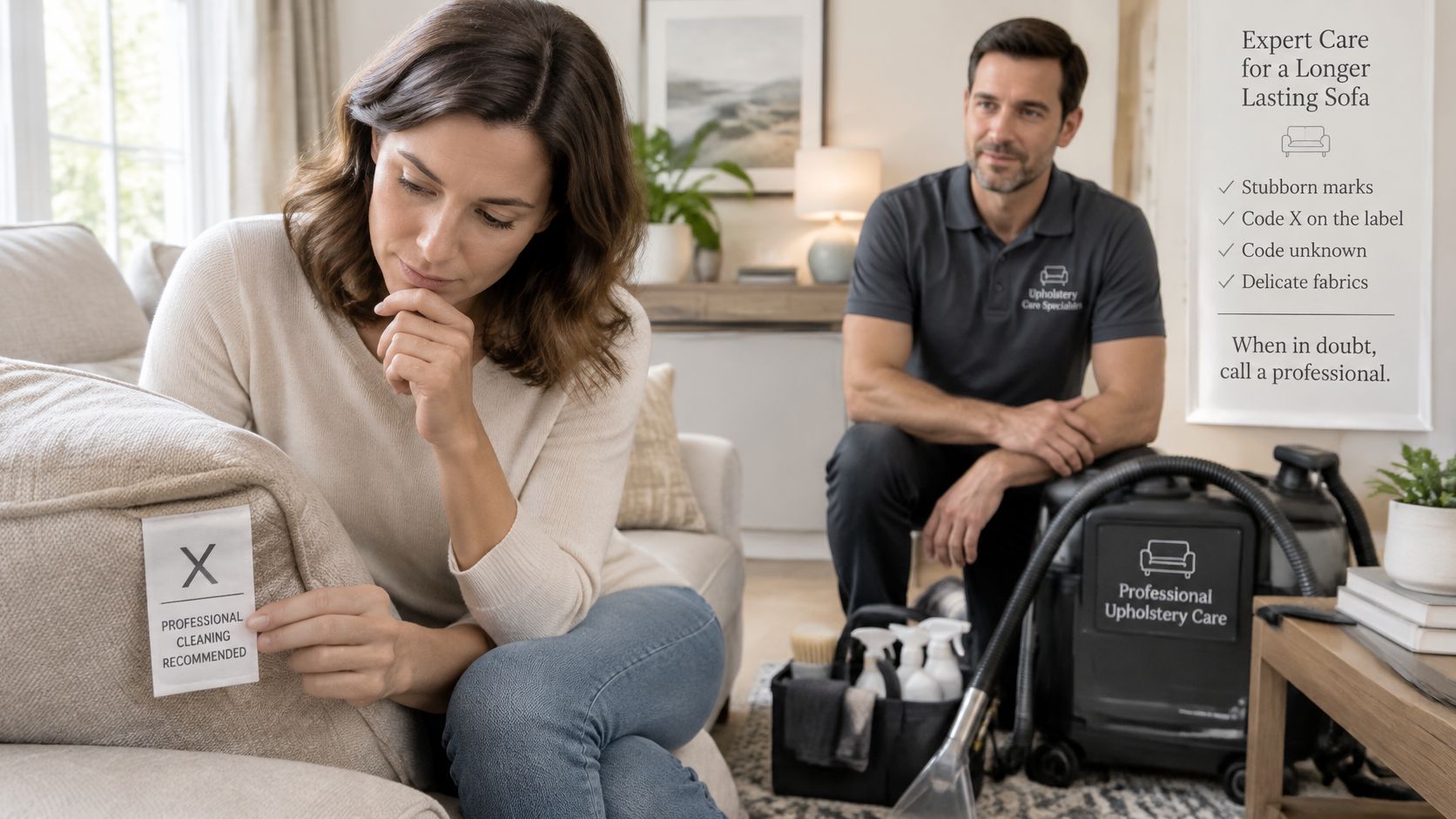
X does not mean a household product is safe to try. A controlled vacuum, a light brush, or a specialist assessment is safer than a home wet treatment on an unknown or restricted cloth.
- Read the sofa's code before any liquid is considered.
- Classify the mark as water-soluble, oily, or mixed.
- Test a hidden area only if the code allows liquid.
- Finish in place if the test is clean and the mark lifts. If it doesn't, stop and call a professional.
Note the code with the sofa, and check the care label on any cover before it goes in the machine. For a cover that matches the configuration on its listing, browse the sofa cover collection. Covers are sold as machine washable, and the care label on each still decides the wash. We also provide an Installation Guide, a Size Guide, an FAQ page, and order tracking, so the fit and the aftercare stay with the listing rather than with a guessed code.
The Sofa Cover Crafter makes removable, machine-washable sofa covers and cushion covers so everyday spills can come off the sofa and go through an even wash, while the sofa's own tag still decides what may touch the upholstery underneath. Check the listing for your seater or corner shape, then follow the care label on the cover you choose. Visit The Sofa Cover Crafter to compare covers for your sofa.
