



If you're searching for an Ektorp IKEA armchair, you're probably deciding whether to refresh the chair you already own or replace its worn cover. The Ektorp is a substantial, traditionally upholstered armchair with removable covers, but the universal covers discussed here are not genuine IKEA replacements. They're adaptable stretch layers that sit over the existing chair, so fit depends on the frame width, padded arms and the way you tuck the fabric around the lift-out cushions.
Table of Contents
- What Is an Ektorp IKEA Armchair and Will a Universal Cover Fit It
- How Do You Measure an Ektorp Armchair for a Stretch Cover
- Which Stretch Cover Fabric Works Best on Padded Arms
- How Do You Fit a Stretch Cover Over a Lift-Out Seat Cushion
- Why Does My Armchair Cover Look Wrinkled or Saggy
- How Should You Wash the Cover and Manage Fire Safety Labels
What Is an Ektorp IKEA Armchair and Will a Universal Cover Fit It
A universal stretch cover can fit an Ektorp IKEA armchair when the chair falls within the 1 seater width band of 90 to 130 cm, but the fit depends on how the fabric behaves over the frame, especially around the padded arms and the lift-out cushion system.
The Ektorp armchair is still sold in the UK in several upholstery options, as shown in the IKEA UK Ektorp range. IKEA lists the Hakebo dark-grey armchair at £279, so this is still a current chair, not just a second-hand reference point.
The physical build is what decides the cover fit. According to the IKEA UK Hakebo product information, the frame uses plywood, particleboard, solid wood and fibreboard, with foam in the frame and arms, while the seat uses high-resilience foam and the back cushion uses recycled hollow-fibre polyester. Those generously padded arms create the main fitting problem. The fabric has to clear a broad rounded shape before it can be tucked down and held in place.
We don't sell IKEA furniture, we don't make Ektorp-pattern covers, we don't make made-to-measure covers and we aren't affiliated with IKEA. Our universal stretch covers are organised by overall width, not by furniture model. An armchair takes the 1 seater size, while the wider sofa sizes cover 2 seater, 3 seater and 4 seater configurations. A recliner is a different shape: the Interwoven Recliner Cover comes in Normal Size S, M, L and XL, and dining chairs take the Classic Stretch Chair Cover.
The honest distinction: a universal cover protects and changes the appearance of the original upholstery. It doesn't reproduce the Ektorp's factory seams, cushion pattern or exact proportions.
That difference shows up in the way the cover settles. A genuine replacement follows the original construction line, while a universal cover depends on stretch, tension and careful tucking. If you're weighing those approaches, custom versus universal slipcovers gives useful context.
The Ektorp's design also explains why many owners choose to recover rather than replace it: IKEA built it with a removable, washable cover from the start, so changing the cover rather than the chair was always the idea. Current UK second-hand listings still show pre-owned Ektorp armchairs and sets, although marketplace asking prices are not the same as completed-sale values.
On an Ektorp that measures within the band, a universal cover will span the arms, but the factory seam line can sit a little off the original, which is the visible trade-off you accept when you use a stretch overlay.
How Do You Measure an Ektorp Armchair for a Stretch Cover
Measure the Ektorp armchair from the outer edge of one arm to the outer edge of the other, then check that measurement against the 1 seater range of 90 to 130 cm.
Don't measure only the seat cushion. The Ektorp's arms are heavily padded, and those arms determine how much fabric the cover must span. Measuring between the inner edges of the arms will give you a deceptively small figure and can lead to a cover that pulls hard across the sides or refuses to reach the base.
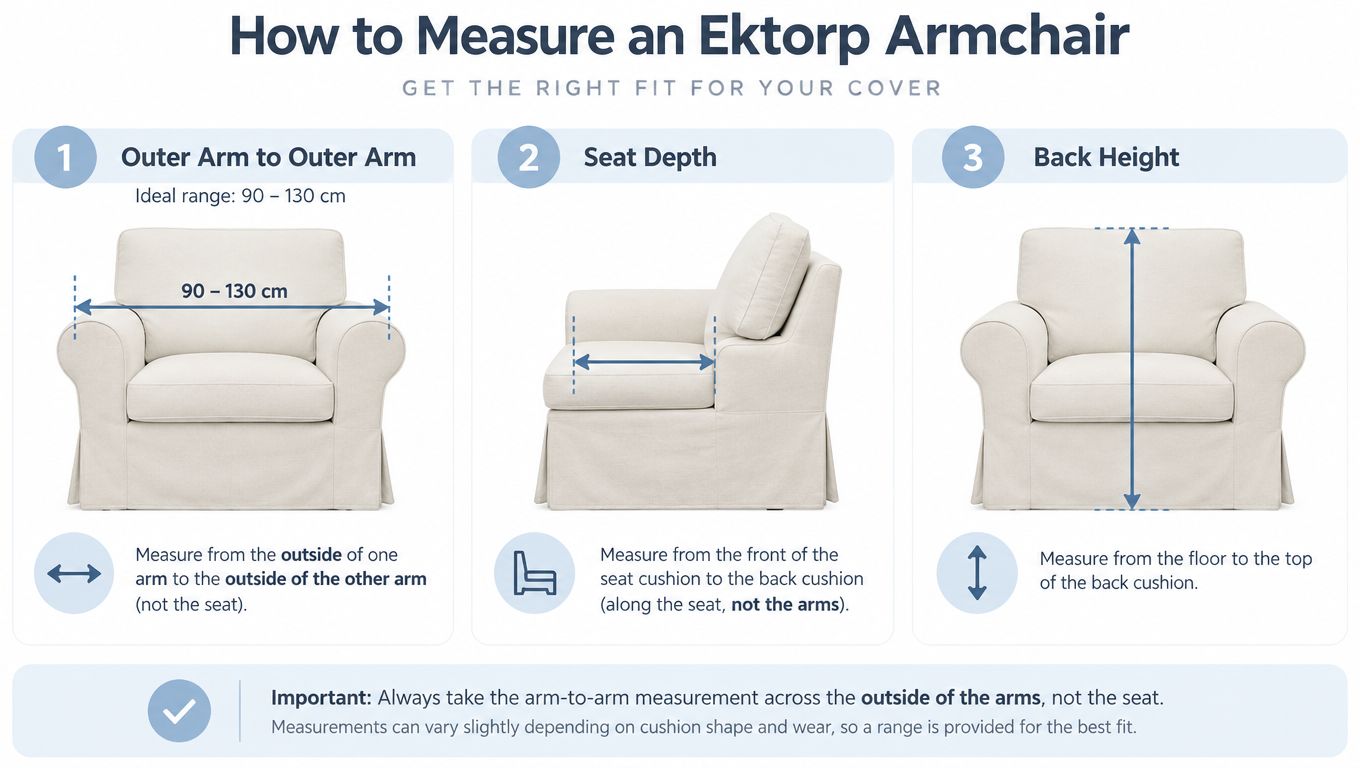
Take the measurements in the right order
- Measure outer arm to outer arm. Keep the tape level across the widest part of the chair. This is the deciding measurement for the universal 1 seater cover.
- Measure the seat depth. Take the distance from the front edge of the seat area to the point where the seat meets the back. This helps you understand how much fabric will need to settle into the rear crevice.
- Measure the back height. Measure from the floor or base area to the highest point of the upholstered back. A tall back can use more of the cover's available fabric than a low occasional chair.
- Check the cushion arrangement. Note whether the seat cushion and back cushion lift out. The Ektorp's removable cushions affect the fitting order, even though they don't replace the outer-width measurement.
The Ektorp is a substantial item rather than a lightweight slipper chair, so clear space around the chair before measuring or fitting.
For a fuller measuring method across upholstered furniture, use this guide to measuring a sofa. If you're considering a velvet option, the Sofa Cover, Velvet, Dark Green, Adaptable & Expandable is described as a machine-washable, protective layer with an adaptable design. Its listed product information doesn't establish Ektorp-specific compatibility, so the outer-arm measurement still comes first.
A cover that falls within the band may still need careful tucking around the arms and seat crevice. Width tells you whether the fabric has a realistic chance of spanning the chair. It doesn't guarantee that every curve, seam or cushion edge will align like a custom pattern.
Which Stretch Cover Fabric Works Best on Padded Arms
A textured jacquard or crosshatch stretch cover generally works better on padded Ektorp arms than a smooth, flat fabric when the chair sits in a busy home.
The reason is practical rather than decorative. A smooth surface makes every wrinkle, crumb, hair and pressure mark easy to see. Texture breaks up those small visual changes, while a tighter-feeling woven surface can look more settled after children or pets climb across the rounded arms. The cover still needs correct anchoring, but the fabric choice affects how forgiving the finished appearance is.
The available cover families include Classic Stretch, Jacquard, Crosshatch, Velvet, Bobble-Textured, Diamond Jacquard and one-design Printed covers. Classic Stretch is the straightforward adaptable option (for example the Classic Stretch cover in Clay Grey), while textured families are more useful when the chair receives constant contact. Classic Stretch Sofa Covers are listed in 20 colours, with catalogue pricing of £25.90 to £43.90, depending on the selected product option.
Match the surface to the room
A mid-tone textured cover is usually easier to live with than an extremely pale or very dark smooth one. Pale fabric tends to reveal marks quickly, while very dark fabric can show light pet hair and crumbs. A water-repellent finish can give you time to blot a spill before washing, but it doesn't make the cover spill-proof and it doesn't remove the need to follow the care label.
Velvet can give the chair a softer, richer appearance, but its pile can show directional shading after hands, cushions or clothing move across it. Bobble and diamond textures disguise casual wear effectively, although their raised surfaces may not suit every room. Jacquard and crosshatch are the safer starting points when the priority is a tidy-looking arm rather than a particular luxury finish.
The fabric can hide a poor fit, but it can't correct one. Anchor the cover first, then choose texture as a practical visual advantage.
For a broader comparison of surfaces and finishes, see the guide to sofa cover materials.
The relevant catalogue accessories are simple. Foam Rods, listed at £8.00, help hold surplus fabric inside the seat and back crevice. Anti-Slip Sofa Pads, listed at £9.99, can help reduce movement where the cover meets the seating surface. Neither accessory turns a universal cover into a fitted IKEA replacement, but both address common movement problems after the main installation is done.
How Do You Fit a Stretch Cover Over a Lift-Out Seat Cushion
Fit a universal stretch cover to an Ektorp armchair with the seat and back cushions removed, anchor the fabric in the crevices, and put the seat cushion back only after the frame is smooth.
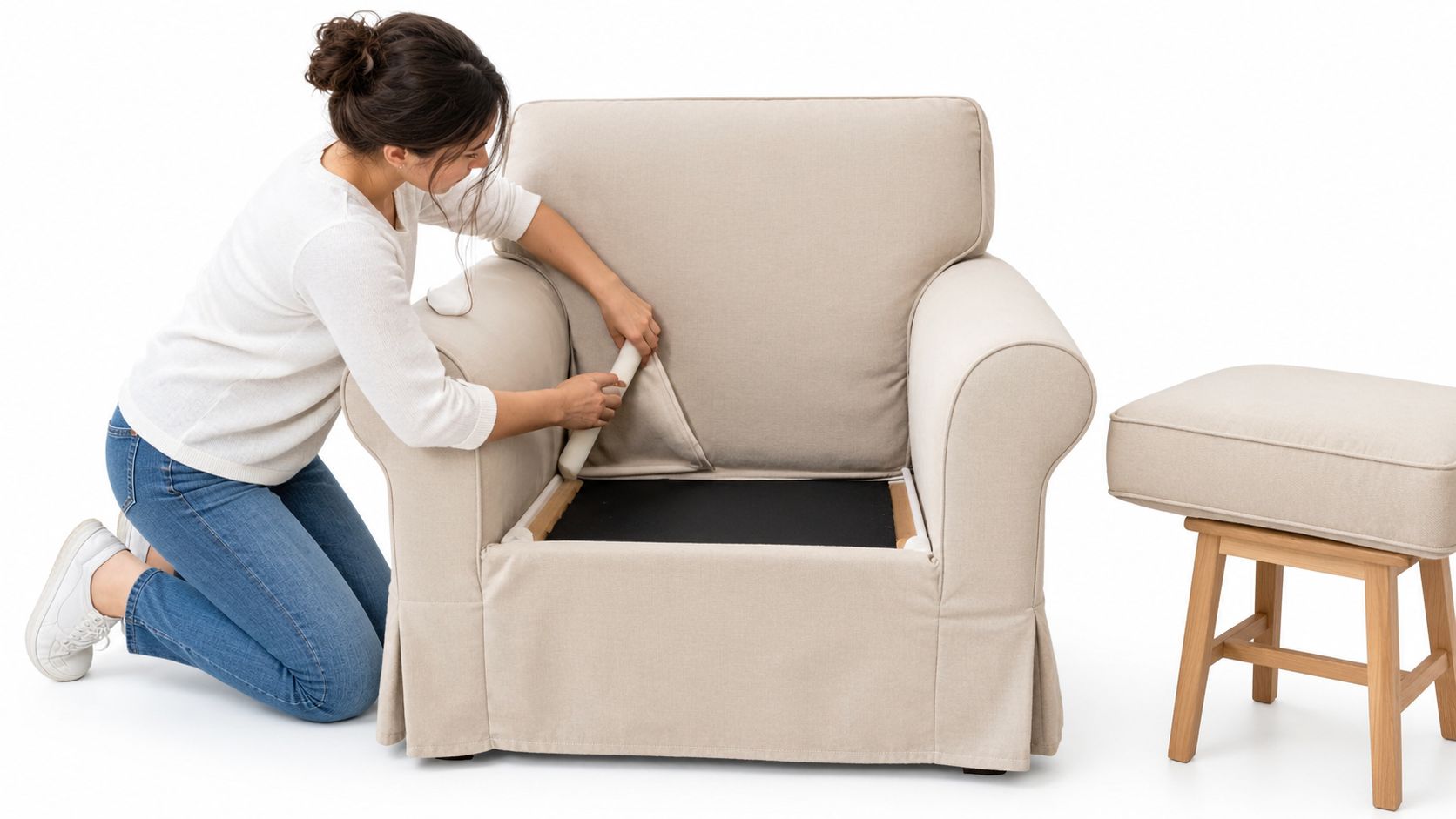
Start by removing the loose seat cushion and back cushion. Leave the original Ektorp cover in place if it's clean and secure. It can act as an additional layer underneath, but remove loose throws, cushions and anything else that prevents the stretch cover from contacting the chair evenly.
Use this fitting sequence
- Centre the cover on the frame. Find the centre of the cover and align it with the centre of the chair. The side seams should sit approximately over the outer edge of each arm, not towards the inside of the seat.
- Pull the cover over the back first. Work it over the top of the back like the first corner of a fitted sheet. Keep the fabric centred rather than stretching one side fully into position before the other.
- Cover both arms evenly. Pull the material down and over the rounded arms, alternating from left to right. The padded arms need even tension, so don't finish one arm while the other is still bunched at the top.
- Bring the fabric down the front. Once the back and arms are covered, pull the front section down over the chair's face. Smooth with your hands from the centre towards each arm.
- Tuck the elastic hem under the base. Reach under the lower edge and work the hem beneath the chair. This gives the cover an initial anchor before you start dealing with the surplus fabric.
- Push fabric into the rear crevice. The gap between the seat and back is where excess material belongs. Press it firmly into that channel rather than leaving a shallow fold on the visible seat.
- Add foam rods. Push foam rods into the crevice over the tucked fabric. They hold the surplus down when someone sits on the chair. If fabric spills down the sides of the seat, tuck those sections into the side gaps as well.
- Stretch outwards from the centre. Only after the crevice has swallowed the slack should you smooth the remaining fabric towards the arms and back. Pulling outwards before anchoring just moves the wrinkles around.
- Replace the seat cushion last. Drop the cushion back into position once the frame is taut. Check that its cover sits squarely and that the cushion hasn't lifted the tucked fabric back out of the rear channel.
Wrinkles are usually surplus fabric with nowhere to go. The seat-to-back crevice provides that missing destination. Foam rods aren't there to repair a collapsed cushion or create support under the seat. They hold fabric in place.
The back cushion usually lifts out too, so don't try to stretch the cover around it while it's installed. Fitting over the bare frame gives you access to the rear channel and lets you control the material around the generously padded arms.
Allow the cover to settle after the cushion is replaced, then inspect the front corners and arm seams. Small ripples can often be worked towards a tuck point. A diagonal pull across the chair usually indicates that the cover is off-centre, not that the fabric needs more force.
The fitting order matters more than brute strength. If you start by pulling hard across the seat, you'll create tension in the wrong place and spend the rest of the installation fighting the arms and back. If you anchor the central excess first, the visible surfaces have somewhere to become taut.
Why Does My Armchair Cover Look Wrinkled or Saggy
An Ektorp armchair cover usually looks wrinkled because the fabric is unanchored, incorrectly centred or too large for the chair, while a sagging seat may indicate worn cushion foam rather than a cover problem.
Begin with the cover itself. If one arm has a deep diagonal crease and the opposite side is tight, remove the seat cushion and check whether the cover is centred across the frame. If the side seams sit too far towards the middle of the arms, reposition the cover before adding more tucks.
Next, inspect the crevices. Slack fabric left on top of the seat has nowhere to disappear, so it pools under the sitter and reappears as wrinkles. Push it into the seat-to-back channel and side gaps, secure it with foam rods, then smooth the face outward from the centre.
Separate fabric slack from cushion collapse
A cover can improve appearance, reduce staining and hold loose upholstery in place. It can't recreate missing foam density or structural support. One owner review on IKEA's UK Ektorp armchair listing reports the seat cushion flattening within a year. That is an individual review, not a controlled durability study, but it reflects the question many owners face when a new cover doesn't restore comfort.
Leave the insert uncompressed and check whether it rebounds. Look for reduced height, a permanent hollow, pressure points or a cushion that feels soft only at the edges. Rotating or refilling a removable cushion may help where appropriate, but a cover won't compensate for a collapsed insert.
Use foam rods for fabric control, not foam repair. If the seat has lost its support, treat the cushion as a separate upholstery problem.
Also check whether the cover is just oversized for the measured frame. A universal product has tolerance by design. If the chair sits at the edge of the size band, it may need more careful tucking and may never look as precise as a pattern made for the Ektorp frame.
How Should You Wash the Cover and Manage Fire Safety Labels
Wash a universal stretch cover separately according to its own care label, and retain access to the Ektorp's original permanent safety information.
Care instructions vary by fabric, so don't assume that every cover can use the same wash or drying programme. IKEA's own Ektorp Hakebo dark-grey cover is removable and machine-washable, with a maximum 40°C normal wash and separate washing required, while IKEA lists 50,000 abrasion cycles for that cover in its care and product information. The Karlshov cover must also be washed separately at a maximum of 40°C, with no bleach or tumble-drying, according to its IKEA UK care instructions. Kilanda light-beige instructions also specify separate washing at no more than 40°C, no bleach, no tumble-drying and reverse-side ironing at a maximum of 150°C, as stated by IKEA UK.
Those instructions apply to the named IKEA covers, not automatically to a universal stretch cover. Follow the label supplied with the cover you buy, and don't force a damp cover back onto the chair if doing so would stretch the fabric or trap moisture.
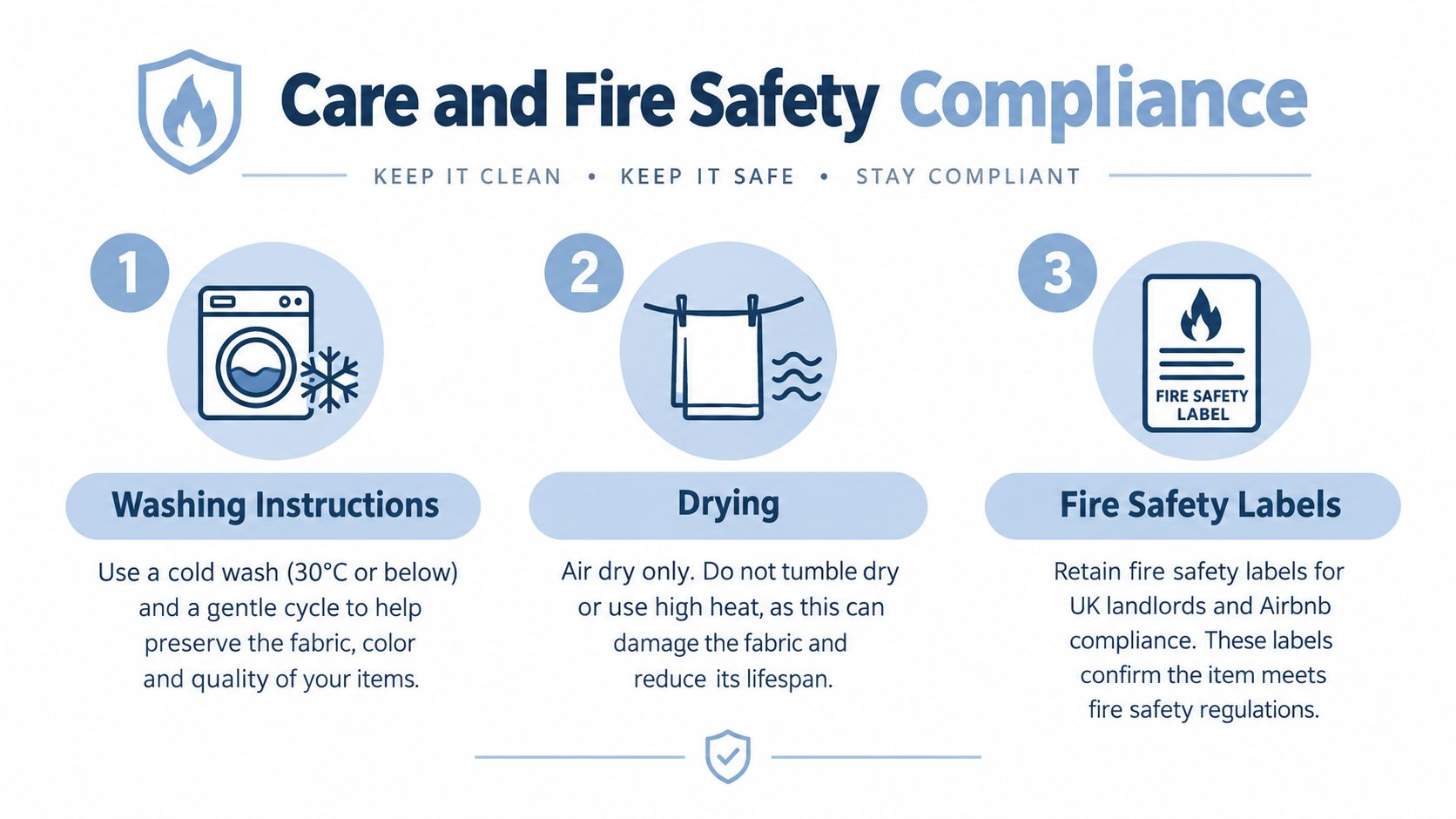
Check safety information before commercial use
UK upholstered-furniture rules apply to the upholstery, filling and cover system. The framework requires relevant upholstered furniture to meet ignition and cigarette-resistance tests, and the 2025 amendment changed the framework from 30 October 2025, including removing the display-label requirement for new products and extending the legal-proceedings period from six to twelve months, as set out in the UK government's statutory guidance on the 2025 amendment. Local guidance from Bromley Council also explains the relevance of ignition resistance and permanent safety labelling.
A water-repellent finish concerns liquid handling, not fire performance. Before using a covered Ektorp in a landlord or Airbnb property:
- Photograph the original label before fitting the new cover.
- Keep safety information accessible rather than permanently covering it.
- Ask the cover seller for documented material and fire-performance information where commercial use requires it.
- Confirm the requirement with the supplier or a competent safety adviser before placing the chair in rental accommodation.
IKEA UK's returns policy allows most products to be returned within 365 days, including opened or assembled products, but condition affects the refund method and used, modified or cosmetically damaged items may be refused. That makes measurement and a careful test fit important before washing, altering or heavily using any cover.
The Sofa Cover Crafter offers universal stretch sofa and armchair covers, including 1 seater options for chairs measuring 90 to 130 cm across the outer arms, plus Foam Rods and Anti-Slip Sofa Pads for controlling movement and surplus fabric. Measure your Ektorp frame first, then visit The Sofa Cover Crafter to compare the available cover families without mistaking a universal overlay for a genuine IKEA-pattern replacement.
