



Your tired armchair does not need to be reupholstered just to look decent again. A removable armchair cover solves the part that matters for daily life, because the cover comes off, goes back on, and protects the chair without turning the furniture into a fixed project.
Table of Contents
- Why a Removable Armchair Cover Beats a Throw or Reupholstery
- Will a Stretch Armchair Removable Cover Fit Your Chair
- How Do You Measure an Armchair for a Removable Cover
- How Do You Fit an Armchair Removable Cover So It Stays Put
- Why Does My Armchair Cover Ride Up Every Time Someone Sits
- How Do You Wash and Refit a Removable Armchair Cover
- Choosing the Right Armchair Removable Cover for Your Chair
Why a Removable Armchair Cover Beats a Throw or Reupholstery
A removable armchair cover is the middle path when an armchair is marked by pets, spills, or heavy daily use and you want a cleaner result than a throw, without the cost and downtime of reupholstery. A throw only drapes over the chair, so it shifts, gaps, and ends up on the floor. Reupholstery is fixed work, so the chair is out of action and the finish stays where it is.
What each option actually solves
A throw can soften the look of an armchair, but it does not solve fit. If the seat gets used hard, the fabric slides forward and the arms stay exposed. That is fine for occasional styling, not for a chair that needs proper day-to-day protection.
A fixed reupholstery job solves the appearance problem, but it does not suit a chair that needs regular stripping and washing. A removable armchair cover changes that equation because the cover grips the upholstered frame, can be taken off, and can be put back on when the chair needs freshening.
For landlords and Airbnb hosts, that distinction matters. A removable cover lets a guest-facing armchair be refreshed between stays without replacing the furniture itself.
Practical rule: if the chair has to survive repeat use, choose something that can come off cleanly and go back on without losing shape.
Will a Stretch Armchair Removable Cover Fit Your Chair
Yes, the one-seater size in the armchair range fits armchairs measuring 90 to 130 cm across their widest point, and every cover in the range is removable and washable. That includes the Classic Stretch, Jacquard, Crosshatch, Velvet, Diamond Jacquard, Bobble-Textured, Flecked, and Linear Geometric options.
What fits, and what does not
A stretch armchair cover needs upholstered surfaces to grip. It does not suit an armchair with bare wooden arms, because polished timber gives the fabric nothing to hold. It also does not cover a wing chair's ears, because there is no wing-shaped pattern in this range and no made-to-measure or cut-to-size service.
Recliners are a separate case. They need the Interwoven Recliner Cover in Normal Size S, M, L, and XL, cut to move with the chair. Dining and desk chairs take the Classic Stretch Chair Cover, which is a different product again.
| Chair Type | Cover That Fits | Notes |
|---|---|---|
| Standard upholstered armchair | One-seater 90 to 130 cm | Measure the widest point |
| Wing chair | None in this range | Ears need a shaped wing-chair cover |
| Armchair with bare wooden arms | None in this range | Stretch fabric slides on timber |
| Recliner armchair | Interwoven Recliner Cover | Separate sizes S to XL |
| Dining or desk chair | Classic Stretch Chair Cover | Different chair category |
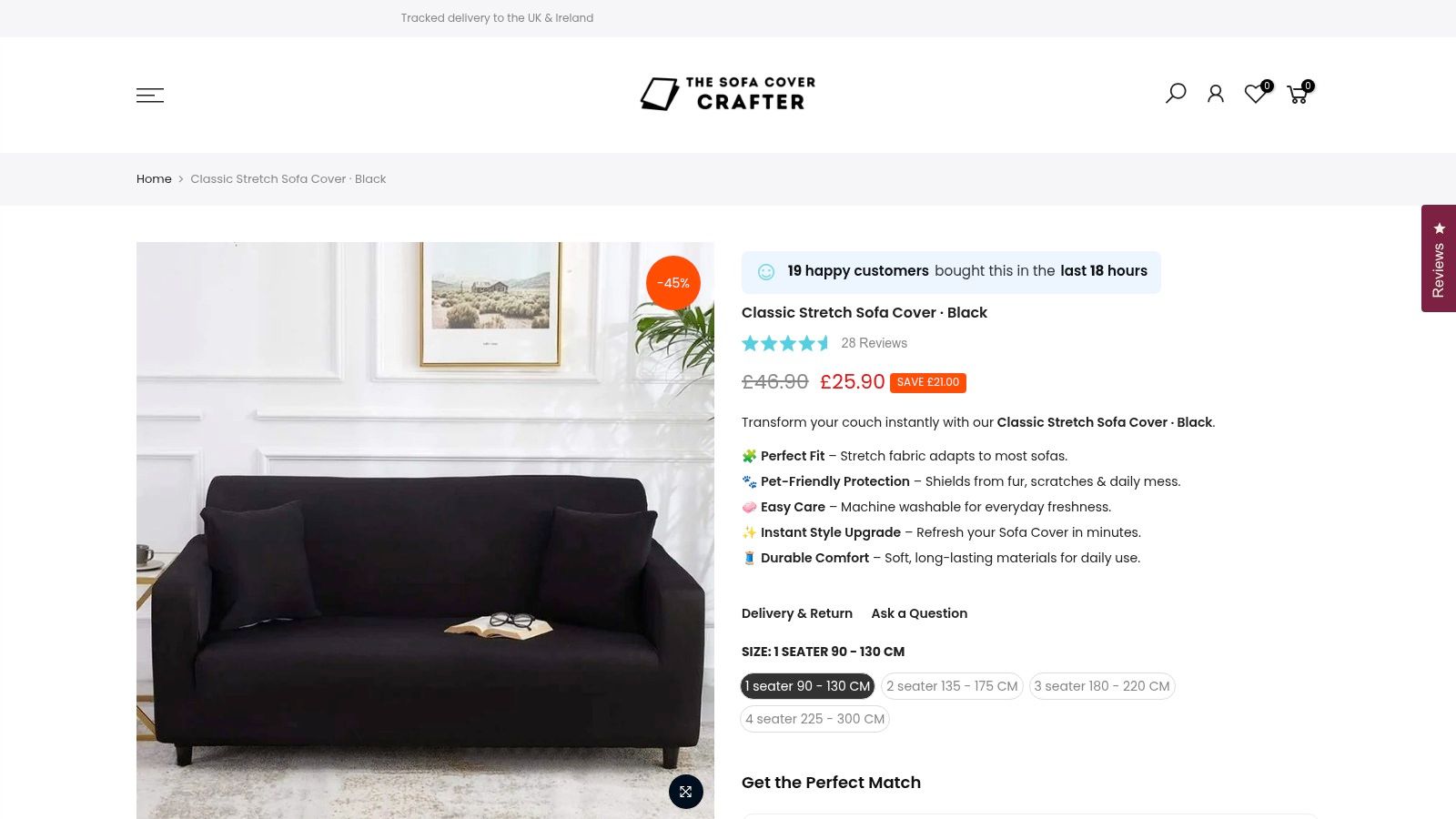
Bailey W., on the Classic Stretch Sofa Cover in Black: "This couch cover has been a game changer for the old armchair. Fits snugly from 90 to 130 cm, and it's held up really well against my dog’s claws".
If you want a visual reference for chair-cover formats, the stretch chair cover guide is a useful place to compare seat-based cover types.
For a style-led example in the broader family, the Velvet Sofa Cover in Dark Green shows how an expandable cover can be presented for a range of room looks, but the armchair fit still comes back to the size band and the upholstery surface.
How Do You Measure an Armchair for a Removable Cover
Measure the armchair across its widest point, not the seat between the arms. The seat measurement is the mistake that sends people toward a band that is too small, even when the chair itself is within range.
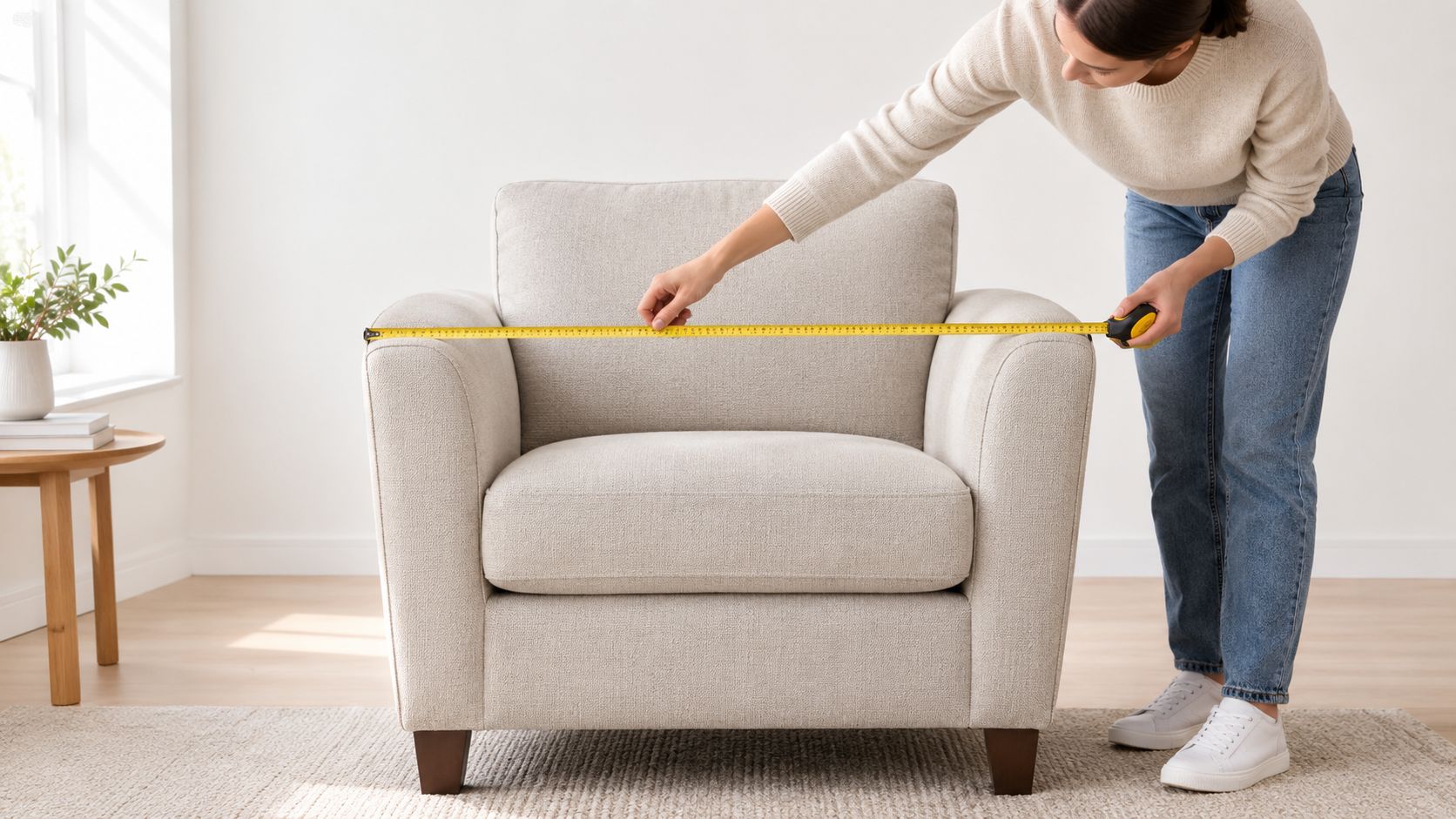
The measurement that matters
A chair that measures 55 cm across the seat but 110 cm overall still takes the 90 to 130 cm one-seater band. If you order by the seat width, you end up chasing a size that does not exist for the actual frame. The cover needs to reach around the chair's full footprint, not just the sitting surface.
Measure the chair, not the cushion gap.
The same basic idea applies to fitting furniture at home, measure the furniture's real outer dimensions first, then judge the cover or fabric choice against that total span.
Before ordering, check three things. First, the overall widest span. Second, whether every surface the cover will touch is upholstered. Third, whether the chair has wings or exposed wooden arms, because those are outside the standard stretch range.
The chair dimensions overview at dimensions of a chair is a useful companion if you want to compare a seat's footprint with its arm-to-arm span before you buy.
How Do You Fit an Armchair Removable Cover So It Stays Put
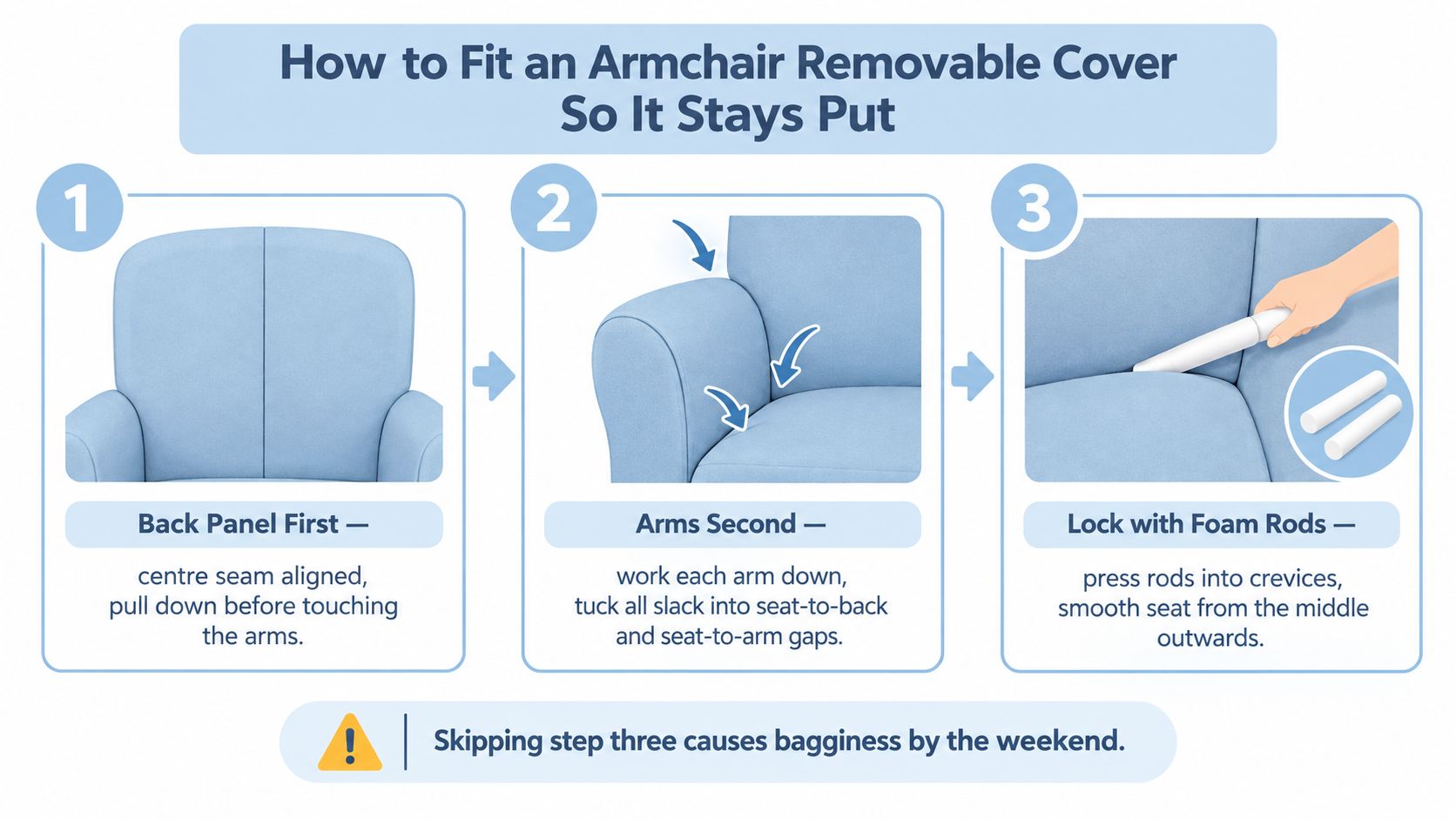
A stretch armchair cover stays put when it goes on back panel first, arms second, foam rods third, and that order matters. If you start off-centre or skip the tucking stage, the fabric looks neat for a moment and then slips out when someone sits down.
Step one, centre the back panel first
Put the cover on with the centre seam lined up on the middle of the chair back, then pull the back panel down before you touch the arms. A cover that starts off-centre cannot be re-centred once tension is in the fabric, so the first few seconds decide the final look.
Step two, work each arm down separately
Pull each arm down one at a time, then push every bit of surplus fabric into the two crevices, where the seat meets the back and where the seat meets each arm. All the slack has to end up inside the chair. Anything left outside moves to the front edge as soon as somebody sits.
Step three, lock the tuck with foam rods
Press foam rods into those same crevices to hold the tucked fabric, then smooth the seat outwards from the middle. Skipping this step is why a cover can look perfect on day one and baggy by the weekend.
If the fabric still feels awkward to seat, use the handle of a wooden spoon to push the tuck deeper than fingers can reach.
The one-seater covers are in the sofa covers collection; Foam Rods and Anti-Slip Sofa Pads are sold separately as fixing accessories.
Fit rule: the grip does not come from brute tension, it comes from a deep tuck and a locked seam line.
Why Does My Armchair Cover Ride Up Every Time Someone Sits
A removable armchair cover that goes on with no surplus fabric at all is the wrong size, not a perfect fit. All the stretch has been spent on the frame, nothing is left to anchor, and the front edge rides up as soon as somebody sits down.
Where the grip actually comes from
The hold comes from the tuck, not from pulling harder. That is the same logic as a rope wrapped around a post, the wrap and squeeze do the work, not raw tension. If the seat is stretched flat like a drum skin, the fabric has no reserve to stay anchored in the creases.
Recovery matters after repeated removal and refitting. A cover with poor recovery goes baggy on the arms and never quite fits again. A cover with good recovery springs back into shape every time it goes back on.
A tight, even weave helps too, because loose or weak fabric can pill, thin, or lose its shape at stress points such as the arm tops. Cleanability and abrasion durability are separate things, so a washable cover can still fail in everyday use if the fabric lacks wear resistance (The Sofa Cover Crafter armchair washable covers guide).
Leave the seat relaxed and push spare fabric at least 10 cm down into the gaps. If the cover still slips, push a foam stick or a rolled towel on top and lock it in place.
How Do You Wash and Refit a Removable Armchair Cover
Every cover in the armchair range is machine-washable, so you take the cover off, wash it, and put it back on without losing the fit. That is the point of removable rather than fixed upholstery, but the fit only survives if you refit the cover carefully after washing.
Keep the care routine simple
Follow the care label on the specific cover, because the label always overrides a generic washing habit. Some UK care pages note gentle handling, low heat or air drying, and refitting while the cover is slightly damp, but the exact routine still depends on the label attached to the actual product.
Before washing, brush or lift off pet hair so the machine is not fighting fur. For a fuller step-by-step care routine, the how to wash chair covers guide covers the general cleaning side without changing the fit logic.
Refit the cover the same way every time
Use the same three-step order after washing. Start with the back panel centred, then work the arms down, then lock the tucked fabric with foam rods. If you refit in a rush and skip the tuck, the cover can look fine straight away and start creeping within a few uses.
For high-wear households, wash only when needed rather than on a fixed schedule. The more often a removable armchair cover goes through cleaning, the more important careful refitting becomes.
Choosing the Right Armchair Removable Cover for Your Chair
The two things that decide a fit are simple, every surface the cover touches has to be upholstered, and the chair has to sit within the 90 to 130 cm range. Shape matters, but less than most shoppers think, because a stretch cover can cope with a surprising amount of contour if the frame gives it something to grip.
Shape is less important than surface and size
A deep-buttoned armchair with rolled arms often worries people most. In practice, a stretch cover pulls straight across the button dips and follows the roll of the arm. Deep buttoning started as a practical fix to keep horsehair stuffing from shifting, not as decoration, so the folds are part of the chair's structure rather than a fitting problem.
That same logic is why a standard removable armchair cover can work on a classic club-chair look but still fail on wings or exposed timber. Those chairs need a cover made for them, or bespoke upholstery, rather than a stretch cover.
Pick the look, then keep the fit
The fabric range gives you different finishes over the same core fit, not different sizing systems. Classic Stretch, Jacquard, Crosshatch, Velvet, Diamond Jacquard, Bobble-Textured, Flecked, and Linear Geometric all do the same structural job while changing the visual texture. If you want to tie the room together, the matching Sofa Cushion Covers for the seat cushion and Pillow Covers for scatter cushions make that easier.
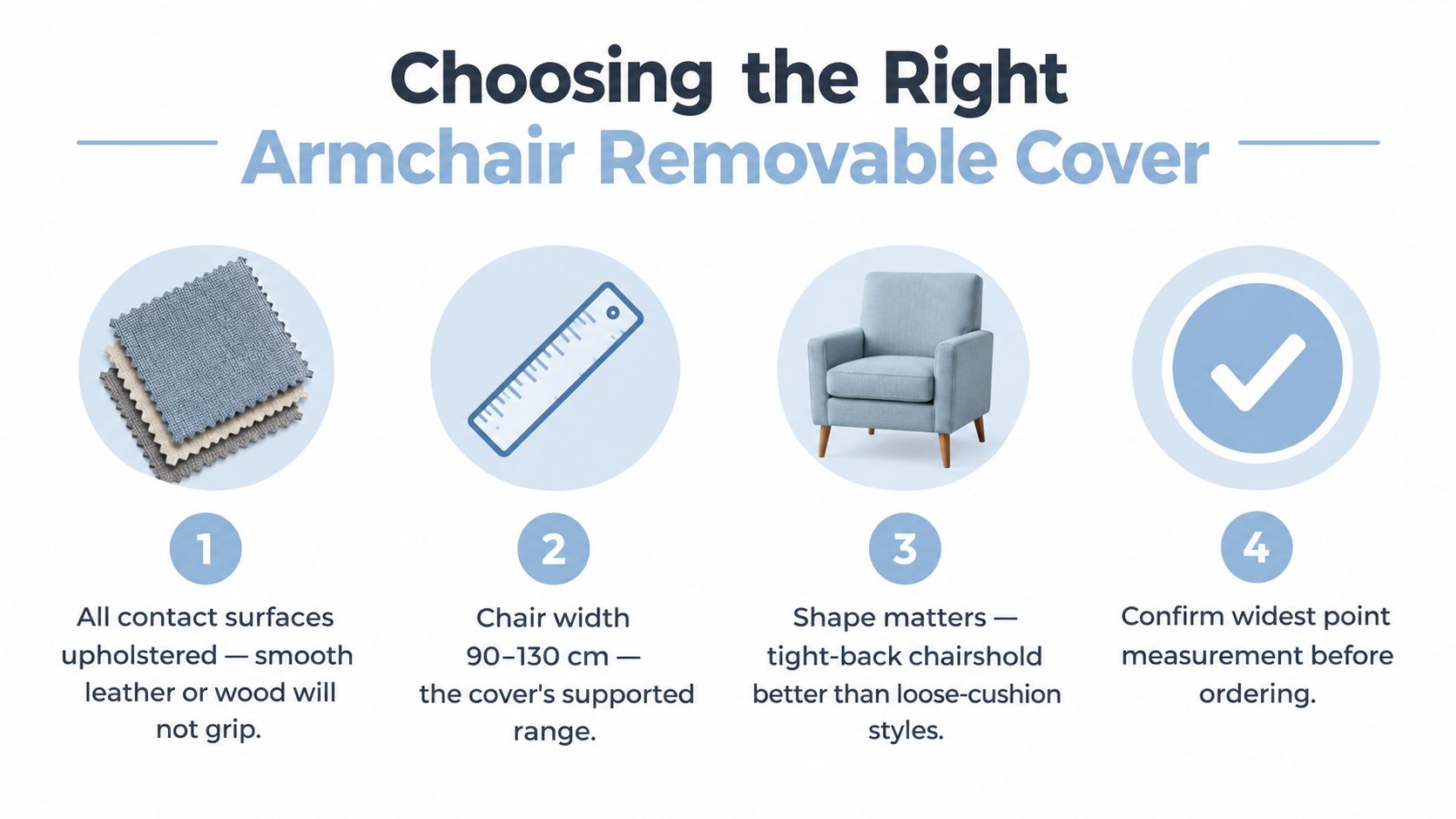
The simplest buying check is still the most reliable one, measure the widest point, confirm the surface is upholstered, fit in three steps, and lock the fabric with foam rods. Do that and a tired armchair stays protected, washable, and ready for repeat use.
The Sofa Cover Crafter offers removable, washable armchair covers, fixing accessories, and matching cushion pieces that suit the way UK homes use furniture. If you want a cover that comes off cleanly, goes back on properly, and fits within a clear size band, visit The Sofa Cover Crafter and compare the armchair options against your chair before you order.
