



There are no zip sofa cushion covers in this range because every cover uses an elasticated stretch opening.
The search term “zip sofa cushion covers” often sends shoppers towards the wrong decision. A zip sounds like the obvious answer: remove the cover, wash it, put it back. But the closure is only one part of the fit. The measurement that usually decides whether a cushion cover stays smooth or slides around is depth, from the front edge to the back edge, followed by the tension created by the selected size.
That distinction matters here because the product range is not made-to-measure upholstery. It offers stretch covers in defined size bands, so the right purchase starts with accurate measurements rather than an assumption that a zip will compensate for a poor fit.
Table of Contents
- Do Zip Sofa Cushion Covers Exist Here
- Zip Versus Stretch Sofa Cover Closures
- How to Measure Your Sofa Cushions for a Perfect Fit
- How to Install and Remove Stretch Sofa Cushion Covers
- Washing and Caring for Your Sofa Cushion Covers
- Troubleshooting Common Fit Issues
Do Zip Sofa Cushion Covers Exist Here
The Sofa Cover Crafter does not sell zip sofa cushion covers. Its Jacquard, Waterproof, Velvet and Luma Sofa Cushion Cover families use elasticated stretch openings. The catalogue also excludes cushion inserts, replacement fillings and made-to-measure cushion covers.
That answer matters for those searching specifically for a zip closure. A stretch opening provides a removable outer layer, but it will not reproduce a zipped seam or a particular zip arrangement. Cushions with unusual construction, permanently attached covers or a non-standard shape are better handled by a specialist upholstery maker. Ordering a standard stretch cover and expecting it to behave like a custom zipped cover is a reliable way to waste money.
The practical fit decision starts with the cushion's depth and the tension created by the selected size. Measure from the front edge to the back edge, then check the product's stated dimensions. Measuring the visible top or front face alone can lead to a cover with insufficient fabric around the cushion. That shortage may pull at the corners, expose the filling or make the cover work loose during use.
The catalogue groups its options into Standard, Deep and Chaise bands. Velvet and Luma also offer Backrest choices, while Luma includes Headrest options. These names describe available product configurations, not a guarantee that every sofa design will fit. Check the cushion's shape, thickness and edges before choosing a band.
The four cover families range from GBP 12.90 to GBP 33.90. Jacquard is available in 12 colours, Waterproof Sofa Cushion Cover in 9, Velvet in 9 and Luma in 5. Separate pillow covers, sold in 1 piece and 2 pieces at 45cm x 45cm, can refresh the room, but they serve a different purpose from a fitted sofa cushion cover.
Keeping a usable sofa in service can also avoid unnecessary textile and furniture waste. WRAP estimated that UK households generated approximately 1,590,000 tonnes of bulky waste during 2010–11. Furniture accounted for about 670,000 tonnes, while textiles contributed a further 310,000 tonnes. Those figures do not measure zip covers, yet they support replacing a worn removable layer when the frame and filling remain sound. The WRAP study of household bulky items provides the underlying UK waste research.
Zip Versus Stretch Sofa Cover Closures
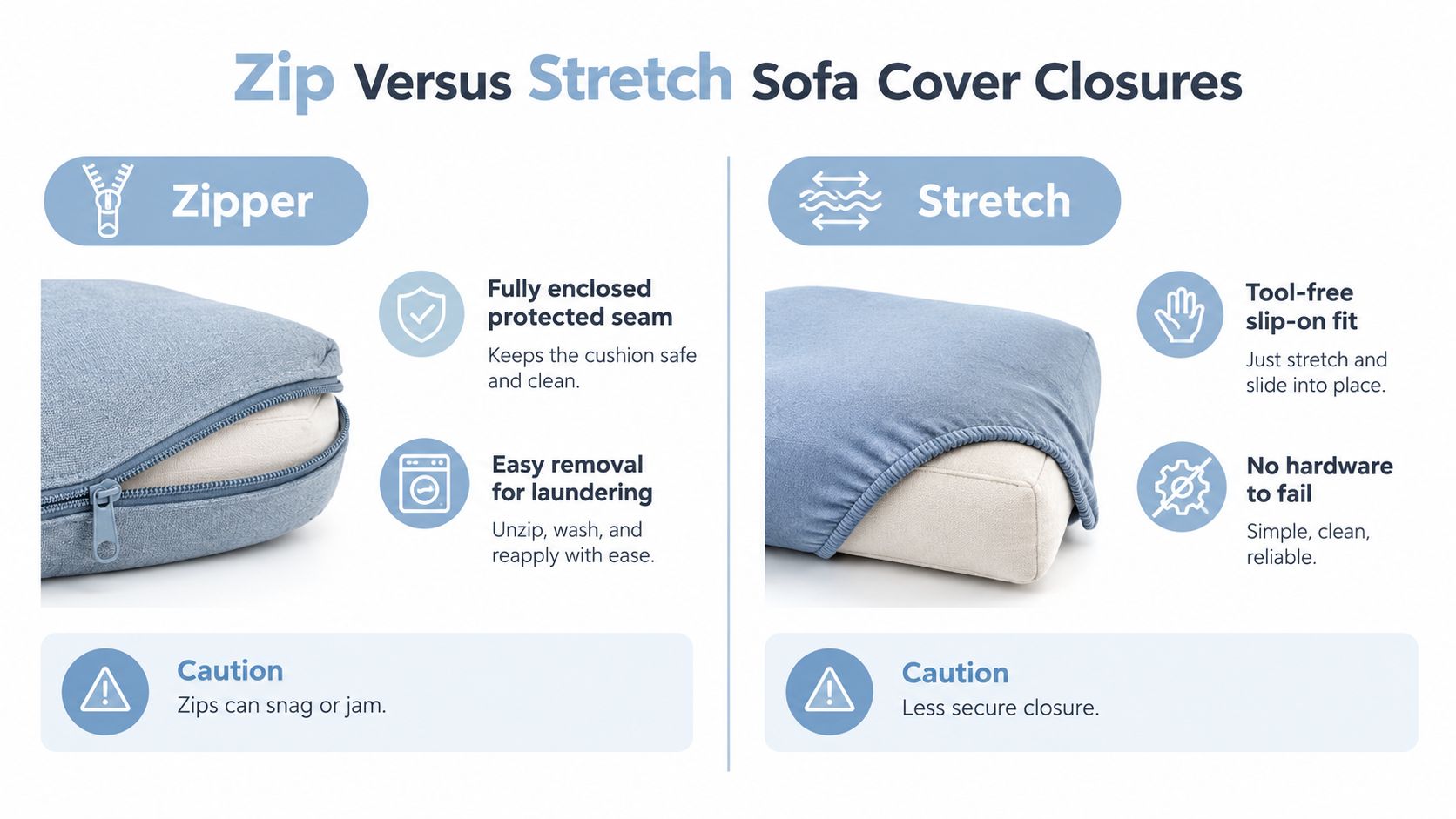
A zip sofa cushion cover encloses the cushion through a mechanical fastening, while a stretch sofa cushion cover stays in place through tension across the fabric. The two systems solve removal and refitting differently, and neither removes the need to measure the cushion accurately.
A zip can make the cover feel contained and can give a clean, defined opening. When the pattern and dimensions are correct, unfastening the cover makes removal straightforward. That can suit someone who wants a fully enclosed seam or who is commissioning a replacement cover for a particular cushion.
The trade-off is precision. A zip has to be aligned, and its slider can snag when it meets a folded seam. A cover that's too small can also transfer strain to the zip tape instead of allowing the surrounding seam to carry the load. For practical guidance on another type of zipped textile protector, the Protect-A-Bed pillow protector tips illustrate why fastening design and care instructions should be considered together.
What stretch changes in daily use
A stretch cover has no slider, teeth or visible fastening hardware to align. The opening expands over the cushion, then the fabric pulls back around the shape. That makes the fitting process quick, but the fabric must be under the right amount of tension. Choose too large a cover and it can move, wrinkle or look slack. Choose too small a cover and the corners can strain.
A verified buyer review captures the practical benefit without pretending the product has a zip. Sophie W., reviewing the Jacquard Sofa Cushion Cover in Burgundy, says: “They’ve got that lovely stretch to them, making it easy to get on and off without any fuss.”
The relevant comparison is therefore not “zip versus a better zip”. It's enclosed fastening versus tension-based installation. If you want a smooth, hardware-free appearance and can measure within the listed bands, stretch is a reasonable choice. If you specifically require a zip, don't substitute a stretch cover and assume the mechanisms are interchangeable.
The guide to stretch-fit versus loose-fit covers is useful when the wider question is whether tension or a looser drape suits your furniture. For a larger furniture refresh, our sofa covers are a separate product that covers the whole sofa rather than individual cushions. They aren't zip sofa cushion covers.
How to Measure Your Sofa Cushions for a Perfect Fit
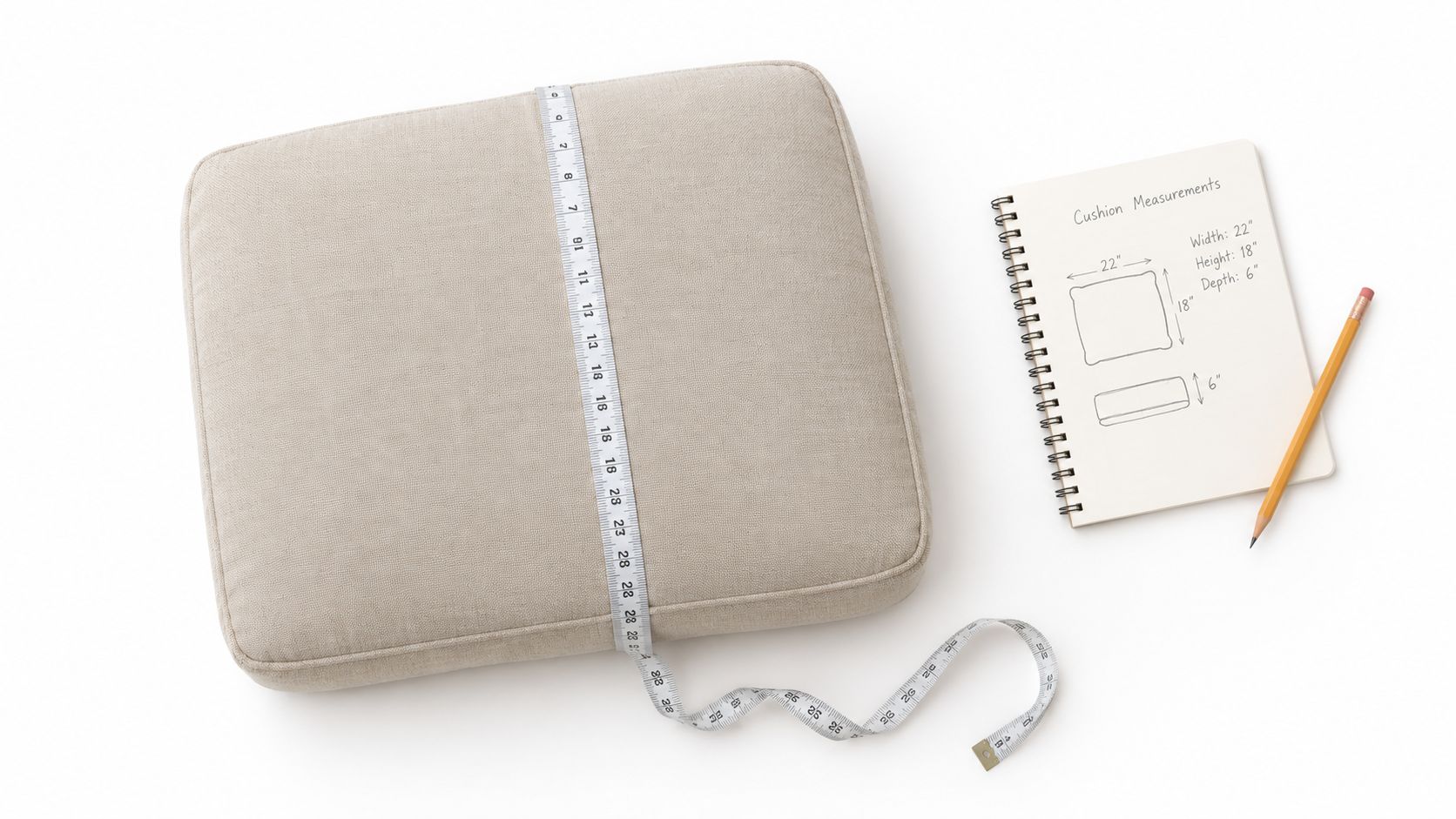
Depth is the measurement people skip, and it is the one that decides the size band. Measure the cushion flat across its front face, then measure its full depth from the front edge to the back edge.
Place the cushion on a flat surface instead of measuring it while compressed into the sofa. Keep the tape straight across the front face and record the relevant width. Then measure from the front edge over the top or along the side profile to the back edge, following the product's measurement diagram where one is provided. The face measurement alone cannot establish the correct fit.
Use depth to choose Standard or Deep
Standard and Deep refer to different front-to-back profiles. Two cushions may have similar front-face measurements but require different size bands because one is deeper. A cover with insufficient depth can pull at the corners and strain the fabric. Excess depth leaves more material available to shift, wrinkle or gather.
Use this sequence:
- Identify the cushion type. Confirm whether you are measuring a seat cushion, backrest, headrest or chaise cushion. A seat measurement should not be matched against a backrest option.
- Measure the front face flat. Record the width without squeezing the filling or wrapping the tape around a corner.
- Measure the depth. Take the distance from the front edge to the back edge. Use this figure to decide whether to investigate Standard or Deep options.
- Match the product family. Check the size options for your chosen cover family, including the Standard, Deep, Chaise, Backrest and Headrest variants listed in the previous section. Confirm that the required configuration is available.
- Choose the smaller suitable band between two options. Stretch fabric needs enough tension to stay in place. A slightly smaller band is generally more secure than a larger slack one, provided the cushion falls within that band's stated measurements.
Practical rule: For rounded or tapered cushions, measure the widest usable points and follow the cover's diagram. Do not shorten the measurement to match the curve. If an edge narrows, record the main cushion dimensions and check whether the stated band allows for that shape.
Check the actual cushion configuration before ordering. A similar-looking cushion does not confirm compatibility with an L-shape, recliner or sofa-bed arrangement. Seat, backrest, headrest and chaise pieces can also differ in depth even when they belong to the same sofa.
If your cushion is close to a square format, the 60 x 60 cm cushion-cover guide can help with that specific measurement question. You still need to check depth and select the relevant product family.
How to Install and Remove Stretch Sofa Cushion Covers
A stretch sofa cushion cover should be installed over the rear corners first, then walked forward so the front corners receive the final tension. This order produces a cleaner result than forcing the opening over the most visible corners at the start.
Remove every old cover before fitting anything new. Photograph the sofa first, because seat cushions are often handed, and a left cushion may not return correctly to the right side. The photograph gives you a reference for orientation, seams and any cushion arrangement that isn't symmetrical.
Prepare the cushions before fitting
With the foam or filling exposed, lint-roll or vacuum the surface. Small crumbs, loose threads and clumps can show through a stretch cover as visible lumps, especially when the fabric is pulled firmly across the face.
Fit the back cushions before the seat cushions. The seat cushions then settle in front of or below the back cushions as intended, rather than forcing you to remove fitted seats to reach the rear section.
Follow this physical sequence:
- Start at the rear corners. Slide the cover over both rear corners of the cushion.
- Walk the fabric forward. Move a little fabric at a time rather than pulling one edge aggressively.
- Take the opening over the front corners last. These corners are visible and need the most even tension.
- Smooth the face and edges. Work out gathered sections with your hands, checking that seams sit evenly.
- Refit the cushion in its photographed orientation. Don't rotate a handed cushion just because the cover appears to fit more easily that way.
The installation sequence differs from a zip cover because there's no slider to close after the fabric is positioned.
For a removal routine, reverse the process gently. Ease the front opening away from the corners, walk the fabric towards the rear, then lift it clear without dragging the cover across sharp furniture edges or forcing a seam.
Washing and Caring for Your Sofa Cushion Covers
A removable sofa cushion cover isn't automatically machine-washable just because it comes off. Read the supplied care instructions before washing, and follow the restrictions for the actual fabric and construction.
UK consumer guidance says textile products must carry a fibre-content label, but manufacturers aren't legally required to provide fabric-care information. Where care instructions are supplied, recognised symbols communicate restrictions. For example, a crossed-out circle means do not dry-clean, while a circle indicates dry-cleaning suitability and a circle containing “W” indicates professional wet cleaning. The relevant UK consumer guidance on textile labelling and care symbols explains why a removable cover still needs specific care information.
Protect the fit, not just the appearance
Washing can affect the dimensions that keep a stretch cover secure. Before committing a complete set to a new cleaning routine, pre-wash a sample according to its supplied instructions and record any change in length and width. A cover that loses dimension can place excess strain on the opening, seams and corners.
After laundering, inspect the cover while it's dry and before refitting it:
- Check the opening. On a stretch cover, look for distorted elastic or uneven recovery. On a zip cover bought elsewhere, check that the zip tape lies flat and runs freely.
- Check the seams. Look for puckering, pulled thread or a corner that no longer sits square.
- Check the fit. Refit the cover without forcing it. If the cushion no longer sits inside the intended size band, washing may have changed the dimensions.
- Follow the label each time. Don't assume a previous successful wash makes a different cycle safe.
The guide to washing sofa covers without shrinking deals with the wider process. For a cushion cover, the practical test is simple: after care, the opening must still hold the cushion under even tension, and the corners must remain aligned.
Troubleshooting Common Fit Issues
A loose sofa cushion cover usually indicates an oversized selection, while a tight sofa cushion cover usually indicates underestimated depth or the wrong size band. Stretch fabric can smooth a correctly sized cushion, but it can't turn an inaccurate measurement into a secure fit.
Start with the symptom rather than pulling harder. If the cover slides across the face or gathers at the sides, check whether you chose the larger band after seeing a measurement between options. Slack fabric has no useful tension to stabilise it, so tucking more material underneath rarely solves the underlying problem.
If the cover strains at the corners, remove it and recheck the front-edge-to-back-edge depth. A cushion that is deeper than assumed can make an apparently correct face measurement misleading. Also check whether you've selected Standard where Deep is required, or a general seat option where the cushion is in fact a chaise or backrest.
What to do with a zip bought elsewhere
A zip malfunction belongs to the separate product, not to the stretch covers in this range. If a slider has been forced over a folded seam, don't pull harder. Work the slider back from the other end and free the fold gradually.
If the cover is one size too small, the zip tape may be carrying load that the surrounding seam should carry. Replacing the zip won't correct the pattern or the fit. The remedy is a correctly sized cover, and for a custom replacement that may mean returning to the upholstery maker who measured the cushion.
Wrong sizing can't be repaired by force. Recheck the cushion's face and depth, then choose the correct size band.
For a stretch cover, inspect the front and rear corners after installation. Uneven tension points towards a fitting problem, while consistent strain around the whole perimeter suggests the cushion is outside the selected band. Don't cut the opening, add fasteners or alter the cushion filling to make a standard cover work. Those changes can damage the cover and still leave the fit unresolved.
The Sofa Cover Crafter offers Jacquard, Waterproof, Velvet and Luma Sofa Cushion Covers with elasticated openings, defined Standard and Deep sizes, and specialist chaise, backrest and headrest options. Measure the face and depth first, then visit our sofa cushion covers to compare the available cover families and choose a stretch size that matches your cushion rather than searching for a zip that isn't supplied.
