



A retro leather settee is a compact, period-looking leather sofa whose proportions, legs, buttoning or continuous seat make it feel rooted in mid-century furniture rather than modern living-room design. The popular advice is to cover it completely and forget about the leather, but that often creates a mechanical problem: smooth leather has no nap, so fabric slips, creeps and rubs instead of gripping. Protection works better when you choose where contact happens and allow the settee to breathe between uses.
To be clear from the start: The Sofa Cover Crafter sells covers and throws, not sofas. We do not sell leather settees, leather-look or faux-leather covers, or leather conditioners, balms or cleaning kits.
The best approach is usually to keep the original shape visible, reduce direct wear on the high-stress areas and repair surface damage before it becomes structural. That means understanding what makes the piece look retro, identifying how its leather is ageing, checking UK fire-safety documentation, and choosing between a throw, a full cover or a small repair patch with some restraint.
Table of Contents
- What Makes a Settee Read as Retro
- A Short Styling History of the Retro Leather Settee
- What Actually Ages a Vintage Leather Settee
- Materials, Finishes and UK Safety Standards to Check
- Throw First or Full Cover on a Leather Settee
- How to Protect the Leather Without Smothering It
- Repairing Surface Damage on a Retro Settee
- Living With a Retro Settee for the Long Term
What Makes a Settee Read as Retro
A retro leather settee is usually a two- or three-seat bench-style sofa with a relatively short seat depth, exposed legs and a continuous seat cushion, often with proportions associated with furniture made between the 1950s and 1970s. It isn't just any old brown leather sofa. The silhouette does more work than the colour.
Start with the frame. A raised wooden or metal leg gives the settee visual lightness, while a low, broad base creates a heavier lounge profile. The arms may be narrow and open, or rounded and generously padded. Buttoning can be sparse and geometric, tightly repeated across the back, or deep enough to create a more formal, cushioned surface.
How can you tell a retro settee from a modern three-seater?
A retro leather settee usually has shorter seating, more visible legs and a single continuous bench cushion, while a modern three-seater more often has deeper proportions and separate seat cushions. A Chesterfield is identified more strongly by its rolled arms, deep buttoning and formal upholstered structure. A club chair is a single-seat piece, not a settee, even when the leather and curves look similar.
The distinction matters because protection has to follow the furniture's construction. A fitted cover designed around loose modern cushions may pull across the front edge of a shallow bench seat. A throw can be placed over the seating area without forcing the back, arms or buttoned panels into an unfamiliar shape.
Practical rule: Judge the legs, frame proportions and cushion arrangement before judging the leather colour. A distressed finish cannot turn a modern deep sofa into a convincing retro settee.
Look closely at the junction between the arms and the back. Exposed wood, tapered legs, a floating seat or a neatly defined wooden rail can all give a settee a period character that a cover may conceal. The mid-century modern furniture guide is useful when the frame is doing most of the visual work and you need to decide whether protection should be selective rather than complete.
The most convincing pieces aren't always pristine. A softened seat crown, a slightly darker arm and a few changes in the leather's sheen can make the furniture feel lived-in. The key is to distinguish an intentional surface history from damage that affects comfort, safety or the frame.
A Short Styling History of the Retro Leather Settee
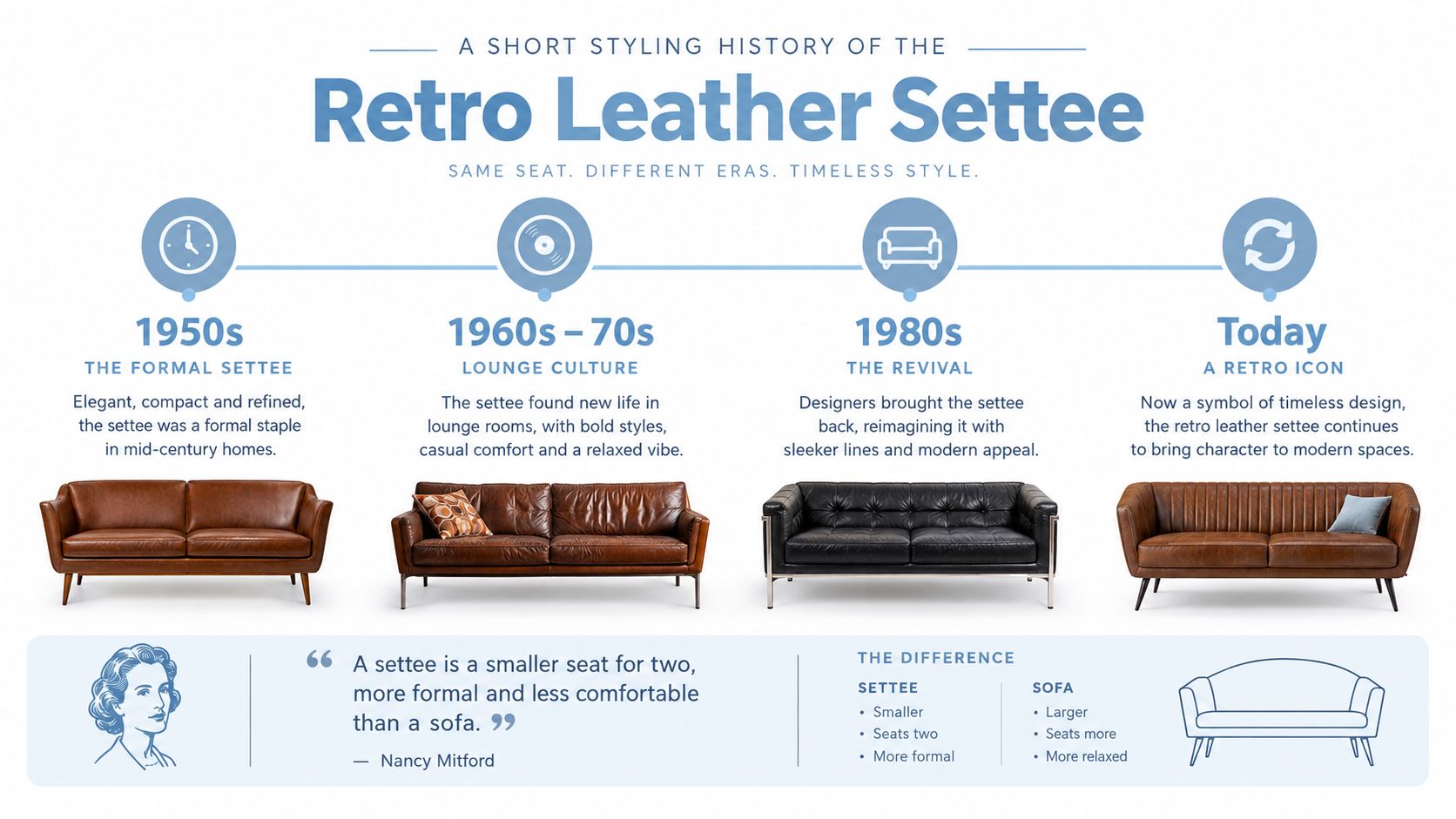
The word “settee” itself carries a social history. In the 1950s, Nancy Mitford popularised the “U and non-U” word lists, in which “settee” marked a speaker as non-U: the upper classes, she noted, said “sofa”.
During the 1960s, designers and manufacturers moved that formal compactness towards a more relaxed lounge shape. Slim teak legs, exposed wooden frames and cleaner lines became familiar features of Danish modern and British mid-century interiors. G-Plan and Ercol are useful reference points for the British eye, while Danish designers such as Børge Mogensen helped establish the appeal of an uncomplicated leather seat supported by a clearly expressed frame.
Why do 1960s and 1970s settees look so different?
A 1960s leather settee often reads as lighter and more architectural, with slim legs and a restrained surface, while a 1970s version may have deeper buttoning, darker leather and a heavier lounge presence. The decade isn't always obvious from the hide alone. Stitching, leg geometry and the relationship between the seat and the floor often provide better clues.
Aniline leather can show a more open, natural surface, while pigmented leather gives a more even colour and a stronger visual block. Neither automatically makes a settee more authentic. A carefully chosen modern cover can also change the room's mood without pretending to be the original upholstery.
By the 1980s, retro styling began to be revisited, often through darker tones, rounded forms and renewed interest in earlier furniture. Today, a retro leather settee can sit beside contemporary lighting, painted walls or more traditional pieces because its shape carries the period reference without requiring a room to become a museum set.
What makes the style endure is the balance between structure and informality. The settee looks designed, but it still invites daily use. That tension is exactly why protection should be discreet. A solution that hides the legs, flattens the arms or obscures the buttoning may protect the leather while removing the qualities that made the piece worth keeping.
What Actually Ages a Vintage Leather Settee
The three most damaging everyday conditions for vintage leather are direct sunlight, close heat and repeated contact with skin oils. The seating zone suffers most because people sit there, lean against it, place bare legs on it and often leave it in the brightest part of the room.
Direct sunlight can leave a paler patch on the exposed side of a seat or arm. It can also dry the surface, particularly where an older finish has already lost flexibility. Close heat from a radiator or heater accelerates drying and can show up as stiffness, cracking along a seat front or brittle areas on an arm roll.
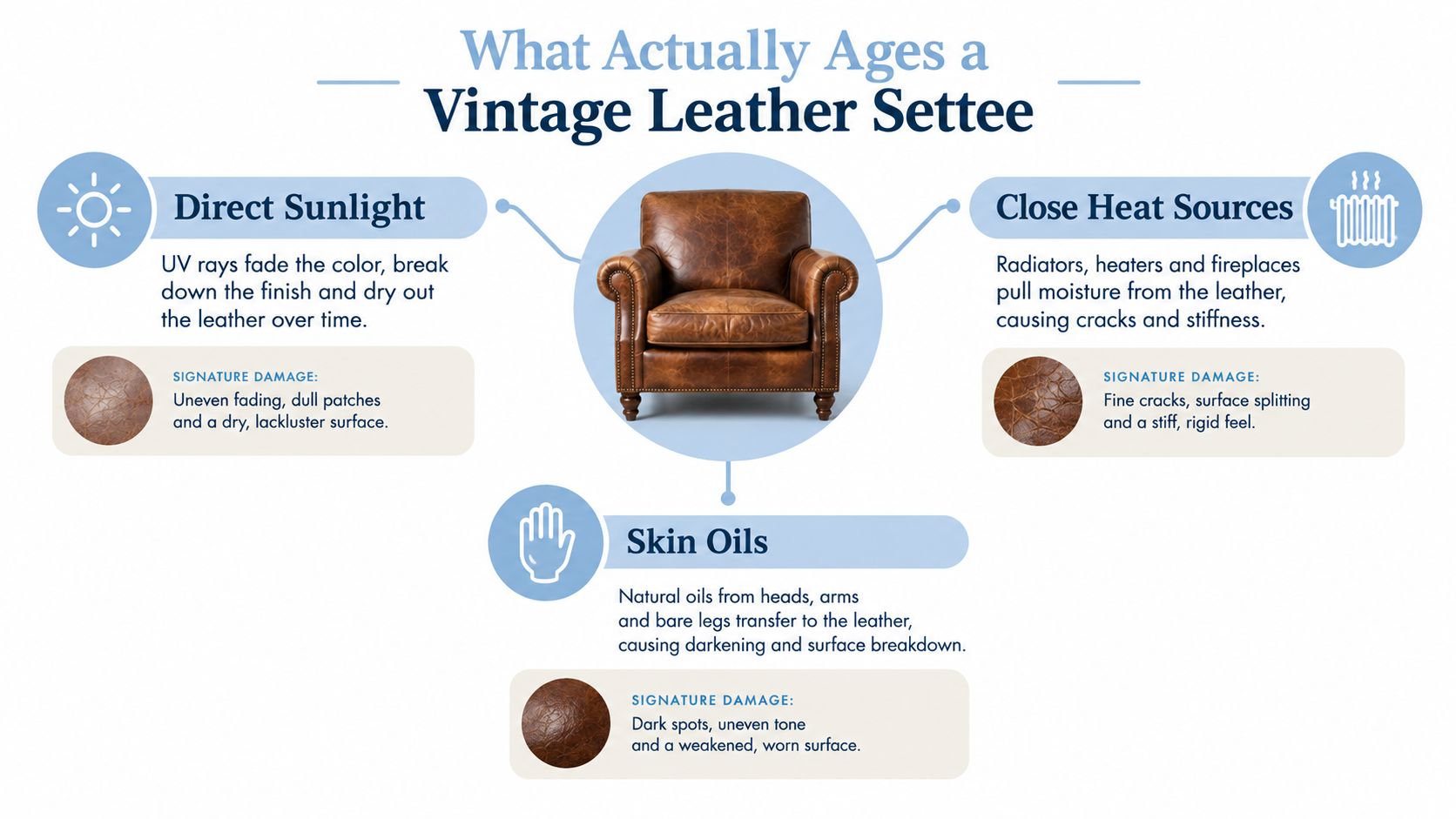
Skin and hair leave a different signature. The headrest, front edge and arm caps can become darker and glossier where hands, necks and hair make contact every day. That darkening isn't always attractive patina. It may include accumulated oils, dirt and a weakened finish underneath.
Where does damage usually appear first?
Damage usually appears first on the seat leading edge, arm rolls, headrest and the area beneath a favourite sitting position. Those locations receive pressure, bending, abrasion and body contact at the same time. The back panel may still look comparatively fresh because it isn't exposed to the same combination of forces.
Humidity swings can also make an old hide feel alternately stiff and relaxed, while dark denim or a dark throw may transfer dye when left against a light-coloured surface. These problems don't always announce themselves immediately. Check the finish after removing a throw, especially if the settee has been covered in the same position for a long period.
The sensible response isn't to seal the whole item in fabric indefinitely. Move a throw so the same fold doesn't press into one line, give the leather time uncovered, control direct light where possible and keep the settee away from close heat. A protective layer can reduce contact, but it can't reverse drying, fading or cracking that has already happened.
Materials, Finishes and UK Safety Standards to Check
Leather terminology tells you how a retro settee may look and age, but it doesn't prove that the upholstery is suitable for domestic use. Ask the dealer or upholsterer which hide was used, which finish sits on the surface, which interliner is present and which fire-test level the current construction meets.
Full-grain leather retains more of the natural surface character. Top-grain leather has been adjusted or finished to produce a more controlled appearance. Corrected-grain leather has had more surface treatment, while bonded leather uses leather fibres combined with a binding material. On a 1960s or 1970s frame, any of these may appear, particularly if the settee has been reupholstered.
| Leather grade or finish | Surface character | How it ages on a retro settee |
|---|---|---|
| Full-grain | More visible natural variation and a less uniform surface | Can darken and develop a distinctive surface history, but shows wear and fading clearly |
| Top-grain | More controlled appearance with some natural character | Usually gives a balanced look, while flexing and abrasion still show at seat fronts |
| Corrected-grain | More even surface with heavier adjustment or coating | Can resist some visible marking, but cracking or finish wear may be more obvious when the coating fails |
| Bonded leather | Manufactured surface made with leather fibres and binding material | May look consistent at first, but surface breakdown needs close inspection |
| Aniline | Little surface pigment and a more open natural appearance | Darkens, marks and changes visibly with contact, light and moisture |
| Semi-aniline | Some protective pigment or finish while retaining surface variation | Offers a middle ground between natural variation and more controlled colour |
| Pigmented | More uniform colour and a stronger protective surface finish | Scuffs may be less immediate, but the finish can crack along repeated crease lines |
Which UK fire tests should a retro settee meet?
A UK domestic upholstered settee should be assessed against the cigarette-resistance test for upholstery, the match test for applicable cover materials and the relevant ignitability requirements for fillings. The legislation distinguishes between these tests, so “fire resistant” on its own isn't a sufficient specification. The Furniture and Furnishings (Fire) (Safety) Regulations 1988 sets out the separate requirements for covers, fillings and upholstery composites.
The regulations apply to new and second-hand upholstered furniture supplied in the UK, including settees, sofa beds and cushions. Leather isn't automatically exempt. UK guidance explains that leather covers must meet the relevant requirements, including match resistance and the cigarette-composite test, while the construction must use compliant fillings and a permanent label where required. The guidance also addresses upholstered furniture fire safety for domestic settings.
A vintage settee may pre-date the regulations, but age isn't proof of suitability. Replacing foam, batting, webbing or the cover can change the tested upholstery combination. Landlords and hosts should ask for documentation from the upholsterer and check the full text of the regulations before putting an unknown reupholstered piece into rental accommodation.
Throw First or Full Cover on a Leather Settee
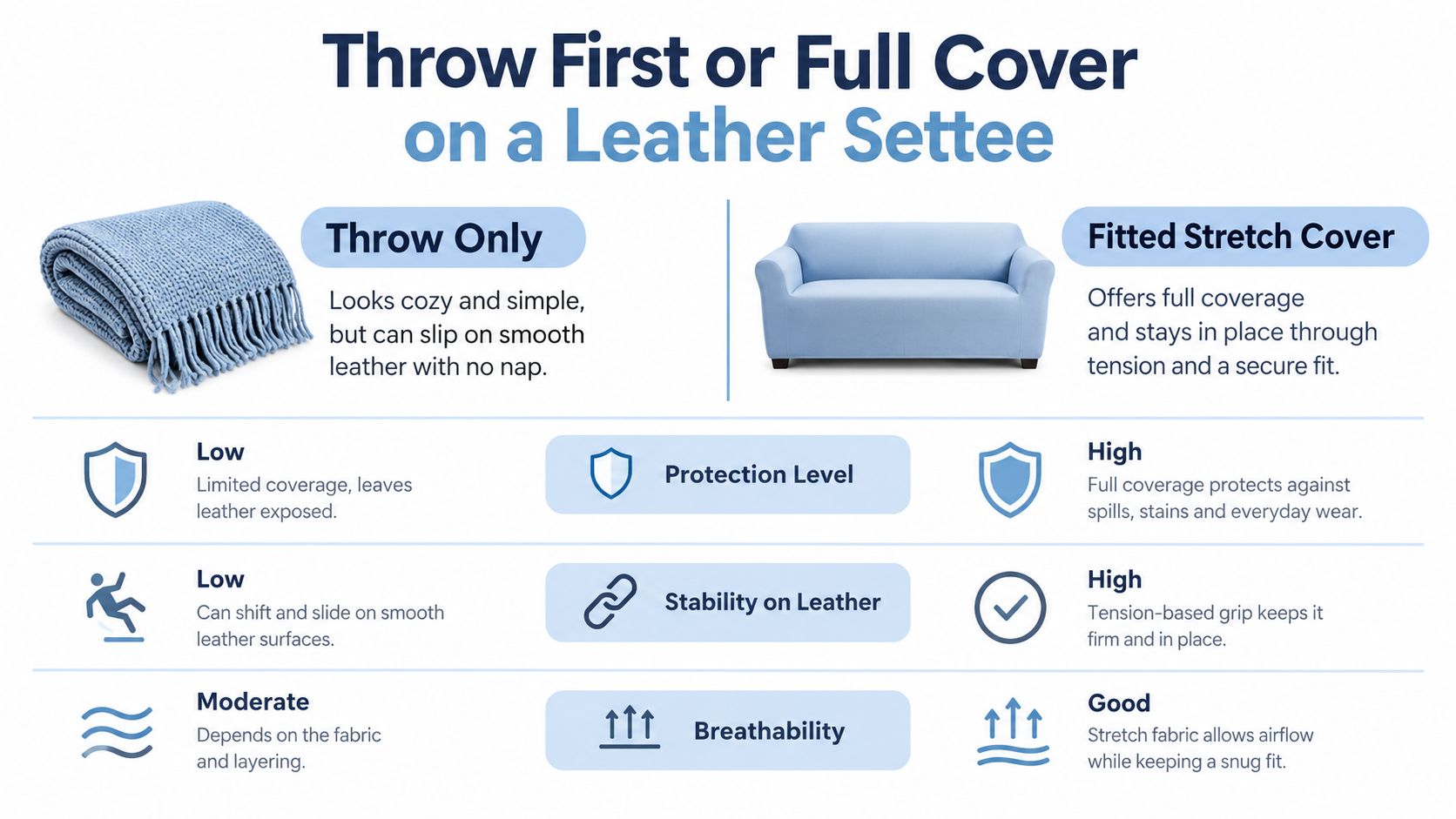
A throw is usually the first choice for a leather settee because smooth leather has no nap for a stretch fabric to grip. A full stretch cover is the second choice when complete coverage matters, but it needs deeper tucking and additional friction control to stop it travelling whenever someone stands up.
A throw lies on the surface rather than trying to become part of the settee's shape. It leaves the legs, arms or back partly visible, can be moved easily and gives you control over which area receives contact. The drawback is that a single heavy throw can slide and create a wear line along its folded edge. Our guides to throws for leather couches and slipcovers for leather couches cover each route in full.
Which protection works better when a dog sleeps on one arm?
For a dog that sleeps on one arm, a targeted throw usually works better than covering the entire retro leather settee, provided the throw is repositioned and the leather is checked underneath. A full cover may make sense when the dog moves across the seat and back, but it hides the settee and creates more contact points against the hide.
Our Sofa Throws collection includes throws in 180 cm by 130 cm, 180 cm by 230 cm, 180 cm by 300 cm and 180 cm by 420 cm. Those sizes allow a buyer to cover a seat and one arm, or arrange a larger layer across the settee and both arms. The catalogue includes families such as Elligate, Melareve, Coveri, Herpome, Norka, Striniara, Soft Tassel, Mousoon and Atlas Geo, with listed prices from £26.90 to £104.90.
A full cover distributes fabric across more panels and can be removed for washing, but the extra tension doesn't make leather behave like woven upholstery. Tuck the hem beneath the frame rather than relying on clips or straps across a rounded arm. Foam Rods in the crevice and Anti-Slip Sofa Pads can reduce movement, while a piece of non-slip rug underlay beneath the seat can add friction in a difficult fitting situation.
Dedicated furniture protectors for moving are also useful when the immediate problem is transport or temporary storage rather than everyday styling. For permanent use, choose between showing the leather and shielding it, rather than assuming maximum coverage is automatically the safest option.
How to Protect the Leather Without Smothering It
No throw or cover preserves patina. Patina is the surface finish, and anything resting on it can burnish the high points over time. Protection changes the pattern of contact, but it doesn't freeze the leather in the condition it had on the day the layer was fitted.
A throw is the lowest-contact option because it fastens to nothing. Drape it rather than stretching it tight, keep the floor edge clear, and move it regularly so one fold isn't pressed into the same surface. A cover should take its grip from the hem tucked beneath the frame, not from straps or clips biting across the arm roll, where old leather often cracks first.
How should a cover sit on an old leather settee?
A cover for an old leather settee should sit smoothly over the frame, with seams away from the crown of the seat and the hem tucked under the base where possible. A seam pressing into a softened cushion can create a compression line, while a tucked hem can hold moisture against the hide if the cover is left in place without inspection.
The Sofa Covers collection includes stretch options such as Classic Stretch, Crosshatch and Jacquard in stated sizes for 1 seater, 2 seater, 3 seater and 4 seater configurations. The listed ranges are 90 to 130 cm, 135 to 175 cm, 180 to 220 cm and 225 to 300 cm respectively. These measurements don't confirm compatibility with every retro frame, particularly a settee with exposed wooden arms, unusual legs or fixed upholstery.
Corner configurations need separate checking. The Corner Sofa Covers collection uses paired size descriptions such as 2 seater and 3 seater, but a standard cover doesn't automatically fit a retro settee with open wooden arms or a non-standard bench frame.
Keep a cover clear of the floor so it can't wick moisture upwards. Rotate or remove it seasonally, inspect the leather underneath and use a barely damp cloth for a monthly wipe. Condition only when the surface feels dry and with a product suited to the finish, rather than applying conditioner on a fixed schedule. Keep the settee well away from a radiator where the room allows.
The decision is straightforward. If the room's main risk is a pet on one arm, use a movable throw. If children, guests or repeated spills affect the whole seating area, consider a fitted cover, but accept that you're trading visibility and airflow for broader surface protection.
Repairing Surface Damage on a Retro Settee
First separate surface damage from structural failure. Scuffs, small tears and local peeling may be suitable for a leather repair treatment or patch, while a sprung frame, broken webbing or collapsed foam core needs an upholsterer. A surface patch can't make an unsafe or structurally failed settee sound.
A self-adhesive patch works best when the damaged area is clean, dry and reasonably stable. Match the patch colour and grain direction as closely as possible, prepare the surface with a mild cleaner so the adhesive meets leather rather than old conditioner, and press from the centre outward to limit trapped air. Rounded edges usually look less abrupt than a square patch placed across a prominent panel.
“Got this leather patch for an old lounge that’s seen better days, and it’s just tops!”
Marcus M., verified buyer review of the Self-Adhesive Leather Repair Patch
The Self-Adhesive Leather Repair Patch measures 50 by 120 cm and is listed at £29.90. It sits on top of the surface, so it won't match the settee's patina exactly. Skin oils, flexing and sunlight can also affect how long the adhesive remains secure, especially on an arm or headrest that receives constant contact.
When should you stop patching a leather settee?
Stop patching when the damage extends through the panel, the adhesive edge repeatedly lifts, or the underlying padding and structure have failed. An upholsterer can then judge whether a panel replacement, new webbing, foam work or complete re-covering is proportionate to the settee's condition.
For smaller abrasions, the guide to repairing scratched leather offers a more detailed route. The right decision isn't driven by sentiment alone. Compare the repair required with the frame's condition, comfort and likely usefulness, then protect the repaired area from the contact that caused the damage.
Living With a Retro Settee for the Long Term
A retro leather settee makes sense as long-life furniture when the frame and structure remain sound. UK households discard about 190,569 tonnes of sofas, approximately 4.8 million sofas, according to figures reported through the eBay and WRAP circular furniture initiative. The same source reports that around 20% of discarded home furniture is considered suitable for reuse, and estimates that choosing reused furniture could save households £2.37 billion and avoid 62,255 tonnes of carbon emissions.
Those figures don't mean every damaged settee deserves expensive restoration. They do support a more useful question: is the frame worth keeping, and can the main failure be addressed without replacing the entire piece? Household spending on furniture has been under pressure in recent years, as the FIRA Statistics Digest documents.
A practical maintenance rhythm is simple:
- Weekly: Dust the frame and vacuum crevices with a soft brush attachment. Check for grit under a throw because grit creates abrasion when people sit down.
- Monthly: Wipe the leather with a barely damp cloth, then allow the surface to dry fully before adding any protective layer.
- Once or twice a year: Condition the leather only when its finish feels dry, using a product compatible with that finish. Aniline and pigmented surfaces shouldn't be treated as interchangeable.
- Annually: Inspect seams, legs, webbing and the underside. Look for loose stitching, movement in the frame, early foam collapse and cracks along arm rolls.
A stretch cover doesn't automatically damage the leather underneath, but it can rub, trap moisture or burnish high points if fitted badly and left untouched. A throw can also cause sweating if it stays damp or pressed tightly against the hide, so remove it for inspection and allow the leather to air. Because leather has no nap, every layer can move. Deep tucking, Foam Rods and Anti-Slip Sofa Pads help with a full cover, while a loose throw avoids tension but needs repositioning.
If the settee needs to leave the room during decorating or a move, use suitable furniture protection and avoid storing leather in a damp, unventilated space. For longer periods in storage between homes, the settee should still be clean, dry and supported rather than left under a tightly sealed plastic sheet.
Frequently Asked Questions
Does a stretch cover damage the leather underneath?
A stretch cover can rub or hold moisture against a retro leather settee if the fit is tight, the seams press into high points or the cover remains in one position without inspection. Tuck the hem beneath the frame, keep pressure away from cracked arm rolls and remove the cover periodically to check the hide.
How often should I condition a vintage leather settee?
Condition a vintage leather settee when the surface feels dry and the product suits its finish, rather than following a rigid calendar. A barely damp monthly wipe and regular inspection are more useful than repeated heavy application.
Can throws make leather sweat?
Throws can trap moisture against a leather settee when they remain damp, tightly tucked or in constant contact with the same area. Drape rather than seal the throw, move it regularly and let the leather dry fully.
When is a repair patch better than a throw?
A repair patch is more suitable than a throw for a small, localised split or worn area on a high-contact arm or headrest. It isn't a solution for failed webbing, collapsed foam, a broken frame or damage extending across a whole panel.
The Sofa Cover Crafter offers sofa throws, stretch sofa covers, corner sofa covers, Anti-Slip Sofa Pads, Foam Rods and a Self-Adhesive Leather Repair Patch. If you're protecting a retro leather settee, compare the available options at The Sofa Cover Crafter and choose the lightest layer that solves the actual wear problem.
