



A pillow sofa throw usually means one of two things, throw pillows for a sofa, or a sofa throw and pillow covers chosen to work together. The most common buying mistake is mixing up a 45cm x 45cm pillow cover with a sofa cushion cover, because the first is a decorative cover for a separate insert and the second fits the sofa's own fixed cushions.
If you're styling a living room, the useful question isn't which phrase sounds nicer, it's which product solves the problem in front of you. If you want the sofa to read as one considered scheme, the throw sets the ground and the pillow covers carry the colour.
Table of Contents
- What Does Pillow Sofa Throw Actually Mean
- Do You Need Pillow Covers or a Sofa Cushion Cover
- How to Style a Throw and Pillow Covers Together
- Which Colours Do Customers Choose Most
- Which Fabric Textures Work Best for Families and Pets
- How to Wash and Store Throw and Pillow Cover Sets
- Does a Throw Make a Non Compliant Sofa Safe
- Frequently Asked Questions
What Does Pillow Sofa Throw Actually Mean
A pillow sofa throw can mean decorative pillow covers for a sofa, or a coordinated look built from a sofa throw plus pillow covers. Those are related ideas, but they solve different problems, and getting that distinction right saves you from ordering the wrong size.
A pillow cover is a 45cm x 45cm shell. In this range, every pillow cover is sold as 1 piece 45cm x 45cm or 2 pieces 45cm x 45cm, and inserts are not included. That matters because buyers often assume they're getting a full cushion, then discover they've bought only the cover.
A sofa cushion cover is the separate product for the sofa's own seat and back cushions. It is sized Standard S/M/L/XL, Deep S/M/L, Chaise Narrow, Chaise Wide, and, on some ranges, Backrest and Headrest. If you want to recover the sofa itself, you need the sofa cushion cover collection, not a 45cm x 45cm pillow cover.
Practical rule: if the textile sits on top of a separate cushion, you need a pillow cover. If the textile replaces the sofa's fitted cushion fabric, you need a sofa cushion cover.
A useful reference point is the wider styling guide in Pillows and Throws for Couches, because the same sofa can call for both products, but never for the same purpose. A decorative throw on its own can soften a room, while a pillow cover can pick up colour already present in lamps, art, or upholstery.
Do You Need Pillow Covers or a Sofa Cushion Cover
If you're refreshing loose cushions, you need pillow covers. If you're covering the sofa's fixed seat and back cushions, you need a sofa cushion cover.
Start with the part you want to change. A 45cm x 45cm pillow cover changes the look of an existing cushion insert, so ranges like Classic Stretch, Jacquard, Velvet, Crosshatch, Diamond Jacquard, and Pebble-Textured Waterproof make sense when the sofa is sound but the soft furnishings need updating.
A sofa cushion cover does a different job. It fits the sofa's actual upholstery panels, so sizing follows the sofa rather than a square cushion shape. That is the right choice when the seat and back cushions are worn, stained, or clash with the room.
For a full walkthrough of fitted sizing, see a complete guide to sofa cushion covers.
A pillow cover changes the accent. A sofa cushion cover changes the furniture.
If you want to browse decorative options, use the pillow covers collection. If the sofa's own cushions are the issue, go straight to the sofa cushion covers collection. Choosing between those two collections first stops the most common mis-buy on this topic.
How to Style a Throw and Pillow Covers Together
A throw and pillow covers work best as one scheme when you use one pattern, one texture and one solid, with at least one colour shared across all three. The pattern brings energy, the texture adds depth, and the solid gives the eye somewhere to rest.
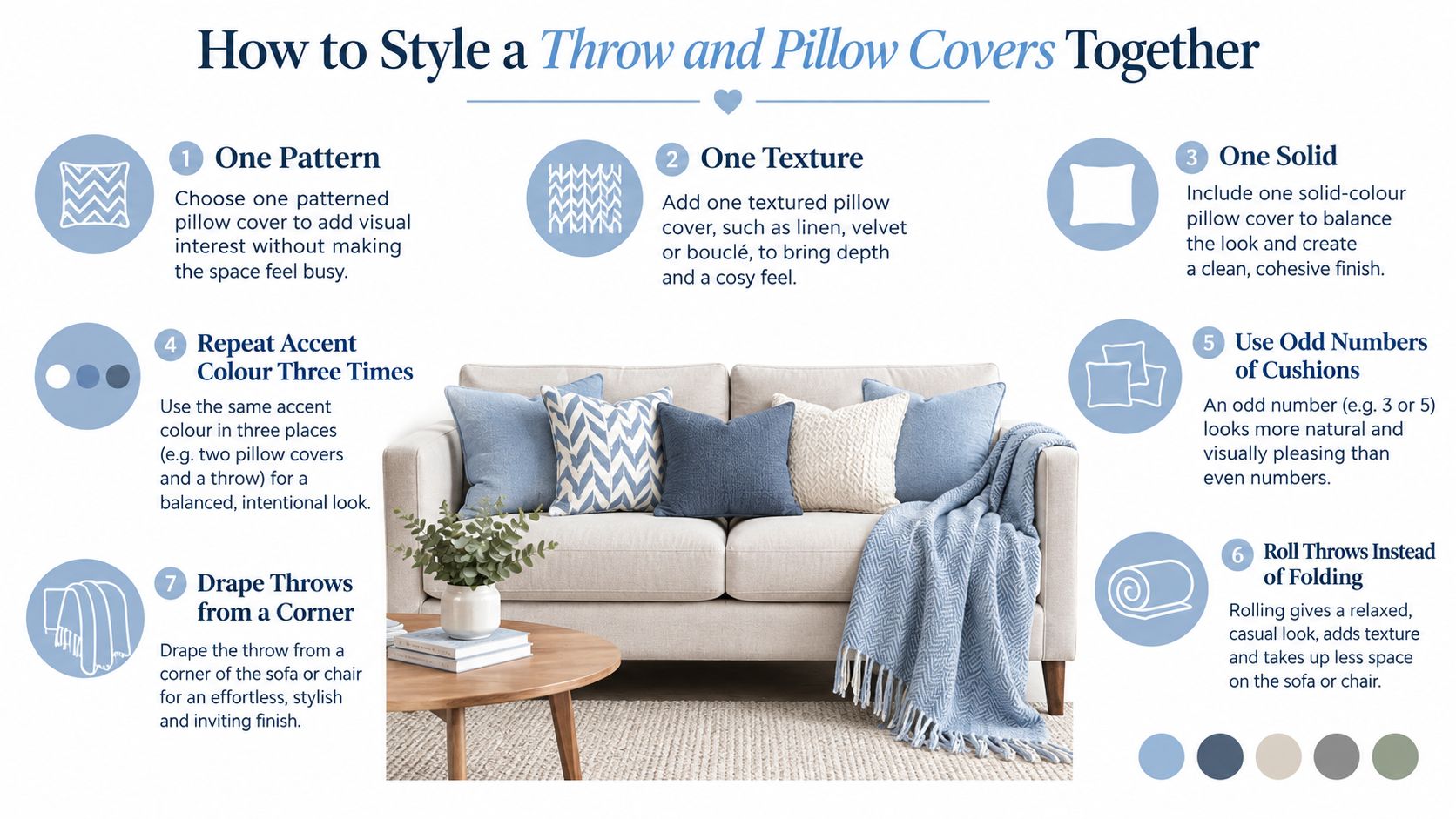
That's why a print-matched set isn't the goal here. No sofa throw in the range has a pillow-cover twin in the same print, so the smarter move is to pick the throw first, then choose pillow covers that share one of its colours. The throw gives the room its base note, while the pillow covers echo one colour in a cleaner, easier-to-control way.
The three-repeat rule is what makes the palette look deliberate. Put the accent colour once in a cushion, once in the throw, and once somewhere else entirely, such as a vase, print, or lamp detail. Three hits is enough for the eye to read the colour as planned rather than accidental.
Use odd numbers of cushions. Three or five look relaxed, while two or four tend to read like a showroom. That rule holds whether the sofa is compact or oversized, because the eye likes asymmetry that still feels controlled.
A throw also looks better when it's draped, not folded into a perfect rectangle. Hold one corner and drop it over a back corner so it lands with some movement. A square fold on an arm can look tidy, but it usually reads flatter than a casual corner drape.
For a similar mixing approach, the mix and match cushions guide is a helpful companion read, especially if you're deciding how much contrast a sofa can take before it starts to look busy.
Which Colours Do Customers Choose Most
Which colours do customers pick first? The strongest sales patterns are green, grey and blue, so those shades are the safest starting points for a pillow sofa throw scheme. Our order history records colour demand, not which items went in the same basket. Of the 14,926 units ordered in the last year, green accounted for 22% of units ordered (3,214), grey for 21% (3,065) and blue for 15% (2,246).
That matters because it shows the palettes buyers pick, not just what looks good on a sample board. Brown is 5% of units ordered (696), beige 5% (680) and orange 4% (578), so there is a clear gap between the top three and the rest. If you want the broadest appeal, start with green, grey, or blue, then refine from there.
Choose the throw's ground colour first, then pick pillow covers that repeat that shade or sit comfortably beside it. Pillow covers usually give you more colour options than throws, so they are the easier piece for fine-tuning. The throw sets the room's tone quickly, while the covers do the quieter work of repetition.
I often steer clients away from trying to match every textile exactly. A disciplined colour-repetition system works better, one colour in the throw, one in a cushion, and one elsewhere in the room, such as a lamp base, print, or vase. That reads as intentional and keeps the sofa from looking over-designed.
Cooper K. described the Crossmere Pillow Cover in Cloud Grey like this, “the cloud grey colour looks heaps good on my couch and goes perfectly with the other cushions I’ve got. They’re soft but still feel durable”. It is a practical example of a cover slotting into an existing cushion mix without forcing you to start again.
If the sofa already has a strong upholstery colour, repeat it in a softer register with the pillow cover rather than letting the new textile compete with it.
Which Fabric Textures Work Best for Families and Pets
Tighter, smoother weaves usually work better than loose, fluffy ones if you've got pets, children, or a sofa that gets used hard. Chunky knits and open weaves look rich, but claws catch them quickly and hair tends to sit in the surface.
The practical compromise is a texture that still feels interesting but doesn't fight daily life. A Velvet Pillow Cover adds a softer, more polished hand feel, while the Pebble-Textured Waterproof Pillow Cover gives a more functional surface where spills or mess are part of the picture. The Classic Stretch Pillow Cover is useful when colour flexibility matters more than surface drama, because it comes in the widest palette.

A good family sofa also needs textiles that behave in the wash and don't turn into a tangle. Keep the throw size realistic for the machine drum, so the fabric can move freely rather than balling up, and tie up or bag any tassels before washing so they don't knot.
If you want a useful companion read on living with dogs around soft furnishings, cozy blankets for older dogs offers a relevant angle on comfort and practicality around pet textiles. The same logic applies to a sofa throw, because a textile that looks lovely but falls apart under use never stays lovely for long.
The point is simple. Pick textures that can take pressure, brushing, and everyday movement, because a beautiful fabric that snags in a week isn't a good design choice.
How to Wash and Store Throw and Pillow Cover Sets
Wash according to the care label, not by guesswork. The temperature on a care label is a limit, not a suggestion.
For washable pillow covers and throws, a shorter cooler cycle usually does less harm than a long hot one when the label allows it. Avoid overfilling the machine, because textiles need room to move, and don't cram the wash load with so much fabric that the pieces can't rinse properly.
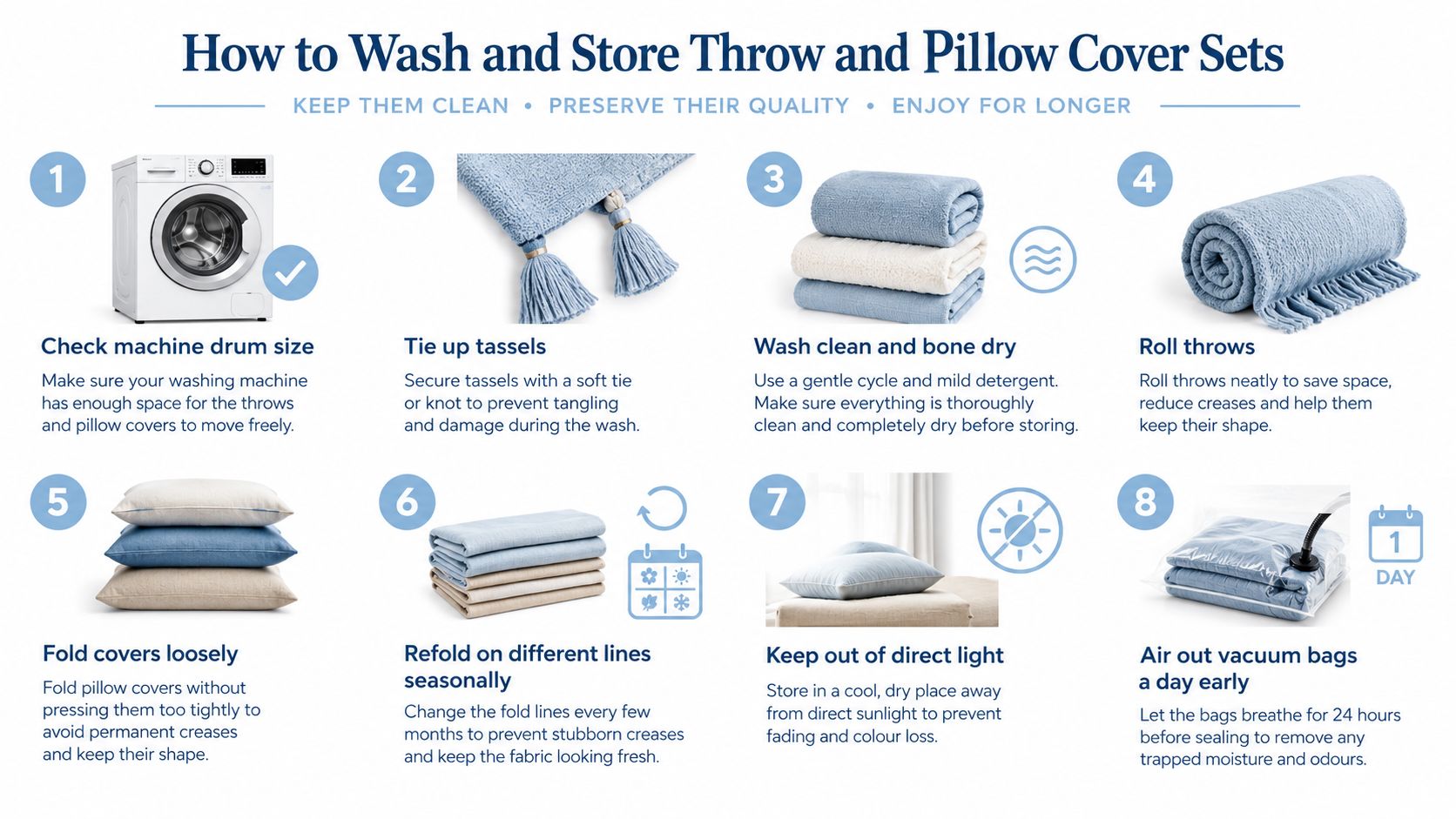
Storage matters just as much as washing. Put throws and pillow covers away clean and bone dry, because hems and seams are the last places to dry and the first to go musty. Keep them out of direct light as well, since a folded textile left in a sunny cupboard can fade along the exposed edge.
Practical storage rule: roll throws instead of folding them into rigid quarters, and refold pillow covers on different lines each season so the same crease doesn't become permanent.
Velvet deserves extra care because a hard fold can crush the pile and leave a pale stripe where the bend sat. If you use vacuum storage bags, take the textile out a day before you want to use it so the folds have time to relax. That small buffer makes a visible difference when the sofa is back in use.
Does a Throw Make a Non Compliant Sofa Safe
No, a throw does not make a non-compliant sofa safe. Under UK furniture-fire rules it is the sofa itself, its filling and its cover fabric, that has to comply, and a throw laid over the top changes none of them.
The key mistake is assuming that a decorative layer can change the compliance status of the furniture underneath it. It can't: the sofa below keeps its own requirements whatever sits on top of it.
The practical check is simple: make sure the throw doesn't hide the permanent label or safety information on the sofa.
Loose textiles also need sensible placement near heat and flame sources. A throw near a radiator, candle, fireplace, or smoking area should be treated as a styling item, not a safety measure. If the underlying sofa needs compliance confirmation, the throw doesn't solve that problem.
Frequently Asked Questions
Do pillow covers include inserts?
No, the pillow covers in this range are covers only. They are sold as 1 piece 45cm x 45cm or 2 pieces 45cm x 45cm, and inserts are not included.
Can I use a sofa throw on any sofa size?
No single throw size suits every sofa. Every throw in the sofa throw collection comes in 180130 cm, 180230 cm, 180300 cm and 180420 cm, and the size needs to match the sofa width: 180130 is a single-seat drape and 180420 covers a large sofa end to end.
What's the difference between a pillow cover and a sofa cushion cover?
A pillow cover fits a separate cushion insert at 45cm x 45cm. A sofa cushion cover fits the sofa's own fixed seat and back cushions in sizes such as Standard, Deep, Chaise Narrow, and Chaise Wide.
Are print-matched throw and pillow sets available?
No, the coordinated look here is a colour match rather than a print match. The safest route is to choose the throw first, then pick pillow covers that share one of its colours.
If you want to build a sofa scheme that feels deliberate rather than overdone, start with the throw, then choose pillow covers that echo its colour story. Visit The Sofa Cover Crafter to compare throws, pillow covers, and sofa cushion covers, then choose the combination that fits your room, your sofa, and the way you live.
