



So, can you dye a sofa? The short answer is yes, dyeing a sofa is possible. But the honest answer is that it's a high-stakes DIY project, and the odds of a perfect finish aren't always in your favour. Your success hinges almost entirely on what your sofa is made of. Natural fibres like cotton and linen tend to drink up dye beautifully, but synthetics like polyester often resist it, leading to a patchy, disappointing mess.
Table of Contents
- How We Evaluated Whether a Sofa Can Be Dyed
- Diagnosing Your Fading Sofa Fabric
- Sun fade is fabric sunburn
- Stains aren't always colour problems
- Wear looks different from fading
- Crocking means the dye is already moving
- Is Dyeing a Sofa the Right Choice for You?
- Quick decision check
- Evaluating Your Situation
- When dyeing makes sense, and when it does not
- Cheap projects can become expensive corrections
- Longevity is often weaker than people expect
- Fire safety is not a minor detail
- Dyeing a Sofa vs Using a Sofa Cover: A Quick Comparison
- Matching the Right Dye to Your Sofa Fabric
- Identifying Your Sofa Fabric at Home
- Fabric-to-method guide
- Which products actually colour the fabric?
- Fabrics that usually should not be dyed at home
- Choosing the Right Type of Dye
- Understanding Colour Theory for Dyeing
- Calculating How Much Dye You Need
- Your Essential Toolkit and Preparation Guide
- Assembling Your Dyeing Toolkit
- The Crucial Deep Clean
- Special Preparations for Different Materials
- Getting Your Dye Application Just Right for a Smooth Finish
- Step 1: Test a hidden area first
- Step 2: Mask everything that should stay clean
- Step 3: Work one panel at a time
- Step 4: Keep a wet edge
- Step 5: Apply thin coats, not one heavy coat
- Step 6: Brush seams, piping, and tufting by hand
- Step 7: Manage drying time between coats
- Step 8: Heat-set only if the product instructions allow it
- What changes when the covers are non-removable?
- Troubleshooting the Inevitable Hiccups and Looking After Your Work
- Fixing Patchy or Uneven Coverage
- Dealing with Colour Bleed and Rub-Off
- Restoring a Soft Texture
- The Smarter Alternative to Dyeing Your Sofa
- Comparing the four main options
- Which option usually wins?
- Frequently Asked Questions
- Can you dye a fabric sofa?
- How do you dye a sofa without removing the fabric?
- Which fabrics cannot be dyed successfully at home?
- Can I dye a leather or velvet sofa?
- Can you dye an old couch?
- How long does sofa dye last?
- Is It Safe to Dye a Sofa with Kids or Pets at Home?
- How do I change the color of my sofa if dyeing feels too risky?
How We Evaluated Whether a Sofa Can Be Dyed
Focus on the questions that decide the outcome, not the product aisle. The main checks are simple: the fibre content, whether the upholstery is removable or fixed, how absorbent the surface is, whether the sofa has stain-resistant treatment, how worn the fabric already is, and whether the colour change is realistic.
In practice, compatibility matters more than enthusiasm. Tulip’s upholstery guidance notes that success depends heavily on fabric type and preparation, and that not every sofa is a good candidate for home dyeing, especially when the fabric resists absorption or the covers cannot be removed for more even treatment Tulip FAQ. Consider the difference between true dye, fabric paint, and upholstery spray, because many people are not recolouring fibres so much as tinting the surface.
My rule of thumb is blunt: if a hidden test patch dries patchy, sticky, or much darker around seams, I stop there. A failed test on the back skirt or underside is useful information, not a setback.
Diagnosing Your Fading Sofa Fabric
A sofa doesn’t lose its looks for one simple reason. Usually, several forms of damage happen at once, but one of them is the primary driver. If you identify that first, you’ll know whether dyeing couch fabric has any realistic chance at all.

Sun fade is fabric sunburn
A lot of people underestimate UV damage in UK homes. Grey skies don’t protect upholstery when a sofa sits beside a bright window day after day.
Lightfastness ratings are what matter here. According to this explanation of dyed polyester end-use properties, ISO 105-B02 rates lightfastness on a scale of 1 to 8, and 4 to 5+ is sufficient for most upholstery. The same source notes that natural fibres such as cotton can fall to 2 to 3 without UV finishes, with visible fading in as little as 12 to 18 months when placed near a window.
That type of fading usually looks uneven. The top edge of the backrest may be lighter. One arm may look chalky. Patterns lose depth. Reds and blues often look washed first, while neutrals start to feel yellowed or tired.
If that sounds like your sofa, the issue isn’t dirt. It’s light damage built into the fabric surface.
Stains aren’t always colour problems
Some marks look like they can be “covered” with a darker dye, but stains don’t all behave the same way.
A water ring, oil mark, old food spill, or cleaner residue can change how fabric absorbs colour. That means a DIY dye job may soak in more heavily around one patch and barely take in another. The result is a cloudy, blotchy finish rather than a uniform one.
Watch for these clues:
- Sharp-edged marks often mean a spill dried into the fabric.
- Darkened headrest areas usually point to body oils and repeated contact.
- Pale crusty patches can come from cleaning products or hard-water residue.
- Mystery discolouration may be old spill damage that has already altered the fibres.
If you’re still deciding what your sofa is made from, this guide to sofa fabric material is useful because fibre type affects both staining and whether dye can bond properly.
Wear looks different from fading
True wear has a texture problem, not just a colour problem.
You’ll see it in favourite seats first. The fabric may look smoother, shinier, flatter, or slightly fuzzy compared with the rest. On some sofas, the front edge of the seat cushion thins out before the middle does. On others, piping and seams stay dark while the broad sitting areas go dull.
Dye can deepen colour, but it can’t rebuild surface structure. If the fabric has gone threadbare, rough, or polished from friction, colour may highlight the damage rather than disguise it.
Practical rule: Run your hand across the faded area and then across a protected section at the back. If the texture feels different, your sofa has wear, not just colour loss.
Crocking means the dye is already moving
Another problem is dye transfer, often called crocking. This is when colour rubs off onto clothing, blankets, or nearby surfaces.
You might notice it if pale trousers pick up a faint tint after sitting down, or if a throw blanket touching the armrest develops a shadow of the sofa colour. Dark fabrics are especially prone to showing this issue.
Crocking tells you that the sofa’s surface dye stability is poor. In practical terms, that means adding more DIY dye can become a gamble. Instead of solving transfer, you may increase it.
A useful way to think about diagnosis is this short checklist:
| Symptom | Most likely issue | Will dye fix it well? |
|---|---|---|
| Uneven pale areas near windows | UV fading | Sometimes, but often unevenly |
| Single dark or greasy mark | Staining or residue | Usually not reliably |
| Shiny, flattened seat zones | Physical wear | No |
| Colour rubbing onto clothes | Poor rubbing fastness | Risky |
Once you know which of these you’re dealing with, the appeal of a quick dye project starts to look very different.
Is Dyeing a Sofa the Right Choice for You?
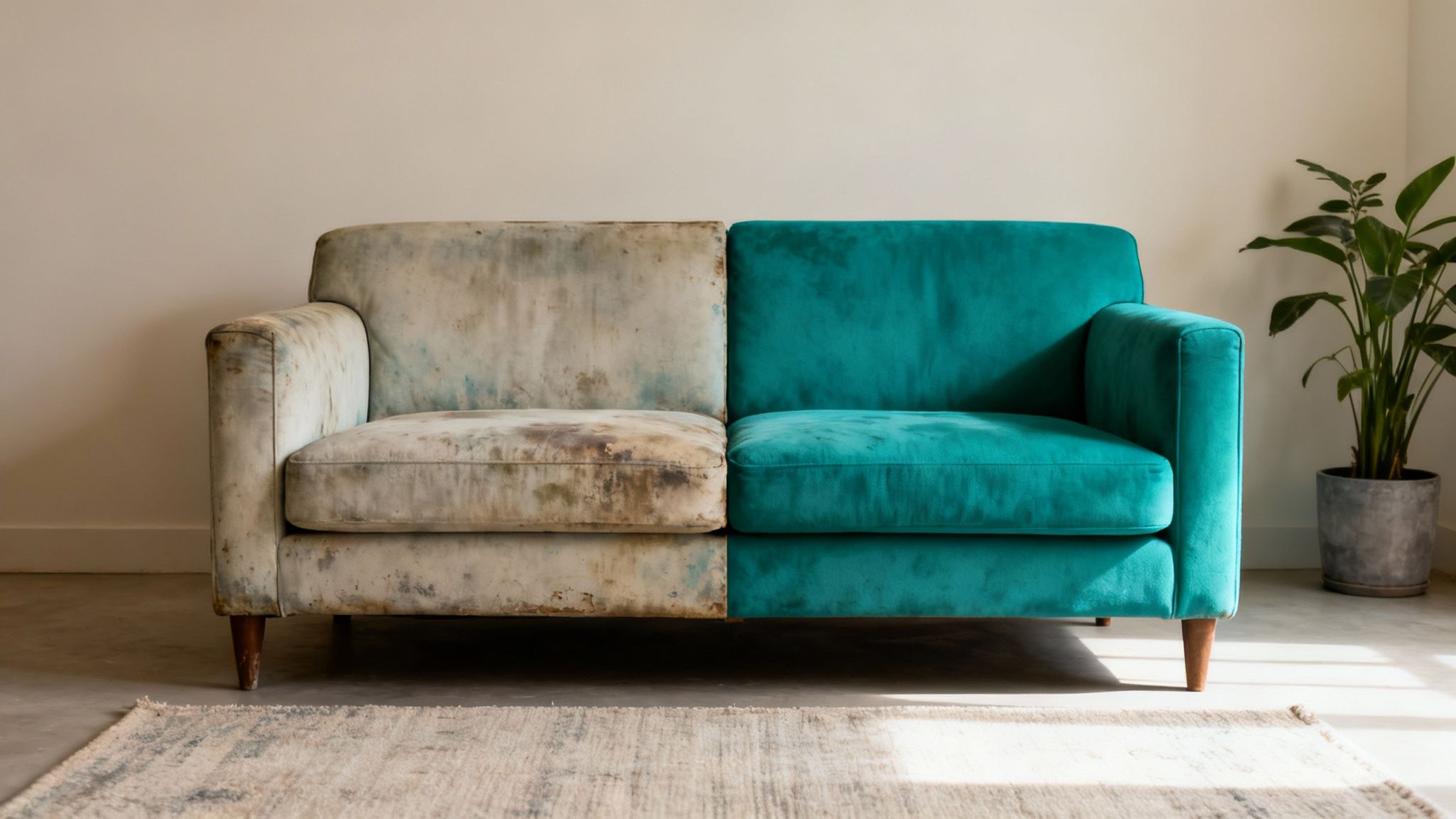
Yes, a sofa can be dyed, but only when the upholstery is fabric-based, absorbent, structurally sound, and worth the risk. No, it is usually not a good idea for polyester-heavy upholstery, badly worn seating, or sofas with strong stain-resistant coatings. If you can accept some variation in tone and texture, a faded cotton or linen sofa may respond well. If you need a factory-even finish, most home projects will fall short.
Quick decision check
Use this as a go-or-no-go filter before you buy anything:
- Fibre content: Cotton, linen, viscose, and some canvas blends are the best candidates. Polyester, olefin, acrylic, and microfibre are the common deal-breakers.
- Current colour vs target colour: Going darker is realistic. Going lighter is not. Dye adds colour; it does not remove the old shade.
- Removable vs fixed upholstery: Removable covers can sometimes be dyed more evenly. Fixed upholstery is much harder because you cannot immerse it.
- Stain protection: If water beads on the fabric, dye may do the same. Protective coatings often block absorption.
- Sun fading and wear: Mild fading is fine. Threadbare arms, shredded seat fronts, and weak seams are not worth rescuing this way.
- Value of the sofa: If you would be upset to ruin it, think twice. I would not test an expensive designer sofa with an unknown blend at home.
Evaluating Your Situation
A practical way to answer this is to separate cosmetic problems from structural ones. Dye can help if the sofa is comfortable, solid, and the wrong colour or unevenly faded. It cannot fix sagging cushions, worn-through arms, pilling, or old stains that have changed the fibre itself.
Guidance from upholstery-dye sellers and furniture-dye tutorials broadly agrees on the same point: upholstery can only be recoloured with any reliability when the textile is dye-friendly and carefully prepped, while synthetic blends often resist even coverage WellWhisk overview. That matches what I see most often in DIY attempts: the flat cushion tops look decent, but piping, seams, and high-touch areas tell the truth.
When dyeing makes sense, and when it does not
Dyeing makes the most sense when you have a plain woven natural-fibre sofa, a darker target colour, and enough patience for patch testing and multiple coats. It makes much less sense if the sofa is a rental, a family workhorse, or a high-performance fabric designed to repel spills.
If your main goal is to change the colour, you have four broad routes:
-
Dyeing: Best when the fibres can absorb colour and you accept an artisan result rather than a factory one.
-
Painting or upholstery spray: Better for some synthetics, but it coats the surface and can alter feel.
-
Slipcover: Lowest risk and fully reversible.
-
Reupholstery: Highest finish quality, but usually the biggest spend.
That comparison matters because some readers do not need dye at all; they need the most sensible route to a colour change. For a useful outside perspective on the trade-offs, this article, Is Dyeing Furniture Fabric a Smart Move or a Design Disaster?, is a helpful expert reference to read before you commit.
Cheap projects can become expensive corrections
The visible supplies are only part of the cost. You may also need cleaners, applicators, gloves, protective sheets, drying space, and time to strip the room back and rebuild it after.
Then there’s the cost of getting it wrong. If the finish is uneven, if the texture worsens, or if the colour transfers, you still need another solution. At that point, you’ve paid in money, time, and effort, and the sofa may now be harder to rescue attractively.
A failed dye job can also affect resale and warranty position. Manufacturers don’t usually treat after-market colour changes as normal wear. Once the original upholstery has been altered, you’ve taken responsibility for the result.
Longevity is often weaker than people expect
Even when the first week looks promising, daily use exposes weaknesses fast. Friction on seat fronts, body oils on armrests, sunlight on the back cushions, and cleaning attempts after a spill all test the finish in different ways.
That’s why sofa dyeing can become a cycle. Refresh the colour. Notice transfer or patchiness. Try again. End up with an increasingly artificial surface on a sofa that still isn’t solved.
The underlying logic is simple:
- If the original problem was wear, dye won’t repair the fibres.
- If the original problem was sun damage, the sofa is still sitting in the same room.
- If the original problem was staining, recolouring can lock in unevenness rather than hide it.
- If the original problem was embarrassment, a blotchy DIY result rarely restores confidence.
For many households, the hidden cost isn’t just financial. It’s living with a piece of furniture that now feels like a project you regret touching.
Fire safety is not a minor detail
In the UK, upholstered furniture has to meet the Furniture and Furnishings (Fire) (Safety) Regulations 1988. That isn’t optional guidance. It’s mandatory.
Dyeing upholstery can compromise the chemical fire-retardant treatments applied to the original fabric, which may affect compliance and insurance position — this is worth checking before you start, not after.
For landlords, hosts, and anyone furnishing a let property, that matters even more. A DIY colour change may look harmless, but from a compliance point of view it’s a modification to regulated upholstery.
Safety check: If you can’t prove the sofa still meets the relevant fire requirements after dyeing, don’t assume it does.
Dyeing a Sofa vs Using a Sofa Cover: A Quick Comparison
To help you decide, let's put the two main options side-by-side. This table breaks down the key things you need to think about for each method.
| Factor | Dyeing a Sofa | Using a Sofa Cover |
|---|---|---|
| Effort & Time | High. A multi-day project requiring prep, application, and drying time. | Low. Can be fitted in under 10 minutes for a total transformation. |
| Cost | Moderate. Dye, tools, and protective gear can add up. | Low to Moderate. A fraction of the cost of reupholstery or a new sofa. |
| Risk | High. Risk of uneven colour, fabric damage, and colour bleed. Mistakes are often irreversible. | Very Low. No risk of damaging the original sofa. Can be easily removed or changed. |
| Reversibility | None. The colour change is permanent. | Total. You can switch back to the original look or try a new cover anytime. |
| Durability | Variable. Prone to fading, especially in sunlight. Can rub off on clothing. | High. Protects the original fabric from spills, stains, and wear. Often machine washable. |
| Best For | Experienced DIYers with natural-fibre sofas seeking a unique, custom colour. | Almost everyone seeking a quick, affordable, and risk-free style update. |
Looking at the options this way makes it pretty clear. While dyeing offers a permanent change, the process is fraught with risk. A sofa cover, on the other hand, gives you a fresh new look instantly, with none of the stress and all of the flexibility.
Matching the Right Dye to Your Sofa Fabric
This is the make-or-break moment of the entire project. Choosing the right dye isn’t just important; it’s everything. If you get this wrong, you're heading straight for a blotchy, uneven disaster that no amount of wishful thinking can fix. The success of dyeing a sofa depends entirely on the marriage between your chosen dye and the fabric it's intended for.
First, you need to play detective and figure out exactly what your sofa is made of. Your best starting point is the care tag, usually tucked away under a cushion or on the frame. If you’re lucky, it will clearly state the material composition, like "100% Cotton" or "Polyester Blend."
If the tag is missing or the text has worn away, you'll need to run a couple of simple tests on a hidden area, like the fabric on the underside of the sofa.
Identifying Your Sofa Fabric at Home
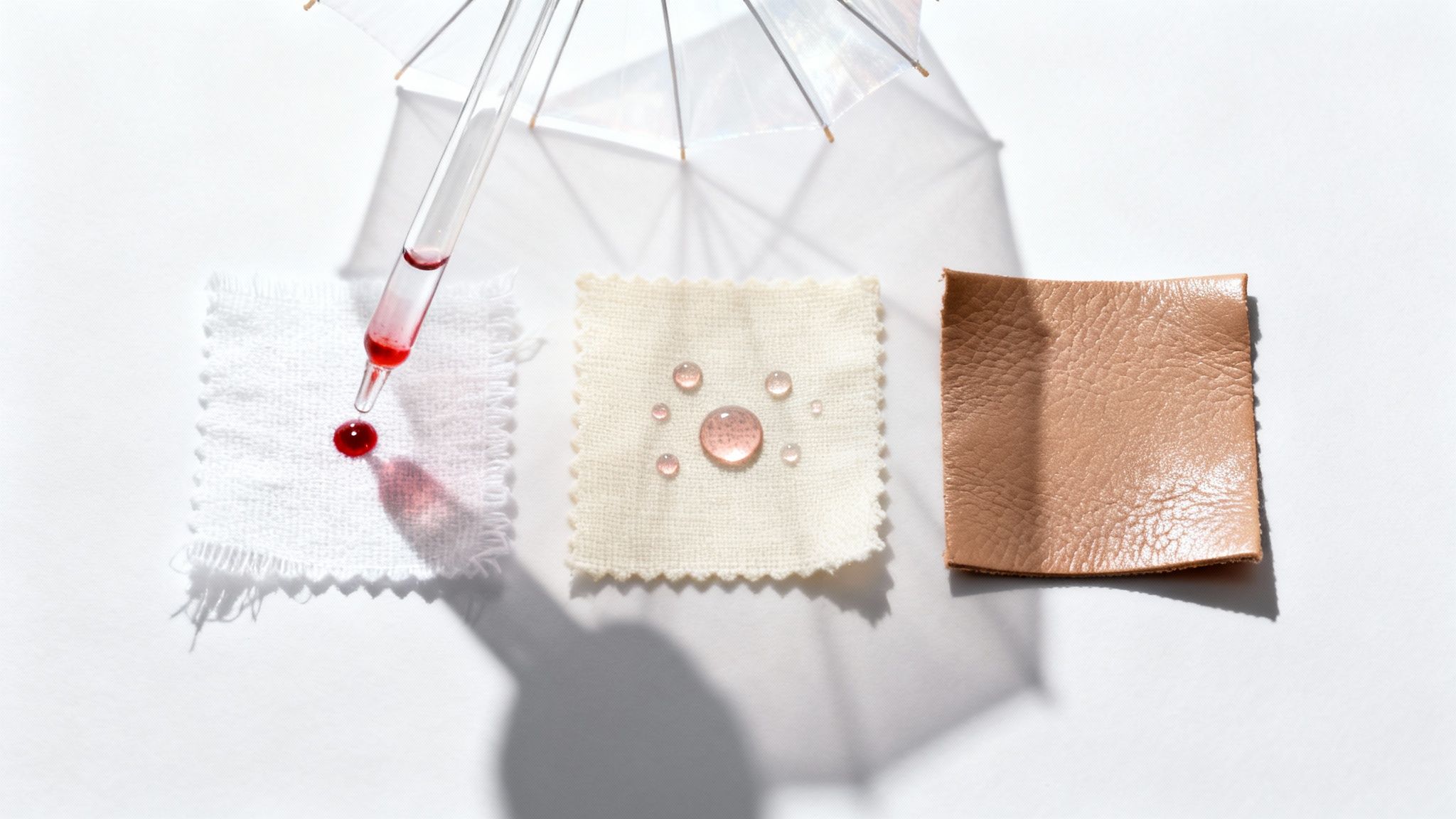
The simplest check is the water absorption test. Drip a single drop of water onto the fabric. If it soaks in quickly, you likely have a natural fibre like cotton, linen, or viscose. If the droplet beads up and sits proudly on the surface, you’re almost certainly dealing with a synthetic material like polyester, nylon, or acrylic.
For a more definitive answer, you can try a burn test, but this requires extreme caution. Snip a tiny thread from a hidden seam and, holding it with tweezers over a fireproof dish, carefully bring it close to a flame.
- Natural Fibres (like cotton): These will catch fire and burn with a yellow flame. They smell a bit like burning paper or leaves and leave behind a fine, soft ash.
- Synthetic Fibres (like polyester): These will melt and shrink away from the flame, often dripping and forming a hard, black bead. The smell will be distinctly chemical, a bit like burning plastic.
Understanding this difference is important. Natural fibres have porous structures that soak up dye, giving you that deep, rich colour you’re after. Synthetics, on the other hand, are plastic; they repel water-based dyes, which is why a standard fabric dye will just slide off, leaving a streaky, awful mess. You can find out more about how different materials perform by exploring our guide to the best fabric for a sofa. If you're checking loose sample fabric before any upholstery project, The Fabric Company's guide is also a useful companion for understanding how natural textiles can shift after washing and wet processing.
Fabric-to-method guide
Here is the practical matching guide most people need before they commit:
-
Cotton: Usually the best home candidate. Absorbent, widely compatible with fibre-reactive or upholstery dyes, and capable of taking deeper colour well.
-
Linen: Often dyeable, though slubs and texture can make variation more visible. Expect a slightly lived-in finish rather than perfectly flat colour.
-
Viscose/Rayon: Can take colour, but it is more temperamental when wet and may show water marks or stiffness if overworked.
-
Canvas: Good candidate when it is cotton-rich. Because it is heavier, it may need more product and more brushing into seams.
-
Velvet: Depends entirely on fibre content. Cotton velvet may accept colour; polyester velvet usually resists it. Pile direction also makes overlap marks more obvious.
-
Polyester blends: Usually poor candidates for true dye at home. A small natural-fibre percentage does not guarantee an even result.
-
Microfibre: Generally a bad fit for home dyeing because the dense synthetic construction resists absorption and can turn patchy quickly.
-
Acrylic: Similar problem to polyester. Colour tends to sit on the surface unless you use products that behave more like coatings.
-
Olefin/Polypropylene: Usually not worth attempting. This fibre is prized because it resists moisture and staining, which is the opposite of what dye needs.
-
Leather: Needs leather-specific dye or leather paint, not textile dye.
-
Vinyl: Needs a vinyl-safe coating product, not a fabric dye.
Which products actually colour the fabric?
DIY projects often go wrong. A true dye penetrates or bonds with the fibres themselves. That is what you want for cotton, linen, and other absorbent textiles. Fabric paint adds pigment with a binder, so it sits more on the surface. Upholstery spray is usually the most surface-level option and is better understood as recolouring than dyeing.
That difference matters because each route changes the feel differently. In my experience, readers are often disappointed not by the colour itself but by the texture afterwards. If softness matters more than exact shade, a poor fabric match is a reason to stop.
Fabrics that usually should not be dyed at home
Some upholstery does not reward the effort:
-
High-polyester blends: The synthetic content resists penetration, so broad areas may tint while seams stay lighter.
-
Stain-resistant upholstery: Protective finishes are designed to block liquids, and dye is still a liquid.
-
Microfibre: Dense synthetic fibres and brushed texture make even coverage difficult.
-
Unknown coated fabrics: If the surface feels slick, waxy, or performance-treated, you may be coating the top rather than changing the fibre.
That caution is consistent with product guidance. Tulip notes that not every upholstery fabric will take colour the same way, and WellWhisk’s furniture-dye overview stresses matching the dye formula to the fibre and planning for multiple coats and testing first Tulip FAQ WellWhisk overview.
Choosing the Right Type of Dye
Once you’ve cracked the code of your fabric, you can finally pick the right product. The world of dyes is vast, but for a sofa project, it boils down to just a few key categories. Never, ever assume an "all-purpose" dye will work on everything—it won't.
For Natural Fibres (Cotton, Linen, Viscose)
Your best bet here is a fibre-reactive dye. These dyes create a permanent chemical bond with the fabric's molecules, making them colourfast and resistant to fading. They are the gold standard for achieving a professional, even finish on plant-based materials.
For Synthetic Fabrics (Polyester, Nylon, Acrylic)
Let’s be honest, dyeing synthetics is notoriously difficult. Standard dyes just won't work. You’d need a specialised disperse dye that requires high heat to bond, which is completely impractical for a whole sofa. The realistic solution isn't a dye at all, but a fabric paint or spray. These products coat the surface of the fibres rather than penetrating them. Look for sprays designed specifically for upholstery to avoid a stiff, crunchy texture.
For Leather and Vinyl Sofas
Trying to use a textile dye on leather will end in ruin, plain and simple. You absolutely need a dedicated leather dye or paint. These are formulated to either penetrate and condition the leather or create a flexible, durable coating on top. They often come in kits with a preparer solution to strip the original finish and a sealer to protect the new colour.
Expert Tip: Always buy more dye than you think you'll need. Running out midway through is a guaranteed way to get an uneven, two-toned finish, as matching a second batch perfectly is nearly impossible. I always aim for at least 20-30% more than the manufacturer's estimate for the size of the sofa.
Understanding Colour Theory for Dyeing
Because dye is translucent, a little colour theory goes a long way. You aren't covering up the old colour; you're mixing with it. This is where so many projects go sideways. Trying to dye a light blue sofa with yellow dye won’t give you a yellow sofa—it’ll give you a green one.
To avoid any nasty surprises, keep these principles in mind:
- Go Darker: You should always pick a colour that’s darker than the sofa’s current shade. You simply can’t dye a navy sofa a pale, creamy beige. It just won’t work.
- Stay in the Family: For the most predictable outcome, choose a new colour from the same family. Taking a light grey sofa to a deep, rich charcoal, for instance, is a safe and very effective bet.
- Use the Colour Wheel: If you’re determined to change the colour entirely (say, from beige to blue), just remember the result will be a blend. A pale yellow sofa dyed with red will probably turn out a lovely shade of orange.
Luckily, the colour trends here in the UK have shifted towards those beautiful, earthy tones that are perfect for a dye project. Hues like mocha, olive green, rust, and charcoal remain consistently popular. Not only do these shades create a wonderfully calm atmosphere, but they’re also fantastic for hiding a bit of wear and tear, making them brilliant for busy family homes.
Calculating How Much Dye You Need
The last piece of the puzzle is figuring out how much dye to buy. Running out halfway through is a complete disaster that almost guarantees a patchy, uneven finish.
As a general rule of thumb, one box of powder dye or one bottle of liquid dye will typically colour about 1 kilogram of dry fabric.
First, you’ll need to estimate how much your fabric weighs. This is a bit of guesswork, but a good method is to weigh your cushions and then estimate the frame’s fabric weight from there. For instance, if a large seat cushion weighs 1.5 kg, and your sofa has two of them, that’s 3 kg right off the bat. A standard three-seater sofa can easily need enough dye for 5 to 7 kg of fabric to get full, rich coverage.
My best advice? Always buy more than you think you’ll need. It is so much better to have a bottle left over than to run out when you’re only halfway done.
Your Essential Toolkit and Preparation Guide
Let me be blunt: the secret to a professional-looking finish when you dye a sofa isn't in the dye bottle. It’s in the painstaking prep work you do before you even think about applying the colour. Rushing this stage is the single biggest reason for blotchy, uneven results that scream "bad DIY".
Think of your sofa as a painter’s canvas. You can’t create a masterpiece on a dirty, unprepared surface. Proper prep allows the dye to soak in or stick to the fabric evenly, giving you that smooth, consistent colour you're hoping for. Skipping this is a false economy, and it almost guarantees you’ll be disappointed.
It’s this exact unpredictability that makes dyeing a sofa a bit of a niche, and often flawed, trend. While the UK home furniture market is set to hit USD 22.69 billion by 2030, most of that is still focused on new purchases. Only a small fraction, around 5-7%, of furniture refresh projects even involve dyeing, partly because 45% of sofas made locally use durable synthetics that won't take dye. A 2024 poll of 5,000 UK buyers revealed that 68% ditched their dyeing plans after reading horror stories about patchy results, which just goes to show how critical this prep phase is.
Assembling Your Dyeing Toolkit
Before you start, do yourself a favour and lay out everything you need. Having your complete toolkit ready will stop you from frantically searching for a sponge or more masking tape with dye-covered hands. You’ll thank yourself for it later.
Here’s a checklist of the absolute essentials:
- Protective Gear: Wear good rubber gloves, safety goggles, and old clothes you don't mind ruining. Dye can splash, so protect your skin and eyes.
- Surface Protection: You’ll need large plastic drop cloths or old sheets to cover the floor and any nearby furniture. Masking tape is also a must-have for protecting wooden legs, metal studs, or any other bits you don't want dyed.
- Cleaning Supplies: A good vacuum with an upholstery attachment is your starting point. You'll also need a mild detergent, a few clean cloths or sponges, and a bucket.
- Application Tools: Depending on your dye, this could mean a spray bottle for even misting, natural sea sponges for blending, or a set of small artist's brushes for getting into seams, tufts, and corners.
- Mixing Equipment: Have a few plastic buckets or bowls ready for mixing your dye solution. Use separate ones for rinsing your tools so you don't contaminate your colours.
The Crucial Deep Clean
Your sofa might look clean, but years of use leave behind an invisible layer of dirt, body oils, and residue from old cleaning products. These act as barriers, blocking the dye from absorbing properly and leading straight to a patchy, unprofessional finish. A deep clean is probably the most critical part of this whole process.
Start by giving the entire sofa a really thorough vacuuming. Use the crevice tool to get right down into the seams and under the cushions where dust and crumbs love to hide. This first step gets rid of all the loose debris.
Next, you need to wash the fabric. Mix a tiny amount of mild, colour-free detergent with warm water to create some suds. Using a clean sponge, gently scrub the whole surface of the sofa, working in small, manageable sections. Be careful not to completely soak the fabric. Follow up with a different sponge dipped in clean water to "rinse" the area by wiping away the soap residue. You can find more expert advice in our guide on the best way to clean a fabric sofa.
Important Reminder: Let your sofa dry completely before you even think about the next step. This can take up to 24 hours. Applying dye to damp fabric will just dilute the colour and cause it to run, ruining all your hard work.
Special Preparations for Different Materials
Not all sofa surfaces are created equal. Leather and certain synthetic fabrics need a few extra steps to make sure the new colour will stick.
If you’re tackling a leather sofa, you absolutely must strip its factory finish first. This protective topcoat is designed to repel stains—and it will repel your dye just as effectively. Use a product called a de-glazer or a leather preparer, applying it with a clean cloth to gently remove that glossy seal.
For synthetic materials that you’re planning to treat with a fabric spray or paint, you need to create a surface the paint can grab onto. Lightly scuffing the fabric with a fine-grit sanding sponge can give the paint something to grip, which helps with adhesion and gives you a more durable finish. Always, always test this on a hidden spot first to make sure it doesn't damage the fabric.
Getting Your Dye Application Just Right for a Smooth Finish
If your sofa does not have removable covers, this is the method that matters. Usually, cushion covers are not removed for a dye bath; instead, the work involves recolouring fixed upholstery while it is still attached to the frame. That changes the whole job. You cannot immerse the fabric for even penetration, so the result is usually closer to controlled surface recolouring than true factory dyeing.

That sounds discouraging, but it is also the honest expectation to set. The aim is an even-looking finish from normal viewing distance, not a laboratory-perfect colour change.
Those preparation steps serve as the foundation for a great result, and following them carefully increases the likelihood of success.
As you can see, the journey to a beautiful finish begins long before you even open the dye bottle.
Step 1: Test a hidden area first
Mix a small batch exactly as directed and apply it to a hidden section, such as the back edge, underside, or inside face of a cushion. Let it dry fully before judging it. Wet fabric nearly always looks darker, so an early verdict is unreliable.
This is the stage that changes the plan most often. I have seen a hidden patch reveal water rings, stiff texture, or colour that grabs to the weave but skips the seams. That is your signal to stop or switch methods.
Step 2: Mask everything that should stay clean
Tape off legs, trim, studs, zips, and nearby wall edges. Slide plastic or card behind seams and around base rails where overspray could catch. If the sofa sits on carpet, protect a much larger area than you think you need.
Step 3: Work one panel at a time
Treat the sofa as a set of separate zones: outside arm, inside arm, seat front, seat deck, backrest, and cushion faces. Finish one complete section before moving on. That makes it easier to control overlap and compare coverage while the previous area is still workable.
Step 4: Keep a wet edge
To avoid lap marks, overlap each fresh pass into the still-damp edge of the last one. This is the single most useful habit for fixed upholstery. Start high and work down so any extra moisture moves into areas you have not finished yet.
Step 5: Apply thin coats, not one heavy coat
A heavy first pass is the fastest route to drips, dark spots, and crunchy fabric. Light misting or light sponge application gives you more control and usually produces a softer finish. Coverage guides from furniture-dye retailers are useful here: product estimates often scale from footstool to armchair to full sofa, and larger pieces commonly need multiple coats rather than one saturated application WellWhisk overview.
Step 6: Brush seams, piping, and tufting by hand
Large flat areas are rarely the hardest part. Seams, welting, piping, and buttoned details are where patchiness usually shows up first, because those areas have denser stitching and more wear. Use a small brush to work colour into these details before they dry lighter than the surrounding panel.
Step 7: Manage drying time between coats
Let each coat dry to the point recommended by the product before adding the next one. Rushing this stage can lift colour, create tacky patches, or trap too much product at the surface. Good airflow helps, but direct heat too soon can lock in unevenness.
Step 8: Heat-set only if the product instructions allow it
Not every upholstery dye or paint wants heat. Some do, some do not, and some only allow gentle setting through a cloth. Follow the manufacturer’s instructions exactly rather than assuming a hairdryer or iron will improve durability.
What changes when the covers are non-removable?
The biggest compromise is saturation. Because fixed upholstery cannot be dipped and agitated evenly, colour often ends up a little richer on broad faces and a little lighter on stitched or highly compressed areas. That does not always look bad, but it does mean permanence claims should be modest. High-friction seat edges, sun-struck arms, and corners cleaned heavily in the past are the most common failure points.
Troubleshooting the Inevitable Hiccups and Looking After Your Work
Even when you’ve done everything by the book, dyeing a sofa is one of those projects where little surprises can pop up. You might step back to admire your handiwork, only to spot a patchy area that just didn’t take the colour, or find the fabric feels a bit stiff once it’s dry. Don't panic—most of these common issues are fixable with a bit of patience and the right technique.
This isn't always down to bad luck; sometimes, the fabric itself is the culprit. A 2024 Office for National Statistics survey found that 18% of DIY dyeing jobs resulted in uneven colour, often because of the polyester blends so common in modern UK sofas. This is a clear example of why an alternative like a slipcover can be a smarter move, giving you a fresh new look without the risks.
Fixing Patchy or Uneven Coverage
Inconsistent colour is easily the most frequent frustration. You’ll see lighter patches where the dye didn’t quite sink in, or dark spots where it got a bit oversaturated. This often happens in high-wear areas like armrests, where years of built-up residue can be tougher to shift than you think.
If you’ve got a light patch, the fix is usually another targeted layer of dye.
- Let It Dry Completely: First, wait for the entire sofa to be bone dry. You can't properly judge the final colour when it's still damp.
- Mix a Weaker Solution: Prepare a small batch of your dye, but this time, dilute it with about 25% more water than you used for the main coats. This gives you far more control and helps the new layer blend in seamlessly.
- Apply with a Sponge: Using a small, slightly damp sea sponge, gently dab the diluted dye onto the patchy spot. I find it’s best to start from the centre of the patch and work your way out, feathering the edges to blend it into the surrounding colour.
- Blot, Don't Rub: Gently blot the area with a clean, dry cloth to lift any excess dye and soften the transition. Let it dry completely before you decide if another light coat is needed.
Dealing with Colour Bleed and Rub-Off
There's nothing worse than finishing your project, only to find the new colour is rubbing off on your clothes. This is almost always a sign that either the dye wasn't properly heat-set, or there was just too much excess dye left sitting on the surface of the fibres.
If you notice colour transfer, you need to go back and set the dye again. Go over the entire sofa with a hairdryer on its highest heat setting, moving it constantly to make sure every inch gets treated. For fabric, you can also place a clean, dry cloth over a section and press it with a hot, dry iron (no steam!) for about 30 seconds. This really helps to lock the pigment into the fibres for good.
Restoring a Soft Texture
Sometimes, particularly if you’ve used fabric paints or sprays, you might find the sofa feels a bit stiff or crunchy to the touch. The binders in these products can tighten the fabric's weave as they dry, but this is usually an easy fix.
A simple trick is to gently go over the fabric with a soft-bristled upholstery brush. Brushing in gentle, circular motions helps to break up that stiffness in the paint and soften the fibres without damaging the colour. For a really stubborn case, you can lightly mist the sofa with a solution of one part fabric softener to three parts water, then give it another brush once it’s dry.
Aftercare Is Everything: Once your sofa looks perfect, your job shifts from creator to caretaker. Proper maintenance is what will keep your newly dyed sofa looking vibrant and fresh for years to come.
After the dye has fully cured (I always recommend waiting at least 72 hours), applying a fabric protector spray like Scotchgard is a fantastic idea. This creates an invisible barrier that helps repel spills and stops stains from setting in, buying you precious time to clean up messes. For regular cleaning, stay away from harsh chemical cleaners. Instead, just stick to vacuuming with a soft brush attachment and spot-cleaning spills immediately with a damp cloth and a touch of mild, clear soap.
The Smarter Alternative to Dyeing Your Sofa
After weighing up the risks and sheer effort of dyeing a sofa, the smarter choice is often the one that matches your goal, your budget, and your tolerance for risk. If what you want is a colour change, there are four realistic routes, and each suits a different kind of sofa problem.
Comparing the four main options
1. Dyeing
Best when the upholstery is absorbent, the sofa is worth saving, and the target colour is darker than the current one. The finish can look good from a normal room view, but it is rarely identical to factory upholstery. Durability ranges from decent to disappointing depending on fibre compatibility, prep, sunlight, and friction. It is not reversible. Budget is usually in the low-to-mid range for DIY materials, but the risk level is high.
2. Upholstery paint or spray
Best when the fabric is synthetic or when true dye will not bond well. The finish can be visually effective, especially on occasional-use furniture, but it may alter softness more than a true dye does. Durability is moderate and depends heavily on thin coats and curing. Reversibility is low. Budget is similar to dyeing, sometimes slightly higher if several cans or bottles are needed.
3. Slipcovers
Best when you want an immediate colour change, washable protection, or a fully reversible update. The finish depends on fit: a well-fitted cover can look surprisingly polished, while a loose one looks casual. Durability is generally high because the original upholstery stays protected underneath. Reversibility is excellent. Budget usually ranges from relatively low for stretch covers to moderate for more fitted options.
4. Reupholstery
Best when the sofa frame is worth keeping but the upholstery is too damaged, too synthetic, or too valuable to gamble on. This gives the most professional finish and the widest choice of fabric, but it is the least reversible and usually the most expensive route. For a beloved sofa with good bones, though, it is often the best long-term answer.
Which option usually wins?
If your sofa is natural-fibre, faded, and otherwise in good shape, dyeing can be justified. If the upholstery is synthetic, coated, or fixed in a way that makes even saturation unrealistic, paint or a slipcover usually makes more sense. If the frame is excellent but the upholstery is tired beyond colour alone, reupholstery is the cleaner solution.
I tend to recommend slipcovers most often not because they are glamorous, but because they solve the actual problem for most households: they change the look, protect the sofa, and do not punish one mistake forever.
That’s where The Sofa Cover Crafter fits best. If you decide the risk of dyeing is higher than the reward, a fitted cover gives you a cleaner, faster route to a new colour scheme while keeping the original sofa intact. See the process in how to cover a couch. If you're still set on a hands-on project but dyeing isn't the right fit, you could explore other approaches. For example, some homeowners are turning to durable and stylish furniture wrapping to update their pieces.
Frequently Asked Questions
Can you dye a fabric sofa?
Yes, sometimes. Fabric sofas made from cotton, linen, viscose, or other absorbent fibres have the best chance of taking colour well, while polyester-heavy upholstery often resists dye or dries unevenly. A hidden patch test is the fastest way to tell whether the project is viable.
How do you dye a sofa without removing the fabric?
You work in place, one section at a time, using thin coats and keeping a wet edge so overlaps blend together. Fixed upholstery cannot be immersed, so the finish is usually more like careful surface recolouring than a perfectly even through-dye. Test first, mask the surrounding areas, and expect seams and piping to need hand work.
Which fabrics cannot be dyed successfully at home?
High-polyester blends, microfibre, olefin, many acrylic upholstery fabrics, and stain-resistant or coated textiles are the usual no-go list. They either repel liquid, require heat levels impractical for a full sofa, or dry with visible patchiness. If water beads on the surface, dye often will too.
Can I dye a leather or velvet sofa?
Leather isn’t the same as woven upholstery fabric, so standard fabric dyeing methods aren’t suitable. Velvet is tricky too because pile direction, backing, and fibre content all affect the result. Both materials need specialist treatment if you’re attempting recolouring, and both are easy to make worse.
Can you dye an old couch?
Only if the main issue is colour. An old couch with solid structure and intact fabric may be a decent candidate, especially if it is faded rather than worn through. If the arms are threadbare, the cushions sag, or the seams are already weakening, dye will highlight the wear instead of hiding it.
How long does sofa dye last?
On a dye-friendly fabric with careful prep, several light coats, and gentle aftercare, the colour can last for years. On synthetic upholstery or heavily used seating, wear can show much sooner, especially on front edges and sunny spots. In my view, durability depends less on the label saying “sofa dye” and more on whether the fibre should ever have been dyed in the first place.
Is It Safe to Dye a Sofa with Kids or Pets at Home?
Safety should always be your top priority here. While you're applying the dye and throughout the entire drying process, it is vital that the room is extremely well-ventilated. Open every window you can and get some fans going to keep the air moving.
During this time, you must keep children and pets completely away from the area. This prevents them from accidentally touching the wet dye or breathing in any strong fumes.
Once the dye is fully cured and has been set according to the product's instructions, it’s generally considered inert and safe for everyday use. For extra peace of mind, look for non-toxic or low-VOC (Volatile Organic Compound) dye formulas whenever possible.
If the thought of dyeing your sofa feels like too much of a risk or commitment, there's a much easier way to get a fresh new look. At The Sofa Cover Crafter, we offer a stunning collection of stylish, durable, and washable sofa covers that can transform your living room in minutes. Explore our beautiful designs at The Sofa Cover Crafter's website and find the perfect fit for your home.
How do I change the color of my sofa if dyeing feels too risky?
A slipcover is the easiest reversible option, upholstery paint can work on some problem fabrics, and reupholstery gives the best finish if the frame is worth keeping. The right choice depends on whether you care most about softness, permanence, budget, or the ability to undo the change later.
Ultimately, if the risks and sheer effort of dyeing a sofa feel a bit too daunting, you can get a stunning, stress-free transformation in minutes. Why not explore the stylish and practical collection at The Sofa Cover Crafter and find your perfect new look today? Visit us at The Sofa Cover Crafter.