



If you're choosing between a corner sofa and a normal sofa, the answer is simple: a corner sofa gives you more fixed seating and takes over more of the room, while a normal straight sofa gives you more flexibility and is easier to live with. We sell covers, not sofas, so I'm not going to pretend otherwise. What I can do fairly is compare both shapes on room fit, access and layout, then tell you exactly how that decision changes the cover you'll need once the sofa is in place.
Table of Contents
- How a Corner Sofa and a Normal Sofa Actually Differ
- Which Shape Fits Your UK Living Room Best
- Can a Corner Sofa Actually Get Through Your Front Door
- How a Corner Sofa Locks the Room Versus a Sofa You Can Re-angle
- Does a Corner Sofa Cover Fit the Same Way as a Normal Sofa Cover
- How Do You Fit a Corner Sofa Cover Without Wrinkles
- Choosing the Right Sofa Shape and Cover for Your Home
How a Corner Sofa and a Normal Sofa Actually Differ
You spot a sofa online, measure the wall, and think the job is done. It is not. The shape you choose changes the layout, delivery, and the cover you will need once the sofa is in your house.
A corner sofa has two connected seating runs that meet at an angle. A normal sofa is one straight seat unit. That sounds basic, but the buying difference is practical, not cosmetic. A straight sofa gives you one clear width and depth to measure. A corner sofa gives you a main run, a return, and a left-hand or right-hand orientation that has to match the room and the cover.
The size gap is usually obvious. A standard 3-seater sofa gives you one width to plan around, while a corner sofa takes a broader footprint, because the return adds a second run reaching out into the room. UK room-size guidance for sofas makes the same point: corner models need more floor than a straight 3-seater.
That matters even more once you get to covers.
A straight sofa cover is usually a simpler fit because the shape is consistent from one arm to the other. A corner sofa cover has more variables. You need to know whether the return sits on the left or right when facing the sofa, whether the chaise is part of the same unit or separate, and whether the sections can be covered together or need individual pieces.
Why shape matters once the sofa is in place
A normal sofa is easier to shift, turn, and replace later. A corner sofa commits the room earlier and more firmly. It also makes cover buying less forgiving, because one wrong measurement on the return section can leave you with loose fabric on one side and strain on the other.
That is the difference that gets missed in generic sofa comparisons. Corner versus normal is not only about how many people can sit down. It decides what you have to measure, what will fit properly, and what sort of cover you can buy with confidence.
Which Shape Fits Your UK Living Room Best
You get home, put the tape measure against the wall, and the corner sofa looks like it should fit. Then the return cuts across the walkway, the coffee table has nowhere sensible to go, and later you realise the cover you need is a left-hand or right-hand shape, not a standard straight one. That is the part buyers miss.
A straight sofa fits more UK living rooms with less compromise. A corner sofa suits a square room, an open-plan layout, or a dead corner you want to use. In a long narrow lounge, a straight sofa is usually the better call because it keeps the route through the room clear and leaves you more options later.
Wall length is only half the job. Walking space decides whether the room feels usable. UK corner sofa space guidance recommends about 90 cm of clearance on a main walking route, and a larger room envelope for a standard corner setup than you would usually need for a straight sofa.
Room shape matters more than headline size.
If your living room has a chimney breast, a bay window, or a doorway that opens into the seating area, a corner sofa can force the layout before you have even chosen the cover. A straight sofa is easier to centre, pull forward, or angle slightly to work around awkward features. That flexibility matters because covers follow the shape you settle on. Straight sofa covers are simpler to buy and simpler to fit.
Corner sofa vs normal sofa room fit at a glance
| Criterion | Corner (L-shaped) sofa | Normal (straight) sofa |
|---|---|---|
| Overall footprint | Larger footprint, with one main run plus a return section | Simpler rectangular footprint |
| Typical sizing | Compact versions often need around 220 × 220 cm of floor space, with bigger options running much larger per side | Usually shorter front-to-back and easier to place against one wall. Standard 2 and 3 seaters take less planning than a corner unit |
| Walkway demand | Needs more care because the return projects into the room | Easier to place while keeping a clear route through the room |
| Best room shape | Square living rooms, open-plan spaces, corner-led layouts | Narrow rooms, terraces, flats, rentals |
| Layout flexibility | Lower. The L fixes the seating direction | Higher. You can re-angle and reposition more easily |
The practical test is simple. Mark the sofa shape on the floor with masking tape, then walk the route you use every day, from door to seat, radiator to window, TV to sideboard. If the taped return feels in the way now, it will still feel in the way after delivery.
If you need the measuring detail before you buy a cover, use our guide to corner sofa dimensions and how to measure them properly. That is the point where corner versus normal stops being a style choice and starts changing the cover you can order.
A straight cover product such as Velvet Sofa Cover · Dark Green · Stretch Fit is made for a straight sofa with machine-washable velvet fabric, a stretch fit and everyday protection. This reflects the key difference. Straight sofas are easier to place, and they are easier to cover well.
Can a Corner Sofa Actually Get Through Your Front Door
Yes, a corner sofa can get through your front door, but a corner sofa needs far more checking on the route in than a normal straight sofa. The issue isn't just the front door. The issue is the whole route from outside to the final room.
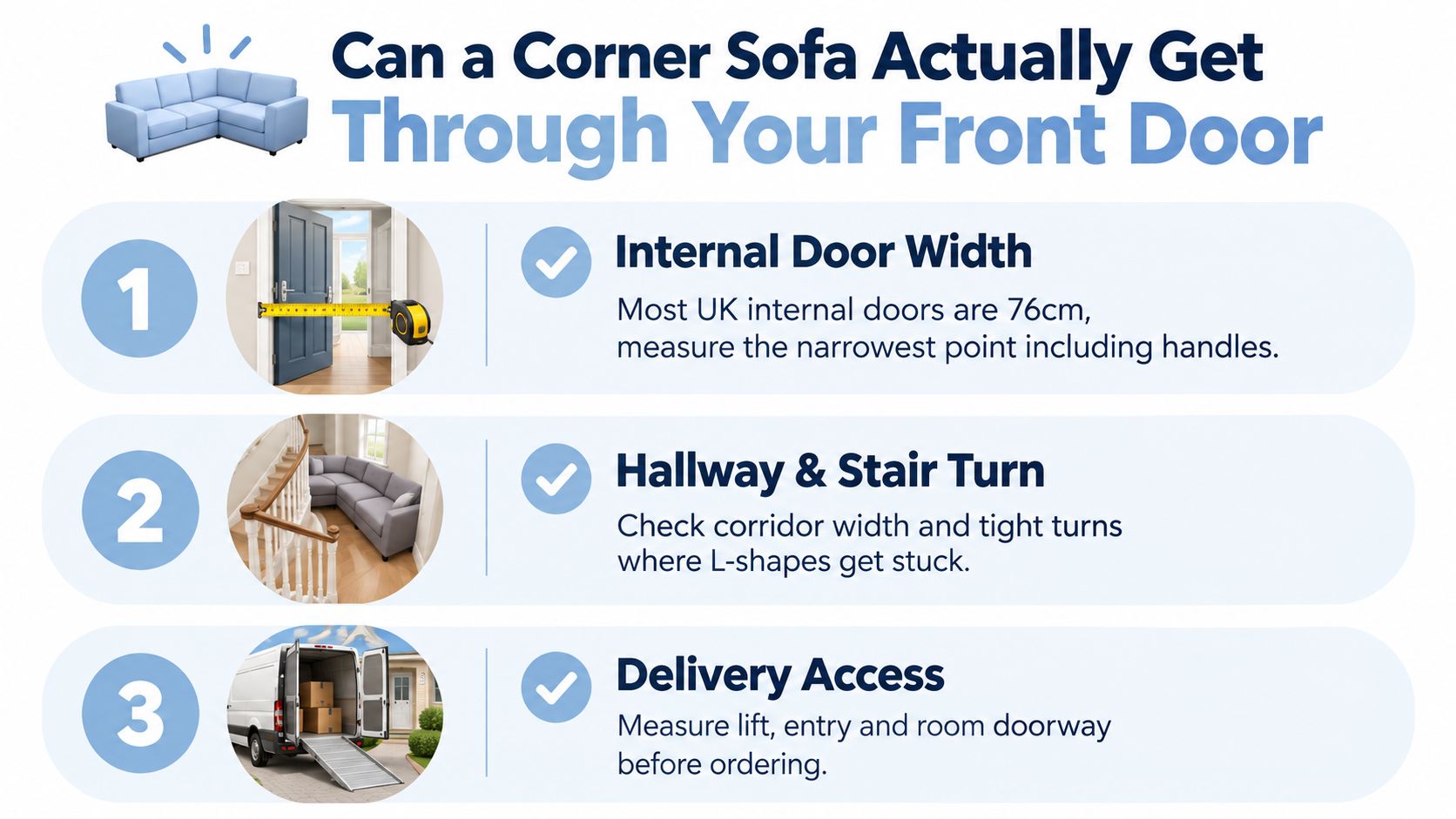
A UK furniture guide notes that a corner sofa is commonly delivered in 3 sections: a corner box and 2 sofa sections with 1 arm. That helps, but it doesn't make access easy. Each section is still bulky, and the awkward part is usually the turn from hallway into room, not the fact that the sofa comes in pieces.
What to measure before a corner sofa arrives
Take these measurements before you order any large sofa:
- Door width: Measure the narrowest usable opening, not just the frame.
- Hallway pinch points: Check the tightest point on the route, especially near radiators, bannisters and turns.
- Turning space: Measure the space needed to rotate each section through the route and into the room.
UK guidance for corner sofas repeatedly stresses measuring every doorway, hallway and staircase landing on the route, and leaving at least 90 cm between the sofa and the nearest wall or piece of furniture once it is in place, as explained in this UK corner sofa buying guide. That's why access is often the primary decision point, not style.
A corner sofa that fits the room on paper can still fail at the hallway turn.
If you're decorating during building work or clearing rooms before delivery, practical storage can be the difference between an easy route and a blocked one. Temporary storage, or simply moving the smaller furniture out of the way for the day, can clear awkward routes before large furniture arrives.
For the actual measuring method, use our sofa measuring guide. Covers, at least, don't create this problem. They arrive folded, boxed and easy to carry.
How a Corner Sofa Locks the Room Versus a Sofa You Can Re-angle
A corner sofa locks the room layout far more than a normal sofa does. A straight sofa can be turned, shifted, pulled off the wall, or paired with other seating later with much less fuss.
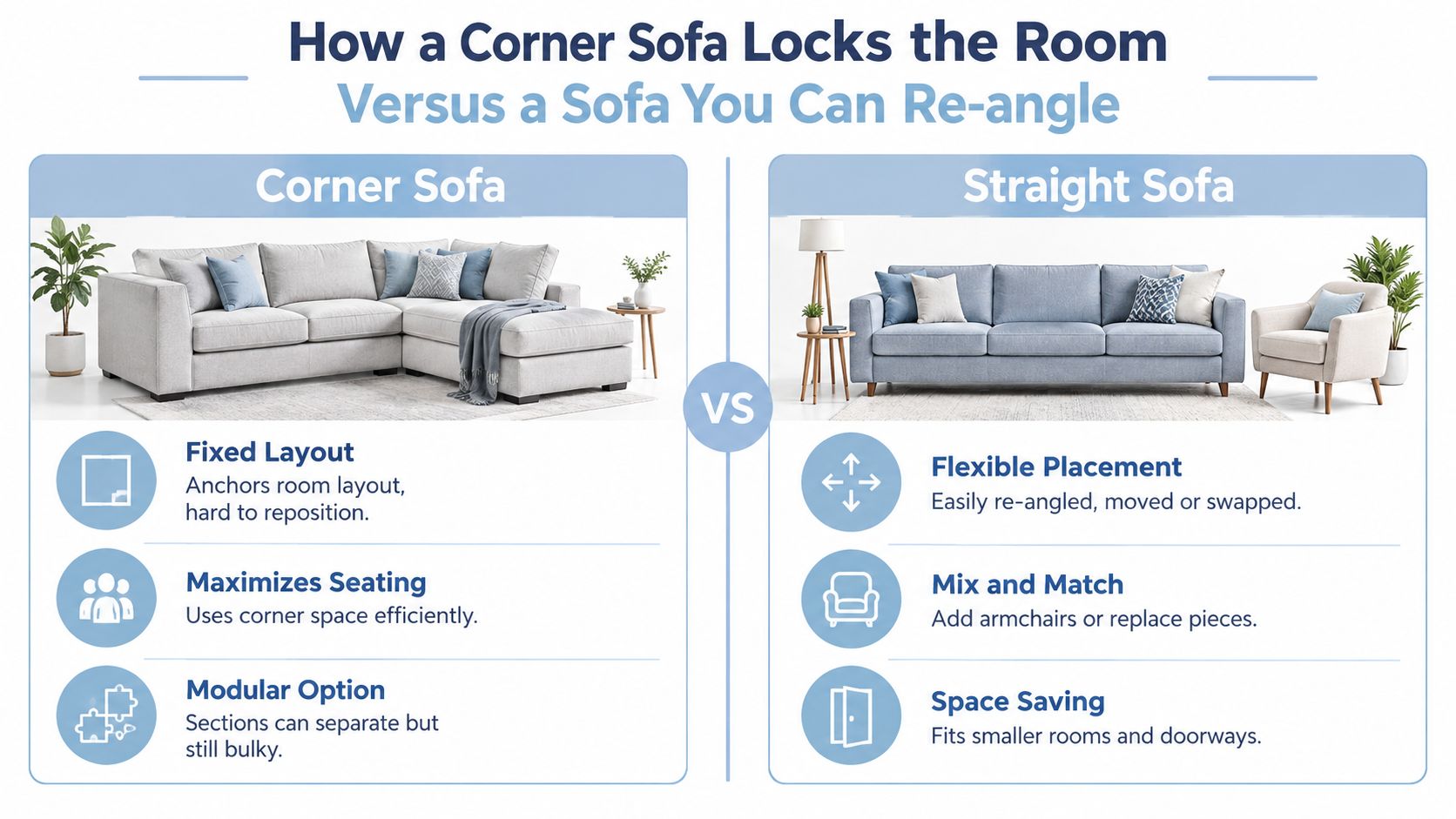
That rigidity is the key trade-off. A corner sofa can seat more people in one connected shape, but once it goes in, the room tends to revolve around one wall junction. A straight sofa leaves you options. You can angle it towards a fireplace, turn it towards a television, float it in a room, or swap the supporting chair and side table later.
Why handedness matters
A corner sofa is often left-hand or right-hand facing, or modular with a defined return. Get the orientation wrong and the whole room feels wrong. In a tight living room, you usually can't just turn the sofa around and hope for the best.
That is also why a corner sofa is measured in more than one direction: the main horizontal run first, then the return that meets it at the corner, then the depth of each run taken separately. A corner sofa has more than one critical direction. A straight sofa mostly doesn't.
Who usually benefits from each shape
A normal sofa usually suits people who need to adapt the room over time. That includes renters, landlords, Airbnb hosts, and anyone likely to move or redecorate. A corner sofa usually suits people who want one settled arrangement and plan to keep it.
Another UK sofa guide on layout and flexibility points out that standard sofas are the most flexible in layout and the easiest to replace when the time comes, while corner sofas tend to dictate the rest of the room layout once they are in.
Layout truth: More seating isn't always better if the room loses flexibility the moment the sofa goes in.
Does a Corner Sofa Cover Fit the Same Way as a Normal Sofa Cover
No, a corner sofa cover does not fit the same way as a normal sofa cover. A normal sofa cover is one piece sized across the full width including the arms, while a corner sofa cover is a two-piece set sized separately for each run of the L.
This is the point where the corner sofa vs normal decision stops being abstract and becomes practical. Once the sofa is in the room, the cover shape has to follow the furniture shape properly. A straight cover works on a straight sofa. It does not solve an L-shape by going bigger.
How straight sofa covers are sized
A straight sofa cover is one piece, chosen by the width across the sofa including the arms:
| Feature | Normal sofa cover | Corner sofa cover |
|---|---|---|
| Number of pieces | One piece | Two pieces |
| How to measure | Measure full width across the sofa including arms | Measure each run of the L separately |
| Size bands | 1 seater 90-130 CM, 2 seater 135-175 CM, 3 seater 180-220 CM, 4 seater 225-300 CM | Sold as paired run sizes, from combinations such as 1 seater and 2 seater through to 4 seater and 4 seater |
| Common mistake | Ordering by rough seat count | Measuring the whole L as one sofa |
| Product type needed | Straight sofa cover | Corner sofa cover |
| Price range | 24.90-107.90 GBP | 49.90-100.90 GBP |
One family, Luma, also runs a 5 seater 305-360 CM in the straight sofa range.
For straight shapes, our live families include Classic Stretch, Jacquard, Diamond Jacquard, Velvet, Bobble-Textured, Crosshatch and Flecked Sofa Covers. If you're browsing the full category, that's our straight sofa cover collection.
How corner sofa covers are sized
A corner sofa cover is sold as a pair of pieces named after the two runs of the L. You don't measure the sofa as one giant shape. You measure each run separately and order the pair that matches.
Getting that wrong is the single most common sizing mistake on an L-shape.
Our live corner families include Classic Stretch, Velvet, Flecked, Luma and Crosshatch Corner Sofa Covers, plus the printed Corner Sofa Covers Asio, Esagonali, Automne, Printemps, Vintage, Azrose and Folige. Most families exist in both shapes, so choosing a corner sofa doesn't narrow the fabric choice much. The category page for that is our corner sofa cover collection.
George M., on the Crosshatch Corner Sofa Cover, Eggshell, wrote: "fits both my two-seater and three-seater like a glove thanks to its expandable design".
Why one big straight cover won't work on an L-shape
The geometry is the reason. A stretch cover grips by pulling over outward shapes such as arms, backs and seat fronts. An L-shaped sofa introduces an inward angle where the two runs meet. Fabric under tension takes the shortest path. Across that inward angle, the shortest path cuts over the corner rather than following it.
We hold no record of a specific customer’s room, but the geometry explains the difference. A single cover stretched over an L-shaped sofa bridges the inward corner, lifts off the seat there and drags the back panel down on both sides. Our corner covers come as two pieces sized as a pair, such as two-seater and three-seater, so each run is tensioned over its own shape. A chaise-end sofa follows the same principle.
Pulling harder usually makes that worse.
If you want the fit-style comparison itself, use our guide on stretch fit and loose fit sofa covers. The key point here is simpler: a corner sofa is not covered by buying a bigger straight cover, and a straight sofa does not need the two-piece product.
Corner sofa covers account for 749 units, or 5% of all units ordered. Straight sofa slipcovers account for 5,909 units, or 43%. We record no reason for any order and run no buyer survey, so we cannot honestly attribute a main motive to customers.
How Do You Fit a Corner Sofa Cover Without Wrinkles
Yes, you can fit a corner sofa cover neatly, but a corner sofa cover has to be anchored at the inside corner first. A normal sofa cover is more forgiving because the fabric only has to settle across one straight run.
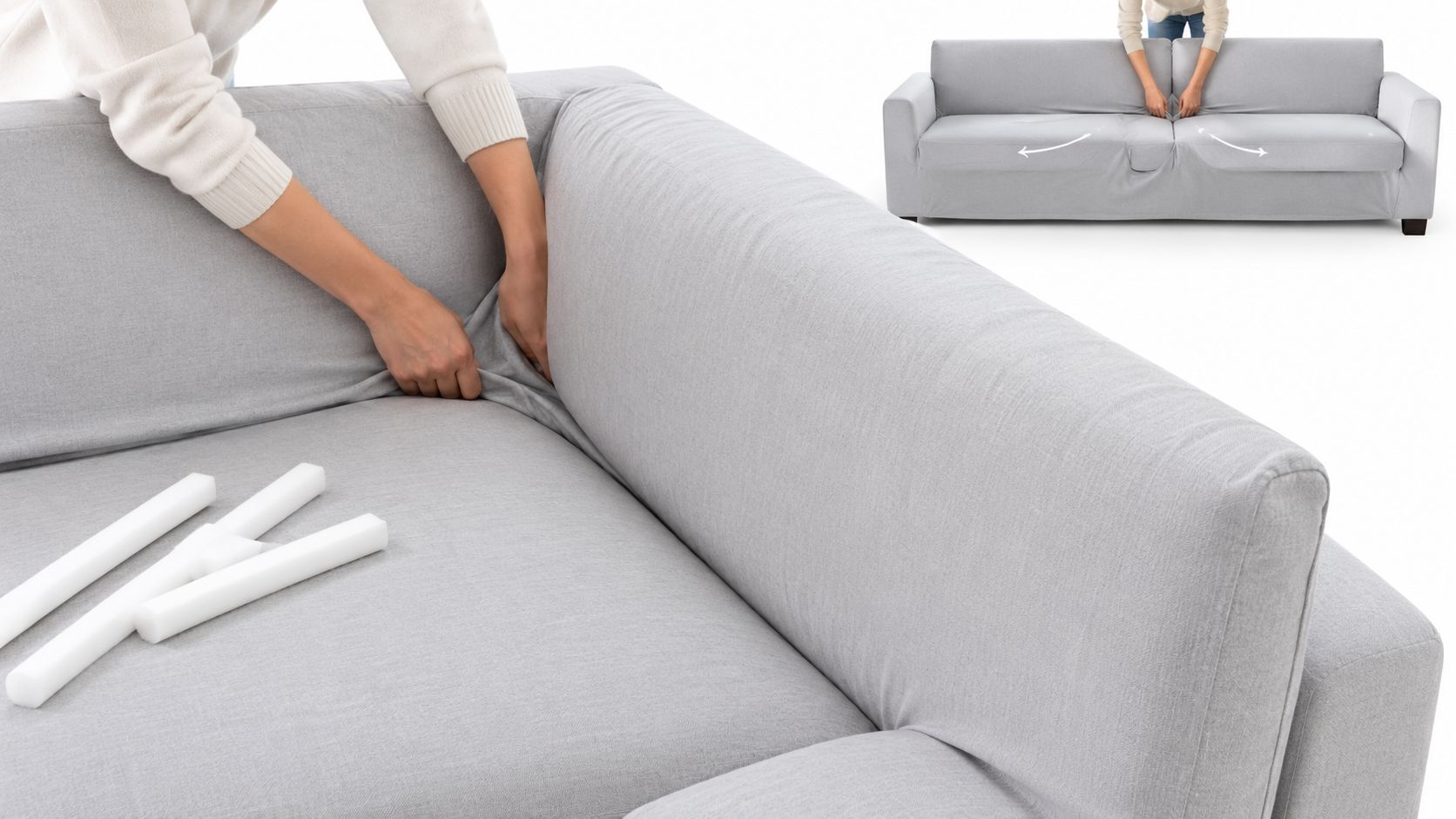
The best fitting trick is the same on both shapes. The crevice does the work, not the pulling. Fit the cover loose first, then push the spare fabric deep into the gap between seat and back so the cover is anchored from the inside.
Fitting a straight sofa cover
A straight sofa cover goes on in one piece. Start by placing the cover evenly over the frame, then seat the back and arms, then tuck the excess down into the seat-back crevice.
- Start at the centre back: Get the top line even before you worry about the seat.
- Work towards each arm: Don't drag one side tight first or the whole cover shifts off-centre.
- Tuck before you pull: Once the crevice holds the fabric, small tugs clean up the rest.
Fitting a corner sofa cover
A corner sofa cover needs a stricter order because one point on the sofa cannot be corrected later. That point is the inside corner where the two runs meet.
- Anchor the inside corner first: Seat that inner angle before anything else.
- Fit one run, then the other: Each piece should be tensioned over its own run, not across the whole L.
- Push fabric deep into the crevice: That's where Foam Rods hold the tuck, while Anti-Slip Sofa Pads help keep the cover from shifting on the seat base.
If the inside corner is wrong, every wrinkle gets pushed out along both runs.
If you want to see the general fitting sequence in more detail, our sofa cover installation instructions show the process clearly.
A quick visual helps more than any paragraph for this part:
What a good fit looks like
Check four things when you're done:
- Arms sit flush: No twisting at the front corners.
- Inner seam sits cleanly at the L junction: No bridging over the corner.
- No diagonal drag lines across the seat: Those mean the fabric is pulling from the wrong anchor point.
- Spare fabric pools evenly at the back: It shouldn't bunch at one end.
That's the practical difference most comparisons miss. The shape you choose changes not just the room, but the cover, the measuring method and the fitting order.
Choosing the Right Sofa Shape and Cover for Your Home
A normal straight sofa is the safer choice for tight UK rooms and changing layouts, while a corner sofa earns its place when the room is large enough to support the return and you want fixed seating in one zone. The right cover follows directly from that choice.
If the room is narrow, awkward, rented, likely to change, or likely to see furniture moved around, the straight sofa is usually easier to live with. If the room is open-plan, square enough, and set up around one settled seating area, the corner sofa can make sense.
Choosing shape and cover by room type
| Room scenario | Recommended shape | Why it fits | Cover implication |
|---|---|---|---|
| Narrow terrace living room | Normal straight sofa | Easier to keep a usable walkway and simpler to re-angle | One-piece straight sofa cover sized by full width |
| Flat with tighter access | Normal straight sofa | Fewer access headaches and easier future moves | One-piece straight sofa cover |
| Open-plan family room | Corner sofa | Better for zoning one seating area if circulation still works | Two-piece corner sofa cover sized by each run |
| Square lounge with one obvious corner layout | Corner sofa | Makes use of the corner and gives continuous seating | Two-piece corner sofa cover plus correct handedness |
| Rental or frequent room refresh | Normal straight sofa | Easier to replace, move or pair with other seating later | Simpler re-measuring and one-piece cover ordering |
| Long-term settled layout | Corner sofa | Works when you already know the room will stay arranged one way | Separate run measurements are essential |
The honest recommendation
If you're still torn, I'd lean straight sofa first unless the room clearly wants an L-shape. Too many corner sofas win on showroom appeal and lose on access, circulation and long-term flexibility.
For covers, the rule is even firmer:
- Straight sofa: order one cover by total width including the arms.
- Corner sofa: order the proper two-piece corner set by measuring each run separately.
- Don't mix the two: a bigger straight cover is not a substitute for a corner cover.
- Note the orientation: if the sofa has a defined return, handedness matters when you're measuring the room and planning the fit.
If you want a practical place to start with current product ranges, our Best Sellers page shows the cover families people are ordering across different shapes and fabrics.
We sell covers, not sofas, so that's where I'll stay precise. Correct centimetre measurements matter because the shape decides the product, and the product decides whether the cover sits neatly or fights you from the first pull.
If you've settled the corner sofa vs normal question and need to cover what you already own, The Sofa Cover Crafter offers straight sofa covers, corner sofa covers and fitting guides built around the actual differences between those shapes. Measure first, order the shape-specific cover second, and you'll avoid the most common mistake people make with L-shaped sofas.