



If you're searching for cushion covers 55cm x 55cm, you're probably staring at a pad, an old cover, or a faded label and wondering why this size is oddly hard to replace. Here's the straight answer: The Sofa Cover Crafter doesn't make a 55cm x 55cm cushion cover. Every cushion cover we sell is 45cm x 45cm, in 1-piece or 2-piece packs.
That matters because 55cm is a real UK cushion-cover size, equal to 22 x 22 inches, and it sits above the more common 45 x 45 cm and 50 x 50 cm squares that most British ranges are built around. It's a recognised size, but it's still awkward to shop for. Most ready-made ranges jump from smaller square cushions to larger ones, and 55cm often lands in the gap.
So this guide does three things plainly. It shows why 55cm x 55cm falls between standard UK shelf sizes, how to measure the pad you have, and how insert sizing changes the finished look. Then it tells you exactly what we do stock for shoppers who either measured wrongly or are buying fresh at 45cm x 45cm.
Table of Contents
- Why 55cm x 55cm Is the Awkward UK Cushion Size
- Why 55cm Falls Between the Standard UK Shelves
- How to Measure the Pad You Already Have
- The One-Size-Up Rule for a Plump Cushion
- How Fill Type Changes the Look of the Finished Cushion
- Fitting a Cover Without Splitting a Seam
- What We Actually Stock at 45cm x 45cm
- A Quick Pre-Order Checklist for a 55cm x 55cm Shopper
- Cushion Covers in Centimetres Versus Fitted Sofa Cushion Covers
- Frequently Asked Questions About 55cm x 55cm Covers
Why 55cm x 55cm Is the Awkward UK Cushion Size
You measure the pad, read 55cm x 55cm, then start shopping and hit the same problem many UK buyers hit. The size is real, but stock is patchy, and at The Sofa Cover Crafter we do not make it. We only stock 45cm x 45cm cushion covers in 1-piece or 2-piece packs.
That point needs saying plainly because it saves wasted orders. If your cushion pad measures 55cm x 55cm, a 45cm x 45cm cover is the wrong product full stop.
What makes 55cm x 55cm awkward is not that it is unusual or incorrect. It is that it sits in an annoying middle spot. It is larger than the everyday square sizes many UK shops carry heavily, but it is not large enough to be treated as a floor cushion size either. So you get a recognised cushion size with thinner stock, fewer fabric choices, and more made-to-order listings.
Retail language also muddies the water. Some shops group 55cm x 55cm under standard scatter cushions, others treat it as a larger decorative size, and shoppers end up guessing whether they should buy by the old cover, the pad, or the label. The pad is the measurement that matters.
That is the UK rule to keep in your head. Buy for the insert size first, then decide whether you want the cover to fit snugly or sit looser. The finished look comes from the relationship between pad and cover, not from the nominal size printed on a product page.
So treat 55cm x 55cm as a legitimate large square cushion size, but an awkward one to buy quickly from a standard ready-made range.
Why 55cm Falls Between the Standard UK Shelves
55cm falls between the shelf sizes most UK shoppers see most often, which is why fabric choice and stock depth usually get worse at that measurement.
A lot of UK shoppers run into the same problem. The obvious ready-made square sizes are usually smaller common options, then a larger jump. 55cm x 55cm sits in that middle band where shops often can't be bothered to carry every colour, texture, or closure style.
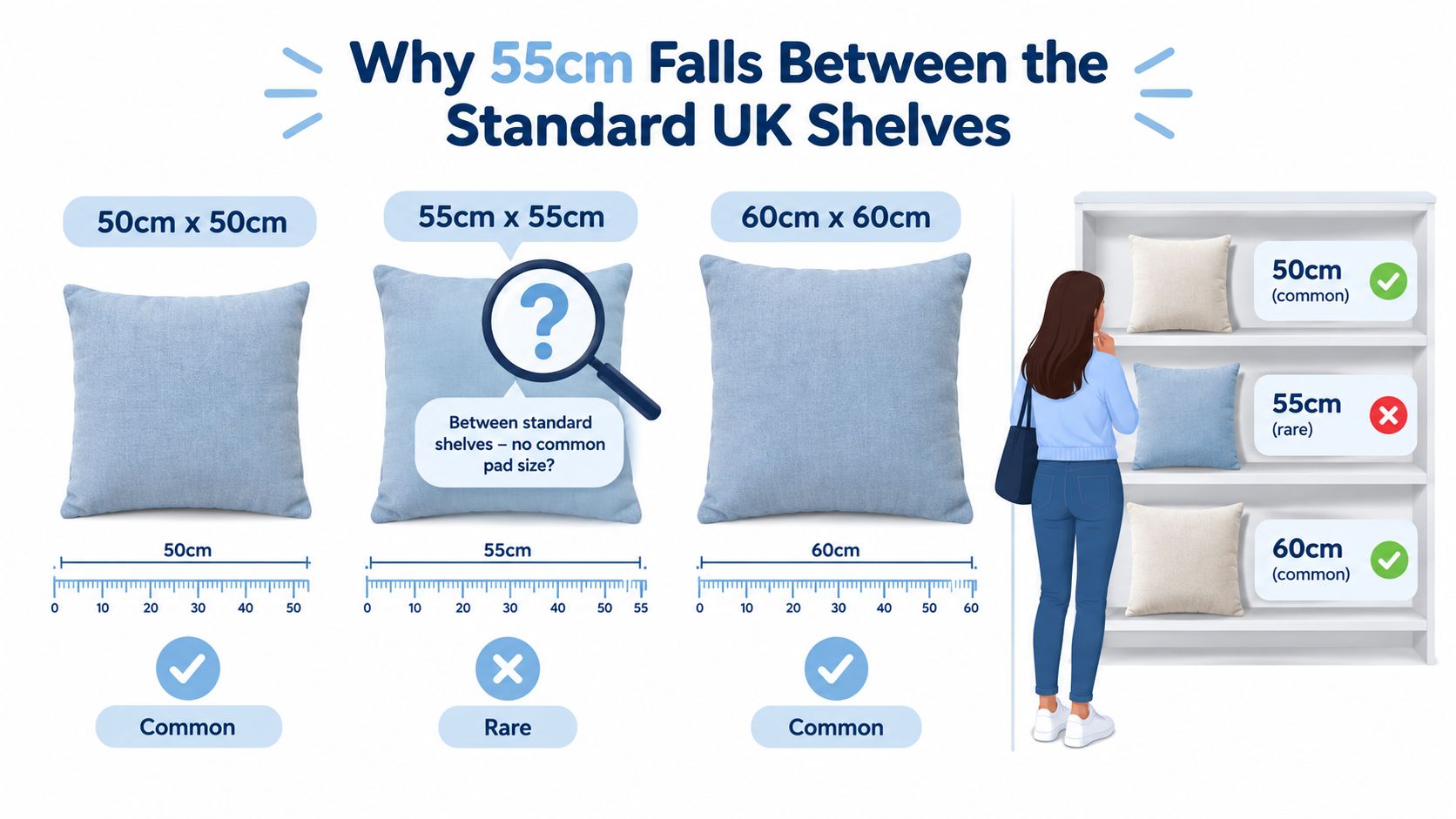
What the shelf gap means in practice
When a cushion size falls between standard stocked sizes, three things usually happen:
- Choice narrows fast. Colours, trims, and fabric families thin out first.
- Made-to-order becomes more likely. That usually means less impulse buying and more waiting.
- Bad substitutes start to look tempting. People try sizing down or forcing stretch fabrics over the wrong pad.
That last mistake is the expensive one. A 50cm cover on a 55cm pad strains. A 60cm cover on a 55cm pad slouches unless the insert is chosen properly for that larger cover size. If you're shopping for a smaller common square, use our dedicated guide to 50 x 50 cm cushion covers instead of trying to make 55cm behave like 50cm.
55cm is awkward because it's recognised, but not consistently stocked. That's worse than a rare bespoke size because shoppers assume it should be easy to find.
How to Measure the Pad You Already Have
You bought a cushion years ago, the cover has stretched, the label says one thing, and the pad inside looks like something else. Measure the pad itself and you stop guessing.
Use the pad's front width, seam to seam, as your working size. For a square pad, that means straight across the centre from one side seam to the other. Ignore the old cover label. Ignore any piping, flange, or trim on the cover. Those details confuse the measurement and send people into the wrong size.
Take the pad out first. Lay it flat without tugging the corners into shape. Then place a soft tape measure across the middle of the front face, side to side, keeping the tape straight rather than drifting on a diagonal.
Measure the insert cleanly
A square pad only gives you a useful buying size if you measure it the way cushion makers size it. Corner-to-corner is wrong for shopping. Measuring the cover is worse, because covers shrink, relax, and distort with use and washing.
If the pad reads close to 55cm x 55cm across the front, treat that as a 55cm pad. If it comes up smaller or larger, buy to that size instead of forcing it into the 55cm bracket just because the old cover claimed it.
What to write down
Keep one measurement in your notes. The pad width across the front.
That single number tells you whether you need a true 55cm x 55cm cover from a retailer that makes that size, or whether your cushion is a different standard. It also keeps you from making the common UK mistake of ordering by the old cover and then blaming the fit when the insert was the wrong reference point all along.
The One-Size-Up Rule for a Plump Cushion
A cushion cover looks properly plump when the pad is one size larger than the cover, not when the pad matches the cover exactly.
That's the rule that decides whether the corners fill out or collapse. Size the pad one step up from the cover and the corners fill out; match them exactly and the face sits slack.
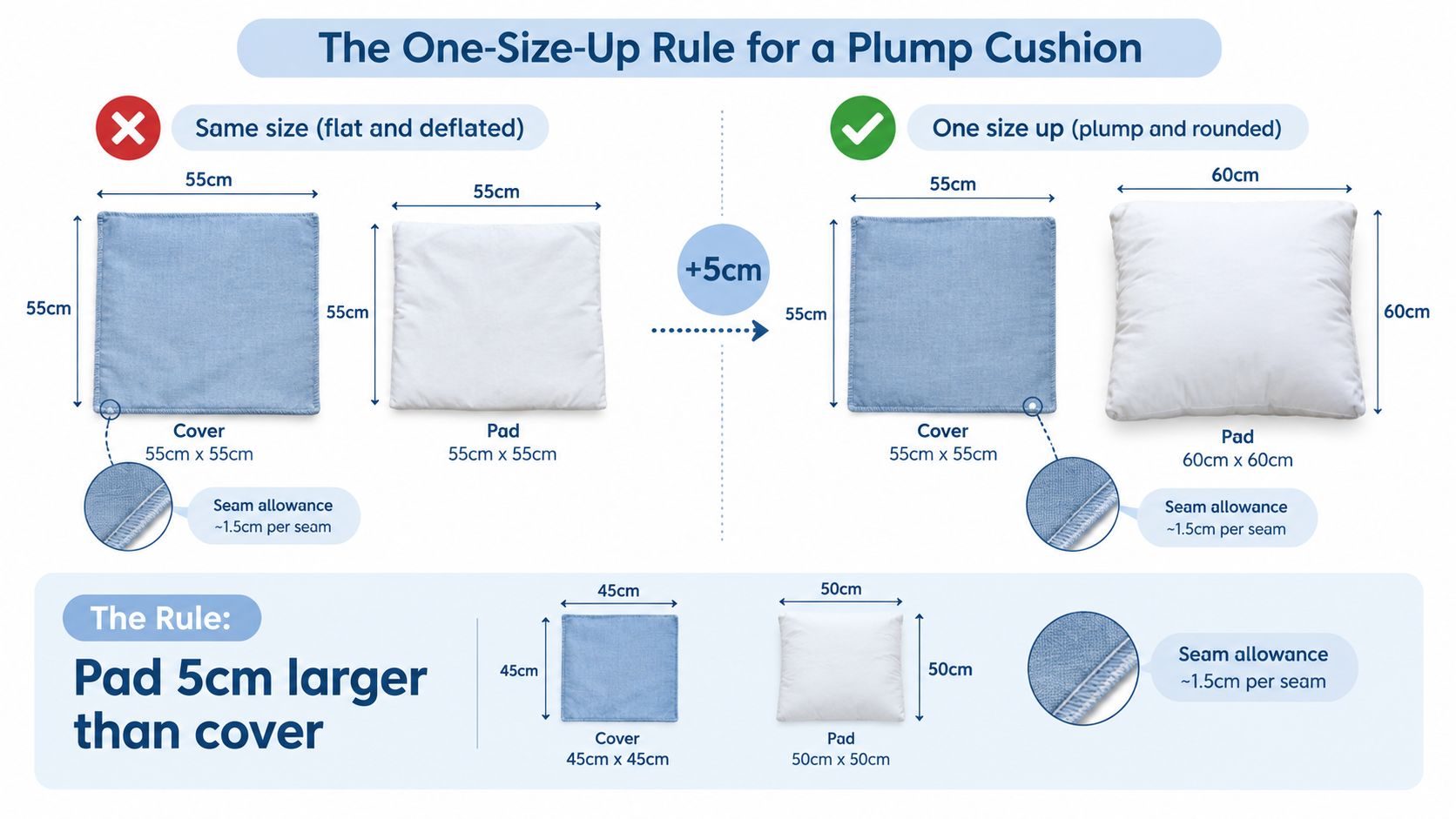
What that means for 55cm and 45cm covers
Use the rule like this:
- For a 55cm x 55cm cover: buy a 60cm x 60cm pad if you want a full, square, properly stuffed look.
- For a 55cm x 55cm cover: buy a 55cm x 55cm pad only if you want a flatter, softer, less fitted finish.
- For our 45cm x 45cm covers: buy a 50cm x 50cm pad if you want that same plump look.
The seam allowance is what causes this. Once a cover is sewn, some of the nominal size is consumed at the edges. That's why a same-size insert often leaves hollow corners and a slack face.
For the larger size end of that decision, see our guide to 60 x 60 cm cushion covers.
Here's a quick visual explanation before you buy:
How Fill Type Changes the Look of the Finished Cushion
Fill type changes the character of the cushion more than the cover fabric does once the size is correct.
After the cover-to-pad sizing is sorted, the next choice is feel. A feather or feather-down pad gives you the relaxed, dented, sink-in look that people usually associate with soft decorative cushions. It slumps where weight lands, moulds to shape, and needs regular plumping if you want it to look tidy.
A hollowfibre or foam-based pad behaves differently. It holds loft, springs back faster, and keeps the corners looking more structured. If you want a squarer profile and less daily fussing, that family usually makes more sense.
Choose the look, not a winner
This isn't a quality ranking. It's a shape decision.
- Feather and feather-down suit a softer, more lived-in cushion profile.
- Hollowfibre and foam crumb suit a springier, more upright profile.
The sizing rule doesn't change. A 60cm x 60cm pad still makes sense inside a 55cm x 55cm cover if fullness is the goal. The fill decides whether that fullness looks relaxed or firm.
Fitting a Cover Without Splitting a Seam
Fit the cushion cover by seating the pad into matching corners first, then close the zip or envelope opening only after you've pushed the filling clear of it.
That sequence prevents most fitting damage. People usually split seams or stress zips because they bunch the whole pad into the middle, then yank at the last corner.
Use the corner-through-corner method
Do it in this order:
- Turn the cover inside out enough to control the front corners.
- Push a hand into each cover corner and grip the matching pad corner through the fabric.
- Pull both corners into place together so the pad seats properly instead of folding over on itself.
- Work the remaining corners in gently rather than stuffing the centre first.
- Close the zip or envelope opening with the pad pressed away from the teeth so fabric or filling doesn't catch.
If a zip fails on a cushion cover, the usual cause isn't mystery wear. It's fabric or filling trapped in the slider during closure.
If you're trying to cover built-in sofa seat or back cushions rather than loose square scatter cushions, that's a different product family entirely. Our fitted Sofa Cushion Covers are shaped for a sofa's own seat, back and headrest cushions. They aren't square 55cm x 55cm cushion covers and shouldn't be treated as one.
Between uses
Stand loose cushions on an edge rather than leaving them flattened all the time. That helps the filling settle back into the corners instead of collecting in the middle.
What We Actually Stock at 45cm x 45cm
You measure your pad, get 55cm x 55cm, then land on a specialist called 45cm x 45cm. The first thing you need is a straight answer.
We stock only 45cm x 45cm cushion covers. We do not make or stock 50cm, 55cm or 60cm covers. We also do not sell cushion pads, inserts or fillings in any size.
That matters because 55cm is one of those awkward in-between UK sizes. It is common enough to exist, but not standard enough that every cushion specialist carries it. If you need a true 55cm x 55cm cover for a pad you already own, buy from a retailer that makes that size. If you are starting from scratch and are happy to build a new cushion around a 45cm x 45cm cover and a 50cm x 50cm pad, our range fits that brief.
Our 45cm covers fall into four useful groups.
The most structured-looking group is jacquard and woven pattern. That includes Jacquard Pillow Cover, Diamond Jacquard Pillow Cover, and Original Jacquard Pillow Cover. These suit buyers who want pattern with a firmer, more crisp face rather than a printed surface.
The broadest group is relief texture. That includes Bobble-Textured, Crosshatch, Flecked, Linear Geometric, Veloura, Luma, Crossmere, Gridelle, Braelyn, Rivelle, Avelia, and Cordelle Pillow Covers. Choose these if texture is doing the decorative work.
Then there are the plain and soft options. Classic Stretch Pillow Cover and Velvet Pillow Cover are the cleanest choices if you want a simpler square cushion with colour and fabric finish doing the job. If you want a clear example of the format we sell, Classic Stretch Pillow Cover, Dolphin Grey shows the standard 45cm square layout.
Last, the practical and printed end of the range. Pebble-Textured Waterproof Pillow Cover, Waterproof Pillow Cover, and Bubble Gauze cover the more functional side. Printed Pillow Cover designs include Blossom, Tropical, Vintage, Azrose, Automne, Printemps, Folige, Geo Chic, Zenmaze, Lunexa, Esagonali and others.
We have no 55cm × 55cm range. Every cushion cover we make is 45cm × 45cm. We keep no wash-durability record, so we will not rank the textures. Structurally, jacquard and textured cloths have the design woven into the fabric, while printed designs sit on the face where washing, rubbing and sunlight act.
Here is the useful distinction:
| Texture family | Surface finish | Look on a 50cm pad |
|---|---|---|
| Woven-in pattern | Pattern built into the weave | Squarer and more defined |
| Relief texture | Raised or tactile surface | Textured face with visible depth |
| Plain and soft | Smooth or plush finish | Cleaner silhouette, softer visual feel |
| Wipeable and printed | Practical finish or face print | More about surface pattern than bulk |
If you are a 55cm x 55cm shopper, the key point is simple. Our store is relevant only if you are switching to a new 45cm x 45cm cushion setup. It is not the right shop for replacing a genuine 55cm cover like for like.
If you want a shorter route through the current range, the Best Sellers collection is the quickest starting point.
A Quick Pre-Order Checklist for a 55cm x 55cm Shopper
Use this checklist before you order any 55cm x 55cm cover elsewhere or switch down to a 45cm x 45cm setup.
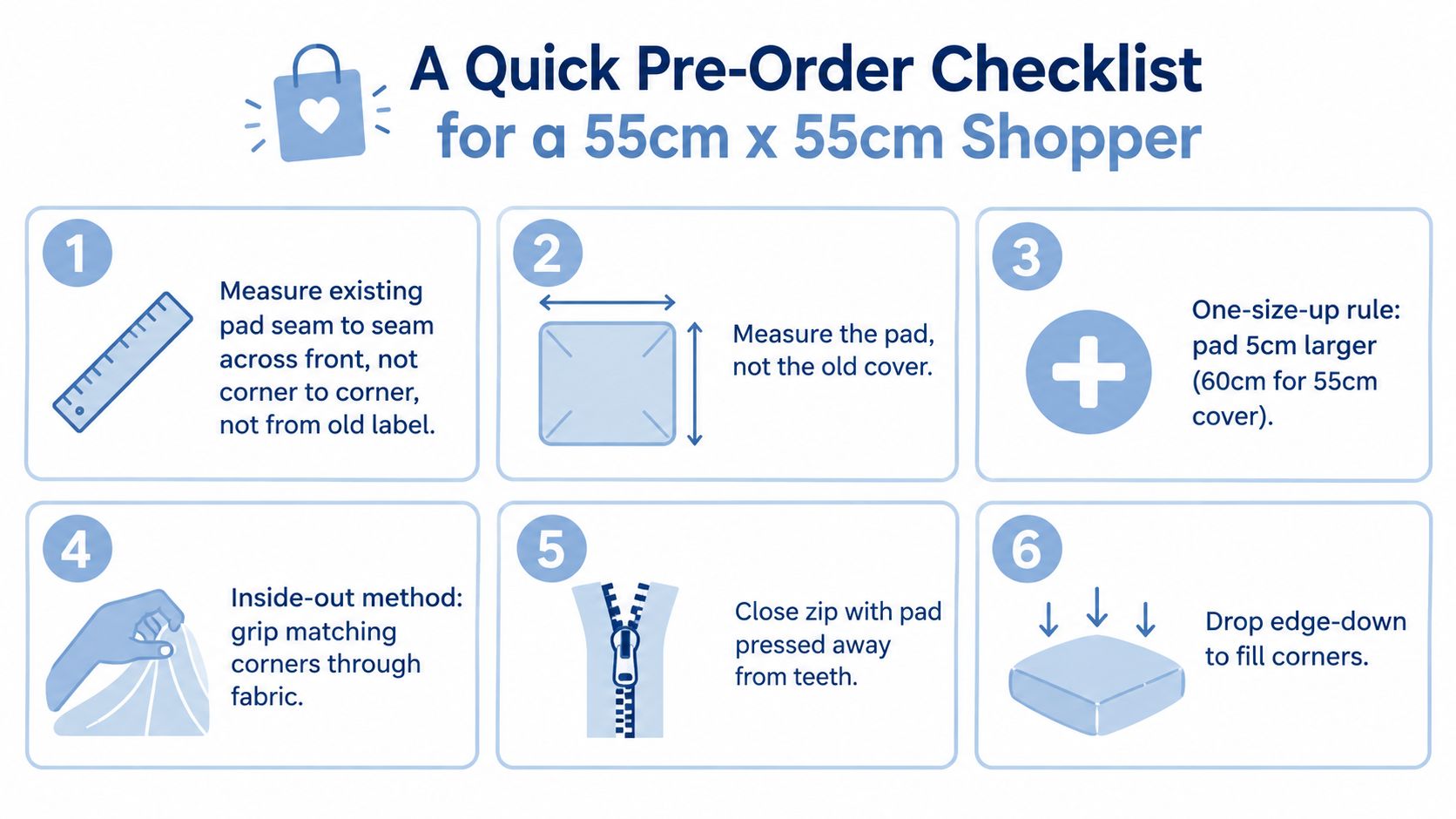
- Measure the pad seam to seam across the front through the centre.
- Ignore corner-to-corner measuring because it gives the wrong buying size.
- Ignore the old cover label if the pad and cover may have been mixed or stretched.
- Match the insert to the cover look you want. For a plump 55cm x 55cm cover, that usually means a 60cm x 60cm pad.
- Choose fill by behaviour. Feather gives a softer dented look. Hollowfibre and foam-based fills sit springier.
- Check the closure style before ordering, especially if you care about easy fitting.
- Decide whether you need a true 55cm cover or whether you're buying a fresh 45cm cushion setup instead.
- Don't force a 45cm cover over a 55cm pad. That isn't a clever shortcut. It's the wrong size.
Cushion Covers in Centimetres Versus Fitted Sofa Cushion Covers
Square cushion covers measured in centimetres are not the same product as fitted Sofa Cushion Covers shaped for built-in sofa cushions.
This confusion wastes more time than the sizing itself. A 45cm x 45cm or 55cm x 55cm cushion cover refers to a loose square decorative cushion cover. A fitted sofa cushion cover refers to the sewn cover for a sofa's own seat, back, headrest, or chaise cushion.
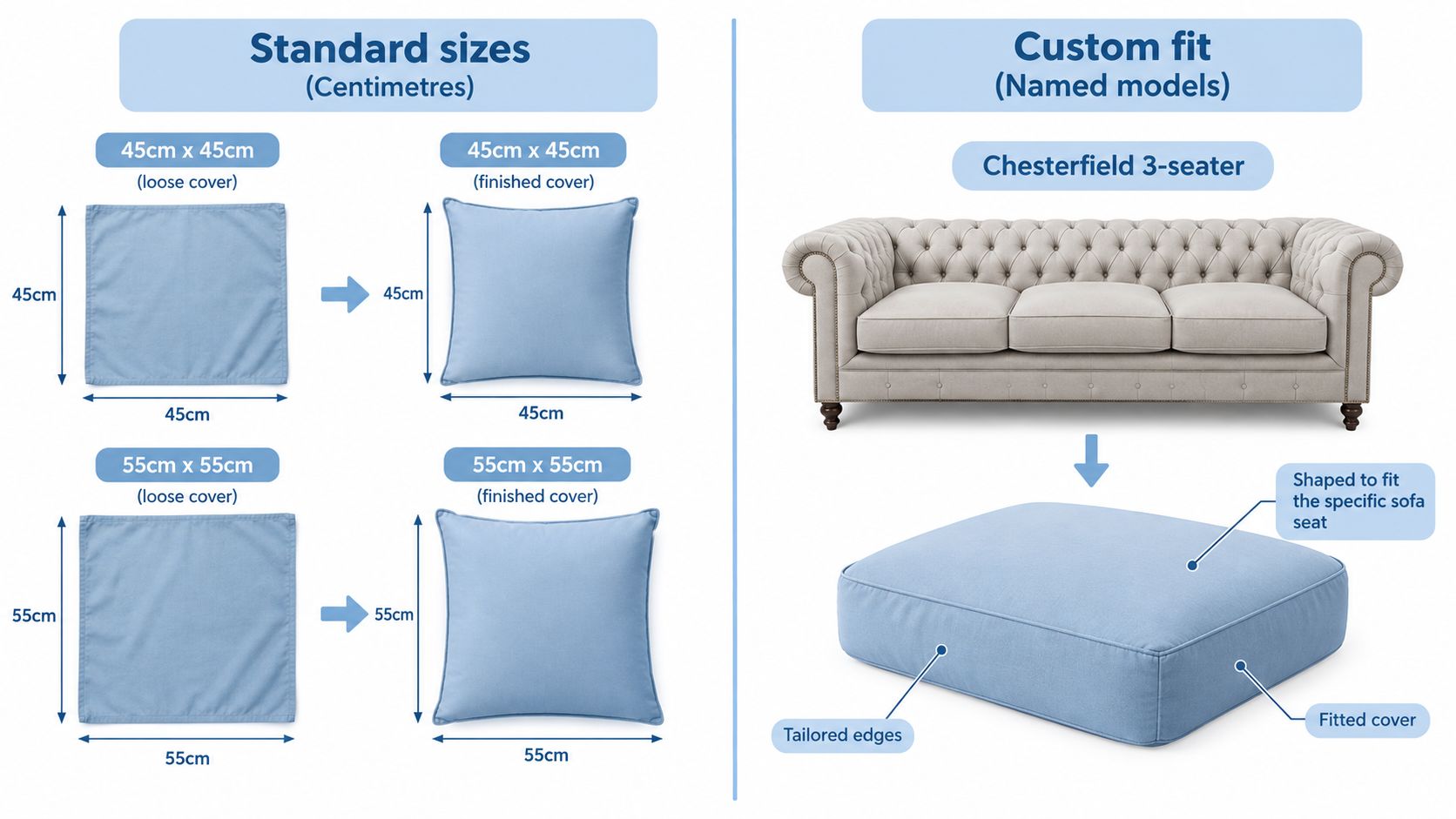
They solve different problems
Our fitted Sofa Cushion Covers are sold in named size bands such as Standard S/M/L/XL, Deep S/M/L, Backrest S/M, Headrest S/L, and Chaise Narrow/Wide, priced from £12.90 to £33.90. Those covers are for a sofa's own fixed-use cushions. They are not sold as square centimetre cushion covers, and they are not an answer to a loose 55cm x 55cm scatter cushion.
If that's the product you need, use the separate Sofa Cushion Covers collection. If you need a loose square cushion cover, stay in the pillow-cover category and ignore the sofa-cushion sizing codes.
Frequently Asked Questions About 55cm x 55cm Covers
What insert size should I buy for a 55cm x 55cm cushion cover
A 55cm x 55cm cushion cover usually looks best with a 60cm x 60cm insert. That follows common UK fit guidance that the insert should be larger than the cover for a fuller finish. A same-size insert will usually look flatter and leave the corners softer.
Will a 45cm x 45cm cushion cover fit a 55cm pad
No, a 45cm x 45cm cushion cover will not fit a 55cm pad properly. A 45cm × 45cm cover on a 55cm × 55cm pad is a strained, flattened fit, not a substitute. If your pad really measures for a 55cm cover, buy a proper 55cm cover elsewhere.
Are 55cm cushions the same as 22 inch cushions
Yes, 55cm x 55cm is equal to 22 x 22 inches. That conversion is standard for this cushion size in UK soft furnishings, and it's one reason some listings switch between metric and imperial descriptions.
Does cushion sizing follow the cover or the pad
Retail cushion sizing usually refers to the cover size first, then the insert is chosen to suit the look. That's why a 55cm cover can still pair with a 60cm insert, and why our 45cm covers pair best with a 50cm pad if you want a plumper result.
If you came here looking for cushion covers 55cm x 55cm, the honest answer is that we don't make them. What The Sofa Cover Crafter does offer is a focused range of 45cm x 45cm pillow covers in 1-piece and 2-piece packs, plus fitted sofa cushion covers for built-in seat and back cushions. If your measuring shows you're working with 45cm pads, or you're buying fresh and want a ready-made option, that's the range to browse.