



Standard UK sofa beds range from compact chair beds to full 3-seater and corner models, but the number that matters most is not just the headline width. You need to know the sofa’s size when closed, its sleeping surface when opened, and the total floor space it consumes once extended. In smaller UK homes, that difference is often what decides whether a model is practical or frustrating.
Key Takeaways Sofa Bed Sizes
- Measure open, not just closed: Check closed size, sleeping width and full open length.
- Leave room to unfold: Allow for the extended footprint and clear walkways.
- Try the masking tape test: Mark the open size on the floor before you buy.
Table of Contents
- Key Takeaways Sofa Bed Sizes
- Why Sofa Bed Sizes Matter
- Key Considerations Before You Buy
- How We Put This Sofa Bed Size Guide Together
- Understanding Sofa Bed Length: Closed vs Open
- Typical UK Sofa Bed Dimensions
- Typical UK Sofa Bed Dimensions at a Glance
- How to Measure Your Sofa Bed Accurately
- Key Dimensions to Record
- Tips for Different Sofa Bed Types
- How Different Sofa Bed Styles Affect Length
- The Predictable Click-Clack Sofa Bed
- The Expansive Pull-Out Sofa Bed
- The Versatile Corner Sofa Bed
- Standard UK Sofa Bed Size Charts
- Detailed UK Sofa Bed Size and Dimension Chart
- What the UK Size Labels Usually Mean
- How Much Floor Space to Leave When Open
- Chair and Loveseat Sofa Bed Dimensions
- Standard 2 and 3 Seater Sofa Bed Dimensions
- Large and Corner Sofa Bed Dimensions
- Cross-Referencing Your Dimensions with Our Covers
- How Our Fabric and Design Ensure a Great Fit
- Making Covers Work for You
- Solving Common and Unusual Sizing Challenges
- Tackling Wide or Uniquely Shaped Arms
- Fitting Sofa Beds with High Backs
- Measuring Models with an Attached Chaise
- The Ultimate Trick: The Masking Tape Test
- Before You Buy: Sizing Checklist, Care and Returns
- Frequently Asked Questions
- What is the standard size of a sofa bed?
- What is the size of a standard sofa in the UK?
- How much space do you need for a sofa bed?
- What is the average size of a 2 seater sofa bed?
- Why do two sofa beds with the same seat count measure differently?
- Which measurement matters most for a sofa bed cover?
- How Much Space Should I Leave Behind a Sofa Bed?
- Will a Standard Double Bedding Set Fit My 3-Seater Sofa Bed?
- What Is the Best Sofa Bed Length for an Airbnb Property?
Why Sofa Bed Sizes Matter
Choosing the right sofa bed is really a room-planning exercise, not just a style choice. In the UK, that matters more than ever because homes are often expected to do double duty: living room by day, guest room by night. Which? reflects this by listing sofa bed dimensions in both closed and open positions, with examples such as a single chair-sofa at about 75 x 80 cm closed and 180 x 80 cm open, and a small double/two-seater at about 80 x 160 cm closed and 220 x 160 cm open in its sofa bed buying guide.
I’d treat that closed-vs-open difference as the first filter, because it catches the mistake buyers make most often: measuring the wall, but not the room once the bed is pulled out. If a sofa bed is going into a flat, office, or box room, the open footprint usually matters more than the showroom look.
Key Considerations Before You Buy
Before you compare models, decide what job the sofa bed needs to do most of the time.
-
Primary use: An occasional guest bed can prioritise compact seating. A sofa bed used weekly should give more weight to mattress width, sleeping length, and ease of opening.
-
Available space: Measure the parked position and the fully opened footprint. Also check turning space, bedside clearance, and the route in through doors, stairs, and hallways.
-
Sleeper count: One adult can use a well-sized single or chair bed; two adults normally need at least a small double sleeping surface, and often a full double if comfort matters.
For broader buying context beyond measurements, this ultimate guide to choosing the perfect sofa bed covers mechanism and comfort considerations well, and Good Housekeeping’s roundup of the best sofa beds is also useful for seeing how different designs compare in real-world use.
It’s also worth comparing your notes with standard dimensions for a couch, because a sofa bed still has to function as everyday seating even before you think about the bed mechanism.
How We Put This Sofa Bed Size Guide Together
Key measurements UK shoppers need to compare include overall width, closed depth, back height, sleeping width, and total open length. Recurring UK retail categories include chair bed, loveseat, 2-seater, 3-seater, and corner sofa bed; these were cross-checked against published buying guidance from Which? and standard UK mattress norms from retailers including Bensons for Beds and Dreams.
For this article, “standard” means dimensions that sit within the common retail bands you will repeatedly see across mainstream UK sellers, not one brand’s custom proportions. Models were treated as outliers if they were unusually shallow, oversized in arm width, or used a sleeping surface that did not line up with familiar UK single, small double, or double mattress widths. In practice, that is why width ranges are given as bands rather than pretending every 2-seater or 3-seater sofa bed is identical.
One editorial note from me: I put more weight on sleeping width and fully extended length than on marketing labels. A product called a “compact double” can still feel narrow in use, while a plain-looking 2-seater sometimes opens to a much more usable bed than its name suggests.
Understanding Sofa Bed Length: Closed vs Open
Think of it like a butterfly. In its 'closed' state, it's a compact sofa, neat and contained. But when it's time to 'open' it up for a guest, it unfurls its wings, taking up a surprising amount of floor space. To make sure it works perfectly in your home, you have to plan for both of its personalities.
This dual-measurement approach is absolutely vital, especially in modern UK homes where every square centimetre is precious.
The closed measurement is simply the total width of the sofa, from the outer edge of one armrest straight across to the other. This is the number you need to:
- Find the perfect spot for it along a wall or in an alcove.
- Make sure it won’t crowd your living room or block a walkway.
- Buy a sofa cover that fits snugly, without any sagging.
The open measurement, on the other hand, is its full length when it’s transformed into a bed. You measure from the very back of the sofa frame to the foot of the fully extended mattress. This figure is crucial for making sure there's enough room to walk around it comfortably.
Typical UK Sofa Bed Dimensions
As more of us look for furniture that works harder, some standard sizes have started to emerge.
A popular 2-seater sofa bed, for instance, is usually around 160-190 cm wide as a sofa, but unfolds to a sleeping length of about 190 cm. Larger 3-seater models often measure 200-230 cm when closed, opening up to a length of 190-200 cm to match a standard double bed.
A sofa bed's success isn't just about how it looks, but how it functions in its two states. Measuring for both the sofa and the bed prevents the all-too-common problem of buying furniture that fits the space but not the purpose.
To make things a bit easier, I've put together a quick reference table. This gives you a good idea of what to expect when you're shopping around.
Typical UK Sofa Bed Dimensions at a Glance
| Sofa Bed Type | Typical Sofa Length (Closed) | Typical Bed Length (Open) |
|---|---|---|
| Chair Bed | 90 - 120 cm | 190 cm |
| 2-Seater (Small Double) | 160 - 190 cm | 190 cm |
| 3-Seater (Double) | 200 - 230 cm | 190 - 200 cm |
This table neatly summarises the key dimensions, showing you just how much extra space you'll need to account for when that sofa transforms into a comfortable bed for the night.
How to Measure Your Sofa Bed Accurately
Getting the perfect fit for a new cover, or just making sure the new sofa bed will fit in your room, starts with one thing: accurate measurements. Don’t worry, it’s a straightforward job that only needs a tape measure and a few minutes of your time. Breaking it down into simple steps is the best way to avoid common mistakes and guarantee a great result.
The goal is to capture the core dimensions of your sofa bed in both its forms, as a sofa and as a bed. This dual measurement matters because you need to account for its footprint when it's closed for daily use and when it's fully extended for your guests. Getting either one wrong can lead to a cramped room or a cover that does not fit.

This quick visual guide shows the typical journey from a compact chair bed right up to a larger 3-seater sofa bed.
As you can see, each size serves a different purpose, scaling up in width and sleeping capacity to suit different homes and needs.
Key Dimensions to Record
If you want a sofa bed measurement that is useful, record it in three stages: closed, open, and access route. That gives you the numbers needed for room planning, sleeping comfort, and delivery.
Closed measurements tell you how the sofa works day to day:
- Width: Measure arm to arm at the widest outer points. This is the easiest way to compare one model against another and the key number for cover sizing.
- Depth: Measure from the very front edge to the very back of the sofa when it is upright. This tells you how far it projects into the room before it is unfolded.
- Height: Measure floor to the highest point of the back. This matters near windowsills, radiators, shelving, and low ceilings on stair turns.
- Seat depth: Measure from the front edge of the seat cushion to the back cushion or frame. It is a comfort measurement, but I also use it as a warning sign: very shallow seat depth can make a sofa feel perch-like even if the total width looks generous.
Open measurements tell you how big the bed really is:
- Sleeping width: Measure the usable mattress or flat sleeping surface across. This is what determines whether it functions more like a single, small double, or double.
- Fully extended length: Open the bed completely and measure from the rearmost fixed point of the frame to the furthest end of the mattress or platform.
- Open-bed footprint: Record the full floor area occupied once open, including any protruding frame, support legs, or tilting back sections.
Access measurements stop delivery-day surprises:
- Doorway width and height: Check the narrowest usable opening, not just the front door on paper.
- Hallway and stair width: Measure the tightest turn, landing, and banister pinch point.
- Lift or stairwell clearance: In flats, the route up can be harder than the room itself.
A quick conversion note helps if one retailer lists inches and another uses centimetres. Since 1 inch = 2.54 cm, a sleeping area of 36 x 75 inches works out to about 91 x 191 cm. Another common comparison: 48 x 75 inches is roughly 122 x 191 cm, which is close to a UK small double width.
My own rule is simple: write every number down in cm first, then note the inch equivalent only if you need to compare with imported specs. Mixing units is where people accidentally lose 10-15 cm and end up with a bed that technically fits the wall but blocks the room.
For an even more detailed walkthrough, you can also have a look at our guide on how to measure your sofa for a cover, which has extra tips on different arm styles and cushion shapes.
Tips for Different Sofa Bed Types
Not all sofa beds are created equal, and their mechanisms can change how you need to measure them.
- Pull-out models: Measure the sofa frame and the sleeping platform separately. The sofa width tells you how it sits in the room; the mattress width tells you whether an adult can sleep comfortably.
- Click-clack models: Measure the full flat sleeping plane once the back drops. On these, the bed length often comes from combining seat depth and back height rather than pulling out a hidden mattress.
- Futons: Prioritise the flat mattress dimensions over the visible frame, especially if the frame overhang makes the unit look larger than the actual sleeping surface.
Taking these few extra minutes to measure carefully eliminates the risk of ordering the wrong size cover or buying a sofa bed that completely overwhelms your space. A little bit of precision now saves a lot of time, money, and hassle later on.
How Different Sofa Bed Styles Affect Length

Not all sofa beds are created equal. The way your sofa transforms from a comfy seat into a place to sleep makes a massive difference to how much space it actually takes up when fully open. Getting your head around the mechanism is the key to picking a style that genuinely fits your room, rather than one you have to squeeze past.
In the UK, you’ll mostly come across three main types: the ‘Click-Clack’, the classic ‘Pull-Out’, and the versatile ‘Corner’ sofa bed. Each one works differently, and that has a huge impact on the final footprint in your living space.
The Predictable Click-Clack Sofa Bed
The click-clack is often the simplest and most brilliantly space-savvy option out there. Its name literally comes from the sound the hinge makes as you push the backrest down until it clicks into place, level with the seat, forming a flat sleeping surface.
The real beauty of this design is how predictable it is. The open sleeping length is almost identical to the sofa's total width—that’s the measurement from the outside of one armrest to the other. This makes it a fantastic choice for tighter spots, like narrow rooms or alcoves, where you just don’t have the floor space for a bed that extends forwards.
A click-clack sofa bed basically unfolds within its own footprint. If the sofa fits against your wall when it's closed, the bed will fit in the room when it's open. It’s a reliable, no-surprises choice for compact living.
Just remember you’ll need to leave a little breathing room behind it, usually around 15-20cm, so the backrest has space to recline fully without scraping your wall.
The Expansive Pull-Out Sofa Bed
When most people picture a sofa bed, this is the one they think of. The classic pull-out design cleverly hides a folded metal frame and mattress just beneath the seat cushions. To get it ready for bed, you simply lift off the cushions and pull the frame outwards and upwards, unfolding it section by section.
This style creates the biggest difference between its closed and open length. A standard 3-seater pull-out sofa might be 200cm wide but can easily extend over 210cm out into the room once the bed is fully unfurled. That’s because the mattress unfolds forwards, away from the sofa base. They often provide a more traditional bed-like experience with their separate mattress, but you absolutely must account for that significant forward extension when measuring.
Thankfully, their comfort has improved massively over the years. Many now come with seriously good mattresses, and you can even find out more about these modern options in our guide on memory foam sofa beds.
The Versatile Corner Sofa Bed
Corner sofa beds, sometimes called chaise sofa beds, really do give you the best of both worlds: plenty of seating for everyone and a generous sleeping area when you need it. They generally use one of two clever mechanisms.
- Drawer-Style Pull-Out: A section tucked under the main seating pulls out smoothly like a drawer, rising up to sit flush with the chaise. This creates a large, squarish sleeping surface. Here, the open length is determined by the sofa’s depth, not its width.
- Fold-Out Mattress: This works just like a standard pull-out, where a mattress is stored inside the main sofa section and unfolds out into the open floor space.
One of the biggest perks is the hidden storage you often find inside the chaise lounge—the perfect spot for stashing away duvets and pillows. Just be aware that when you’re measuring for a corner model, you need to think about its total width, its depth (including the chaise), and the full dimensions of the bed once it's open.
Standard UK Sofa Bed Size Charts
Direct answer: In the UK, standard sofa bed sizes usually fall into these bands: a chair bed is roughly 80-100 cm wide as a seat and opens to a single sleeping surface; a 2-seater sofa bed is often around 145-185 cm wide and opens to a small double or compact double sleeping width; a 3-seater sofa bed is typically about 190-230 cm wide and usually opens to a double bed width. These are ranges rather than fixed rules, because arm shape and mechanism can add noticeable variation.
That variation is one reason modern size guides separate sofa dimensions from sleeping dimensions. It reflects how people use these pieces in compact homes. Market commentary also points the same way: the sofa bed category is being shaped by smaller living spaces and multi-use rooms, with the market overview cited by HomeDone noting continued demand driven by dual-function furniture.
Detailed UK Sofa Bed Size and Dimension Chart
The chart below gives the ranges you are most likely to see across UK retailers. Sleeping-surface sizes are the practical part: they tell you what the guest is sleeping on, not just how wide the sofa looks in the room.
| Sofa Bed Type | Typical Sofa Width (cm) | Typical Sofa Depth Closed (cm) | Typical Sleeping Surface (cm) | Approx. Inches for Sleeping Surface | Typical Use |
|---|---|---|---|---|---|
| Chair Bed | 80-100 | 80-95 | 75-90 x 180-190 | 30-35 x 71-75 in | 1 child or 1 adult for occasional use |
| Loveseat Bed | 120-150 | 85-100 | 100-115 x 180-190 | 39-45 x 71-75 in | 1 adult, occasional 2-person pinch use |
| 2-Seater Sofa Bed | 145-185 | 85-100 | 115-130 x 180-190 | 45-51 x 71-75 in | 1 adult comfortably, 2 adults if small double suits |
| 3-Seater Sofa Bed | 190-230 | 90-105 | 135-145 x 185-195 | 53-57 x 73-77 in | 2 adults |
| Corner Sofa Bed | 220-300+ | 90-160 chaise depth | 140-160 x 190-200+ | 55-63 x 75-79 in | 2 adults, family guest use |
For mattress-width context, common UK bed sizes are widely listed as single 90 x 190 cm, small double 120 x 190 cm, and double 135 x 190 cm by guides such as Bensons for Beds' mattress size chart and Dreams' UK bed size guide. That is why many 2-seater sofa beds cluster around the 120 cm sleeping width mark, while 3-seaters usually aim closer to 135 cm or above.
| Sofa Bed Size | Seating Capacity | Typical Width Range (cm) | Typical Depth Range (cm) | Typical Sleeping Area (cm) |
|---|---|---|---|---|
| Chair Bed | 1 Person | 85 - 140 | 85 - 100 | 80 x 190 (Single) |
| Loveseat Bed | 1-2 People | 120 - 170 | 90 - 100 | 115 x 190 (Small Double) |
| 2-Seater Bed | 2 People | 160 - 195 | 90 - 105 | 120 x 190 (Small Double) |
| 3-Seater Bed | 2-3 People | 195 - 230 | 90 - 105 | 140 x 190 (Standard Double) |
| Corner Bed | 3-5+ People | 220 - 300+ | 90 - 160 (Chaise) | 140 x 200+ (Double/King) |
What the UK Size Labels Usually Mean
In most listings, single, small double, double, and king describe the sleeping surface the retailer wants you to compare it to — not a guarantee that the sofa bed uses a standard loose mattress of exactly that size.
-
Single: Usually around 80-90 cm wide and aimed at one sleeper.
-
Small double: Often close to 120 cm wide, especially on compact 2-seater sofa beds.
-
Double: Usually around 135-140 cm wide in sleeping space, common on larger 2-seater and 3-seater models.
-
King: Often around 150 cm wide and more likely on bigger 3-seater or corner designs.
That causes confusion. A retailer may advertise a sofa bed as a double because it suits two adults, even if the usable surface is slightly narrower than a standard UK double mattress. In my experience, the safest comparison is always the sleeping width x sleeping length shown in the specs, not the product name.
How Much Floor Space to Leave When Open
A sofa bed needs room not only for the frame, but for people to move around it without feeling boxed in. As a practical planning rule, leave enough extra floor area to walk past the foot of the bed and to get in and out from at least one side.
- Chair bed: Usually works with roughly 180-190 cm open length plus at least 45-60 cm of movement space at the foot.
- 2-seater sofa bed: A realistic allowance is about 210-220 cm total open depth once frame and clearance are counted, plus around 45-60 cm to walk past the foot if the room permits.
- 3-seater sofa bed: Plan for around 220-235 cm open depth, and ideally 60 cm clearance beyond the foot or along one side so it does not feel wedged into the room.
I’d be especially careful with 2-seaters because they are the size people buy most confidently and misjudge most often. On paper they sound compact; in a real room, the unfolded length can eat the same walkway you use every day.
Chair and Loveseat Sofa Bed Dimensions
The smallest and most versatile options are the chair beds and loveseats (sometimes called 1.5-seaters). These are useful in studies, box rooms, and spaces where a full-width sofa would dominate the wall.
A chair bed usually opens to a single sleeping surface and is best treated as an occasional adult guest solution rather than an every-weekend bed. A loveseat gives you a little more sitting comfort and often a wider sleep surface, but it is still usually more comfortable for one adult than two. If you want a second opinion on how standard sofa categories scale before you compare bed mechanisms, Room Sketch 3D's guide is a handy visual reference for sofa proportions.
Standard 2 and 3 Seater Sofa Bed Dimensions
The 2-seater and 3-seater models are, by a long shot, the most popular choices for UK homes. They offer a great balance between everyday seating comfort and a decent-sized sleeping area for guests.
A typical 2-seater sofa bed is around 145-185 cm wide when closed, with a sleeping width of about 115-130 cm. That usually puts it in small-double territory. If someone asks for the average 2-seater size in plain English, this is the practical answer: expect a sofa around 160-175 cm wide, opening to a bed around 120 cm wide.
A 3-seater sofa bed is usually around 190-230 cm wide and opens to a sleeping width near 135-145 cm, which is much closer to a standard UK double. That extra sleeping width matters more than the extra sofa width when two adults use it.
Key Takeaway: Always, always measure the fully extended length of a sofa bed, not just its dimensions as a sofa. A 3-seater that's 220 cm wide might unfold to a total length of 235 cm, which can eat up a surprising amount of floor space.
Large and Corner Sofa Bed Dimensions
For those with bigger families or more generous rooms to fill, corner sofa beds and king-size models provide the absolute maximum in both seating and sleeping space. They’re proper statement pieces that can really anchor a living area.
Corner sofa beds are particularly good at making the most of a room's layout and often come with built-in storage, which is a massive bonus for keeping clutter at bay. Their sleeping areas can vary; some are formed by pulling out a trundle section that pops up to meet the height of the chaise cushion. By using these charts, you can confidently compare different models and find the perfect one, and our detailed Sofa Cover Crafter size guide at The Sofa Cover Crafter can then help you match those dimensions to the right cover.
Right, you've got your tape measure out and jotted down the dimensions of your sofa bed. What next? The most useful next step is to decide whether the sofa bed fits the room safely when open, then whether it lines up with the right cover size once closed.
Cross-Referencing Your Dimensions with Our Covers
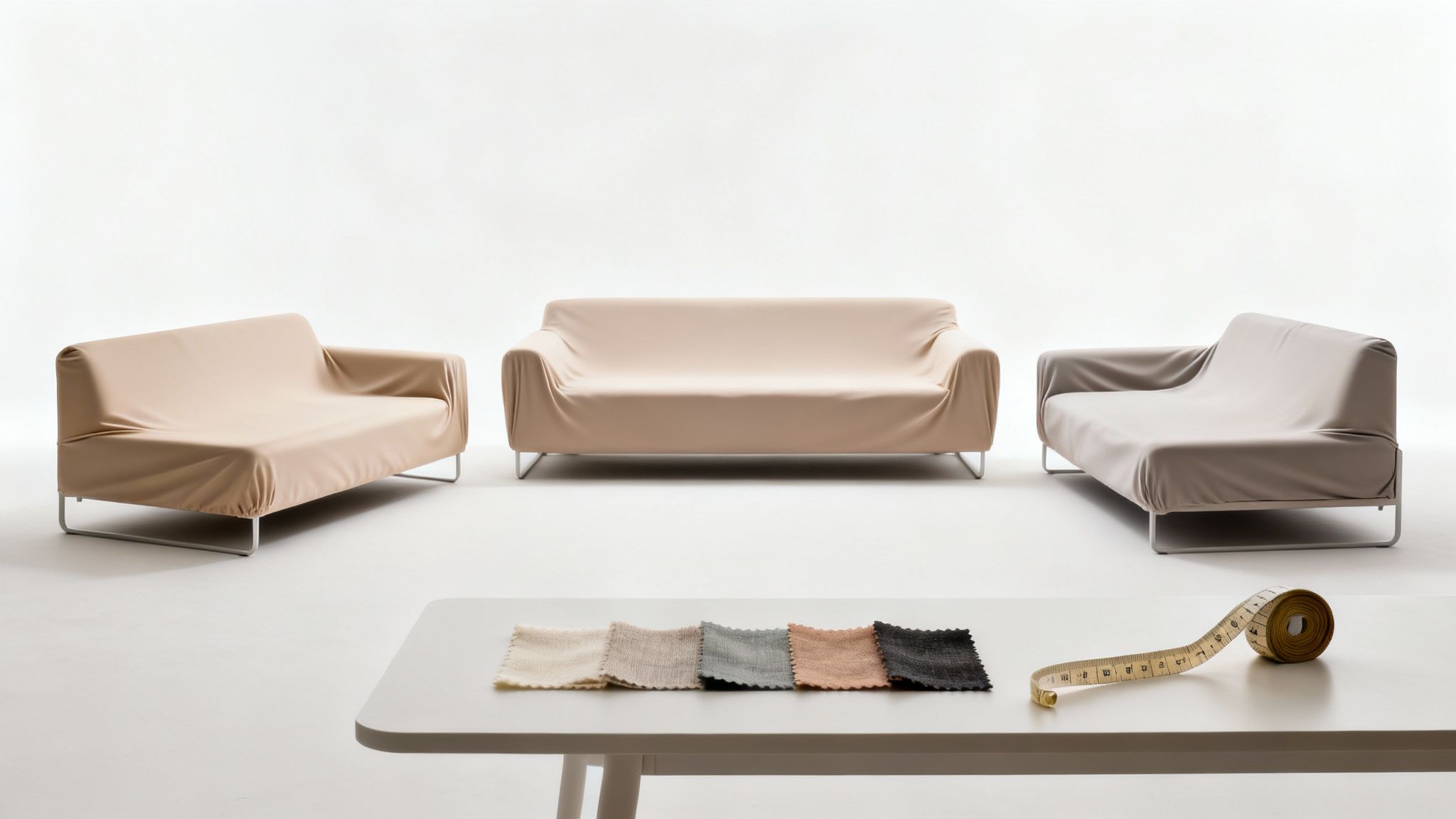
Start with the closed width of the sofa for cover selection, then sense-check that against the open-bed footprint for room planning. That order matters: cover fit is based mainly on the upright sofa, while buying decisions should be based on what happens when the bed is unfolded.
Here’s the practical match-up for our covers:
- Chair bed, roughly 85-140 cm wide: usually maps best to our 1-Seater (Armchair) cover.
- Loveseat or compact 2-seater, roughly 145-185 cm wide: usually suits our 2-Seater cover.
- 3-seater, roughly 190-230 cm wide: generally fits our 3-Seater cover.
- Large 3-seater or corner unit, roughly 235-300 cm wide: typically needs our 4-Seater size or a sectional solution.
The more useful question, though, is whether the numbers work in your room. Here is a realistic planning example for a 165 x 210 cm guest room:
- An adult-friendly single around 90 x 190 cm is feasible, but once you add circulation space, the room will feel tight rather than flexible.
- A small double around 120 x 190 cm technically fits on the floor plan, but with only 165 cm room width, that leaves about 45 cm across the narrow side before you account for skirting, radiator projection, or bed frame bulk. That is usable, but cramped.
- A compact 2-seater sofa bed can work only if its open footprint stays close to that small-double sleeping width and you are comfortable with limited clearance at the foot. In many cases, this is the largest realistic option.
- A full 3-seater opening to double-bed width is usually not the smart choice in a room this size because walking clearance becomes too compromised.
If I were planning that room, I would lean toward a compact 2-seater with a genuine small-double sleep surface only if the mechanism opens cleanly and the room is not expected to handle wardrobes or desks at the same time. Otherwise, a high-quality single or chair bed is the safer buy.
My Pro Tip: If your sofa bed’s measurement falls right on the borderline between two sizes, always go for the larger one. It’s much easier to tuck a little extra fabric than to force a cover that is too small over bulky arms or a deep back.
How Our Fabric and Design Ensure a Great Fit
Our covers are built to cope with the fact that “standard size” sofa beds are never perfectly identical. The stretch in the fabric helps absorb moderate differences in arm thickness, back height, and cushion depth, while the foam inserts help anchor spare fabric into the seat and frame gaps for a neater finish.
That flexibility matters most on sofa beds because many models have chunkier arms and more variable silhouettes than ordinary sofas. In my view, the two problem spots are almost always the outer arms and the top back edge; if a cover is going to look strained or loose, it usually shows up there first.
Making Covers Work for You
A question we get all the time is whether you have to wrestle the cover off every single time you open the bed. For most pull-out and click-clack models, the answer is a very welcome no! Our stretch fabrics are designed to move right along with the sofa’s mechanism.
This means you can leave the cover on, which saves a massive amount of time and effort, especially when you have guests staying over. It's one of those practical little benefits that make our covers such a hit with busy families and Airbnb hosts. If you want some more ideas, you can discover just how versatile a sofa elastic cover can be in our detailed guide.
However, some fold-out models, particularly those where you have to remove and restack the cushions, might need a quick untuck or adjustment. It’s always worth doing a quick test run after you fit it for the first time.
We pop free foam inserts in with every cover. You just push these deep into the gaps between the cushions and the frame, which locks the fabric in place and keeps everything looking smooth and tidy, even with daily use.
Solving Common and Unusual Sizing Challenges
While our size charts cover the vast majority of sofa beds out there, what happens when yours has a bit of a quirky personality? Many modern designs come with non-standard features like extra-wide arms, deep chaises, or unusually high backs. These ‘edge cases’ can make finding a cover that fits properly feel like a bit of a puzzle, but with the right approach, even the most awkward shapes can be handled.
The secret to getting a great fit on these pieces is understanding how a flexible cover can work with your sofa’s specific design. It really comes down to getting the main width measurement right first, then using the fabric's natural stretch and the foam inserts we provide to manage any unique features. Don’t let an unusual shape put you off; a brilliant fit is almost always achievable.
Tackling Wide or Uniquely Shaped Arms
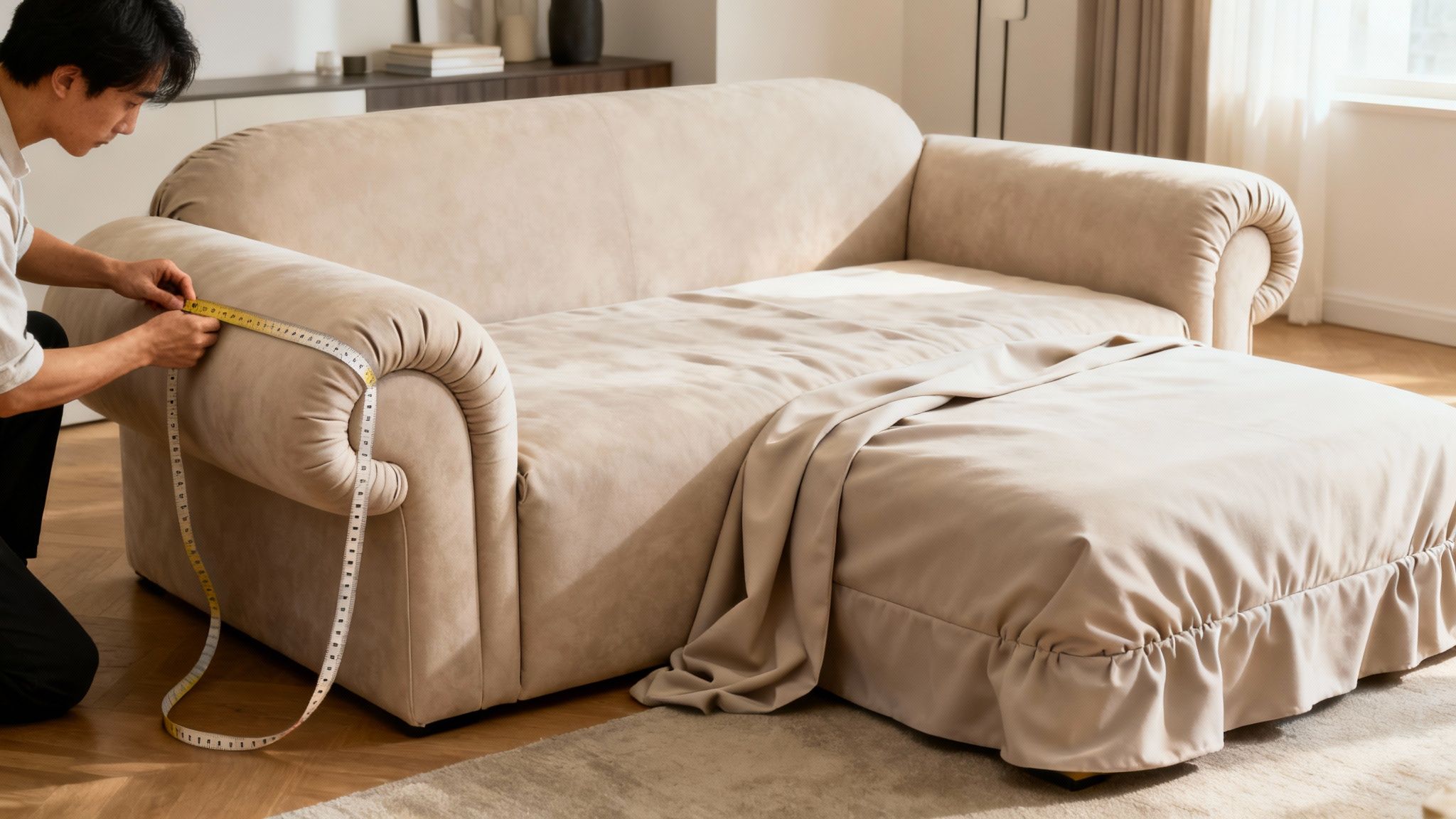
One of the most common challenges we see is dealing with wide, curved, or pillow-top arms. Standard measurements don't always capture their full volume, which can leave the cover feeling a bit too snug in those specific areas.
To get around this, make sure your main arm-to-arm width measurement is generous. If your sofa bed has particularly bulky arms, it’s often a good idea to choose the next size up. This gives you enough extra fabric to drape smoothly over the arms without pulling or straining the seams elsewhere. The extra material can then be tucked neatly into the crevices around the seat cushions for a tidy finish.
Fitting Sofa Beds with High Backs
A high-backed sofa bed offers fantastic support but can make sizing tricky. If the back of your sofa is significantly taller than average, you’ll need to account for that extra vertical distance.
Just like with wide arms, opting for a slightly larger cover size is the most effective solution here. This ensures there’s enough material to stretch comfortably from the very top of the backrest all the way down to the base. The elasticated bottom hem will help keep everything secure underneath, stopping the cover from riding up.
Important Note: Our stretchy fabric blends are specifically designed to accommodate a wide range of shapes. It’s the combination of high elasticity and strategic tucking with foam inserts that allows our covers to conform to so many non-standard designs, delivering a surprisingly tailored look.
Measuring Models with an Attached Chaise
Corner sofa beds or those with a permanent chaise longue need a different approach entirely. These are typically L-shaped, meaning a standard single-piece cover just won't work correctly.
For these models, you’ll need a specific L-shaped or sectional cover set. These usually come in two separate pieces designed to fit the main sofa and the chaise section independently. This ensures you get complete coverage and a much neater, more functional result than trying to stretch a single cover over such a complex shape.
The Ultimate Trick: The Masking Tape Test
Before you add anything to your basket, go and grab a roll of masking tape. Seriously, this humble roll of tape is the single best tool for making those abstract dimensions a reality right there on your floor.
Use the tape to mark out the sofa bed’s full, open footprint in the spot you have in mind. Outline the entire rectangle the bed will occupy, using the total extended length from the product details. Now you can see exactly how much floor space it will claim.
This simple test tells you everything at a glance:
- Walkway Space: Can you still get around the room without having to turn sideways and shuffle?
- Door and Drawer Clearance: Does the open bed block a doorway, a cupboard door, or the drawers on a nearby chest?
- Emergency Exits: Is your path to the door completely clear if you needed to get out in a hurry?
Mapping it out like this takes all the guesswork out of the equation. It's a foolproof way to make sure your room stays a functional, liveable space, day and night.
Before You Buy: Sizing Checklist, Care and Returns
Before you place an order, run through this short checklist:
- Check the access route: front door, internal doors, hallway turns, stairwells, and lift dimensions.
- Check the open-bed footprint: not just the wall width, but the total depth needed once opened.
- Check sleeper count: one adult, two adults, or occasional child use.
- Check mattress width: single, small double, or double is more useful than vague labels like compact or family-sized.
- Check walking clearance: ideally leave enough room to get past the foot or along one side without climbing over the frame.
That is the decision sequence I’d use before thinking about upholstery or colour. Most sizing mistakes happen because buyers stop at sofa width and never test the opened footprint against how the room is used.
Once you’ve got the right fit, care is straightforward. All our covers are fully machine washable, so routine cleaning is simple: use a cool, gentle cycle, mild detergent, and air-dry where possible to preserve stretch.
We also keep a straightforward 30-day return policy. If the cover is not right once it arrives, you have 30 days from delivery to return it for a refund or exchange, provided it comes back in its original condition and packaging.
Frequently Asked Questions
What is the standard size of a sofa bed?
There is no single fixed standard, but most UK sofa beds fall into a few common bands. A chair bed is usually around 80-100 cm wide, a 2-seater is often about 145-185 cm wide, and a 3-seater is commonly around 190-230 cm wide. What matters most is the sleeping surface it opens to, which is often closer to UK single, small double, or double bed widths.
What is the size of a standard sofa in the UK?
A standard UK sofa is usually discussed by seat count rather than one exact measurement. In practical terms, a 2-seater often sits around the mid-100-cm range, while a 3-seater is commonly closer to 190 cm and above depending on arm style. Sofa beds are usually deeper and more variable than ordinary sofas because the mechanism adds bulk.
How much space do you need for a sofa bed?
You need space for both the sofa when closed and the full bed when open. In many rooms, that means planning for roughly 210-235 cm of open depth on common 2-seater and 3-seater models, plus enough clearance to walk past the foot or get in and out comfortably. Always measure the room in open mode before buying.
What is the average size of a 2 seater sofa bed?
A typical 2-seater sofa bed is often around 160-175 cm wide when closed, though the wider category range is roughly 145-185 cm. When opened, many land near a small-double sleeping width of about 120 cm and a sleeping length around 180-190 cm. That makes it one of the most versatile sizes for UK guest use.
Ready to give your sofa bed a stunning new look and the protection it deserves? Explore our full collection at The Sofa Cover Crafter and find the perfect, easy-fit cover for your home. Visit us today at The Sofa Cover Crafter to browse all styles and colours.
Why do two sofa beds with the same seat count measure differently?
Because seat count is a loose retail category, not a precise size standard. Arm width, back design, opening mechanism, and mattress thickness all affect the final measurements. Two 2-seaters can look equivalent online but create very different footprints in a room.
Which measurement matters most for a sofa bed cover?
For cover sizing, the most important figure is usually the outer arm-to-arm width. After that, check back height and seat depth so the cover sits smoothly. For buying the sofa bed itself, open length is just as important, because that is what decides whether it fits the room.
Ready to give your sofa bed a stunning new look and the protection it deserves? Explore our full collection at The Sofa Cover Crafter and find the perfect, easy-fit cover for your home. Visit us today at The Sofa Cover Crafter to browse all styles and colours.
Check out our full collection of sofa bed covers here.
Check out our full collection of corner sofa covers here.
How Much Space Should I Leave Behind a Sofa Bed?
This one depends entirely on the opening mechanism your sofa bed uses.
- Click-Clack Sofa Beds: These need a little breathing room. You'll want to leave about 15-20cm of space between the back of the sofa and the wall. This gives the backrest enough clearance to recline fully and click down flat into the bed position without scraping your paintwork.
- Pull-Out Sofa Beds: With these, the bed frame unfolds forwards from inside the base, so the back of the sofa stays completely still. This means you can usually place it right up against the wall with no issues at all.
Whatever style you have, it’s always a good idea to quickly double-check the manufacturer’s instructions. They'll give you the precise clearance recommendations to make sure everything operates smoothly.
Now that you're an expert on sofa bed lengths and layouts, protect your investment and keep it looking fabulous. Explore the full collection of stylish, durable, and perfectly fitting covers from The Sofa Cover Crafter and give your furniture the care it deserves. Shop now.
Will a Standard Double Bedding Set Fit My 3-Seater Sofa Bed?
In most cases, yes! A typical 3-seater sofa bed opens up to a sleeping area that’s roughly 190-200cm long and 135-140cm wide. This is a near-perfect match for a standard UK double bed (190cm x 135cm), so your existing double fitted sheets, duvets, and pillows will fit beautifully.
For a 2-seater sofa bed, which usually unfolds into what’s called a 'small double' (around 190cm x 120cm), your double duvet and flat sheet will still work just fine. For that perfectly neat, hotel-style finish, though, investing in a small double fitted sheet will give you a much snugger fit on the mattress.
What Is the Best Sofa Bed Length for an Airbnb Property?
If you're aiming for maximum guest comfort and those five-star reviews, a 3-seater sofa bed with an open length of at least 190cm is your best bet. This size comfortably sleeps two adults and lines up with the standard double bed experience they’ll be expecting.
If your space is a bit tighter, a 2-seater that opens into a small double is a great alternative, especially for smaller listings or rooms aimed at solo travellers or couples on a short break. The key is to be crystal clear in your property listing about the exact bed size to manage guest expectations. And honestly, a durable, machine-washable cover is non-negotiable for keeping things hygienic and protecting your investment.
