



You've found the right sofa, but the living room still feels unfinished, or the upholstery needs protection from muddy paws, children and everyday use. A purple sofa throw is a low-risk way to add colour, warmth and texture without repainting the room or replacing the sofa. The important decision isn't whether purple works, but which purple undertone, fabric weight and drape suit your sofa, lighting and routine.
Table of Contents
- Why Choose a Purple Sofa Throw for Your Living Room
- Which Shade of Purple Will Suit Your Sofa and Light
- How Do You Style a Purple Throw With Cushions and Palettes
- What Size Throw Do You Need and How Should You Drape It
- Which Fabric Is Best for Pets Kids and Everyday Use
- How Do You Wash and Care for a Purple Throw So Colour Stays True
- Why Choose The Sofa Cover Crafter for Your Next Throw
Why Choose a Purple Sofa Throw for Your Living Room
A purple throw can turn a plain grey sofa into a deliberate focal point, soften a charcoal suite, or give a beige room more depth. It's especially useful when you want a visible change without committing to a new wall colour or reupholstery. Folded over one arm, it looks tidy and styled. Tossed across the centre seat, it feels relaxed and inviting. Spread over the seating area, it offers more practical protection.
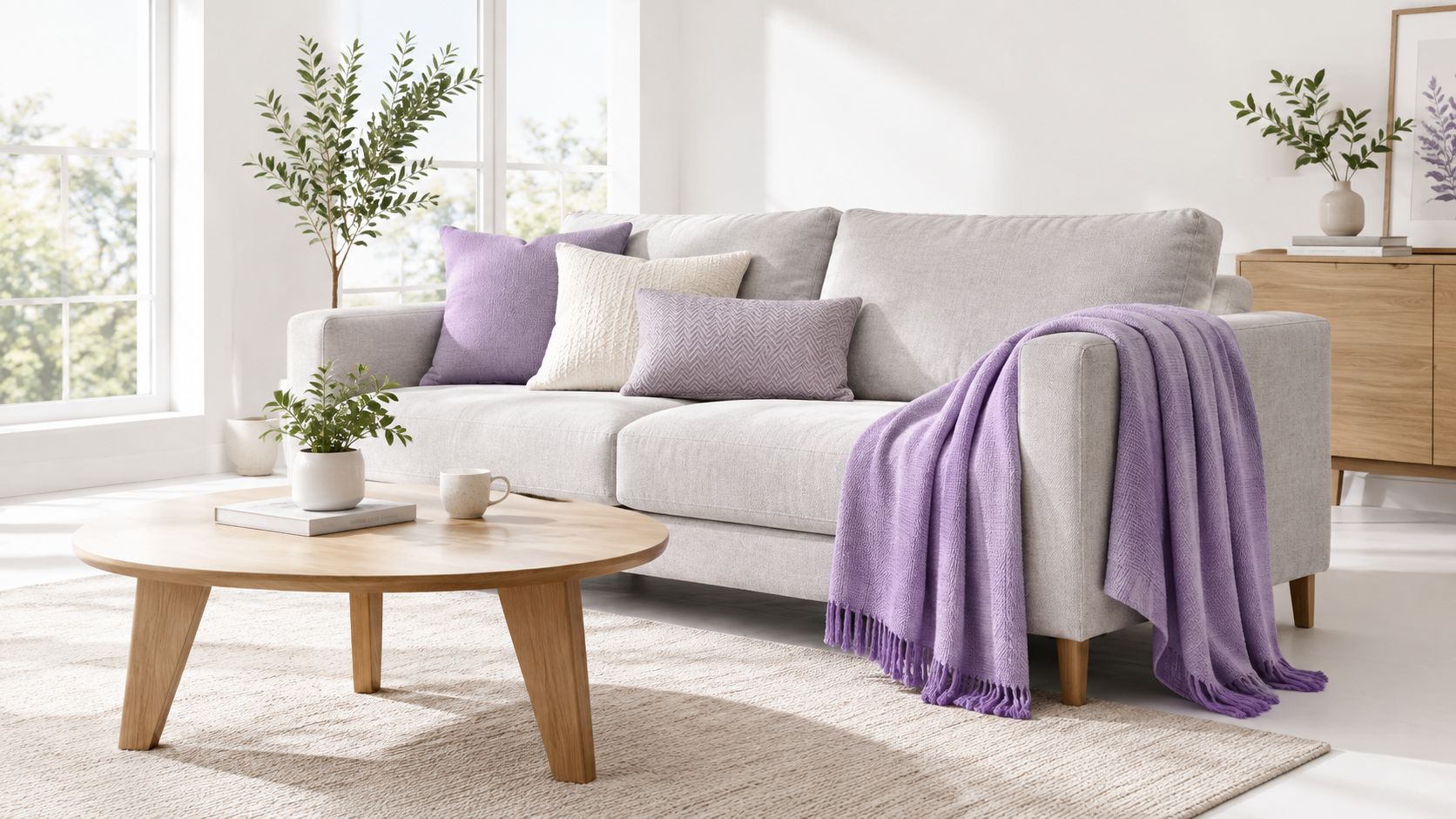
The mood depends on the purple you choose. Lilac and dusty mauve can feel calm and airy, while plum and aubergine create a cosier, more enveloping atmosphere. A soft woven surface makes purple look approachable. Velvet makes the same colour appear richer and more formal, particularly when light catches the pile.
Does purple work in a rented living room?
Yes, a purple sofa throw works well in a rented living room because it adds personality without permanent alterations. A neutral sofa, a purple textile and two coordinating cushions can establish a colour story while leaving the walls and existing furniture untouched.
Purple also suits more than one interior style. In a modern room, a plain mauve throw can complement clean lines and pale wood. In a traditional home, deep plum works with brass, walnut and patterned upholstery. In a small flat, a lighter purple usually gives you colour without making the seating area feel visually heavy.
Stylist's rule: use purple as an accent first. If the room still feels restrained, add a second purple detail rather than buying a much darker throw.
The throw can work beyond decoration. A heavier layer makes a sofa more comfortable during colder evenings, while a washable option helps manage crumbs, spills and pet contact. For wider advice on making a room feel warmer through lighting, texture and soft furnishings, this guide to how to make your home cozy offers useful complementary ideas.
Purple also has a particularly relevant British textile history. In London in 1856, William Henry Perkin accidentally created the first successful synthetic purple dye while working on quinine research at the age of 18. The Royal Society explains that the coal-tar-derived dye, later called mauveine, became commercially valuable because it produced a vibrant purple without relying on scarce natural sources such as murex sea snails, which could require tens of thousands of snails for a small amount of pigment. The Royal Society's account of Perkin's purple dye helps explain why purple moved from elite rarity towards more accessible fabrics and home textiles.
Which Shade of Purple Will Suit Your Sofa and Light
The best purple sofa throw depends on undertone, depth and room light, not the colour name alone. A blue-based lilac can look crisp in a bright room but chilly in a north-facing space, while a red-based mauve can make a cool grey sofa feel more welcoming.
How do lilac, mauve, plum and aubergine differ?
Lilac is the lightest and most forgiving option for a compact living room. It creates a gentle wash of colour and works particularly well with cream, pale grey and light oak. Periwinkle has a clearer blue influence, so it suits rooms with warm lamps, honey-toned timber or ochre accessories that need a cooler counterpoint.
Mauve sits closer to a muted pink-purple. It's often easier to make look grown-up than a bright violet because grey or brown in the mix reduces the sugary effect. On a beige sofa, dusty mauve creates a soft, layered scheme. On a cool grey sofa, it adds warmth without demanding attention.
Plum and aubergine are deeper choices. They're effective on cream, beige and lighter grey sofas where the contrast gives the room structure. On a charcoal sofa, however, an equally dark throw can disappear unless you introduce a lighter cushion, a reflective side table or a contrasting rug.
How does UK daylight change purple?
North-facing rooms generally receive cooler, flatter daylight, which can push blue-based purples towards a colder appearance. Warm bulbs can do the opposite, making mauve, plum and red-based shades look more pronounced. A purple that appears balanced in a shop can therefore look noticeably different beside your own sofa.
Test a swatch or folded corner at different times of day. Place it against the sofa, nearby cushions and the wall behind the seating, then check it under the lamps you use in the evening. Don't judge a purple throw while it's lying flat on a white bed, because that removes the surrounding colours that will affect its appearance.
Saturation matters as much as darkness. A vivid violet can dominate a small room even when the throw itself is physically modest. A smoky mauve or softened plum gives you the same colour family with less visual pressure.
For a useful visual reference, watch the styling video below after considering your sofa's base colour and natural light.
How Do You Style a Purple Throw With Cushions and Palettes
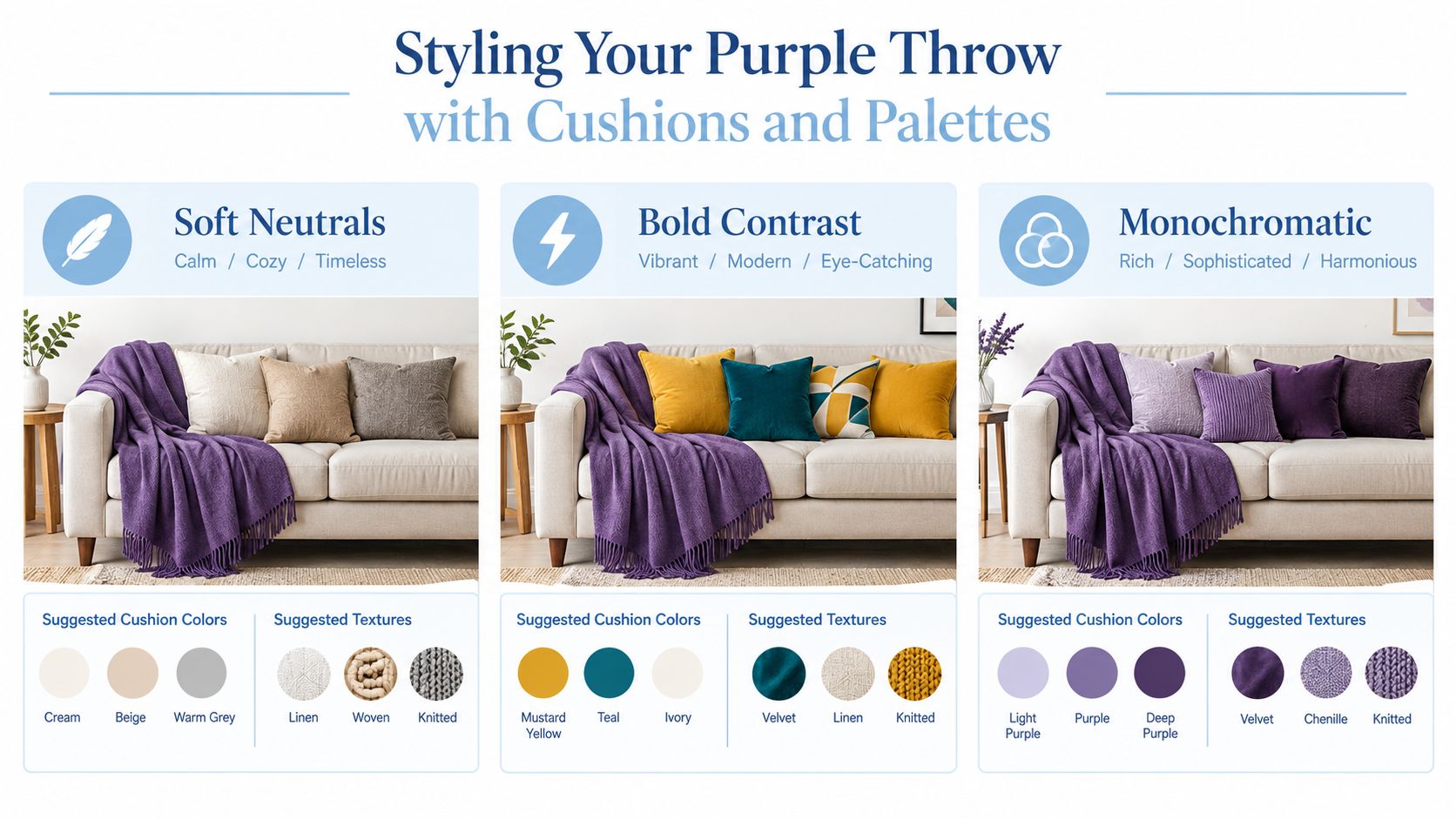
A purple throw looks most refined when the cushions repeat its temperature or depth without copying it exactly. Matching every cushion to the throw can flatten the arrangement, while unrelated colours make the sofa look assembled rather than styled.
Which palette works best with purple?
Soft neutrals are the safest option for a family room or rental. Pair a muted purple throw with cream, beige and warm grey cushions, then add a small amount of brass, aged gold or warm timber nearby. Keep the fabrics varied. A plain cotton cushion, a nubby woven cushion and a subtly patterned lumbar cushion will give a restrained palette enough movement.
Tonal purple is more dramatic but still calm. Combine a pale lilac cushion with a mauve throw and a darker plum accent, using texture to separate the shades. Velvet, boucle-style texture, linen-look fabric and ribbed weaves can stop a single-colour scheme from looking flat.
Complementary accents create more energy. Mustard gives purple warmth and contrast, while sage green makes the room feel botanical and relaxed. Use these accents selectively, especially in a small living room. One patterned cushion or a ceramic accessory may be enough.
A 60-30-10 balance can help prevent over-decoration: use the neutral sofa and surrounding room as the dominant base, purple as the main accent, and mustard, sage or teal as the smaller highlight. The ratio is a styling framework rather than a measurement exercise.
| Sofa base colour | Best purple throw shade | Cushion and accent pairing |
|---|---|---|
| Light grey | Dusty mauve or soft plum | Cream, warm grey and aged brass |
| Charcoal | Lilac, mauve or a lighter plum | Ivory, pale blue and light timber |
| Beige | Mauve, periwinkle or muted plum | Sage, cream and natural textures |
| Cream | Plum or aubergine | Mustard, warm grey and brass |
| Brown | Smoky purple or aubergine | Cream, ochre and bottle green |
The Slone Brothers Furniture guide to throw pillows for sofas is useful when you're deciding how cushion scale, shape and placement should relate to the throw rather than compete with it.
A dark green velvet cover can also sit comfortably within a purple-led room. The Sofa Cover - Velvet - Dark Green - Adaptable & Expandable is described as machine-washable, protective and suitable for a wide range of sofa sizes and shapes, so its role is different from a loose purple throw. The green provides a deeper base, while purple cushions or a folded purple textile can supply the seasonal accent.
What Size Throw Do You Need and How Should You Drape It
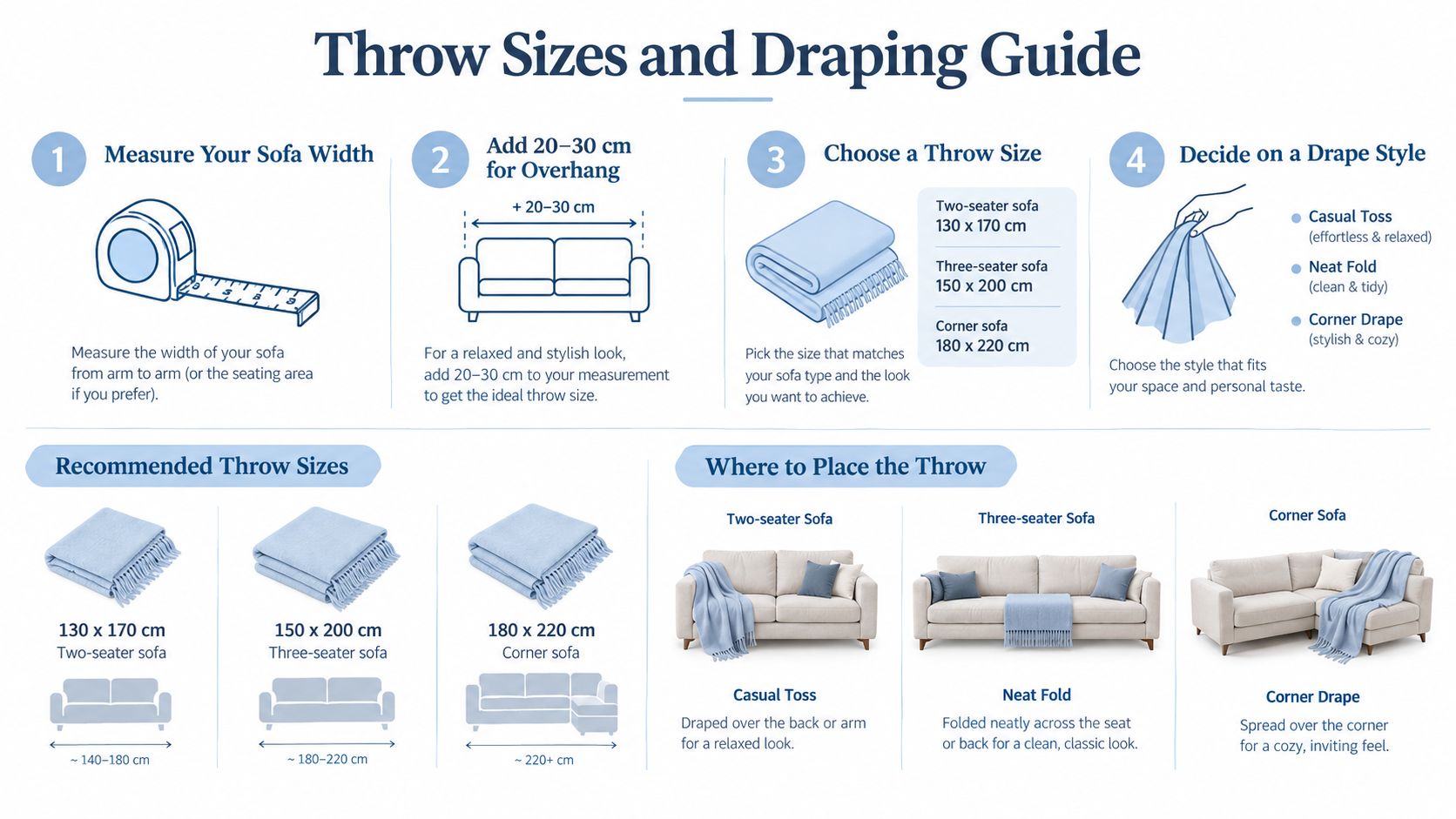
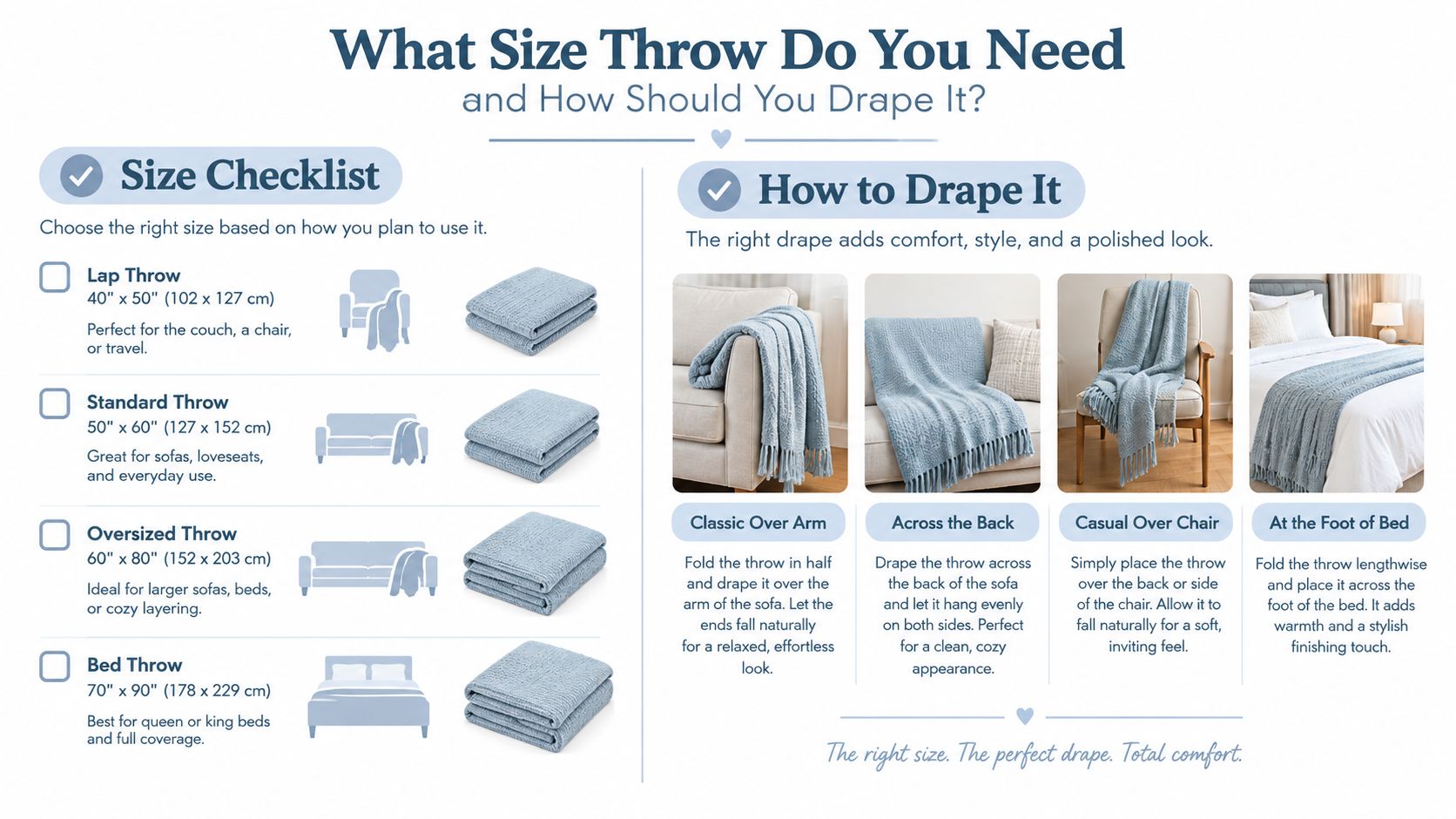
A two-seater sofa usually needs a smaller throw for an arm or centre drape, while a three-seater or corner sofa needs a larger textile for visible coverage. The right size depends on whether you want a decorative accent, partial protection or broad seating coverage.
Start by measuring the area you want the throw to cover, not just the sofa's overall width. Measure from the point where the fabric will begin, across the seat or back, and down to the intended stopping point. Add enough fabric for a relaxed fold or overhang, but don't choose a blanket so large that it pools on the floor or catches under feet.
Which drape suits your sofa?
A neat arm drape works on a two-seater or three-seater sofa when you want the smallest visual intervention. Fold the throw lengthways and place it over one arm, keeping the edge level with the seat or allowing a controlled fall down the outside.
A centre toss suits a relaxed family room. Gather the throw loosely and place it across the middle seat or over the back, allowing some of the texture to show. A heavier weave generally stays more convincingly arranged than a very smooth, lightweight fabric.
A corner drape is useful on a corner sofa when you want to highlight the chaise or create a cosy reading position. It won't create a fitted, secure layer across every section of a corner configuration. A loose throw can shift, so it's decorative protection rather than a replacement for a properly designed cover.
What can't a loose throw do?
A sofa throw can protect the area it covers, disguise light wear and add warmth. It can't guarantee full protection, remain fixed during energetic use, or provide the custom finish of a fitted stretch cover. Recliners, split-back sofas and unusual configurations need particular caution because a loose throw may interfere with moving parts or slide into gaps.
For additional guidance on coordinating cushions and throws, see this practical article about pillows and throws for couches. It's sensible to remove and refold a loose throw regularly, especially where children or pets use the sofa.
Which Fabric Is Best for Pets Kids and Everyday Use
For pets, children and frequent washing, choose a purple throw for its care label, construction and handling properties before choosing its exact shade. A beautiful textile that can't tolerate your household routine will spend more time folded in a cupboard than on the sofa.
Machine-washable synthetic throws are practical for high-traffic seating. They're often lightweight, quick to refresh and available in tightly woven surfaces that resist snagging better than loose decorative knits. The drawback is that some smooth synthetics show lint, static and pet hair clearly, particularly in deep purple.
Cotton blends offer a familiar compromise. They can feel breathable and comfortable across seasons, but the blend, dye and finish determine how well they cope with repeated washing. Always follow the product label rather than assuming that every cotton-rich throw has identical performance.
Velvet gives a purple throw depth because the pile reflects light in different directions. It feels luxurious and can disguise some uneven colour, but crushed areas, marks and pet hair may become obvious when the pile changes direction. Chenille is tactile and cosy, though its loops need care around claws and rough fasteners.
Is wool a good choice for warmth?
Wool-rich throws are attractive for colder rooms because wool fibres have low thermal conductivity. British Wool-linked insulation product data reports values around 0.035–0.039 W/mK, and some pure-wool insulation products state ignition points above 520°C. Those figures come from insulation products, not sofa throws, so they shouldn't be treated as a performance certification for a particular blanket. They do, however, help explain why wool-rich textiles tend to feel warm, breathable and comparatively slow to ignite. The British Wool-linked wool insulation information provides that material context.
For landlords and Airbnb hosts, a substantial wool-rich purple throw can improve perceived comfort, but a washable synthetic may be easier between guests. Pet owners should inspect the weave closely. A dense, smooth surface is generally easier to brush than an open knit, while a mid-tone purple may make everyday dust less conspicuous than very pale lilac.
UK spending remains relevant to these practical choices. Household spending on furnishings grew 0.6% in Q1 2026 and was 0.9% higher year on year, according to the Office for National Statistics consumer trends bulletin. The sensible purchase is the one that matches the sofa's workload, not the one with the most attractive colour online.
For homes with dogs, this guide to couch throws for dogs is useful when comparing loose textiles with more protective furniture coverings.
How Do You Wash and Care for a Purple Throw So Colour Stays True
Wash a purple sofa throw according to its care label, using the gentlest suitable cycle and avoiding unnecessary heat. Purple dyes can fade, transfer or lose tonal depth when a textile is washed harshly, while textured surfaces can flatten if they're overheated or aggressively spun.
Before the first wash, check whether the throw is machine washable, whether it needs a cool cycle and whether it must dry flat. Wash a new dark purple textile separately until you know how stable the dye is. Turn it inside out where the construction allows, use a mild detergent and avoid overloading the drum so water can move through the fabric.
Treat spills promptly. Blot rather than scrub, lift solids with a blunt edge and test any cleaning product on an inconspicuous area. Rubbing can spread a mark and disturb velvet pile, chenille loops or a brushed finish.
Can washing affect fire protection?
Yes, domestic washing can affect the fire-protection performance of treated cover fabrics, and government research says the impact of washing-machine cycles on that protection is unknown. The government report on fire risks in upholstered products is therefore an important caution for washable throws used around children or pets.
A loose cover sold or marketed specifically for use on a sofa can be treated as a loose cover under the Furniture and Furnishings (Fire) (Safety) Regulations 1988. FIRA's UK upholstery flammability guide explains that certain natural-fibre fabrics can be supplied non-match-resistant only within a compliant furniture system that includes a fire-resistant interliner, while the furniture still needs to satisfy cigarette-composite testing.
The regulations also require relevant new upholstered furniture and loose or stretch covers sold in the UK to meet ignition-resistance requirements and carry a permanent label. The legislation itself should take priority over assumptions based on a throw's fibre content or colour.
Dry purple textiles away from strong direct sunlight where possible. Don't store them damp, and fold them loosely once completely dry. For a deeper look at preserving dye appearance, use this guide to colour fastness.
Why Choose The Sofa Cover Crafter for Your Next Throw
The Sofa Cover Crafter suits shoppers who want a quick UK living-room refresh alongside practical sofa protection. Its range includes sofa covers, sofa throws and cushion covers, allowing a purple accent to work as part of a wider seasonal arrangement rather than as an isolated purchase.
The wider collection uses stretchy spandex blends and durable fabrics, with machine-washable options designed for everyday household use. Helpful sizing and installation guides support selection, while details such as foam inserts for gap tucking and discreet under-sofa clips are intended to help covers sit more smoothly. Those features matter when a homeowner wants a more secure protective layer than a loose throw can provide.
The retailer also serves several different use cases. A renter can change the room without replacing furniture. A landlord or Airbnb host can use washable textiles between guests. Families with children or pets can compare protective covers with softer decorative throws, choosing the level of coverage that matches their routine.
The UK homeware market provides substantial context for these smaller furnishing decisions. The market is forecast at USD 40.25 billion in 2025, USD 41.73 billion in 2026 and USD 51.19 billion by 2031, with a projected 4.17% CAGR over 2026–2031, according to Mordor Intelligence's United Kingdom homeware market forecast. Home furniture accounts for 42.73% of the UK homeware market share in 2025, England represents 49.44%, and the online channel is projected to grow at a 6.39% CAGR through 2031, all from the same source. Purple sofa throws sit within that broad furnishing market as an accessible, reversible way to test colour.
Before buying, compare the shade in your room, decide whether you need decoration or protection, check the care label and confirm the seller's returns process. UK online shoppers generally have a 14-day cancellation period, followed by another 14 days to return goods after notifying the retailer, while faulty or misdescribed goods can be rejected within 30 days for a full refund, as outlined in this BBC consumer-rights factsheet.
The Sofa Cover Crafter offers sofa throws, protective sofa covers and cushion covers for practical UK interiors, including homes with children, pets and seasonal styling changes. Visit The Sofa Cover Crafter to compare purple-friendly textures, check the sizing guidance and choose whether a loose throw or a more secure cover suits your sofa.