


PU leather is a synthetic material made by bonding a polyurethane film to a fabric backing and texturing it to look like leather, also called faux leather or leatherette. The standard version contains no animal hide at all. That's the short answer to what PU leather is.
Most advice about it splits into two camps. One calls it the vegan, wipe-clean bargain. The other says it peels, so avoid it. Neither gets to the reason: PU leather is a sealed plastic film sitting on cloth, and everything it does well and badly follows from that construction. A film doesn't breathe, doesn't absorb oil, and doesn't heal.
That framing matters most when you're in a shop, or sitting on a sofa whose seat has gone tacky and started to flake. Once you know how the layers are put together, you can tell which problems are cosmetic, which are permanent, and what a cover or a patch can realistically do.
Table of Contents
- What Is PU Leather and How Is It Made?
- What Are the Advantages of PU Leather?
- Why Does PU Leather Get Sticky and Crack Over Time?
- How Does PU Leather Compare With Real and Other Synthetic Leathers?
- Is PU Leather Bad for the Environment and Your Health?
- How Should You Clean PU Leather Without Damaging It?
- What Should You Check Before Buying PU-Covered Furniture?
- Which Fix Suits a Cracked or Sticky PU Sofa?
What Is PU Leather and How Is It Made?
PU leather is a synthetic material made by coating a fabric backing, usually polyester or cotton, with a flexible polyurethane layer and pressing a leather-like grain into the surface. The backing supplies the strength and the shape; the polyurethane supplies the smooth face and the resistance to everyday spills, as Von Baer's guide to PU leather sets out.
Think of a laminated menu. Paper inside stops it flopping about, plastic outside means a spilled drink wipes straight off. PU leather is the same sandwich in upholstery form, a textile core with a plastic face.
Two materials get confused with it. PVC vinyl uses a different plastic, polyvinyl chloride, over a similar cloth core. Bonded leather is shredded leather fibre bound together and then coated, so it does contain real hide, just not as one continuous sheet.
How PU Leather Is Made, Step by Step
- Prepare the backing. A woven or knitted textile, most often polyester, sometimes cotton or a blend, is readied for coating.
- Apply the polyurethane. The resin goes on as a coating or a laminated film.
- Fuse the layers. Heat and pressure bond the plastic to the cloth.
- Press in a grain. A textured roller or plate embosses a pattern so the surface reads as hide.
- Colour and finish. Dye and a top coat set the shade and the sheen, matte or glossy, and add some resistance to staining.
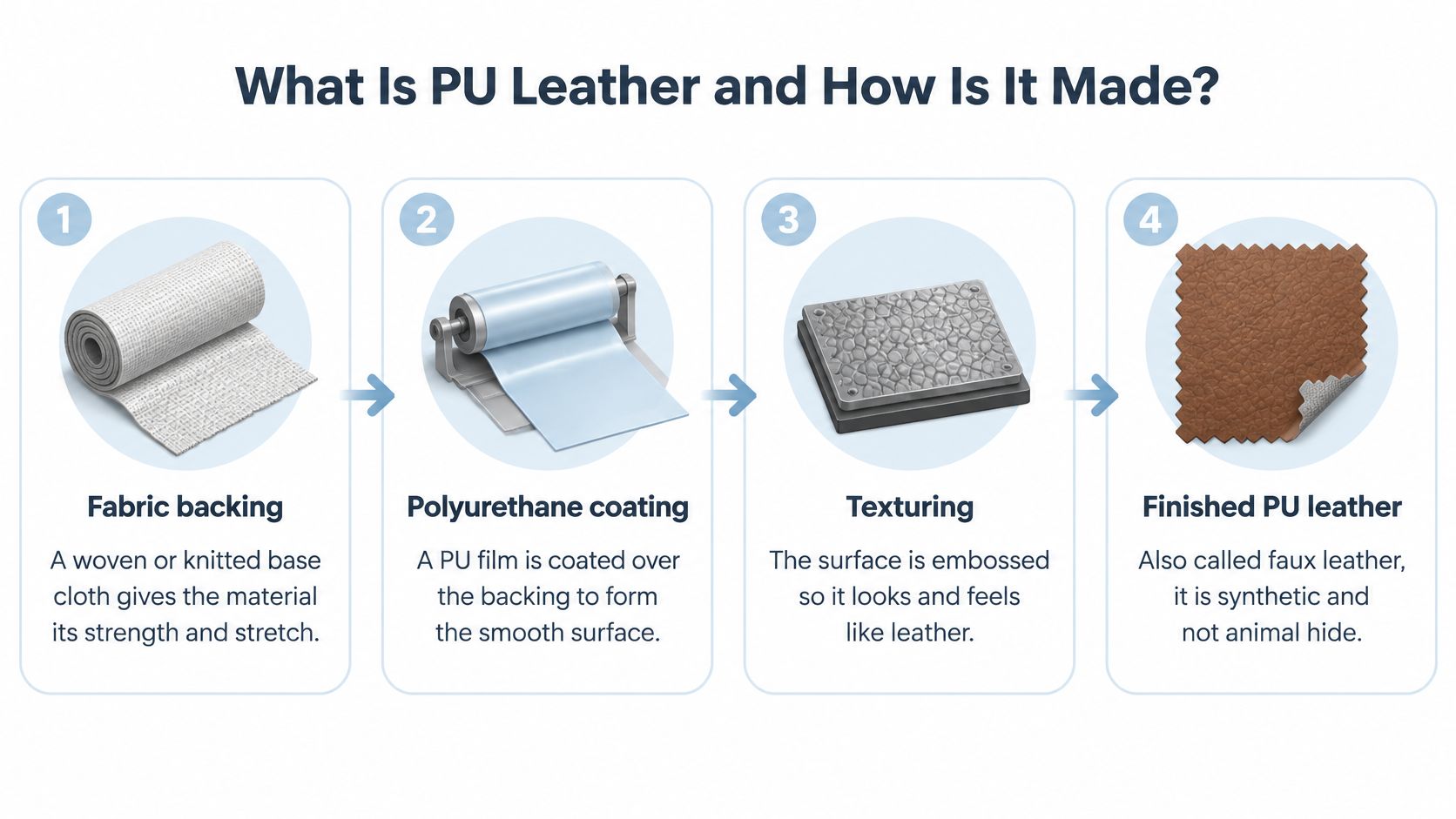
Labels are where this gets murky. "Vegan leather" is an umbrella term rather than a recipe, covering PU, PVC, cork and plant-based coatings alike, so the word alone tells you nothing about what's on the sofa. UK tariff legislation treats textile fabrics coated, covered or laminated with plastics under heading 5903, whether the plastic is compact or cellular, which is exactly the family PU belongs to.
Some PU materials add a thin foam layer between backing and coating so the finished sheet feels softer. Whatever the build, the division of labour holds: cloth for tear strength and stability, film for appearance and liquid resistance. Judge the laminate, not the label.
What Are the Advantages of PU Leather?
PU leather looks uniform, holds a consistent colour, wipes clean, needs no conditioning and costs far less than genuine leather, and in its standard fabric-backed form it contains no animal hide.
- Uniform appearance. There are no hide marks, scars or natural variation, so every panel on a sofa matches its neighbour. A single cow varies across its own back, let alone across a three-seater.
- Consistent colour. The finish is made to a set shade rather than dyed hide by hide, which matters when you need a matching cushion or a second piece months later.
- Easy cleaning. Spills sit on the film. In a rented flat with a toddler and a beaker of juice, that's the difference between a ten-second wipe and a stain you learn to live with.
- No conditioning routine. Nothing needs feeding, so there's one less job on the list.
- Lower cost. It's a fraction of the price of full-grain leather for a similar look, which is why it turns up on office chairs, headboards and rental furniture.
- No animal hide. It suits buyers avoiding animal products, though the environmental picture is more complicated than the word vegan suggests.
The material's reach shows in the market numbers. Grand View Research's UK synthetic leather outlook puts UK synthetic-leather revenue at USD 473.6 million in 2025, with PU the largest segment at a 78.89% revenue share.
For a tidy, low-cost room with moderate use, PU does what it's sold to do. None of those advantages is durability.
Why Does PU Leather Get Sticky and Crack Over Time?
PU leather gets sticky and cracks because its polyurethane film is a closed layer that traps moisture at the surface and slowly breaks down under heat, humidity and body oils, whether the sofa is used or not.
Why a PU Seat Feels Clammy
Real leather is a fibre network. It takes moisture in and lets it out again, the way a cotton shirt does. PU leather is a sealed sheet, closer to a plastic bag. On a warm day sweat collects in the patch where your legs meet the seat, because it has nowhere to go, and the film also slows heat leaving the body at that same patch.
Why the Film Fails
Polyurethane ages by hydrolysis, a chemical reaction with moisture that heat speeds up. The coating loses adhesion and flexibility, and the damage shows as tackiness first, then fine cracks, then flaking.
UK testing specialist SATRA's hydrolysis test method makes the mechanism concrete: specimens are conditioned in a warm, humid environment for 7, 10 or 14 days, then compared with untreated references on flex cracking, coating adhesion, tensile and tear behaviour, abrasion resistance and colourfastness. Heat and damp are the accelerants, in a test chamber and in a front room alike.
What the film doesn't do is age like leather. Hide develops a patina, darkening and softening where hands and elbows land. PU goes tacky in one place and flakes in another, and once it has, it can't be refinished, sanded back or re-dyed at home.
| What you see | Likely cause | Realistic response |
|---|---|---|
| Tacky or sticky surface | Film breaking down under heat, humidity and body oils | Wipe regularly; this slows surface build-up but does not restore the finish |
| Clammy feel on bare skin in summer | Closed film traps moisture at the contact patch | Lay a throw or stretch cover over the seat so skin meets fabric |
| Fine cracks across seat or arms | Coating losing flexibility with age | Cannot be re-finished; a self-adhesive patch can conceal a small area only |
| Flaking or peeling layer | Coating separating from its backing | A patch conceals a small area; widespread flaking needs a full cover |
The honest limit: a wipe slows the build-up and a patch hides the damage. Neither one reverses the ageing of the film.
If your seat has gone sticky rather than cracked, there's more on diagnosing it in this guide to why a leather sofa feels sticky.
How Does PU Leather Compare With Real and Other Synthetic Leathers?
PU leather is cheaper and more uniform than genuine leather but breathes less and ages differently, and bonded leather and PVC vinyl each sit somewhere else again on structure, care and repair.
| Feature | PU leather | Genuine leather | Bonded leather | PVC vinyl |
|---|---|---|---|---|
| Structure | Polyurethane film on a fabric backing | Fibre network from animal hide | Shredded leather fibre bound with polyurethane on a backing | Plastic PVC layer on fabric or foam |
| Animal hide content | None | Full hide | Contains leather fibre | None |
| Appearance | Uniform colour with no hide marks | Natural variation, marks and grain | Uniform surface with a leather-like finish | Uniform, often glossy |
| Moisture and skin feel | Closed film that can feel clammy | Takes in and releases moisture | Closed surface, similar to PU | Closed surface that can feel clammy |
| Ageing | Goes tacky, cracks and flakes, no patina | Develops a patina | Coating cracks and peels as it wears | Hardens and cracks over time |
| Care | Wipe clean, no conditioning | Needs cleaning and conditioning | Wipe clean like a PU coat | Wipe clean |
| Repair | Cannot be re-finished | Can be cleaned, conditioned and restored | Limited | Limited |
| Relative cost | Low | High | Lower than genuine leather | Low |
A short list of situations settles most of it.
- A tidy, low-cost room or a rental with moderate use. PU is the sensible pick. You get the look, the wipe-clean surface and a price that doesn't sting when a tenant moves out.
- A long-term family sofa that should age well. Genuine leather wins, because it can be cleaned, conditioned and restored again and again. It marks more easily and needs regular care, and that's the trade-off for the longer useful life.
- A leather look on a tighter budget. Compare bonded leather with PU on the composition wording rather than the product photo. Bonded is the weaker of the two.
Material families vary inside themselves as well. FIRA's notes on leather types, from the UK furniture-industry research organisation, point out that some leather types are weaker than grain leather and belong in low-stress applications rather than on a heavily used seat.
If you're choosing between full-grain, top-grain and the rest, this guide to the different types of sofa and chair leather covers the grades.
Is PU Leather Bad for the Environment and Your Health?
PU leather avoids animal hide but isn't automatically the greener choice, because it's built on fossil-based polyurethane and its plastic coating is hard to separate from the backing when the sofa reaches the end of its life. In Valpak's waste analysis, polyurethane made up 18% of the material found in the footwear and accessories category, and Valpak, citing a 2022 McKinsey estimate, notes that less than 1% of textile waste is recycled fibre-to-fibre.
That second number is the one that matters for furniture. A plastic layer fused to cloth is exactly what fibre recovery struggles with, and the coating doesn't break down the way untreated natural fibres do, so a PU sofa that goes to landfill stays a PU sofa for a long time. The environmental question isn't "PU or hide" so much as "how long does this thing stay in use". Three practical moves:
- Ask your local authority about upholstery. A household recycling bin generally won't take a PU sofa or its cushions, and rules differ by council.
- Think before replacing. A removable, washable cover changes the look and the surface you sit on, which can be enough to refresh a room without buying new furniture.
- Look at small damage on its own terms. A worn patch on one arm can be concealed rather than treated as a reason to replace the whole sofa.
On health, keep expectations modest. The everyday considerations are skin comfort on warm days and gentle cleaning rather than solvent products, which damage the coating.
How Should You Clean PU Leather Without Damaging It?
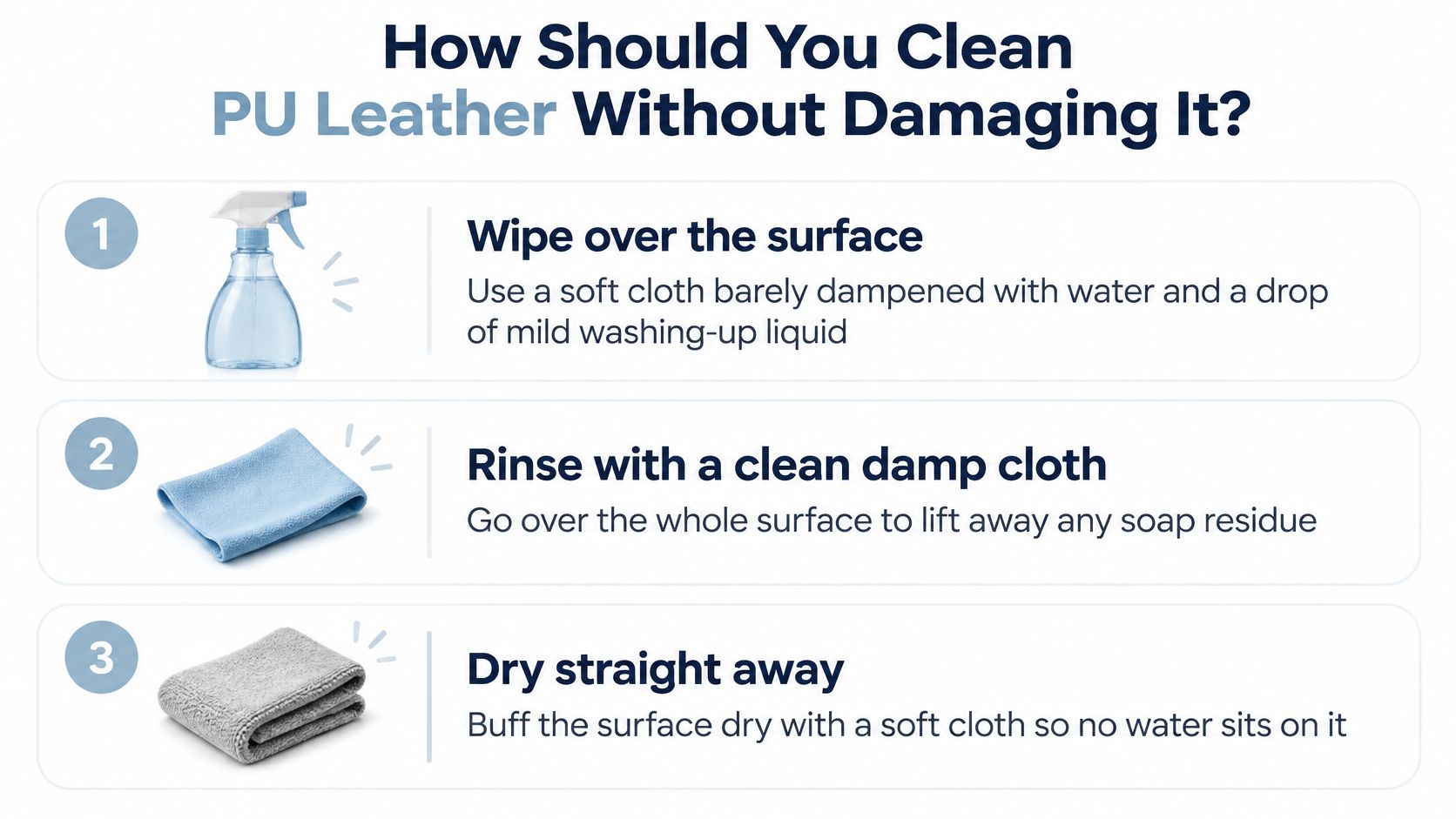
Wipe PU leather with a soft cloth barely dampened with water and a drop of mild washing-up liquid, go over the whole surface with a clean damp cloth to lift the soap, then dry it straight away. The drying isn't optional: water left in seams and stitch holes is water sitting against the coating.
The Full Cleaning Routine, Step by Step
- Dust first. A dry cloth lifts crumbs and grit so you're not grinding them across the grain.
- Wring the cloth out properly. Damp, not wet. If water beads on the surface, the cloth is too wet.
- Add one drop of mild washing-up liquid to a bowl of water. Not a squirt straight onto the sofa.
- Wipe gently. Lift the spill rather than scrubbing at it.
- Rinse with a clean damp cloth so no soap film dries into a dull, slightly tacky haze.
- Dry at once with a soft cloth, paying extra attention to seams and stitch holes.
What to Keep Off PU Leather
- Conditioners and oils. There's nothing to absorb them, so they sit on top as a sticky film that attracts dust.
- Alcohol and solvent wipes. They soften the polyurethane, and softened film cracks sooner.
- Abrasive scourers and cream cleaners. They mark the embossed grain, and those marks don't come out.
- Soaking. Water pushed into seams works at the bond between coating and backing.
Clean it as the plastic surface it is, not as leather.
Timing does more than products. Skin oil and sweat are part of what breaks the film down, so a quick wipe of the headrest and the arm tops every week or so beats an occasional deep clean, because you're removing the aggressor before it sits there. Placement matters too: keep the sofa away from radiators and out of strong direct sun, since both speed the breakdown.
If you'd like to see a faux leather sofa being cleaned, this video shows a professional deep clean on a white one.
For the products worth keeping in the cupboard, and the ones to leave on the shelf, there's a fuller guide to faux leather cleaner choices.
What Should You Check Before Buying PU-Covered Furniture?
Before buying PU-covered furniture, check how the material is described, what the backing is, where the seams and high-wear areas sit, and what care the maker recommends, and do all of that before you judge the colour or the price.
- The wording. Look for PU, polyurethane, synthetic leather or faux leather. Trading Standards guidance sets out that textile products must carry fibre-content labelling under the Textile Products (Labelling and Fibre Composition) Regulations 2012, and that under the Consumer Rights Act 2015 goods must be "as described", so a listing should name the coating and the backing fibre where it applies. The Advertising Standards Authority is equally clear that a product shouldn't be described as leather when it isn't made from 100% leather.
- The backing. Ask what the textile base is. A woven or dense nonwoven base holds a coating far better than a thin, loose one, and it supplies much of the tear strength.
- Seams, arms and headrests. These flex and take skin contact, so they show ageing first. Sit on the sofa and look at them in person if you can.
- Care instructions. Confirm the maker states a cleaning method and that it matches the gentle wiping the coating needs. A care label recommending conditioners suggests the product wasn't designed around how PU behaves.
- The room it's going in. A heavily used family seat wears any coating faster than a spare room. Match the material to the traffic.
- Replacement covers. If you plan to cover it later, check the cover is listed for your sofa's shape and seat configuration before ordering. A configuration that isn't listed isn't one the cover is designed for.
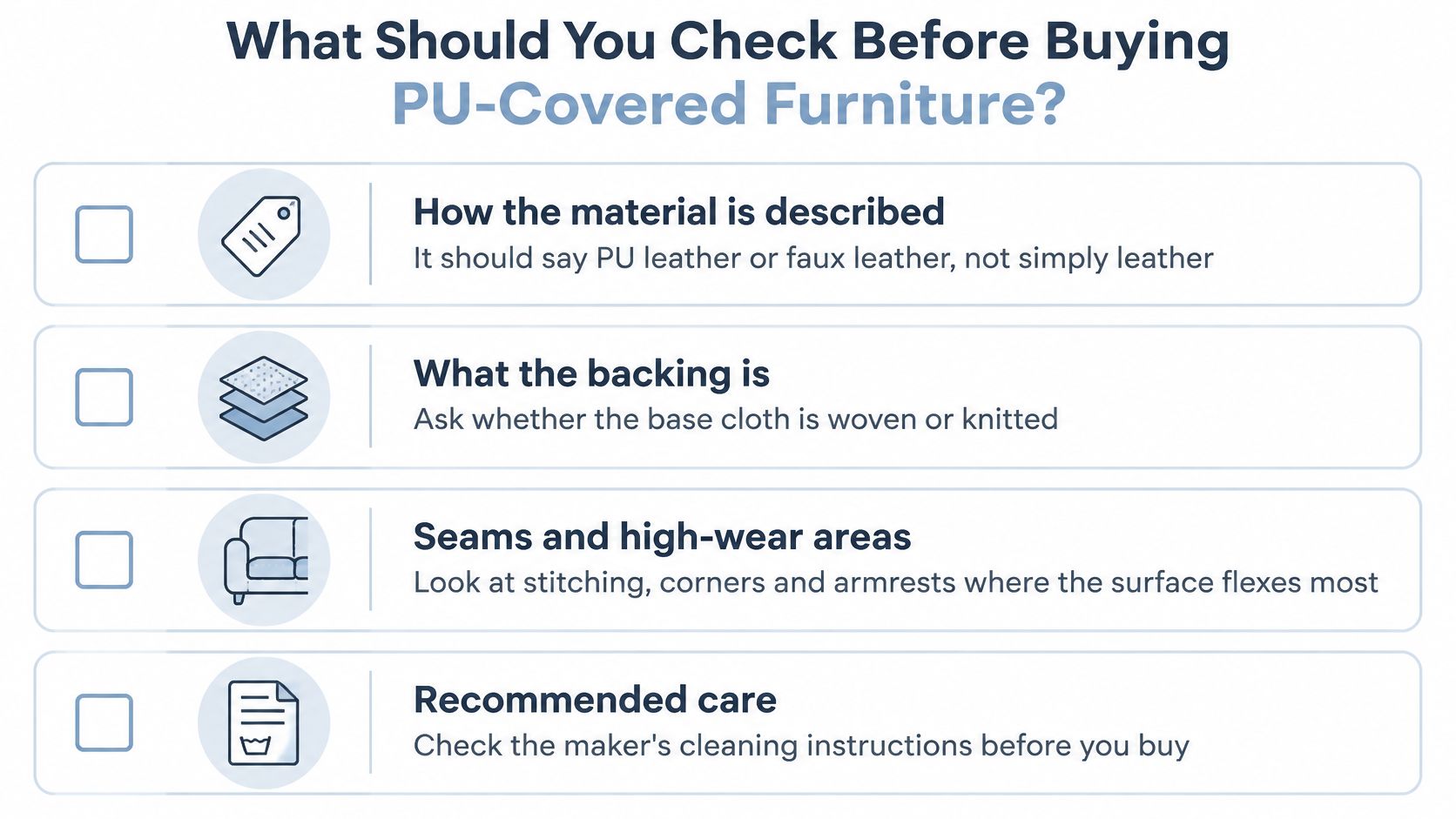
One quick check settles most doubts. Look at a cut edge, a worn seam or the underside: on a PU product you'll usually see the textile backing, a woven or knitted grid under the plastic face. Compare that with the listing wording, because a claim of "leather" on its own doesn't settle anything.
A rule that saves money: if a listing can't name the backing and the coating, it can't tell you how the sofa will wear.
If you're weighing up upholstery in general rather than PU in particular, this guide to the best fabric for a sofa compares the options by how they handle daily life.
Which Fix Suits a Cracked or Sticky PU Sofa?
A sticky PU sofa in summer is best handled with a layer of fabric such as a throw or a stretch cover, a small cracked or peeling area with a self-adhesive repair patch, and widespread flaking with a full stretch cover over the whole sofa. None of these repairs the coating. They conceal damage or change the surface your skin meets, and that's the honest limit of what a cover or a patch does.
For summer stickiness, fabric is the fix because it changes what your skin touches. Our sofa covers are stretch fabrics, not PU or leather, made to go over a sofa rather than imitate one, and our sofa throws give you a fabric layer to lay over the seat and back. A sofa cushion cover does the same for the seat pads.
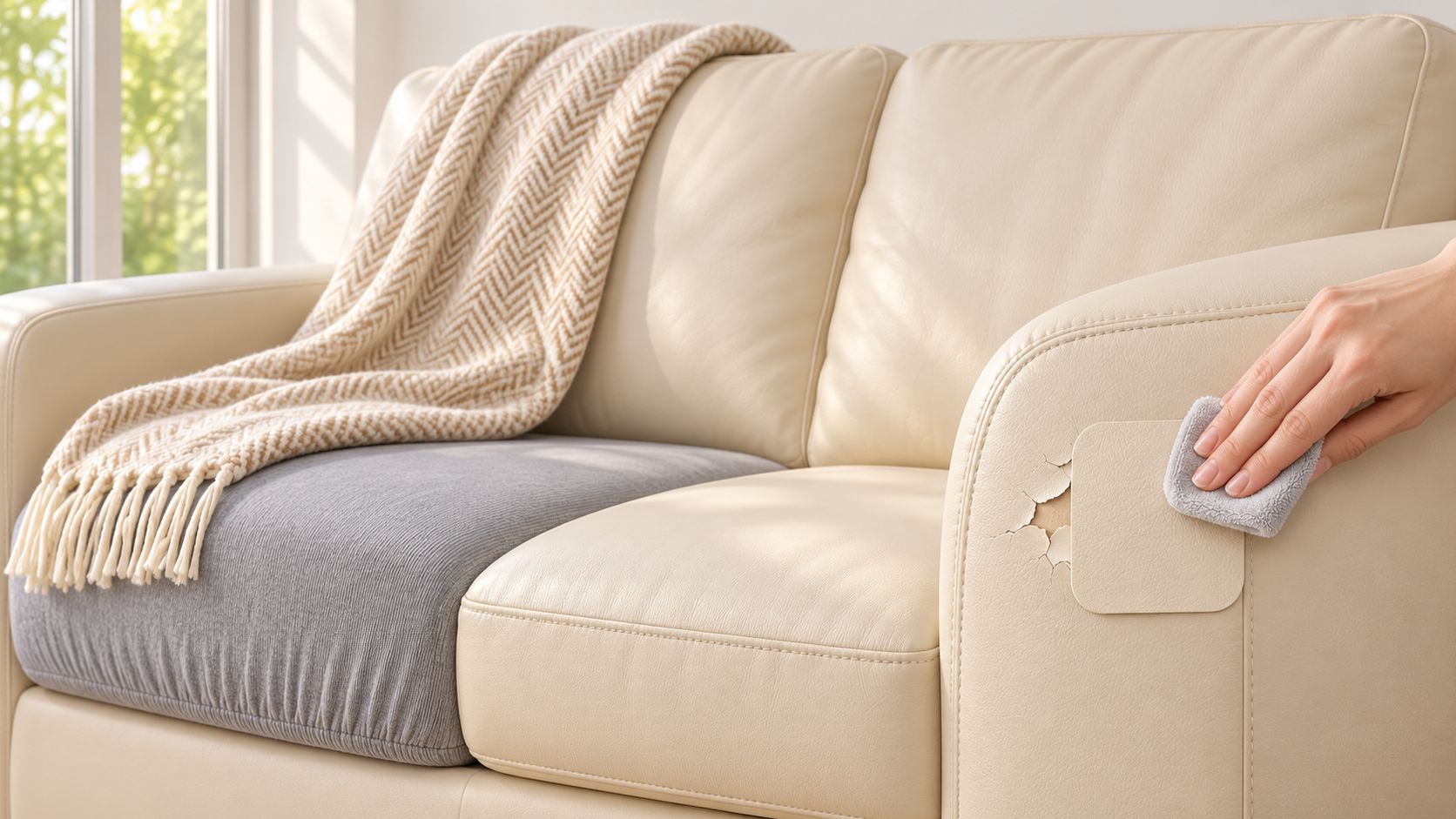
For a small cracked or peeling area, the Self-Adhesive Leather Repair Patch is a 50 cm x 120 cm peel-and-stick sheet you cut to shape. Apply it to a clean, dry, residue-free surface, round the corners so the edges don't lift, and press from the centre outwards.
For widespread flaking, a stretch cover over the whole sofa is the option worth considering. On a smooth PU surface covers can slide, so tuck them in securely, use Foam Rods in the gaps and add Anti-Slip Sofa Pads under the seat. If the sofa underneath is leather or PU and you want more detail on fit, this guide to slipcovers for leather couches covers it.
Before ordering, measure the sofa and check the listing names your seat configuration. A shape or seater size that isn't listed isn't one the cover is designed for.
If your PU sofa has gone sticky or started to flake, the usual answer is a layer of fabric rather than a new sofa. The Sofa Cover Crafter sells stretch sofa covers, throws, cushion covers and a self-adhesive leather repair patch for the furniture you already own, plus Foam Rods to tuck into the gaps and keep the fit smooth. Browse our stretch sofa covers to check which sizes and seat configurations suit your sofa before you order.
