



Trying to figure out the world of sofas can feel a bit much, but getting your head around the three key dimensions—length, depth, and height—is the perfect place to start. These numbers don't just tell you if a sofa will squeeze into your living room; they dictate how it will actually work and feel in your space.
Why Couch Dimensions Matter
Getting the dimensions of your couch right is about so much more than just avoiding a delivery-day disaster. Honestly, it's the foundation of good interior design and creating a room that just works. Accurate measurements make sure your new furniture feels right for the scale of the room, lets you walk around comfortably, and, crucially, fits through doorways and awkward hallways.
Understanding these core numbers helps you visualise the sofa's footprint, so you can pick a piece that feels balanced—not ridiculously oversized or comically small. It has a knock-on effect on everything, from what size coffee table to buy to making sure there's enough room for a recliner to actually recline.
This guide kicks off with a quick-reference table of standard UK sofa dimensions to give you a solid starting point. If you need more detailed instructions on how to measure your specific sofa model for a new cover, you can pop over to our comprehensive sofa cover size guide.
Quick Reference UK Sofa Dimensions
Before we get into the specifics of each sofa type, it’s useful to have a general idea of what to expect. Here’s a quick look at the typical dimension ranges for the most common sofas you'll find in UK homes.
| Sofa Type | Typical Length (cm) | Typical Depth (cm) | Typical Height (cm) |
|---|---|---|---|
| 2-Seater / Loveseat | 150 - 180 | 85 - 100 | 80 - 95 |
| 3-Seater Sofa | 180 - 220 | 85 - 100 | 80 - 95 |
| Armchair | 75 - 110 | 80 - 95 | 80 - 100 |
| Corner / Sectional Sofa | 220 - 300+ | 85 - 105 | 80 - 95 |
As you can see, the classic 2-seater and 3-seater sofas have fairly consistent depths and heights, with the main difference being their length. This makes them incredibly versatile and a perfect fit for the average British home, which is why they tend to dominate the market. An armchair offers a single, comfy spot, while a corner sofa provides expansive seating for larger families and living spaces.
Exploring Dimensions by Couch Type
Now that you've got the basics down, let's get into the specifics of different couch designs. Sofas aren't all created equal, and knowing the subtle differences between types is the key to finding the perfect fit for your room and your lifestyle. From a compact two-seater destined for a cosy snug to a sprawling sectional built for family film nights, each style comes with its own typical range of sizes.
This infographic gives you a quick visual guide to the core measurements—length, depth, and height—that really define a sofa's footprint.
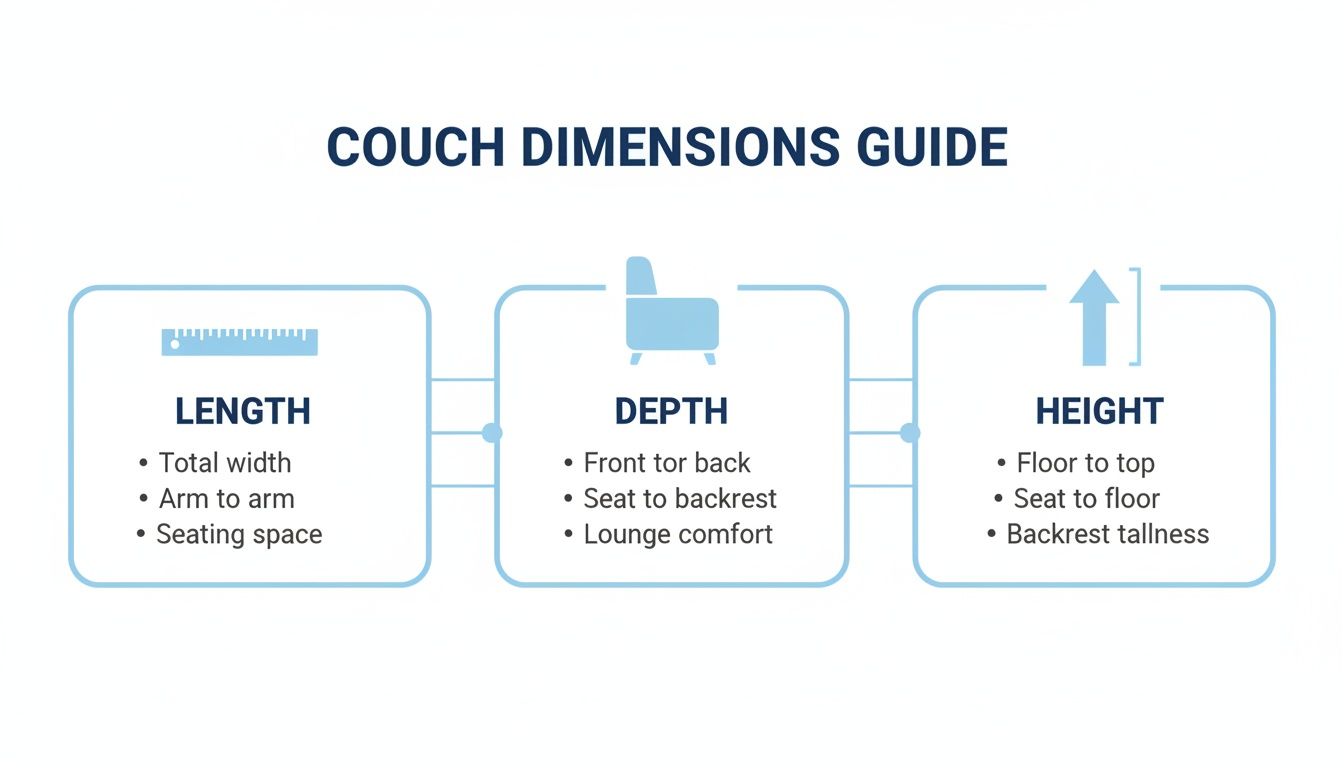
Being able to picture these three key metrics helps turn abstract numbers into a real shape, making it much easier to imagine how a new piece of furniture will actually sit in your space.
Two-Seater Sofas and Loveseats
Often used interchangeably, the two-seater sofa (or loveseat) is a real staple in smaller British homes, flats, and secondary spaces like conservatories or home offices. As the name suggests, they're designed to comfortably seat two adults.
- Typical Length: 150 cm to 180 cm
- Typical Depth: 85 cm to 100 cm
- Typical Height: 80 cm to 95 cm
A loveseat is perfect for creating an intimate seating area or to complement a larger sofa. Its compact nature makes it one of the most versatile bits of furniture you can own.
Three-Seater Sofas
The three-seater is, without a doubt, the most common sofa size in the UK. It hits that sweet spot between comfort and capacity, offering plenty of space without completely taking over a standard-sized living room. It's ideal for seating three adults or giving one or two people ample room to lounge.
A well-proportioned three-seater acts as the anchor for your living room's entire design. Its dimensions often set the scale for other furniture, like coffee tables and accent chairs, helping you create a layout that just works.
The main difference between a two-seater and a three-seater is the length. Their depth and height are often nearly identical, which ensures they look consistent if you buy them as part of a set. If you're weighing up these two popular choices, our guide on the differences between 2 and 3 seater sofas can help you decide.
Corner Sofas and Sectionals
For larger rooms and open-plan living areas, a corner or sectional sofa is a fantastic choice. These pieces are all about maximising your seating, often in an L-shape or U-shape, making brilliant use of corner space that might otherwise go to waste.
The dimensions of couches in this category can vary wildly:
- Length (Each Side): Can range from 220 cm to over 300 cm.
- Depth: Usually a bit deeper to make them extra comfortable for lounging, around 85 cm to 105 cm.
- Height: Stays consistent with standard sofas, typically 80 cm to 95 cm.
When measuring for a sectional, it's absolutely crucial to measure the length of each section that will run along a wall. Don't forget to account for the corner piece itself, as its depth will impact how the two sides fit together. Their modular nature offers great flexibility, but they demand careful planning to make sure they don't dominate the room or block walkways.
Measuring for Specialized and Multifunctional Sofas
Modern homes often need furniture that can pull double duty, adapting to our changing needs. When you're looking at these clever, multifunctional pieces, you have to think beyond the simple length, depth, and height. You need to account for how the furniture actually transforms within your room.
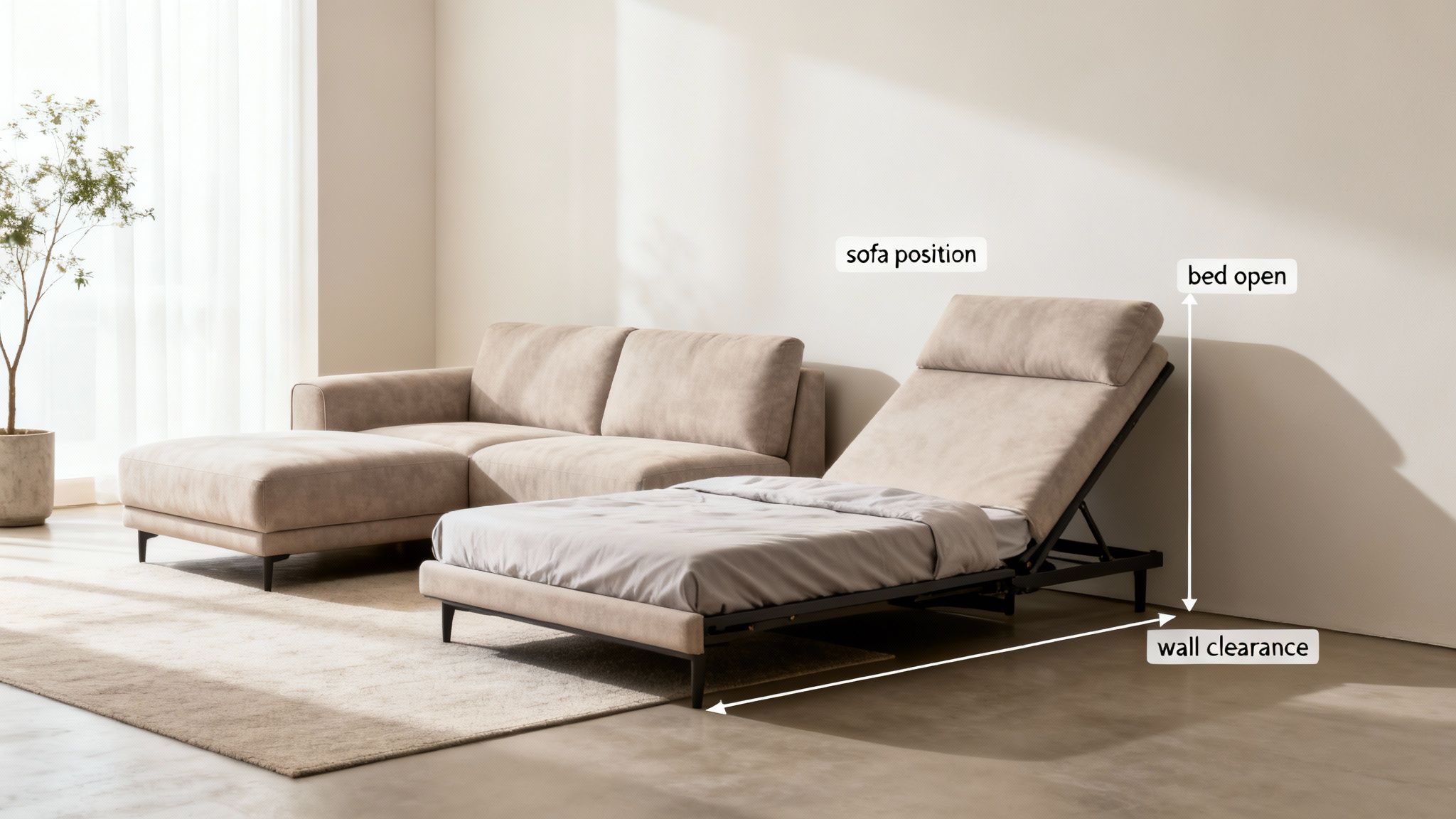
This means measuring not just for its everyday footprint but also for its fully extended or reclined state. Forgetting to check this second set of dimensions is a really common mistake that can turn a brilliant piece of furniture into a massive headache once you get it home.
Dimensions for Sofa Beds
Sofa beds are the ultimate space-savers, but they demand that you measure for two completely different setups: as a sofa and as a bed. First, get its standard length, depth, and height to make sure it fits comfortably in its primary, closed position.
Next, and this is the crucial bit, you have to measure its unfolded length. This is the total distance from the back of the sofa frame right to the very foot of the extended mattress. This single measurement will tell you if you have enough clear floor space for someone to actually use the bed without blocking a doorway or crashing into your coffee table.
Sofa beds have become a go-to choice, especially in cities. They consistently rank as a top-searched furniture item, blending sleep and seating into units that are often around 190 cm long by 140 cm wide when unfolded. This makes them perfect for the 23% of UK adults living in smaller homes or flatshares. You can discover more insights about the UK home furniture market and its trends.
Measuring for Recliner Sofas
Recliner sofas are all about comfort, but they come with one critical measurement requirement: wall clearance. This is the minimum space you need to leave behind the sofa so the backrest can tilt all the way back without scraping or hitting the wall.
To measure for a recliner, you’ll need to figure out its fully reclined depth.
- Start with the standard depth of the sofa when it’s sitting upright.
- Find the reclined depth specification from the manufacturer, or if you can, measure a model in-store from the wall to the tip of the fully extended footrest.
- The wall clearance is simply the difference between the reclined depth and the standard depth.
Always add a few extra centimetres to the required wall clearance. This gives you a small buffer, preventing scuff marks on your walls and making sure the mechanism works smoothly without getting jammed.
Sizing Up Armchairs
While they aren't strictly sofas, armchairs are key players in any living room and come in a surprisingly wide range of sizes. Their dimensions are what determine whether they’ll be a subtle accent or a dominant, feature piece of furniture.
- Accent Chairs: These are usually more compact, with a width of around 75-90 cm. They’re designed to slot into smaller nooks or to complement a larger sofa without taking over.
- Standard Armchairs: The classic choice. These typically measure between 90-110 cm in width, offering a generous and really comfortable single seat.
- Oversized or Cuddler Chairs: These larger seats can be anywhere from 110-140 cm wide, giving you enough space for one person to curl up properly or for two to sit snugly together.
When you're choosing an armchair, think about its depth as well. A deeper chair is perfect for lounging and tucking your feet up, while a shallower one provides more upright, formal seating. Matching the armchair's height to your main sofa can also create a much more cohesive and visually balanced look in your living room.
How to Measure Your Space for a Perfect Fit
Let's be honest, buying a beautiful new sofa only to find it won't fit through the front door is a truly soul-crushing (and expensive) mistake. Before you even start falling in love with couches online, you need to measure your home's delivery path. A few minutes spent now will save you from a world of stress on delivery day.
The first step is to visualise the sofa's entire journey, from the delivery van all the way to its final spot in your living room. Grab a tape measure and jot down the width and height of every single doorway, hallway, and stairwell it needs to pass through. Don't forget to account for any awkward obstacles like radiators, low-hanging light fixtures, or tight corners that could trip you up.
Mapping the Footprint and Checking Entry Points
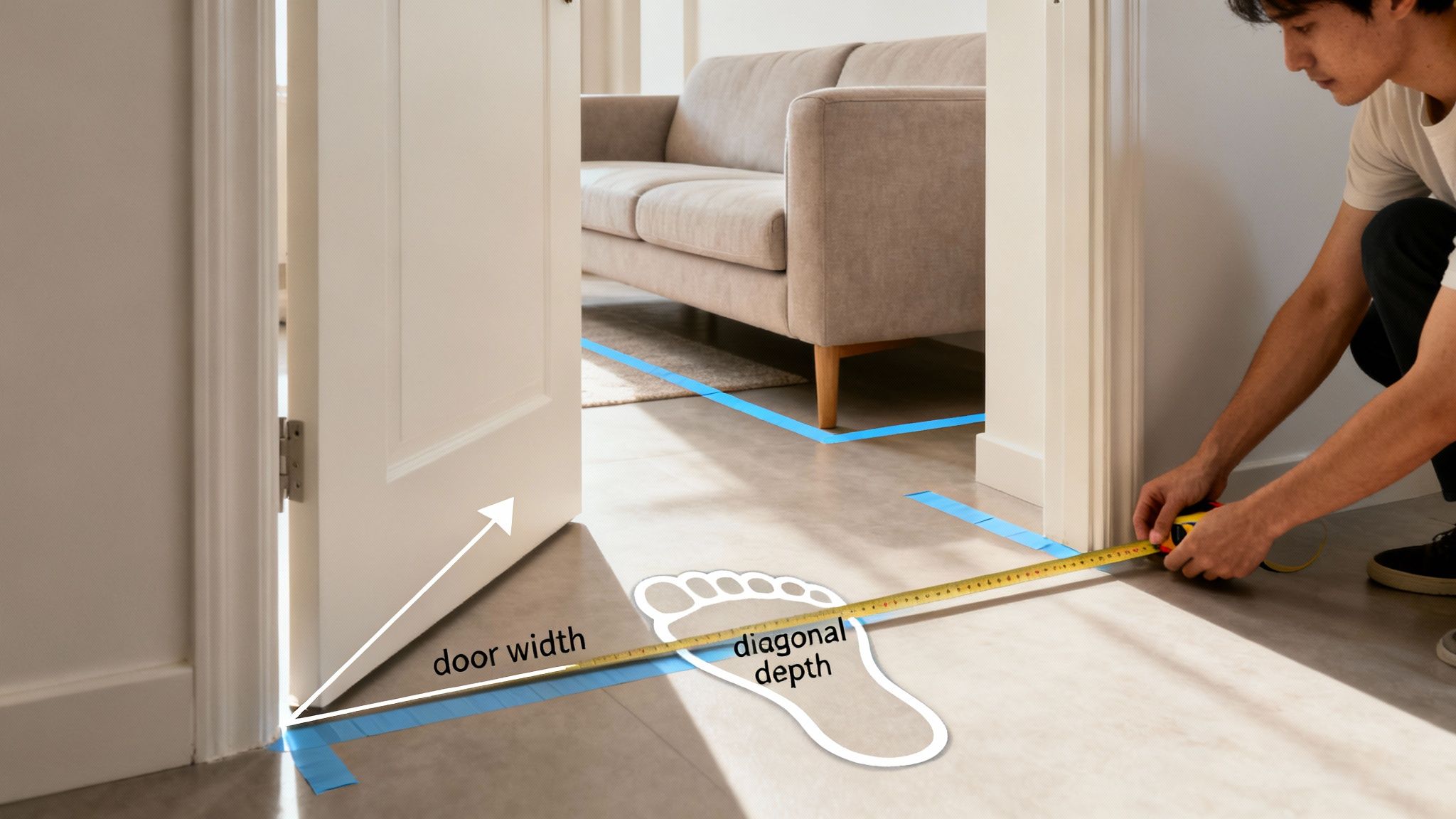
Once you're confident the path is clear, turn your attention to the room itself. A really simple but effective trick is to use masking tape or old newspapers to map out your chosen sofa’s length and depth right on the floor. This gives you a proper, real-world sense of its scale and helps you be sure you’ll still have plenty of room to walk around it.
Now, head back to your doorways for one last crucial measurement: the diagonal depth. This is the secret weapon for navigating tight squeezes and corners. Here's how to measure it:
- Measure the doorway's width (let's call this 'A').
- Measure the doorway's height (let's call this 'B').
- The diagonal measurement is the distance from a top corner of the door frame on one side to the bottom corner on the opposite side.
A sofa can often be tilted and wiggled through a space diagonally, even if its standard height or depth is technically too big for the doorway. As a rule of thumb, the sofa’s depth must be less than your doorway’s width and its diagonal height.
When you're getting down to the nitty-gritty of measurements, you might find you need to switch between units of length. A handy online tool like a feet to inches converter can make this much simpler. Taking these few careful steps turns a potentially chaotic task into a completely foolproof plan, guaranteeing your new sofa arrives without a single hitch.
Finding the Right Sofa Cover Size
Giving your sofa a new lease of life with a stretch cover is a brilliant and affordable update, but all that good work hinges on getting the measurements right. A cover that fits perfectly looks seamless and stays put, while one that’s just a little too small or large will constantly shift, bunch up, and look untidy. Measuring for a stretch cover is a bit different than just jotting down the basic dimensions of a new sofa.
You need to think beyond the overall length, depth, and height. The real key is to measure the parts of the sofa the cover will actually hug. This means getting the tape measure out for the width of each armrest, the total length of the seating cushions from one end to the other, and the height of the backrest from where the cushions end to the very top. For a complete walkthrough, our detailed guide on how to measure your sofa for a cover breaks down the entire process step-by-step.
Mapping Your Measurements to Our Cover Sizes
Once you've got your numbers, you can easily match them to the correct size. While stretch fabrics are quite forgiving, starting with the right size is essential if you want that polished, almost-reupholstered finish. Sofas with unusual shapes, like those with deep T-cushions or an attached chaise, need a bit of extra attention to make sure every contour is accounted for.
Top Tip: Always, always measure the longest possible seating length. For an L-shaped sectional, this means measuring the total length of both seating sections as if they were one continuous line. This single number is the most important one for choosing the right size.
To make things simple, we’ve put together a quick reference table to help you map your sofa’s total seating length to our standard cover sizes here at The Sofa Cover Crafter.
Mapping Your Sofa Measurements to Our Cover Sizes
Here’s a straightforward guide to help you match your sofa's dimensions with the corresponding cover size you'll need from our collection. Just find your total seating length in the first column to see which size to choose.
| Measurement (cm) | Cover Size to Choose (e.g., S, M, L, XL) | Compatible Sofa Types |
|---|---|---|
| 90 - 140 cm | Small (S) | Armchair, Cuddler Chair |
| 145 - 185 cm | Medium (M) | 2-Seater, Loveseat |
| 190 - 230 cm | Large (L) | 3-Seater Sofa |
| 235 - 300 cm | Extra Large (XL) | 4-Seater, L-Shaped Sectionals |
As you can see, a little bit of measuring goes a long way. Taking a few moments to get an accurate number ensures you order a cover that will fit like a glove and give your furniture the fresh, new look it deserves.
Avoiding Common Measurement Mistakes
Even with the best of intentions, it’s surprisingly easy to make a tiny error with a tape measure that leads to a huge headache on delivery day. Getting wise to the most frequent pitfalls is the key to a smooth, stress-free process when you’re bringing new furniture home.
One of the most common oversights is completely forgetting about the permanent fixtures in your room. Things like skirting boards, window sills, and radiators all stick out from the walls, eating into your usable floor space. A sofa that seems to fit perfectly on paper might end up perched awkwardly away from the wall, spoiling the whole look.
Overlooking Obstacles and Access Routes
Another classic mistake is focusing only on the final destination and ignoring the journey. That sofa has to get there, after all. Low-hanging light fixtures, tight turns in hallways, and narrow stairwells can all bring a delivery to a grinding halt. You absolutely must measure every step of the delivery route, not just the room itself.
This is especially true in densely populated areas where space is a real luxury. In England, which accounts for 60.25% of UK furniture sales, sofa dimensions are often designed with compact urban living in mind. For example, average 2-seater widths of 130-160 cm are tailored to fit into the 80% of London flats that are under 60 square metres. You can find out more in this detailed report on UK furniture sales and trends.
The single biggest reason for delivery failures is forgetting to compare the sofa's diagonal depth to the doorway's width. A sofa can often be pivoted through a narrow space if this crucial measurement works.
Finally, resist the temptation to just "eyeball it." A few centimetres can be the difference between a perfect fit and a piece of furniture that just won't go in. Always use a proper tape measure, write down your dimensions clearly, and double-check them before you commit. That little bit of discipline will save you an immense amount of frustration later on.
Got Questions About Couch Dimensions? We've Got Answers
To make sure you've got every last detail covered, I've pulled together some of the most common questions people ask about sofa sizes. Let's clear up a few of the practical bits and pieces that we haven't touched on yet, making sure you have everything you need to choose with confidence.
What Is the Difference Between Sofa Depth and Seat Depth?
This is a brilliant question, as the two terms get mixed up all the time but make a massive difference to how a sofa actually feels to sit on. Sofa depth is the full measurement from the very back of the frame right to the front-most edge. Think of it as the total footprint—it's the number you need to know for planning your room layout.
Seat depth, on the other hand, is just the usable bit you actually sit on. It’s measured from the front edge of the seat cushion to the point where it meets the back cushion. This is a crucial distinction for your comfort. A deeper seat is brilliant for lounging and is often preferred by taller people, while a shallower seat gives you more upright support, which can be much more comfortable for those with shorter legs.
How Much Clearance Space Should I Leave Around My Sofa?
Giving your sofa enough breathing room is key to making a space feel functional and uncluttered, rather than cramped. As a general rule of thumb here in the UK, you should aim for at least 45 cm (about 18 inches) of clear walkway space around the main traffic areas of your sofa. This ensures people can move around easily without having to turn sideways.
When it comes to placing other furniture nearby:
- Coffee Table: The sweet spot is somewhere between 35 cm and 45 cm from the sofa's front edge. This is close enough to be useful for your cup of tea, but still leaves plenty of legroom.
- Radiators: If you're placing your sofa against a wall with a radiator, try to leave at least 10-15 cm of space. This allows air to circulate properly and stops the heat from potentially damaging the frame or fabric over time.
Don't forget to factor in clearance for any moving parts! Recliner sofas need extra space behind them to extend fully, and sofa beds require a huge, clear area in front to unfold without hitting anything.
Are Vintage Sofa Dimensions Different from Modern Ones?
Yes, they absolutely can be, and it's a common pitfall when buying second-hand furniture. Antique and vintage sofas, especially those from before the 1950s, were often built on a much smaller scale to fit the more compact rooms of the era.
You'll typically find they have shallower seat depths and lower backs compared to modern designs, which tend to be all about deep, lounge-style comfort. For instance, a vintage two-seater might only be 120-140 cm long, whereas its modern equivalent is usually somewhere between 150-180 cm. Always, always measure vintage pieces carefully and never assume they'll match standard modern dimensions—especially if you're planning to buy a fitted cover for it.
Ready to give your sofa a fresh, stylish new look? Explore the stunning collection of perfectly fitting, easy-to-install covers at The Sofa Cover Crafter. Find your perfect sofa cover today!