



Finding the right sofa covers for large sofas can feel like a bit of a nightmare, but the secret usually lies in specialised, multi-piece designs. If you've ever tried to wrestle a standard one-piece slipcover onto an oversized or sectional sofa, you know the frustration – it rarely fits, leading to a baggy mess and constant readjustments. The trick is to seek out covers designed specifically for larger furniture to get that full coverage and smart finish you're after.
Key Takeaways Finding Sofa Covers for Large Sofas a Perfect Guide
- Standard covers often fall short: They're usually made for a standard three-seater, which can mean poor fit and slipping on larger sofas.
- Measure each section: Treat a sectional as several pieces, and measure beyond the seat.
- Use the size guide: Compare your measurements with the size chart before choosing colours or patterns.
Table of Contents
- Key Takeaways Finding Sofa Covers for Large Sofas a Perfect Guide
- The Real Challenge of Covering a Large Sofa
- Why Standard Covers Let You Down
- How to Measure Your Sofa for a Perfect Fit
- Mastering Tricky Sofa Shapes
- Essential Sofa Measurements Checklist
- Sofa Measurement to Slipcover Size Guide
- Picking a Fabric That Fits Your Life
- Materials for Every Household
- The Rise of Eco-Friendly Fabrics
- Don’t ignore fire safety compliance
- Making Your New Cover Look Like It Was Made for Your Sofa
- The Art of the Tuck and Secure
- Keeping Your Sofa Cover Looking Brand New
- Washing and Drying Your Cover
- Handling Spills and Minor Issues
- Store it properly when not in use
- Styling Your Covered Sofa
- Accessorising Your Slipcovered Sofa
- Smart Uses for Large Sofa Covers
- For landlords and Airbnb hosts
- For family homes with children and pets
- For seasonal decorators and home stylists
- Where to Buy Large Sofa Covers in the UK
- High-Street Retailers vs Online Specialists
- What to Look for Before You Buy
- Got Questions About Your Large Sofa Cover? We've Got Answers
- Can I Just Use a Regular Cover on My L-Shaped Sofa?
- What’s the Best Fabric if I Have Pets?
- How Can I Stop My Sofa Cover from Slipping and Bunching Up?
- Are the Waterproof Covers Noisy or Uncomfortable Like Plastic?
- Do large settee covers work on leather sofas
- Can I use a cover on a recliner or chaise-style settee
- Will the cover look baggy after people sit on it
- What should I do if I’m between sizes
- Can I return a cover if it isn’t right
The Real Challenge of Covering a Large Sofa

Trying to find a cover for an oversized or sectional sofa can feel like a frustrating puzzle. You’re not just throwing a bit of fabric over it; you're trying to protect a major investment from pets, spills, and general wear and tear. The simple truth is that standard slipcovers aren’t built to handle the unique angles and sheer size of larger furniture.
Why Standard Covers Let You Down
Most off-the-shelf covers are made with a standard three-seater sofa in mind. When you try to stretch one over a much larger frame, you almost always run into the same problems:
- A Terrible Fit: The fabric gets stretched taut across some parts while sagging in others, giving it a really sloppy appearance.
- Patchy Coverage: You'll often find that corners, armrests, or the back of the sofa are left completely exposed and vulnerable to damage.
- Constant Slipping: Without the right dimensions, the cover will forever be shifting, meaning you’re constantly tucking it back into place every time someone sits down.
This is particularly true for L-shaped or U-shaped sectionals. Their complex shapes just can't be properly handled by a single, rectangular piece of fabric.
The goal isn’t just to cover your furniture; it’s to enhance it. A well-chosen cover should look like it was made for your sofa, providing a seamless, tailored appearance that revitalises your entire living space.
Thankfully, the market has caught up. With a growing number of specialist options available here in the UK, it’s easier than ever to find stylish, durable sofa covers for large sofas. This guide will go beyond the generic advice and give you practical solutions, making sure your furniture gets the protection it deserves without you having to sacrifice on style.
How to Measure Your Sofa for a Perfect Fit
When it comes to sofa covers for large sofas, guessing your measurements is a recipe for disaster. I’ve seen it countless times: a beautiful cover arrives, only to look baggy and awkward because a few key measurements were missed. Taking the time to be precise is the single most important thing you can do to get that sleek, custom-fitted look.
It’s really not as intimidating as it sounds, even if you’re dealing with a massive L-shaped or U-shaped sectional. All you need is a flexible measuring tape and about ten minutes. The main things to capture are the total length from one outside arm to the other, the height from the floor to the very top of the back, and the depth of the seat cushions.
Mastering Tricky Sofa Shapes
If you have a sectional, the easiest approach is to think of it as multiple pieces of furniture joined together. Measure the length and depth of the main sofa section first, then repeat the process for the chaise or corner piece. Don't forget the arms! You'll need their height from the floor and their width.
You also need to factor in any quirks. Got those big, puffy cushions you sink into? Make sure you measure over them, not just the sofa frame, so the cover has enough give. For a recliner, you absolutely have to measure it twice: once while it's upright and again when it's fully reclined. This ensures the cover can move with the chair without stretching or tearing.
A classic mistake I see people make is only measuring the bit they sit on. You have to measure the widest points of the entire sofa—including the full sweep of the arms and back—to get complete coverage.
This simple visual breaks down the process, showing how getting the measurements right is the foundation for everything else.
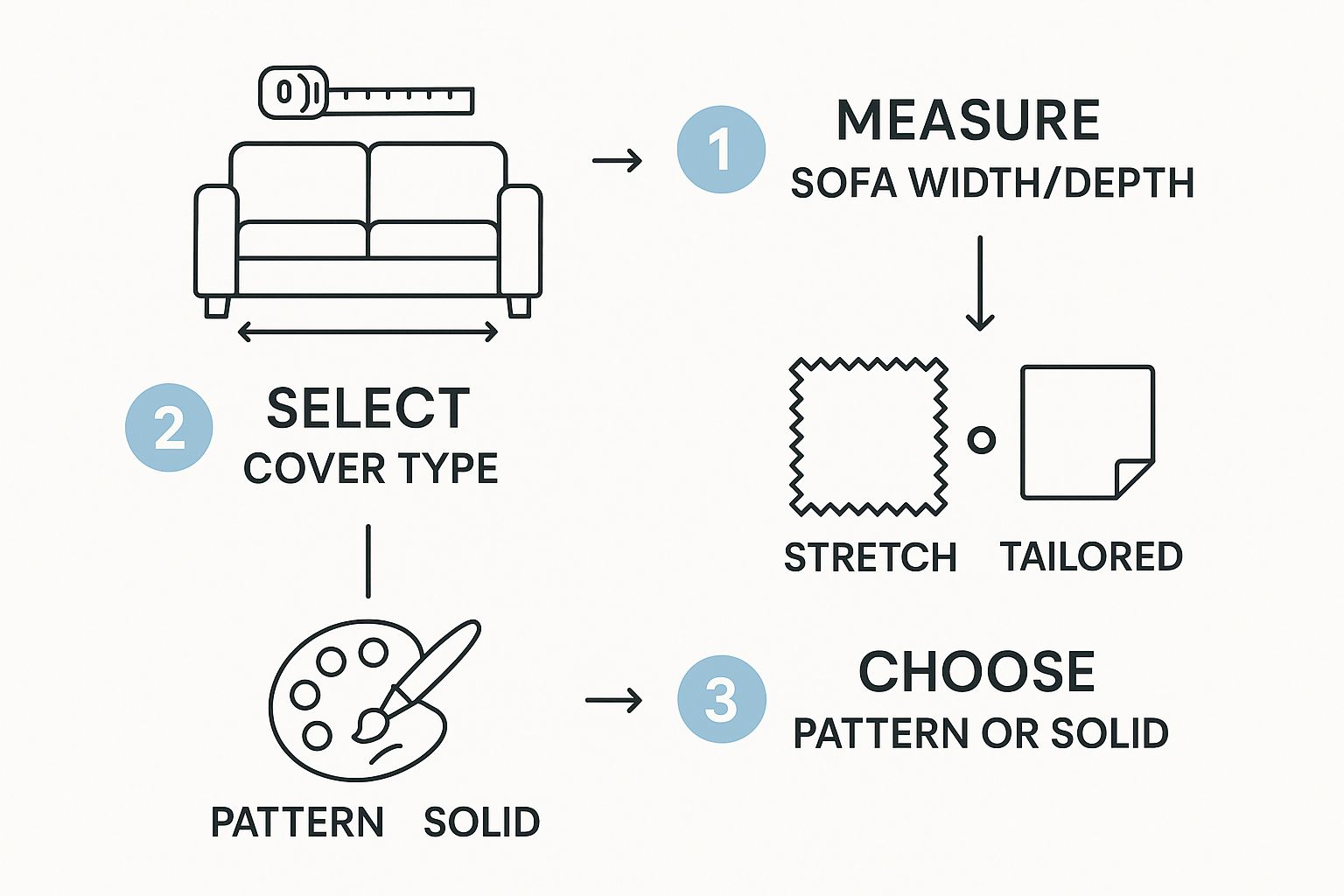
As you can see, accurate measurements come first, long before you start thinking about colours or patterns.
Essential Sofa Measurements Checklist
To make sure you don't miss anything important, I've put together this quick checklist. Having these figures on hand will make shopping for a cover a breeze.
| Measurement Area | How to Measure | Sofa Type Relevance |
|---|---|---|
| Overall Width | From the outer edge of one arm to the outer edge of the other. | All sofa types |
| Total Height | From the floor to the highest point on the sofa's backrest. | All sofa types |
| Seat Cushion Depth | From the front of the seat to where it meets the back frame. | All sofa types |
| Armrest Height | From the floor to the very top of the armrest. | All sofa types |
| Section Lengths | Measure each section of a sectional sofa separately. | L-shaped, U-shaped, Modular |
| Reclined Length | For recliners, measure the full length when fully extended. | Reclining sofas |
This table covers the fundamentals, ensuring you’ve got all the data needed for a fantastic fit.
For an even more detailed walkthrough with diagrams for different sofa styles, you can find everything in our complete guide on how to measure your sofa. Taking a few moments to get this right will save you the headache of returns and leave you with a cover that looks like it was made just for you.
Sofa Measurement to Slipcover Size Guide
Use this table to match your sofa's dimensions to the correct slipcover size from our collection. It's the easiest way to ensure you get that perfect, tailored fit you're looking for.
| Sofa Type | Measurement Range (Length) | Recommended Slipcover Size |
|---|---|---|
| Armchair | 90cm - 140cm | 1-Seater |
| Loveseat | 145cm - 185cm | 2-Seater |
| Standard Sofa | 190cm - 230cm | 3-Seater |
| Large Sofa | 235cm - 300cm | 4-Seater |
By following these simple steps and using the chart, you'll make sure the slipcover you choose fits beautifully, giving your large sofa that sharp, reupholstered finish you're after.
Picking a Fabric That Fits Your Life
Choosing the right fabric is about more than just colour and pattern. It’s about finding a material that can genuinely handle your day-to-day life. A sofa cover in a busy family home with pets and kids needs to be a real workhorse, something entirely different from a cover in a quiet, formal sitting room.
Think durability first. If your sofa is the centre of family life, you need something that can take a beating. Materials like microfibre are brilliant for high-traffic areas. Their tight weave resists snags and makes them a breeze to clean. Pet owners, take note: fur doesn't get tangled in microfibre the way it does in looser weaves like chenille, saving you a lot of vacuuming time.
Materials for Every Household
Of course, sometimes you want a bit of luxury. Velvet offers that rich, plush feel and brings a real depth of colour to a room. Modern velvets are tougher than you might think, but they can still show signs of wear and tear faster in a chaotic household.
For a more relaxed, everyday vibe, you can't go wrong with classic cotton or a good cotton blend. These fabrics are wonderfully breathable and soft, perfect for sinking into after a long day.
- For Homes with Pets and Kids: Go for a tough microfibre or a heavy-duty canvas that can stand up to spills and scratches.
- For a Formal, Elegant Look: A high-quality velvet or a structured linen blend will instantly elevate your space.
- For Casual Comfort: You can't beat a soft, machine-washable cotton for a practical and inviting feel.
A little piece of advice from experience: always check the cleaning instructions before you commit. It’s easy to fall for a beautiful fabric, but if it’s dry-clean only, it might not be the best fit for a home with sticky fingers and muddy paws.
The Rise of Eco-Friendly Fabrics
We're also seeing a big move towards more sustainable textiles. With the UK furniture market projected to be worth around $28.23 billion by 2025, there's a clear demand for high-quality, eco-conscious materials, especially at the premium end. This shift is definitely reflected in sofa covers, with more and more options appearing that are made from recycled fabrics and organic fibres. It's all part of a bigger trend towards a more circular economy, which you can read more about in this report on the UK furniture market.
Ultimately, the best fabric is the one that works for you and your home. If you want to dive deeper into the pros and cons of different materials, have a look at our guide on the best material for your sofa covers.
Don’t ignore fire safety compliance
This part matters. In the UK, all reputable large settee covers must comply with the Furniture and Furnishings (Fire) (Safety) Regulations 1988, and compliant covers made from treated jacquard fabrics can reduce flame spread by up to 65% compared with untreated materials, as noted in this reference on UK cover safety compliance.
That’s not a small detail. It separates a decorative textile from a cover suitable for real household use. If you’re buying for a family home, rental property, or guest space, treat compliance as paramount.
Making Your New Cover Look Like It Was Made for Your Sofa
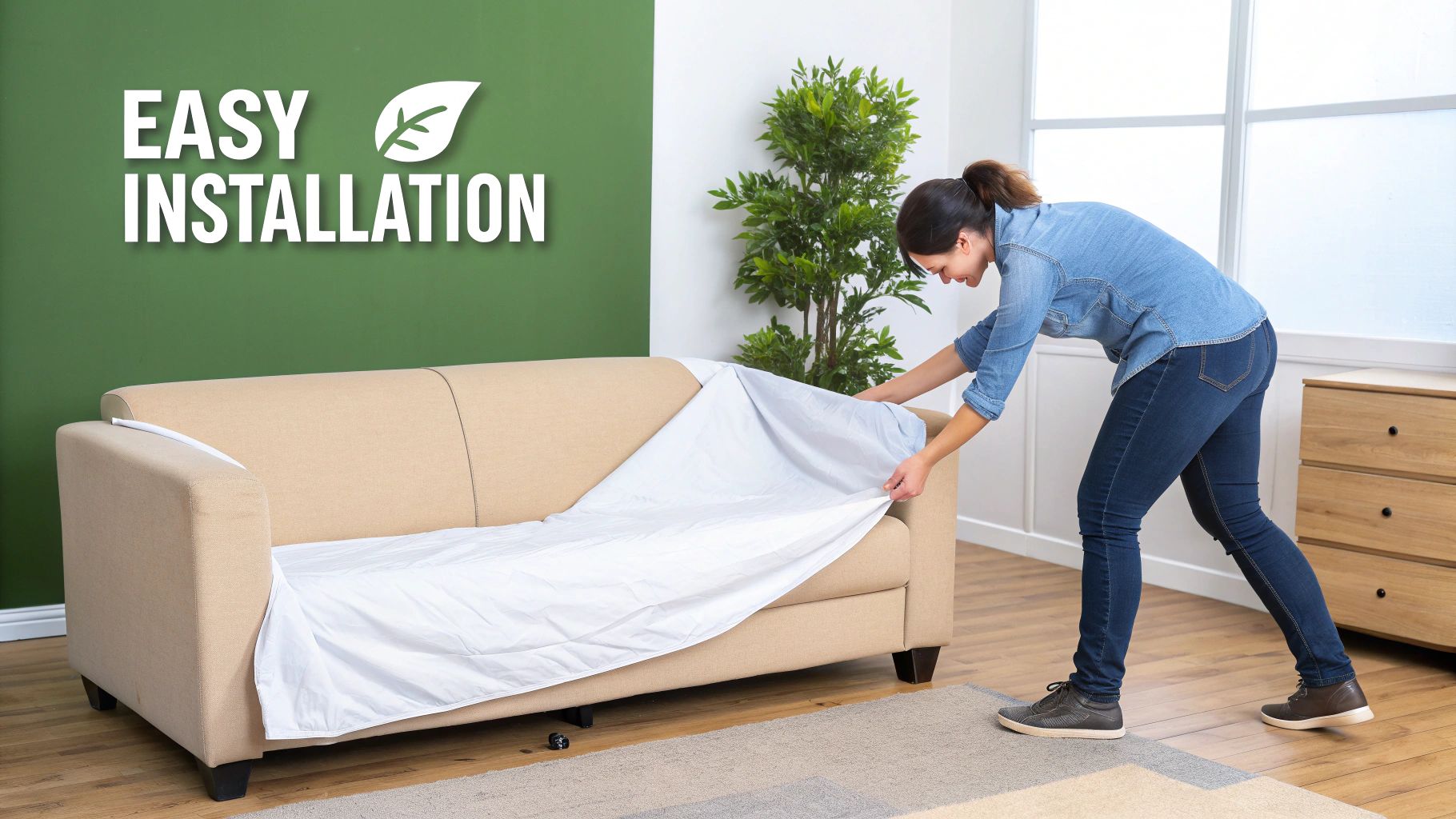
Getting that smooth, wrinkle-free finish is all about a patient installation. A great fit isn’t something you get by just throwing the fabric over your couch; you create it in the tucks and folds.
First things first, find the front and back of the cover. Most have handy tags to guide you. Loosely drape it over the entire sofa, but don't pull anything tight just yet. The initial goal is just to get it centred, trying to align the cover’s seams with the natural lines of your sofa’s arms and back.
Once it’s roughly in position, start smoothing out the big flat surfaces. I always work from the centre of the sofa outwards, gently pushing any bunched-up fabric towards the edges and crevices.
The Art of the Tuck and Secure
This is where the real transformation happens. Use your hands to firmly stuff the excess material deep into the gaps between the arms, the back, and the seat cushions. With sofa covers for large sofas, you’ll naturally have more fabric to work with, so just be methodical and go section by section.
To get that crisp, professional finish that actually stays put, you’ll want to use the little foam rollers or anti-slip tucks that often come with the cover. Now’s the time to grab them.
- Wedge them in deep: Use these foam inserts to really anchor the fabric down into the crevices. You can’t be too gentle here; they need to be pushed in firmly to stop the cover from shifting the moment someone sits down.
- Target the main seating areas: Pay extra attention to the spots where people sit the most, as this is where slipping and bunching always begin.
- Secure the base: The final, crucial step is to fasten any ties or elastic straps underneath the sofa. This is what pulls the whole cover taut and prevents the bottom from riding up over time.
Here’s a little trick I’ve picked up over the years: use a wooden spoon or even a smooth-edged ruler to push the fabric into those really tight gaps. It gives you a bit of extra leverage without snagging the material, helping you achieve a professional, tucked-in look that lasts.
A bit of patience here goes a long way. Taking the time to properly smooth, tuck, and secure your cover is the difference between a frustrating, messy slipcover and a sofa that looks completely revitalised.
Keeping Your Sofa Cover Looking Brand New
So, you've breathed new life into your sofa. Fantastic! Now, let's talk about keeping that cover looking just as good as the day you put it on. The great thing is, most modern covers are built for the chaos of a busy home, so a bit of simple, regular care is all it takes.
A quick vacuum once a week with a soft brush attachment does wonders. It's a small job that stops dust, pet hair, and those inevitable biscuit crumbs from working their way deep into the fabric.
Spills happen—it's just a fact of life. The trick is not to panic, but to act fast. If it’s a liquid like wine or tea, grab a clean, dry cloth and blot the area immediately. Whatever you do, don't rub! Rubbing just grinds the stain further into the fibres. For anything a bit more stubborn, a spot clean with a mild soap and water mix usually does the job. Just be sure to test it on a hidden spot first, like under a cushion.
Washing and Drying Your Cover
For a proper deep clean, you'll be glad to know most sofa covers for large sofas can go right in the washing machine. But before you do anything, check the care label. Every fabric is different.
- Velvet and Microfibre: These need a gentle touch. Pop them on a cool, delicate cycle to keep their soft texture intact.
- Cotton and Linen Blends: These are a bit more robust and can often take a warmer wash. Still, it's best to steer clear of high temperatures to avoid any unwanted shrinking.
- Drying: Letting your cover air-dry is always the safest bet. If you're short on time and need to use a tumble dryer, stick to the lowest heat setting. Pull it out when it's still slightly damp to help prevent wrinkles.
Here's a pro tip I swear by: put the cover back on the sofa while it's still just a little bit damp. As it finishes drying, it will stretch and mould itself to the frame, giving you a perfect, wrinkle-free fit. It looks like it’s been professionally tailored every time.
It's clear we're all investing more in our homes. With the UK home furniture market projected to hit around USD 25.51 billion by 2034, looking after these purchases makes perfect sense. People want quality that lasts, and that includes their sofa covers. You can read more about the UK home furniture market trends to see how this focus on longevity is shaping the industry.
For more detailed advice, have a look at our guide to caring for machine washable sofa covers.
Handling Spills and Minor Issues
Life happens, and spills are pretty much guaranteed. The key is to act quickly. For common culprits like coffee or mud, blot the area immediately with a clean, damp cloth. Always work from the outside of the spill inward to stop it from spreading.
Quick Tip: For a fast refresh between washes, just use a fabric spray or run the vacuum over the surface with an upholstery attachment. This quickly removes dust and crumbs, keeping it looking tidy.
Occasionally, you might run into other little problems. To keep your slipcover looking its best, learning how to handle things like water marks is essential. There are some excellent resources on how to remove water stains from fabric that can help you restore that flawless look. By adopting these low-effort routines, you’ll ensure your slipcover remains a durable, practical, and beautiful part of your home for years to come.
Store it properly when not in use
If you rotate covers by season, make sure the one not in use is clean before storing it. Dirt left in the fabric tends to set over time and can attract odours. Store the folded cover in a dry cupboard or breathable storage bag, not compressed under heavy items that create hard creases.
Clean before storage, not after. A stored stain is much harder to remove than a fresh one.
A little consistency goes a long way here. Covers stay looking fresh when they’re cleaned lightly and often, rather than ignored until they need rescue.
Styling Your Covered Sofa
Accessorising Your Slipcovered Sofa
Styling a newly covered sofa is all about creating that inviting, layered look. The slipcover is your foundation; the accessories are the final touches that bring it all to life.
Here are a few simple ideas that always work a treat:
-
Play with Throw Pillows: Don't be afraid to mix and match different sizes, shapes, and textures. If you've gone for a neutral beige slipcover, you could add a pop of colour with some jewel-toned velvet cushions or introduce a bit of character with bold geometric prints.
-
Drape a Cosy Blanket: A chunky knit throw or a soft fleece blanket, draped artfully over an armrest or the back of the sofa, instantly adds warmth and texture. It makes the space feel much more lived-in and welcoming.
-
Anchor with an Area Rug: A well-chosen rug can tie the entire room together. Just make sure at least the front legs of your sofa are sitting on the rug – this little trick creates a unified and properly grounded seating area.
It’s clear that home styling is on everyone’s mind. The UK sofa market has shifted massively, with a huge increase in online shopping directly influencing the demand for large sofa slipcovers. This boom goes hand-in-hand with a rising interest in accessories that offer a cheap and cheerful way to refresh and protect big sofas. You can dig deeper into the UK sofa market performance to see the trends.
Smart Uses for Large Sofa Covers
For landlords and Airbnb hosts
A furnished rental needs to stay presentable between one set of occupants and the next. The sofa often takes the hardest wear because everyone uses it, but nobody treats it as their own. A cover gives landlords a replaceable surface that’s much easier to deal with than permanent upholstery marks.
For short-stay accommodation, the benefit is speed. If a guest leaves behind makeup marks, food stains, or pet hair, a removable cover is simpler to refresh than arranging upholstery cleaning between bookings. It also helps keep the furniture looking consistent across changeovers.
For family homes with children and pets
Covers earn their place quickly. Muddy paws don’t wait for house rules. Neither do yoghurt spills, pens, wet coats, or the sudden decision to build a blanket fort on the largest seat in the room.
With UK pet ownership reaching 62% of households in 2025 and demand for protective home textiles growing by 27%, the need for pet-resistant, hypoallergenic, and machine-washable settee covers has expanded sharply, especially for families and rental property owners. In practical terms, that means more people now want a cover that can handle routine mess without making the room feel overly utilitarian.
In a busy home, the best cover is the one you’ll actually wash and refit without dreading it.
For families, the most useful setup is usually one that balances comfort and routine maintenance. A cover has to feel pleasant enough for daily sitting, but not precious enough that every spill becomes a drama.
For seasonal decorators and home stylists
A large settee controls the room visually. Change its colour or texture and you change the atmosphere of the whole space. That’s why stylists often use covers as a shortcut to a seasonal update.
A darker textured finish can make a room feel grounded and warm in autumn and winter. A lighter woven cover can make the same room feel fresher in spring. This works especially well when the rest of the décor stays fairly simple and the sofa does most of the visual heavy lifting.
There’s also a budget advantage. You can alter the look of a major furniture piece without buying new upholstery, replacing cushions, or redesigning the room around a different sofa shape.
Where to Buy Large Sofa Covers in the UK
High-Street Retailers vs Online Specialists
Big high-street shops have one obvious advantage: you can see and feel the fabric before you part with your money. The downside? Their selection of large sofa slipcovers is often quite limited, usually only catering for the most bog-standard sofa shapes and sizes. Stock can be a real issue too, meaning you might not find what you need on the day you go looking.
Online specialists, on the other hand, tend to offer a much, much wider range of sizes, fabrics, and styles. This is especially true if you have something a bit trickier, like a corner sofa or a big sectional. While you can't touch the fabric first, a good online seller will give you detailed descriptions, great photos, and often free fabric swatches to help you make up your mind.
The real edge that online specialists have is their focus. They live and breathe sofa covers, which means their product knowledge, sizing guides, and customer support are usually far more detailed and helpful than what you’d find in a general home goods store.
What to Look for Before You Buy
No matter where you decide to shop, a few key details will protect your purchase and save you a headache later on. First, always have a good look at the returns policy before you even think about adding something to your basket. You’re looking for a straightforward, no-quibble return window, like a 30-day policy. This gives you plenty of time to get the cover home and see how it fits and looks in your own light.
Next up, check the shipping details. Make sure there’s clear information on costs and how long you can expect to wait for delivery within the UK. Many online stores, including The Sofa Cover Crafter, provide tracked delivery, so you can follow your parcel from our door to yours.
Finally, use the power of social proof. Don't just trust the glossy, professional product photos. Hunt down customer reviews and, most importantly, any pictures that other shoppers have uploaded. These real-world snaps are priceless for seeing how a cover actually fits on a sofa like yours, what the colour looks like in different lighting, and for judging the overall quality. This insight from fellow shoppers is often the most honest way to know that what you see online is what you’re going to get. The UK's furniture market is booming, and accessories like slipcovers are a huge part of that growth. You can explore more data on the United Kingdom's expanding furniture market trends to see how things are developing.
Got Questions About Your Large Sofa Cover? We've Got Answers
Even with the best planning, a few questions always pop up. Let’s tackle some of the most common queries I hear about covers for large sofas, so you can feel completely confident in your decision.
Can I Just Use a Regular Cover on My L-Shaped Sofa?
I'll be honest, that's almost always a recipe for disaster. A standard, one-piece cover just can't handle the unique angles and separate parts of a sectional. You'll likely end up with fabric stretched in weird ways, pulling at the seams, and leaving corners completely exposed.
What you really need is a multi-piece sectional cover. These are designed specifically to drape over each individual section of your sofa, giving you that clean, custom-fitted appearance. It's a growing market, too – the UK's sofa retail industry saw a huge 25% jump in organic visibility in 2025, which tells us more people are buying all kinds of sofas, including large sectionals that need the right kind of cover. You can find more details in this report on the recovering UK sofa market.
What’s the Best Fabric if I Have Pets?
For a home full of furry family members, microfibre is an absolute lifesaver. Its tightly woven texture is surprisingly durable against claws and, best of all, it stops pet hair from weaving its way deep into the fabric. This makes cleaning up a breeze. Plus, most microfibre covers are machine-washable, which is a must for tackling any unexpected muddy paw prints or odours.
Here's a little trick I tell all my pet-owning clients: keep a small, handheld vacuum tucked away near the sofa. A quick whizz over the cover each day takes less than a minute but makes a world of difference in stopping pet hair from building up between washes.
How Can I Stop My Sofa Cover from Slipping and Bunching Up?
Ah, the dreaded slip. It’s a common frustration, particularly with leather sofas. Your best bet is to look for a cover that has anti-slip features built right in, like a textured backing or sturdy, adjustable straps.
If your cover doesn't have these, don't worry. The foam tuck-ins that often come with the cover are your secret weapon. Don't just place them lightly; really push them deep into the gaps between the cushions and the sofa frame. They act as anchors and do a surprisingly good job of holding the fabric firmly in place.
Ready to give your living room a fresh new look? Have a look through the full collection of stylish and hard-wearing covers at The Sofa Cover Crafter and find the perfect match for your large sofa today. Come and see us at https://thesofacovercrafter.co.uk.
Are the Waterproof Covers Noisy or Uncomfortable Like Plastic?
Not at all. I know exactly the kind of cover you're thinking of, and this is a common concern based on older, less advanced waterproof materials. We use modern fabric technology that bonds a silent, waterproof membrane underneath a soft, comfortable top layer. You get total protection without any of the old-school downsides.
The result is a slipcover that feels just as soft and breathable as our standard versions. There is absolutely no crinkling sound or stiff, plastic-like feeling. You get complete peace of mind from spills without sacrificing the cosy comfort you expect from your sofa, making it the perfect choice for homes with young children and pets.
Do large settee covers work on leather sofas
They can, but leather changes the fitting process. The surface is smoother, so covers can shift more easily than they do on fabric upholstery. That’s where proper tucking and under-frame anchoring become much more important.
If you’re covering leather, look for a stretch fabric with enough grip to contour the shape rather than slide over it. The installation stage matters just as much as the size.
Can I use a cover on a recliner or chaise-style settee
Sometimes, but not always with a single-piece solution. Recliners, chaise ends, and sectional layouts often need a more specific approach because the moving parts and uneven seat lengths don’t behave like a standard large settee.
If your sofa has separate sections, it’s often better to treat those sections individually rather than forcing one universal cover to do too much. A tighter sectional fit usually looks cleaner and stays put better.
Will the cover look baggy after people sit on it
It shouldn’t if the size is right and the installation is finished properly. What creates the baggy look is usually a mismatch between sofa shape and cover size, or a lack of tucking and clipping underneath.
Stretch covers do relax slightly in use, which is normal. A quick retuck in high-traffic spots brings them back into line, especially around the seat-back channels and arm fronts.
What should I do if I’m between sizes
Don’t guess from the product photo. Measure again, paying special attention to arm width, back height, and overall length. On larger sofas, those three areas usually determine whether the finished look feels neat or strained.
If your sofa sits awkwardly between options, choose based on the full shape rather than just the seat area. A large settee cover has to accommodate the whole frame.
Can I return a cover if it isn’t right
Check the retailer’s own terms before ordering. Return policies vary, and they matter most when you’re buying for an unusual sofa shape. If you’re ordering from a specialist store, look for clear guidance on sizing, installation, and the returns window so you can test the fit promptly and keep everything in resalable condition if needed.
Check out our full collection of pillow covers here.
Check out our full collection of corner sofa covers here.
