



There's no single number for how long sofas last, because a sofa doesn't fail as one unit. A sound frame can outlast its fabric by years. Sofas are often discarded because the arm tops are worn, the back has faded, or stains won't shift, not because the structural timber has snapped.
The useful question is therefore not only “How old is my sofa?” It's which part has failed, and can that part be renewed? The practical focus here is the gap between a sofa's structural life and its visible, comfortable life.
Table of Contents
- Why There Is No Single Answer for Sofa Lifespan
- Which Parts of a Sofa Wear Out First
- How Hidden Stains and Spills Ruin Sofa Foam
- Does Sunlight and Fading Destroy Sofa Fabric
- The History of Protecting Sofa Frames with Covers
- Should You Reupholster, Cover, or Replace Your Sofa
- How Modular Covers Let You Replace Only What Wears
Why There Is No Single Answer for Sofa Lifespan
A sofa does not wear out as one unit. Its frame, springs, foam and upholstery age at different rates. The frame carries the load, while the outer fabric takes daily friction, sunlight, dirt and spills. A sofa can therefore look ready for replacement while its structure remains serviceable.
Age alone gives a poor answer, because how often people replace a sofa says more about replacement habits than about how long the structure could last. A household may replace a sofa because its surfaces look worn or its comfort has declined, even when the frame could continue supporting it.
Is the frame really the part that fails first?
Arm tops and seat fronts show wear first because they take hands, sleeves and body weight every day. Back cushions and window-facing arms may fade unevenly, while spills can leave marks that penetrate the cushion. The frame becomes the limiting factor later, after prolonged load-bearing use, unless poor construction, failed springs or excessive weight causes an earlier fault.
That order matters. Structural lifespan and comfort lifespan aren't the same thing. Which? says a sofa should last at least 10 years when bought from the right brand. Its survey of more than 4,000 sofa owners found fewer than 20% of owners of its top-rated brands reported damage or wear after owning the sofa for up to 10 years (Which? sofa shop reviews).
A sound frame with worn fabric calls for a cover or reupholstery. A broken frame, failed springs or collapsed support needs furniture repair. Separating those failures can keep a usable sofa in service instead of sending the whole piece to replacement.
Which Parts of a Sofa Wear Out First
Arm tops and the front edge of the seat cushion usually wear first because they receive the most repeated contact. A body lands on the seat edge, hands grip or rest on the arms, and sleeves drag across the same surface whenever someone settles in.
The Martindale test measures upholstery abrasion by rubbing fabric with a machine until the material shows wear or breaks through. Domestic sofa fabric is typically rated in the tens of thousands of rubs, with higher counts expected for heavier use.
Those ratings describe a testing method and broad use categories. They aren't a rating for every sofa or a certification held by a particular cover. Real life adds pets, grit, clothing seams, children climbing over arms and the concentrated pressure of one favourite seat.
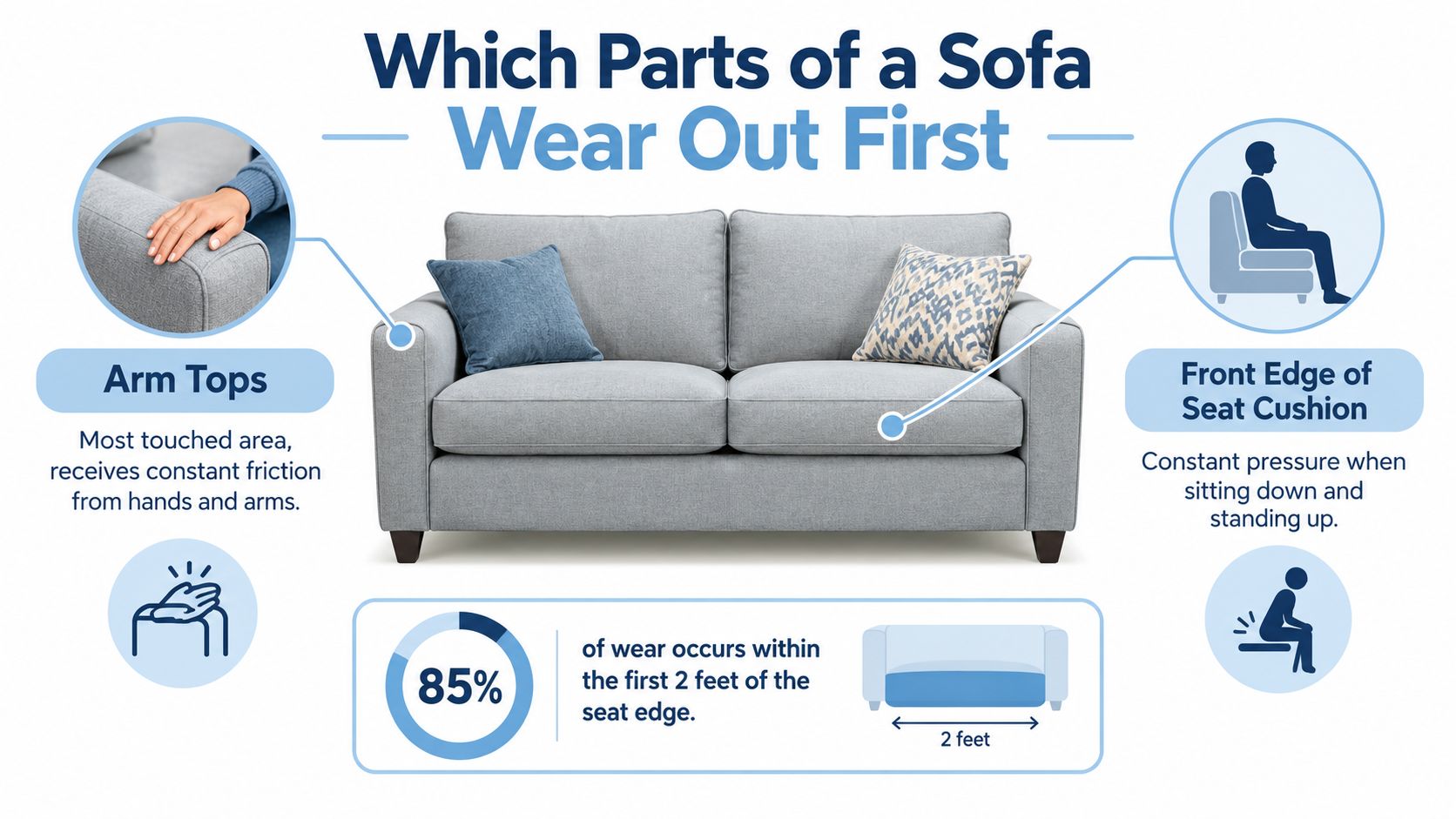
What does a cover actually protect?
A removable cover creates a sacrificial surface between daily contact and the original upholstery. Every rub taken by the cover is one the sofa underneath doesn't take. That doesn't strengthen a weak frame, but it can slow the surface damage that makes a structurally sound sofa look finished.
The fit still matters. A cover that travels across the seat or bunches at the arm can create extra friction rather than reduce it. Anti-Slip Sofa Pads and Foam Rods are designed to help stop a cover moving, particularly where loose fabric needs to be tucked into gaps.
For a soft, machine-washable layer, the Sofa Cover, Velvet, Dark Green, Adaptable & Expandable is sold as a dark green velvet cover with an adaptable design, protective layer and machine-washable fabric. Those are surface-protection features, not a promise that the underlying frame or cushion filling will last indefinitely.
How Hidden Stains and Spills Ruin Sofa Foam
A spill can shorten a sofa's useful life before visible wear becomes serious because liquid can soak into the foam. Cleaning the surface may make the fabric look clear, but moisture and dissolved residue can remain below.
As the damp area dries, liquid can move back towards the surface and carry the stain with it. This process is called wicking. It's why a ring or dark patch may reappear after a sofa looks clean, and why a structurally sound sofa can still become visually unacceptable.
The foam also creates a difficult cleaning boundary. Fixed sofa upholstery can't usually be removed and placed in a washing machine, so the owner has to work through the fabric while trying not to saturate the interior. Aggressive scrubbing can roughen the surface, spread the mark or push moisture further into the cushion.
Practical rule: If stains are the limiting factor in your household, protect the upholstery before the spill reaches the foam.
A cover catches the liquid first and can be removed for cleaning. For households where spills matter more than abrasion, the Pebble-Textured Waterproof Sofa Cover, Waterproof Sofa Cushion Cover and Waterproof Pillow Cover are the relevant lines. “Waterproof” applies to those named products, not to ordinary stretch, velvet or jacquard covers.
For an existing mark, use a method suited to the fabric and the type of spill rather than repeatedly soaking the area. The guide to removing stains from a sofa is useful for separating immediate treatment from the larger decision about whether the upholstery is still recoverable.
The key test is simple. If the foam, smell and structure remain sound but the original surface keeps losing the battle against family spills, a washable protective layer addresses the failure point more directly than replacing the entire sofa.
Does Sunlight and Fading Destroy Sofa Fabric
Sunlight usually damages the most exposed back and arm rather than fading every part of a sofa evenly. The affected area depends on the room's orientation, window position and how long direct light reaches the upholstery.
Printed fabric carries its design as pigment fixed to the face of an already-woven cloth. That surface is exactly where rubbing, washing and sunlight act, so a printed pattern can lose depth and visual sharpness before the cloth itself has worn through.
A jacquard works differently. Its pattern is created by the weave, with coloured yarns carried through the cloth rather than a separate printed layer sitting on top. As jacquard upholstery ages, the texture may flatten from contact and use, but there isn't a printed surface to scuff away in the same way.
Should you choose printed fabric or jacquard?
Neither construction makes a sofa immune to fading or abrasion. The useful difference is how wear appears. Printed fabric may show loss of colour and pattern definition, while jacquard can show a change in texture and relief.
The Jacquard Sofa Cover collection uses the woven-pattern approach and is available in the same four size categories as the Classic Stretch Sofa Cover. Its listed colours are Light Grey, Dark Grey, Navy Blue, Bondi Blue, Sky Blue, Sage Green, Cream, Off-White, Chocolate, Chestnut Brown, Garnet Red and Black.
Seat cushions deserve attention too. One UK furniture retailer's care guide notes that cushion interiors commonly lose at least 10% of their density in the first three months and 20% to 30% over time, so a sofa can become uncomfortable even when its covering still looks acceptable.
Rotate removable seat cushions so one position doesn't absorb all the pressure and light. Rotation won't restore lost foam density, but it spreads wear and exposure instead of concentrating both in the same seat.
The History of Protecting Sofa Frames with Covers
Protecting upholstery with a removable layer is an old furniture habit, not a modern shortcut. Victorian households used antimacassars, small cloths pinned over chair backs, because the Macassar oil worn in men's hair could mark and damage upholstery.
The protection was placed exactly where contact happened. It didn't alter the chair frame or rebuild the padding. It kept a vulnerable surface away from the source of the damage.
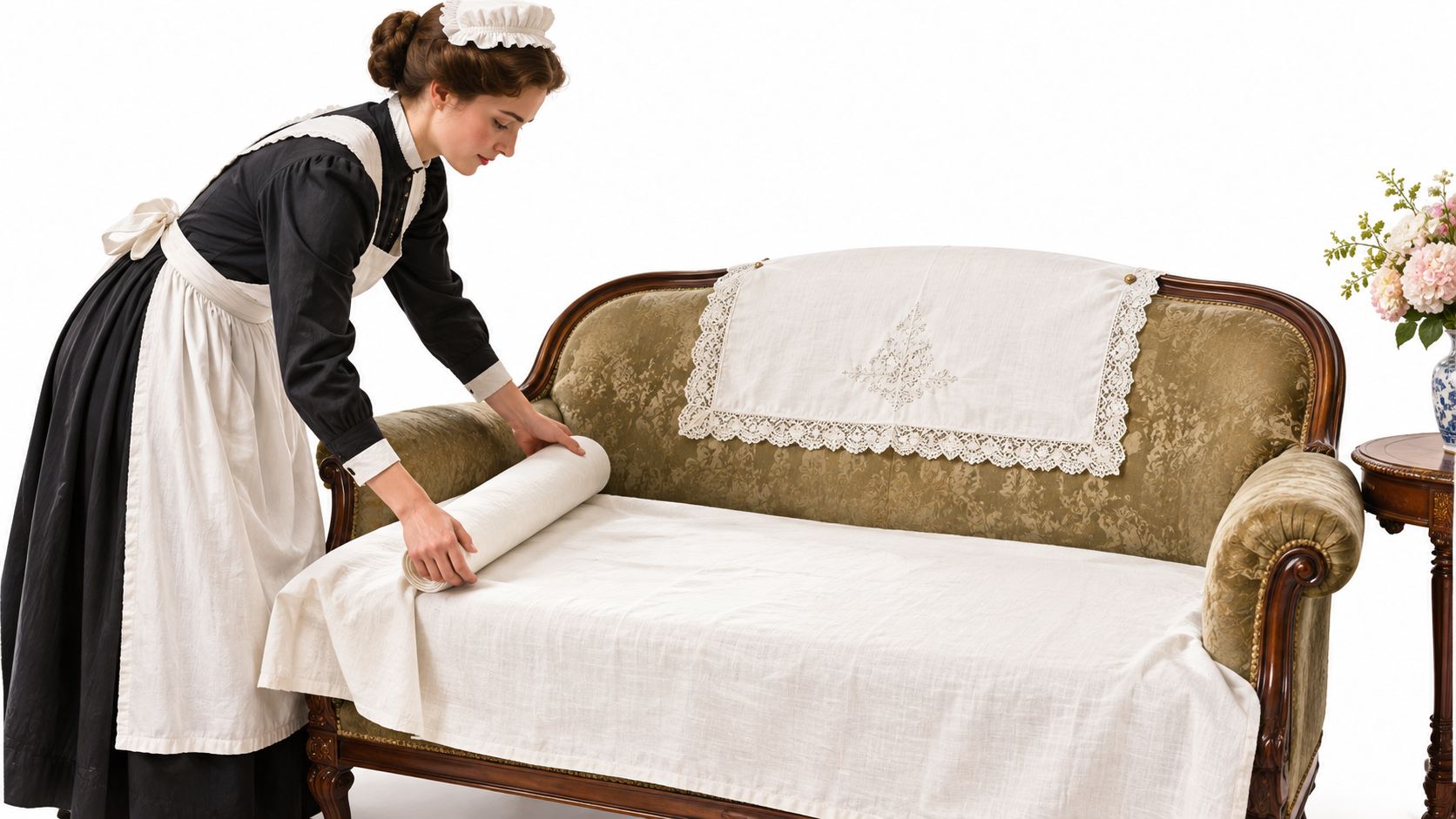
Grand families leaving for the London Season used a more complete version of the same idea. Staff dressed sofas in linen holland covers while the household was away, then removed the covers on their return. The method recognised a basic mechanical truth: a good frame can remain useful after its original fabric has become tired.
Water creates a separate risk because timber, padding and upholstery respond differently to moisture.
The historical lesson is practical rather than decorative. A cover doesn't make a poor sofa well built, and it won't repair failed springs. It does protect the surface that people touch most, allowing owners to judge the frame and support separately from the fabric.
Should You Reupholster, Cover, or Replace Your Sofa
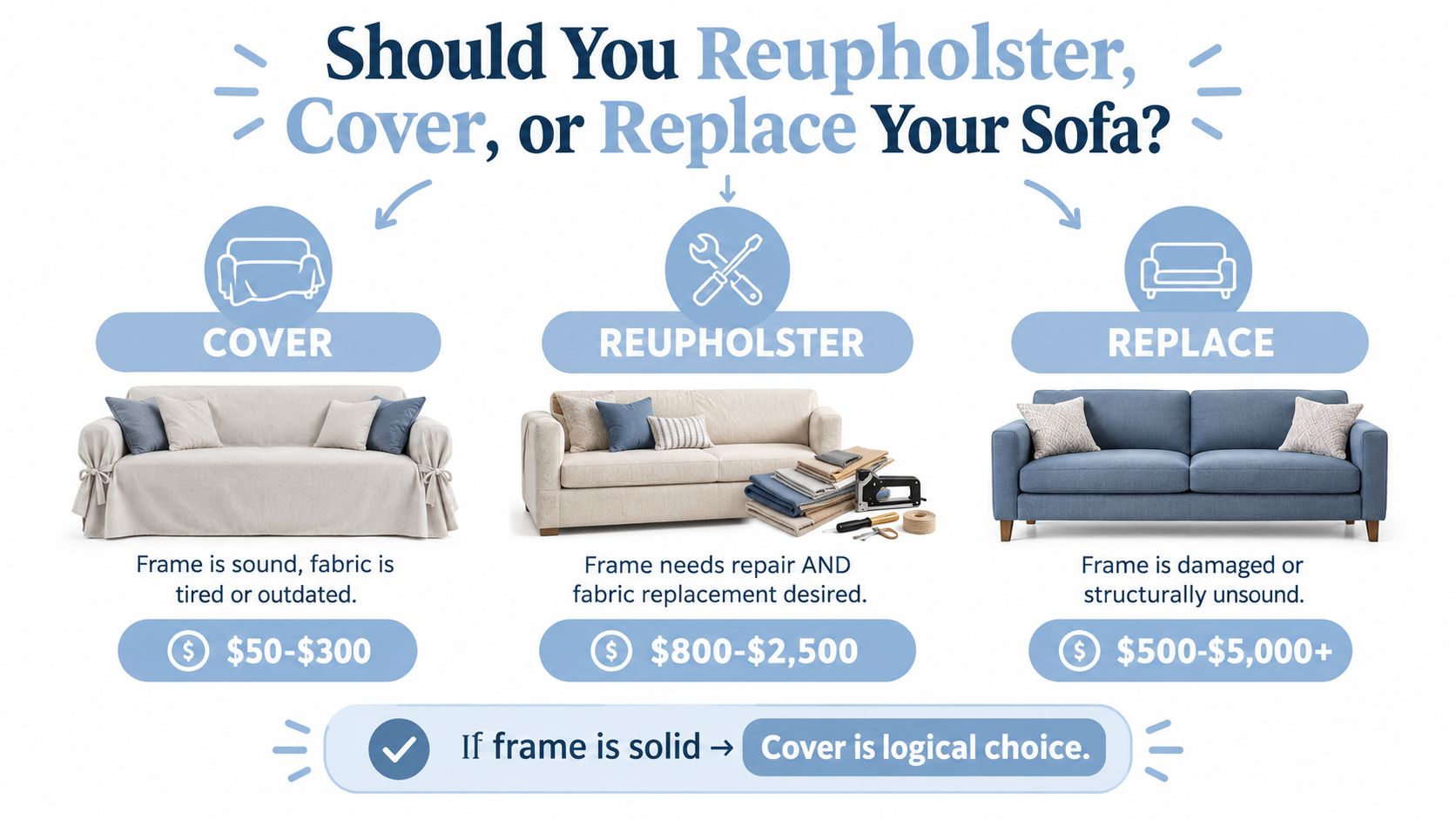
Cover a sofa when the frame is sound but the fabric is tired; don't use a cover to disguise a broken frame or failed springs. Start underneath the appearance. Sit in every position, listen for movement, check whether the frame shifts, and assess whether the cushions still provide usable support.
Use this decision order:
- Sound frame, tired fabric: A cover is the logical first route. It addresses stains, fading, arm wear and surface appearance without throwing away a structure that still works.
- Minor surface damage: A targeted accessory may be enough. Anti-Slip Sofa Pads and Foam Rods help keep a cover in place, while a Self-Adhesive Leather Repair Patch is intended for splits in hide.
- Sound structure, but the original finish matters: Reupholstery may make sense if you want a particular cloth, trim or custom result. Get a quote, then divide the reupholstery cost by the price of a cover. The result tells you how many covers could be worn out for the same expenditure. The UK reupholstery cost guide covers that comparison without pretending every sofa has the same economics.
- Broken frame, failed springs or collapsed support: Replace or seek a proper furniture repair assessment. A cover changes the surface, not the load-bearing parts underneath.
Leather splits need a different response from fabric stains. For a small tear or rip, judge whether a patch is suitable before you commit to a larger intervention.
Decision test: If you'd happily keep the sofa's shape and comfort but dislike its outer skin, don't replace the whole piece by reflex.
Florence C. described the Classic Stretch Sofa Cover in Caramel Brown this way: "It's transformed my old three-seater into something that looks fab!" That supports the cover route for a sofa whose structure remains acceptable, but it isn't evidence of a lifespan or durability result.
The honest boundary matters. We sell no sofas, frames, foam, springs or reupholstery service. That makes the recommendation narrower, but also clearer. A cover is a surface solution, and it works best when the surface is the part that has failed.
How Modular Covers Let You Replace Only What Wears
Modular covers let you replace the worn component instead of discarding every covering layer. Sofa covers, corner sofa covers, fitted sofa cushion covers and pillow covers are separate items, so a tired seat can become a cushion-cover order rather than a replacement sofa or complete cover.
That approach mirrors how sofas wear. One seat may receive nearly all the use, while the back cushions and arms remain presentable. Replacing the heavily used part avoids paying for protection that hasn't failed.
Which cover sizes and parts are available?
The Classic Stretch Sofa Cover is the plain workhorse collection, offered in 20 colourways and four size ranges:
- 1 seater: 90 to 130 CM
- 2 seater: 135 to 175 CM
- 3 seater: 180 to 220 CM
- 4 seater: 225 to 300 CM
The Jacquard Sofa Cover uses the same four size categories, with the pattern woven into the fabric rather than printed on its face. For spill-prone homes, the relevant waterproof lines include the Pebble-Textured Waterproof Sofa Cover, Waterproof Sofa Cushion Cover and Waterproof Pillow Cover.
The Fitted Sofa Cushion Covers range is the more precise replacement route. Velvet options include Standard S, M, L and XL, Deep S, M and L, Chaise Narrow, Chaise Wide, Backrest S and Backrest M. Choose by the cushion configuration rather than assuming a general sofa-cover size will fit a fitted cushion.
Why replace one cover instead of the whole layer?
A modular system reduces unnecessary replacement. If the frame remains stable and only one cushion cover has flattened visually, that cushion is the sensible starting point. If the arms are exposed but the seats are protected, address the arms rather than changing every component.
For households dealing with movement, Anti-Slip Sofa Pads and Foam Rods can help a cover stay positioned. For hide with a minor split, a Self-Adhesive Leather Repair Patch addresses the surface directly. These accessories won't improve failed foam, springs or joinery, so the structural check still comes first.
The wider principles of protecting upholstery are covered in this upholstery protection guide. The practical conclusion is simpler: make the sofa last by replacing what wears, not automatically replacing what still works.
The Sofa Cover Crafter offers Classic Stretch, jacquard, waterproof and fitted cushion covers for protecting sofa surfaces from everyday friction, fading and spills. Visit The Sofa Cover Crafter to compare the available cover types, sofa sizes and separate cushion options before deciding whether your sofa needs a new covering or a complete replacement.
